Things to consider when DIY installing a wall charger / outlet

CHeil402

Well-Known Member
First Name
Chris
Joined
Sep 21, 2020
Threads
8
Messages
726
Reaction score
1,325
Location
King of Prussia, PA
Vehicles
2017 Audi A4, 2021 MME
Occupation
Electrical Engineer
Country flag
Thanks for the detailed response! I assume it's all done correctly as this is new construction and I had the builder put in the two dedicated 50 amp circuits and they used nema 14-50 outlets. Charge point says 50 amp circuit (charging at 40 amp draw) can be plugged in or hard wired. I just wanted to make sure that the the existing wire should work. If not, unfortunately, I'll stick with the Ford Mobile Charger at 32amp charging
I'm sure it's done correctly, but I don't want to assume anything when it comes to safety, especially around giving electrical advice on public forums. If you're not comfortable doing this type of stuff, you should look into getting an electrician to do it... that being said, if the wiring is rated for 50 A, then replacing the NEMA 14-50 outlet with a hardwired ChargePoint device also set to draw 40 A (you have to de-rate for constant loads by 80% hence 50 A * 80% = 40 A) will be fine.

You can look up the allowable cable ampacity charts in many places, but are set in the electrical code. The jacket of the wiring should be stamped with its gauge and type. Here's one example of it...

https://www.cerrowire.com/products/resources/tables-calculators/ampacity-charts/

If you happen to have a larger wire installed, you can even go above 40 A if the ChargePoint supports it. One last thing to verify would be if you have copper vs aluminum wiring as not all receptacles are rated for aluminum and you'll likely need to add anti-oxidation compound in making the connection if it's aluminum.
Sponsored


 

Rockcity313

Active Member
First Name
Will
Joined
Jan 25, 2021
Threads
1
Messages
40
Reaction score
25
Location
Delaware
Vehicles
Atlas
Country flag
I'm sure it's done correctly, but I don't want to assume anything when it comes to safety, especially around giving electrical advice on public forums. If you're not comfortable doing this type of stuff, you should look into getting an electrician to do it... that being said, if the wiring is rated for 50 A, then replacing the NEMA 14-50 outlet with a hardwired ChargePoint device also set to draw 40 A (you have to de-rate for constant loads by 80% hence 50 A * 80% = 40 A) will be fine.

You can look up the allowable cable ampacity charts in many places, but are set in the electrical code. The jacket of the wiring should be stamped with its gauge and type. Here's one example of it...

https://www.cerrowire.com/products/resources/tables-calculators/ampacity-charts/

If you happen to have a larger wire installed, you can even go above 40 A if the ChargePoint supports it. One last thing to verify would be if you have copper vs aluminum wiring as not all receptacles are rated for aluminum and you'll likely need to add anti-oxidation compound in making the connection if it's aluminum.
Cool, I'd definitely use an electrician for this. I figured it's not worth it if it's going to require pulling new wire from the breakers in the basement up into the garage. Thanks again!
 

Bigfeets

Well-Known Member
First Name
JM
Joined
Dec 10, 2021
Threads
5
Messages
1,403
Reaction score
821
Location
Southern California
Vehicles
Ford MMe premium order. Hyundai Ioniq 5 Lrd
Occupation
retired
Country flag
Per Ford's production estimate, I have six months to deal with my home EV charging issue. My garage has a 240v 10-30 dryer connection, which means it can handle 24amp EVSE (with a plug conversion). I was surprised to learn that the MME EVSE could handle non-adjustable 48 amps which requires a 60 amp circuit breaker and wiring. Using the Ford MME EVSE on my existing 240v 30 amp circuit would cause tripping the circuit breaker and/or overheating the wiring/connectors. On this thread, the only solution I've seen for faster home charging than the ordinary and slow 110v 16 amp connection, is to buy another EVSE that has an adjustable amp limit. They are available. 24 amp charging at home would be very appropriate in my circumstances. For me, the solution would be for Ford to make their EVSE, that comes with the MME, adjustable.

Does anyone know if this could be done with a software change? Does anyone know if Ford is considering such a thing. (Ford's charging station is extremely expensive and requires an electrician to add the new circuit box, breaker and wiring.)
 

CHeil402

Well-Known Member
First Name
Chris
Joined
Sep 21, 2020
Threads
8
Messages
726
Reaction score
1,325
Location
King of Prussia, PA
Vehicles
2017 Audi A4, 2021 MME
Occupation
Electrical Engineer
Country flag
Per Ford's production estimate, I have six months to deal with my home EV charging issue. My garage has a 240v 10-30 dryer connection, which means it can handle 24amp EVSE (with a plug conversion). I was surprised to learn that the MME EVSE could handle non-adjustable 48 amps which requires a 60 amp circuit breaker and wiring. Using the Ford MME EVSE on my existing 240v 30 amp circuit would cause tripping the circuit breaker and/or overheating the wiring/connectors. On this thread, the only solution I've seen for faster home charging than the ordinary and slow 110v 16 amp connection, is to buy another EVSE that has an adjustable amp limit. They are available. 24 amp charging at home would be very appropriate in my circumstances. For me, the solution would be for Ford to make their EVSE, that comes with the MME, adjustable.

Does anyone know if this could be done with a software change? Does anyone know if Ford is considering such a thing. (Ford's charging station is extremely expensive and requires an electrician to add the new circuit box, breaker and wiring.)
Theoretically the car could be updated to allow for a current limit to be set by the car; however, I wouldn't hold my breath on that one. I think you're better off either getting a new circuit run with a NEMA 14-50 outlet, or getting an EVSE with a settable current limit and something like the dryer buddy which can share the outlet with your dryer. Personally, I bought the Grizzl-e EVSE. It's not expensive (comparatively) and you can get a tax credit towards its purchase. I'm also in the camp of preferring the keep the mobile charger in the trunk all the time.
 

JJCritch

Active Member
First Name
Jeff
Joined
Oct 31, 2021
Threads
1
Messages
39
Reaction score
41
Location
Detroit
Vehicles
Mustang Mach E GTPE
Occupation
Health care industry
Country flag
Ok, I'm going to pose this question and I'd love to get the input of those of you here. My MME GTPE ordered back in May is finally set to arrive in a couple weeks. And I'm getting ready to figure out my charging situation. I've been tossing around in my head the idea of doing this:

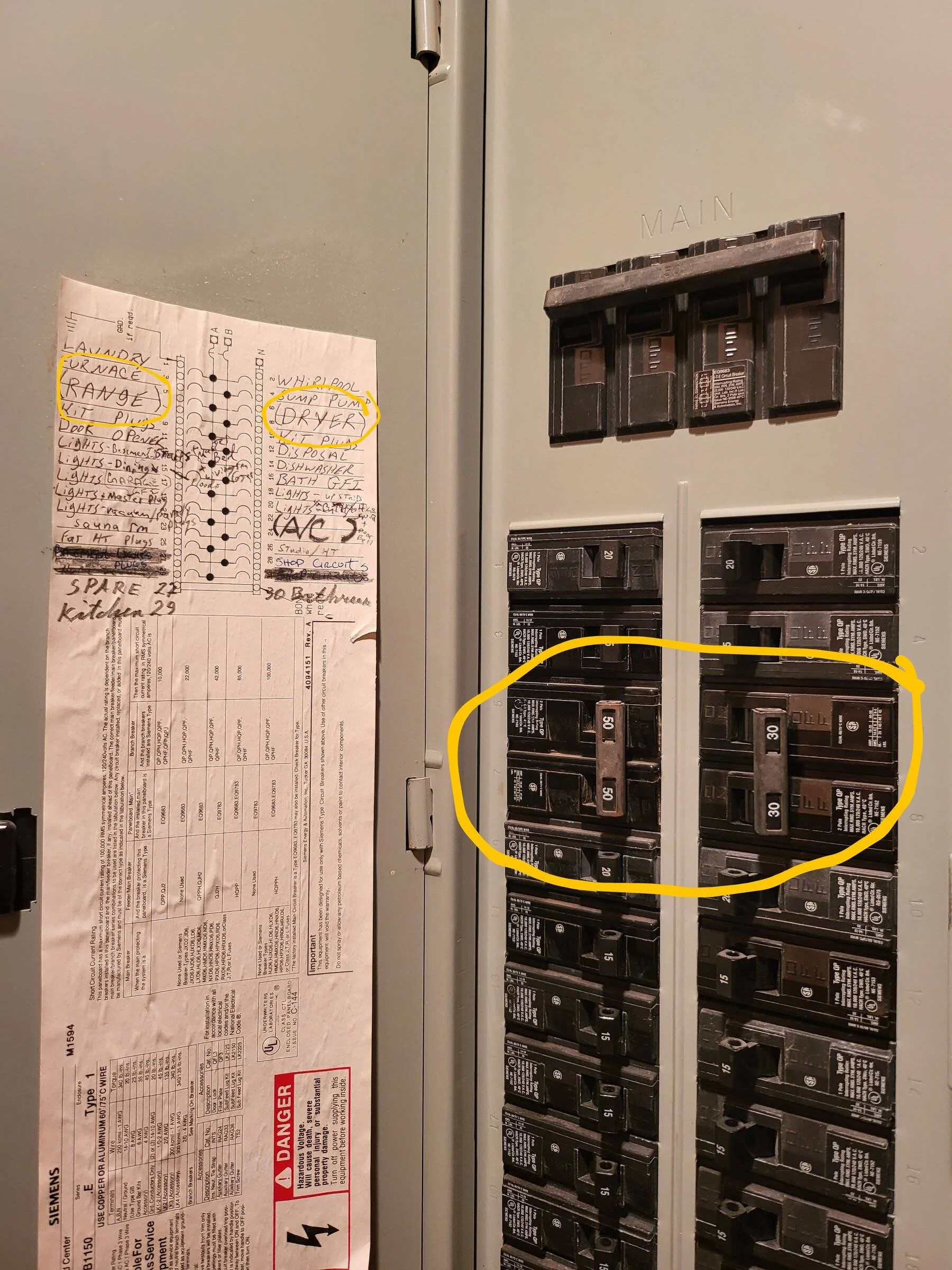
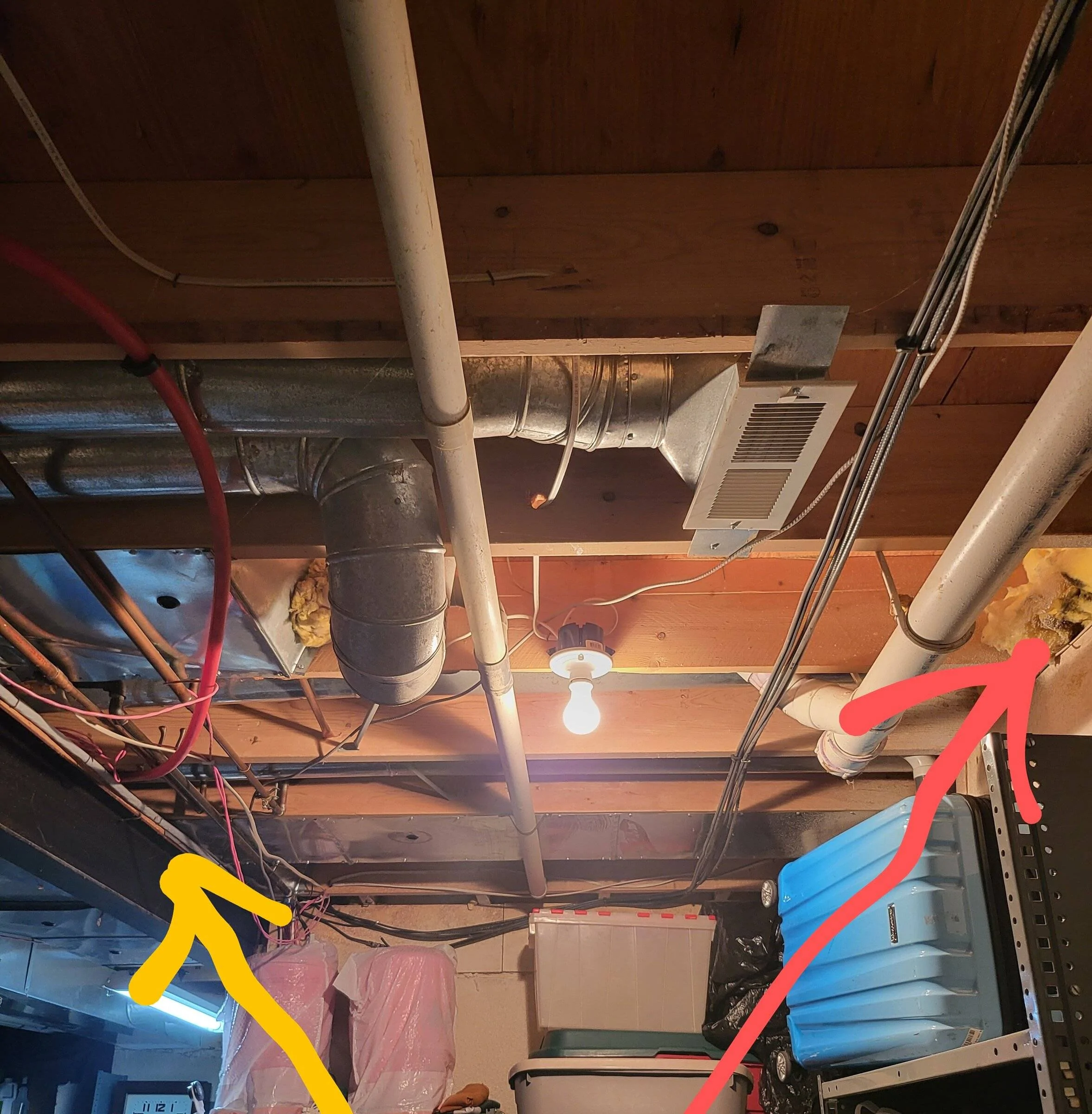
Just inside the garage, I have a laundry room with a 30amp dryer outlet. I have a gas dryer so the outlet is not being used. I also have a 50amp outlet behind my gas range in the kitchen. Not really being used. My breaker box is in the basement and it's about 50 feet from the garage. The dryer outlet run is 6:3 wire (as is the range run.)
Ford Mustang Mach-E Things to consider when DIY installing a wall charger / outlet 20220218_181745


My thought is to switch the two breakers so the 50amp is the one headed to the garage side of the house
Ford Mustang Mach-E Things to consider when DIY installing a wall charger / outlet 20220218_181246~2


then rerun the dryer wire up into the garage wall (yellow arrow is dryer run, red is under garage wall)
Ford Mustang Mach-E Things to consider when DIY installing a wall charger / outlet 20220218_181825~2

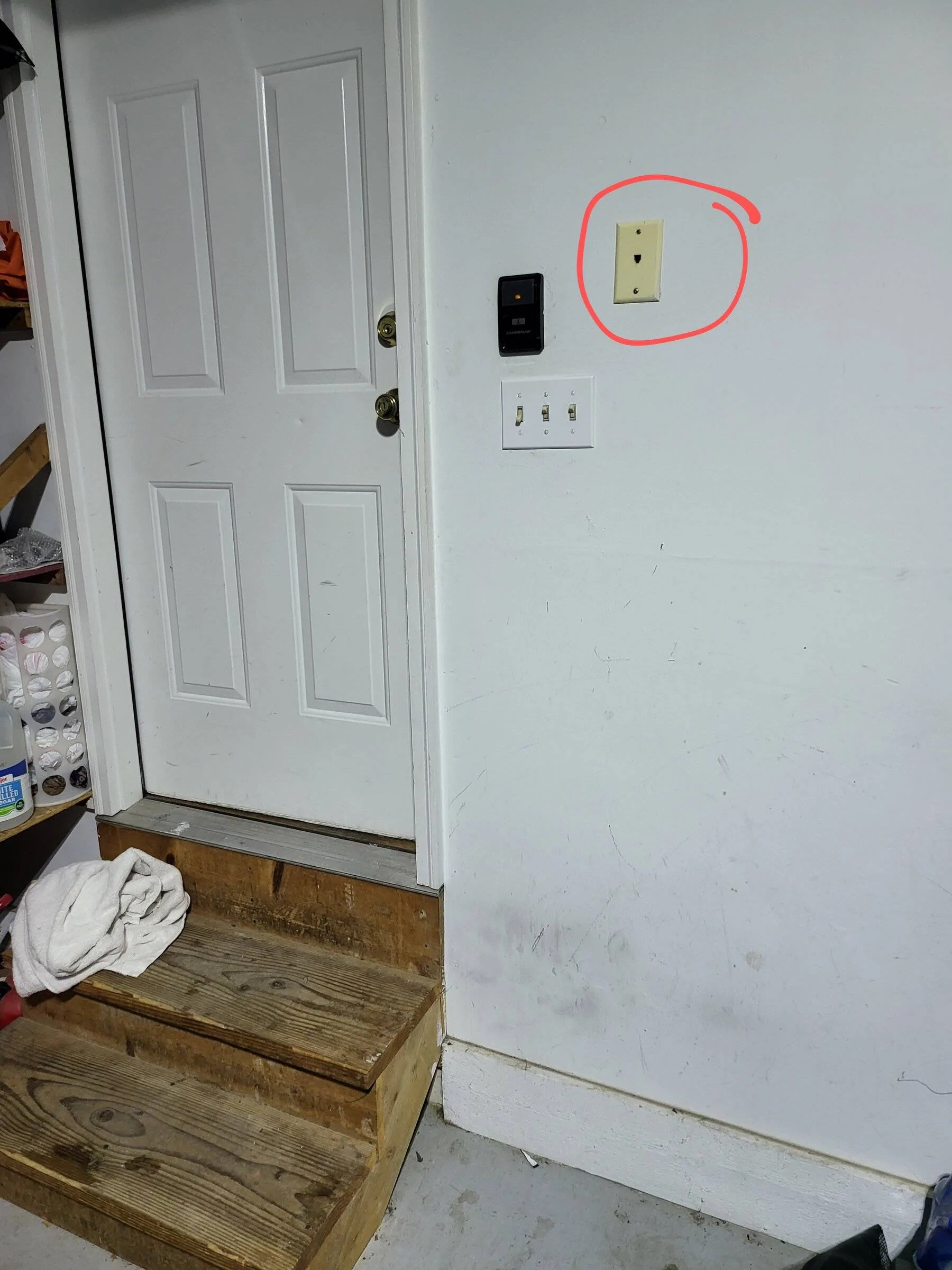
and install the NEMA 14-50 outlet there.
Ford Mustang Mach-E Things to consider when DIY installing a wall charger / outlet 20220218_181933

There is an old phone jack and wire I can use as a pull.
Ford Mustang Mach-E Things to consider when DIY installing a wall charger / outlet 20220218_181435

Ford Mustang Mach-E Things to consider when DIY installing a wall charger / outlet 20220218_181152~2


I am going to install a non-fusible 3-pole AC disconnect in the basement (the heated discussion in this thread on whether this is required by code or not has been interesting. I think it would be silly to install it in line of sight in the garage, as if the car ever did get a runaway battery fire I would assume the heat would be too much to get into the garage. however I would be able to run in the basement and pull the disconnect perhaps.)

Thoughts? Code considerations?

I'd get a permit and inspection for obvious reasons. My biggest question I guess is the breaker box change.
 
Last edited:


Triggerhappy007

Well-Known Member
Joined
Feb 20, 2021
Threads
10
Messages
901
Reaction score
814
Location
TX
Vehicles
23 Premium, 3rd Mach-E
Country flag
Not code if you switch the breakers since the oven outlet is now connected to a 30A breaker. Just replace the 30A breaker with a new 50A breaker.
 

JJCritch

Active Member
First Name
Jeff
Joined
Oct 31, 2021
Threads
1
Messages
39
Reaction score
41
Location
Detroit
Vehicles
Mustang Mach E GTPE
Occupation
Health care industry
Country flag
Not code if you switch the breakers since the oven outlet is now connected to a 30A breaker. Just replace the 30A breaker with a new 50A breaker.
Thanks. That makes sense. Do I have to worry about total capacity of the box?
 

Glen

Well-Known Member
First Name
Glenn
Joined
Oct 22, 2021
Threads
10
Messages
567
Reaction score
463
Location
New Jersey
Vehicles
2022 Range Rover, 2012 Dodge, 2018 Chevy, 52 M38
Occupation
Retired, building inspector / construction super for a builder in NY.
Country flag
Thanks. That makes sense. Do I have to worry about total capacity of the box?
How about wire size? I dont know myself, thats why I am asking. Wonder if thats correct. Mine was done with #6 I believe. Good luck with your project. Youll luv the car.
 

ZMan

New Member
Joined
Feb 28, 2022
Threads
0
Messages
3
Reaction score
0
Location
Maryland
Vehicles
MachE
I have an abandoned 30 amp dryer outlet. The outlet itself is far away from the car, but there is a junction box connecting the Romex. I was hoping to tap off the junction box and run it to my ChargePoint charger. I would then run the charger at 24 amps when charging, set on the Chargepoint. The problem I'm having is that the junction box has 10/3 wiring (2 hot/1 neutral/1 ground) and the Chargepoint only has connections for three wires. Can anyone tell me how I can make this work?
 

Crilly

Well-Known Member
First Name
Dale
Joined
Dec 22, 2020
Threads
3
Messages
374
Reaction score
283
Location
Hartland, Wi
Vehicles
Livewire prius prime Mach e. In 3 weeks if it was built yesterday
Occupation
Retired
Country flag
One of the wires Should be a neutral. The neutral should be a ground. Run a wire from the ground to the neutral and the box.
 

ZMan

New Member
Joined
Feb 28, 2022
Threads
0
Messages
3
Reaction score
0
Location
Maryland
Vehicles
MachE
One of the wires Should be a neutral. The neutral should be a ground. Run a wire from the ground to the neutral and the box.
Thanks! I now see where the ChargePoint doesn't require a neutral. Could I just not connect the neutral (white) at either end and use the bare wire as the ground? I don't want to confuse anyone who might see the work in the future. It is only a six-foot run.
 

Maquis

Well-Known Member
First Name
Dave
Joined
Dec 21, 2020
Threads
34
Messages
5,689
Reaction score
8,069
Location
Illinois
Vehicles
2021 Mach E4X, 2023 Lightning Lariat ER
Country flag
Thanks! I now see where the ChargePoint doesn't require a neutral. Could I just not connect the neutral (white) at either end and use the bare wire as the ground? I don't want to confuse anyone who might see the work in the future. It is only a six-foot run.
That’s correct - don’t connect the neutral to anything if the EVSE doesn’t use it. It sounds like you are hard-wiring the Chargepoint (no receptacle).

The statement “the neutral is a ground” is technically incorrect. The neutral is a current-carrying conductor, the equipment grounding conductor does not carry current during normal operation.
 

ZMan

New Member
Joined
Feb 28, 2022
Threads
0
Messages
3
Reaction score
0
Location
Maryland
Vehicles
MachE
That’s correct - don’t connect the neutral to anything if the EVSE doesn’t use it. It sounds like you are hard-wiring the Chargepoint (no receptacle).

The statement “the neutral is a ground” is technically incorrect. The neutral is a current-carrying conductor, the equipment grounding conductor does not carry current during normal operation.
Thanks for the help. Yes, I am hard-wiring the Chargepoint as the manual says that I should hardwire for 30 amps (24 usable).

In terms of the two hot, does it matter which terminal at the Chargepoint they connect to? I don't see them labeled, and I would assume not since they both carry the same load, but thought I'd ask.

Also, my garage wall is concrete up to about 6 feet and then drywall above that. I'm thinking that I can run the bare Romex until I get to the concrete and then need to switch to conduit along the concrete wall (2-3 feet). If I screwed a piece of plywood to the concrete and mounted the Chargepoint to that, could I avoid using conduit? If so, would that be preferable? I'm just trying to figure out what is cleaner/easier.
 

TheCats

Well-Known Member
Joined
Jan 18, 2021
Threads
0
Messages
95
Reaction score
77
Location
95033
Vehicles
Y5Z
Country flag
Thanks! I now see where the ChargePoint doesn't require a neutral. Could I just not connect the neutral (white) at either end and use the bare wire as the ground? I don't want to confuse anyone who might see the work in the future. It is only a six-foot run.
Yes, you can just 'dead end' the neutral conductor, leaving it with no connection at the final device. That would be the normal and expected approach.

It's typical for the end to be cut with minimal exposed copper then covered with electrical tape, or capped with a wire nut. But this could be an issue for your specific local inspector. Tape might not be considered equivalent to the original insulation. Some wire nuts are not listed for a single conductor, and none for being screwed onto the insulation. It might be less of an issue to just use a modern lever or push-on connector e.g. Ideal In-Sure or Wago, which are listed for "one to (X)" wires.
Sponsored


Top