Tesla’s “Mad Max” mode under federal scrutiny

ChrisO

Well-Known Member
Joined
Jan 11, 2025
Threads
9
Messages
998
Reaction score
992
Location
US
Vehicles
.
Adaptive cruise slows down because there's a vehicle ahead (because if it doesn't, it will literally crash); otherwise, it will always drive at the set speed. Tesla's "max speed setting" isn't deterministic; you can set it to 80mph, but if you're in the left lane with no one in front of you, it could do 60mph. In other words, it drives at a random speed, not necessarily affected by traffic.

Traffic sign recognition is the same; it will either do the limit, or whatever the tolerance is that you've set - again, it's deterministic. Yes, it's gotten more annoying because it used to only mess with your speed if the speed limit has actually changed, whereas now it sometimes changes the set speed if you pass a speed limit sign even if you've been in the same speed zone.

I think this is the problem with describing automation; if we just reduce it to a set of words, everything starts to look the same. "BC 1.5 also does automatic lane changes, which is what Max Max is doing" or "adaptive cruise also slows down below the set speed in some cases, so you can say that you're setting a maximum speed, which is what Tesla's FSD (Supervised)" does. The nuance in behaviour is important.
Yes I agree!
Sponsored


Mach1E

Well-Known Member
Joined
Sep 5, 2021
Threads
93
Messages
10,509
Reaction score
13,295
Location
Florida
Vehicles
69 Mach 1, 11 GT, 21 GTPE- sold, 24 Taycan 4S, 20 F type R
Country flag
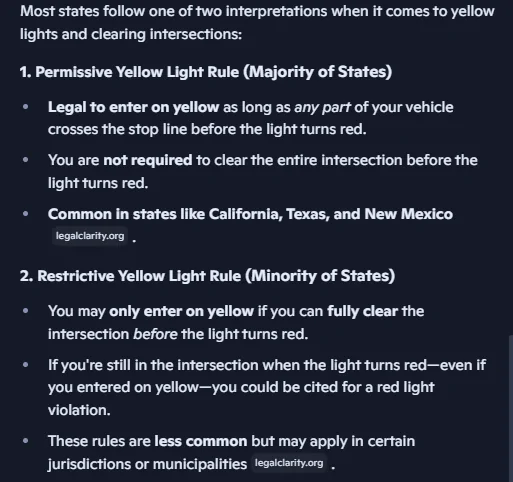
I just checked and it seems that New Mexico changed its laws since I was living there, but there are still states that use the more restrictive definition:


1762194289947-cl.webp


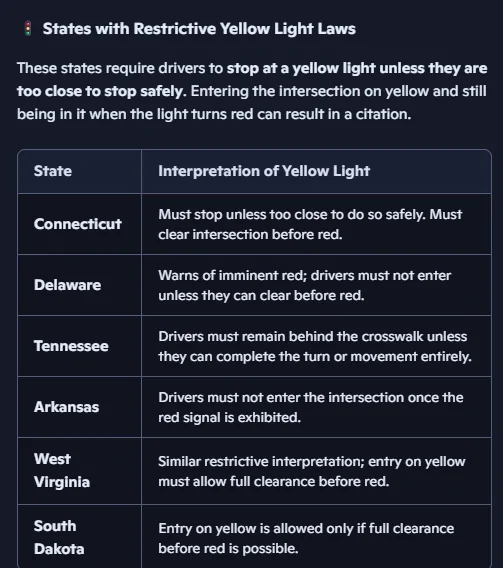
The states that still have this:
1762194340939-6g.webp
Wow that’s crazy. I wonder how they even enforce it. Where does the intersection even end? And how long are those yellow lights?

It would encourage you to speed through the intersection (dangerous) because you have to be going fast enough to clear the intersection in a short time period.

No wonder it’s a pretty unpopular definition, but it does go to the question on if a Tesla knows the red light law in the state you’re in.
 

ChrisO

Well-Known Member
Joined
Jan 11, 2025
Threads
9
Messages
998
Reaction score
992
Location
US
Vehicles
.
Wow that’s crazy. I wonder how they even enforce it. Where does the intersection even end? And how long are those yellow lights?

It would encourage you to speed through the intersection (dangerous) because you have to be going fast enough to clear the intersection in a short time period.

No wonder it’s a pretty unpopular definition, but it does go to the question on if a Tesla knows the red light law in the state you’re in.
When I was in New Mexico when they had the more restrictive law they didn’t seem to have any problem writing up people.

It was stated as “yellow light means clear the intersection”, and there was plenty of time to do that. And in fact there is plenty of time currently in California to clear the intersection on a yellow, with maybe the exception of a left turn that doesn’t have a green arrow.

Here is the real truth people keep pushing the boundaries and then that becomes the “norm”.

You insert time in between when the light turns red and when the cross traffic gets a green and people learn this and run the red lights by that amount or even more counting on the fact that the people in the cross traffic can’t make it to the middle of the road before they get there.

Note I looked up what the current statement is about the yellow lights and it says that you should stop if you can do it safely. How many people do you know do that?
 

Mach1E

Well-Known Member
Joined
Sep 5, 2021
Threads
93
Messages
10,509
Reaction score
13,295
Location
Florida
Vehicles
69 Mach 1, 11 GT, 21 GTPE- sold, 24 Taycan 4S, 20 F type R
Country flag
When I was in New Mexico when they had the more restrictive law they didn’t seem to have any problem writing up people.

It was stated as “yellow light means clear the intersection”, and there was plenty of time to do that. And in fact there is plenty of time currently in California to clear the intersection on a yellow, with maybe the exception of a left turn that doesn’t have a green arrow.

Here is the real truth people keep pushing the boundaries and then that becomes the “norm”.

You insert time in between when the light turns red and when the cross traffic gets a green and people learn this and run the red lights by that amount or even more counting on the fact that the people in the cross traffic can’t make it to the middle of the road before they get there.

Note I looked up what the current statement is about the yellow lights and it says that you should stop if you can do it safely. How many people do you know do that?
None. Thats why that version of the law seems dangerous and subjective.

Not to get too far off the subject. But when I learned about the actual laws here was when we got red light cameras.

Those went away after a few years because the intention was safety but the reality was they actually made accidents go UP. People ended up either slamming on the brakes or speeding through the intersections to avoid tickets.

I could see the same thing with the “clear the intersection” laws.
 

tls

Well-Known Member
Joined
Sep 2, 2024
Threads
6
Messages
53
Reaction score
52
Location
New York
Vehicles
2025 MME GT, 2022 F150 Lightning Lariat
Country flag
Wow that’s crazy. I wonder how they even enforce it. Where does the intersection even end? And how long are those yellow lights?

It would encourage you to speed through the intersection (dangerous) because you have to be going fast enough to clear the intersection in a short time period.

No wonder it’s a pretty unpopular definition, but it does go to the question on if a Tesla knows the red light law in the state you’re in.
Connecticut in particular has a number of odd little differences in its driving laws. There's the yellow light thing and the prohibition on passing on the right - which has been modified since I learned to drive there 40 years ago, and now depends on whether there are 2, 3, or more travel lanes in the same direction! - and a lot more use of statutory (unposted) speed limits than you'll find elsewhere, including a different statutory limit depending whether there are streetlights or not. Also there are a lot of paved, multilane back roads that use the old single yellow center line rather than the double line. At least it isn't one of the states with a weird right turn on red arrow law or driving in the breakdown lane (did MA get rid of that when they finished the Big Dig?).

As far as I can tell, Tesla's driving automation doesn't obey any of these regional differences. BC is intentionally limited in ways that make it hard to tell, but, Ford's autopark, when enabled at all, did routinely leave the vehicle way beyond the legal distance from the curb just like Tesla's.


MacherAWD

Well-Known Member
First Name
Erik
Joined
Mar 29, 2022
Threads
14
Messages
1,830
Reaction score
2,716
Location
North Shore MA
Vehicles
2021 AWD Select C&T, 2020 Bolt Premier
Occupation
Healthcare Software
Country flag
driving in the breakdown lane (did MA get rid of that when they finished the Big Dig?).
Still allowed! I havent commuted in years, but still a wild experience.
 

ChrisO

Well-Known Member
Joined
Jan 11, 2025
Threads
9
Messages
998
Reaction score
992
Location
US
Vehicles
.
None. Thats why that version of the law seems dangerous and subjective.

Not to get too far off the subject. But when I learned about the actual laws here was when we got red light cameras.

Those went away after a few years because the intention was safety but the reality was they actually made accidents go UP. People ended up either slamming on the brakes or speeding through the intersections to avoid tickets.

I could see the same thing with the “clear the intersection” laws.
In California red light cameras are very rare "because of privacy". San Jose, just put in a couple on some main streets where there had been many accidents because of people running red lights.

I can certainly see how the "sudden change" can cause problems, but in fact in back when it was a law back in New Mexico you didn't see that kind of slamming on of the breaks and only tad of speeding through yellows. Like I said, people adjust to what they think they can get away with.

Right now, in isn't uncommon for the light to turn green and have multiple cars still going through the intersection.

And getting back to the mad max mode and FSD in general not knowing the regional traffic laws, as technology like this spreads it will become the "norm". I'm not of the belief that just because humans do it, we should make that the norm for self-driving cars.
 

Mach1E

Well-Known Member
Joined
Sep 5, 2021
Threads
93
Messages
10,509
Reaction score
13,295
Location
Florida
Vehicles
69 Mach 1, 11 GT, 21 GTPE- sold, 24 Taycan 4S, 20 F type R
Country flag
In California red light cameras are very rare "because of privacy". San Jose, just put in a couple on some main streets where there had been many accidents because of people running red lights.

I can certainly see how the "sudden change" can cause problems, but in fact in back when it was a law back in New Mexico you didn't see that kind of slamming on of the breaks and only tad of speeding through yellows. Like I said, people adjust to what they think they can get away with.

Right now, in isn't uncommon for the light to turn green and have multiple cars still going through the intersection.

And getting back to the mad max mode and FSD in general not knowing the regional traffic laws, as technology like this spreads it will become the "norm". I'm not of the belief that just because humans do it, we should make that the norm for self-driving cars.
You would think that “obeying traffic laws” should be standard practice for automated systems but it’s not.

At the very least it should be the default setting and then only breaking laws if you take action and tell it to (similar to how you can make your cruise control break the speed limit on purpose).

But red light laws? There shouldn’t be a setting to break those without intervention.
 

mkhuffman

Well-Known Member
First Name
Mike
Joined
Nov 19, 2020
Threads
29
Messages
6,878
Reaction score
9,512
Location
Virginia
Vehicles
2025 Rivian R1T Tri-Max, Jeep GC-L, VW Jetta
Country flag
You would think that “obeying traffic laws” should be standard practice for automated systems but it’s not.

At the very least it should be the default setting and then only breaking laws if you take action and tell it to (similar to how you can make your cruise control break the speed limit on purpose).

But red light laws? There shouldn’t be a setting to break those without intervention.
This discussion makes me realize that Tesla and other auto companies will never take on the liability of full self-driving, especially if the automated driver is breaking the law. It seems to me the lawyers would shut down that idea immediately. Seriously, if there is no steering wheel, and no brake pedal, the auto manufacturer will be 100% liable. Right?

Tesla currently requires a human to be in charge of the car. If the human tells it to break the law, the human is responsible. If the human is not paying attention and the car makes a mistake, the human is responsible. No Tesla liability. Well, practically.

When the human is not responsible, there will not be a Mad Max mode. No way Tesla will pay the speeding or red-light lockets. No way.
 

tls

Well-Known Member
Joined
Sep 2, 2024
Threads
6
Messages
53
Reaction score
52
Location
New York
Vehicles
2025 MME GT, 2022 F150 Lightning Lariat
Country flag
Except that as we've amply learned from Waymo and Cruise so far, no human person will ever be held accountable for the harm their vehicles do, whether it's running over a cat or a person. That's why they would *rather* not even have a "safety driver" in their cars.

If the executives of these companies were held personally liable, even criminally liable when their "autonomous" cars do things that would incur those consequences for a human driver...but that ship, the one that carries liability away from ultrawealthy or powerful human beings, through the land of corporate-persons-before-the-law, and eventually to nowhere at all, sailed long ago, of course.
 

mkhuffman

Well-Known Member
First Name
Mike
Joined
Nov 19, 2020
Threads
29
Messages
6,878
Reaction score
9,512
Location
Virginia
Vehicles
2025 Rivian R1T Tri-Max, Jeep GC-L, VW Jetta
Country flag
Except that as we've amply learned from Waymo and Cruise so far, no human person will ever be held accountable for the harm their vehicles do, whether it's running over a cat or a person. That's why they would *rather* not even have a "safety driver" in their cars.

If the executives of these companies were held personally liable, even criminally liable when their "autonomous" cars do things that would incur those consequences for a human driver...but that ship, the one that carries liability away from ultrawealthy or powerful human beings, through the land of corporate-persons-before-the-law, and eventually to nowhere at all, sailed long ago, of course.
You are a silly person. There are consequences when a vehicle kills a human. We are on the cutting edge, but don't think liability will be forgotten. As long as the liability is with a private entity. If the government is liable? You may be right about no consequences then.
 

tls

Well-Known Member
Joined
Sep 2, 2024
Threads
6
Messages
53
Reaction score
52
Location
New York
Vehicles
2025 MME GT, 2022 F150 Lightning Lariat
Country flag
You are a silly person. There are consequences when a vehicle kills a human. We are on the cutting edge, but don't think liability will be forgotten. As long as the liability is with a private entity. If the government is liable? You may be right about no consequences then.
Sure, monetary consequences for a gigantic corporation that can easily get more.
But no human being will go to jail. It's the magic criminal liability eraser: nobody is driving the car.

And of course it's not just criminal. Waymo and Cruise cars break the rules of the road in ways that would invoke real civil or administrative consequences for a human driver all the time - blocking emergency vehicles, whipping U turns in traffic, etc. - and because our whole system for regulating driving basically relies on attempting to get the bad drivers off the road - *but there is no driver* - nothing actually happens except that some Alphabet or GM executive apologizes, their subsidiary might pay some trivial amount of money they literally don't care about, and nothing changes.

There was a truly awful incident with a Waymo car and a cat in San Francisco in the news this week. I won't give the details because they literally turned my stomach. Why did it happen? Why is pretty obvious - this generation of autonomous cars doesn't have any effective programming for avoiding small animals. Why's that? Because of course it is cheaper to apologize and throw some money at the pet's owner and some relevant seeming charity. Which is exactly what happened. If it were a person that got mangled, there would be more hue and cry and surely more cash involved, but just as surely not an amount Alphabet would even really notice; and no human person would go to jail or even lose their license.

If some human being were on the hook for the behavior of each of these cars, "silly" as that might sound, things would be different.
 
Last edited:

ChrisO

Well-Known Member
Joined
Jan 11, 2025
Threads
9
Messages
998
Reaction score
992
Location
US
Vehicles
.
I just read that Musk just said that in a month or two the driver will be able to text. Maybe someone should point out to him that is illegal in 47 states.
 

mkhuffman

Well-Known Member
First Name
Mike
Joined
Nov 19, 2020
Threads
29
Messages
6,878
Reaction score
9,512
Location
Virginia
Vehicles
2025 Rivian R1T Tri-Max, Jeep GC-L, VW Jetta
Country flag
Sure, monetary consequences for a gigantic corporation that can easily get more.
But no human being will go to jail. It's the magic criminal liability eraser: nobody is driving the car.

And of course it's not just criminal. Waymo and Cruise cars break the rules of the road in ways that would invoke real civil or administrative consequences for a human driver all the time - blocking emergency vehicles, whipping U turns in traffic, etc. - and because our whole system for regulating driving basically relies on attempting to get the bad drivers off the road - *but there is no driver* - nothing actually happens except that some Alphabet or GM executive apologizes, their subsidiary might pay some trivial amount of money they literally don't care about, and nothing changes.

There was a truly awful incident with a Waymo car and a cat in San Francisco in the news this week. I won't give the details because they literally turned my stomach. Why did it happen? Why is pretty obvious - this generation of autonomous cars doesn't have any effective programming for avoiding small animals. Why's that? Because of course it is cheaper to apologize and throw some money at the pet's owner and some relevant seeming charity. Which is exactly what happened. If it were a person that got mangled, there would be more hue and cry and surely more cash involved, but just as surely not an amount Alphabet would even really notice; and no human person would go to jail or even lose their license.

If some human being were on the hook for the behavior of each of these cars, "silly" as that might sound, things would be different.
It sounds like the consequences for killing an animal may not be serious enough. If it were my dog, I would sue the crap out of them. It is possible the animal's owner was at fault, or partially at fault, in which case it would be hard to sue.

The only way they avoid serious consequences is if the government is protecting them. Are there any special regulations exempting autonomous vehicles from liability where that happened?

I asked Grok to research liability limits on autonomous vehicle companies, and it appears there are none that Grok can find. There are regulations that protect companies who have nothing to do with making the original vehicle autonomous (like Waymo does), but Grok says:

"California (a major testing hub for Waymo) mandates at least $5 million in combined single-limit liability insurance for AVs at Levels 3-5, but this is a floor, not a ceiling on potential damages. Similarly, Florida requires $1 million for fully autonomous vehicles."

This means you can sue the crap out of Waymo (or Tesla) if you feel that company is at fault for the injury or death. Multiple large lawsuits could put the company out of business, essentially the death penalty for a company. There is a huge incentive to avoid that.

If a human being makes a mistake and hurts or kills someone, their insurance company pays. Unless what they did was criminal, the driver is not going to go to jail. So I don't see why putting company managers in jail in a similar situation makes sense. Financial penalties do make sense, and if Grok's research is correct, there is plenty of room for severe penalties if a autonomous vehicle makes a mistake.
Sponsored


Top