Anti_Climax
New Member
- Joined
- Apr 14, 2022
- Threads
- 1
- Messages
- 3
- Reaction score
- 2
- Location
- Valley of the Sun
- Vehicles
- The most custom Ford Focus Electric in existence
- Thread starter
- #1
I own a Focus Electric and, if I'm not mistaken, the MachE uses the same overall configuration for battery cooling. I just got done dealing with a LONG ongoing issue (more than 2 years) where my battery was failing to cool down. Which is great in Arizona, I tell ya. Now that I've solved it I want to get it out there so other folks can identify and address it without all the trouble I went through. There is almost no troubleshooting info for cooling in the shop manual for this and the engineers in contact with the service tech were pretty much clueless. The best they could come up with was asking the tech to find one of the other <10K of these cars to compare them against each other - not that it would have really told them anything other than undeniably confirming it was not cooling as it should be. They were of the mind that it was actually "normal" and it was just too hot out.
In my case the battery cooling would switch on whenever the battery hit 97F and it was plugged into L2 or was turned on. But when cooling was started the battery temperature would not drop. On many occasions the cooling would turn on during charging, heat the battery to well above 97F and continue trying to cool for hours into the night before it got cold enough around it to get below that threshold. The extra load from running the compressor was actually heating the system overall. It wrecked one AC compressor ($2700), the chiller block and put another few years of wear on the replacement compressor. The failure produces no fault codes or errors aside from the battery itself throwing codes when it gets too hot. But that is a symptom rather than the problem itself.
Ultimately it turned out the battery coolant diverter valve, that either loops coolant through the chiller block or out into the rest of the system (motor, radiator, DC/DC converter, etc), had broken in the open loop position. This routed all battery coolant out to the rest of the system and around the chiller at all times. The valve itself would report it's position changing normally when changed/viewed with ForScan. It was only when I put a pinch clamp on the hose leading away from the chiller that I was able to see that it was not right.
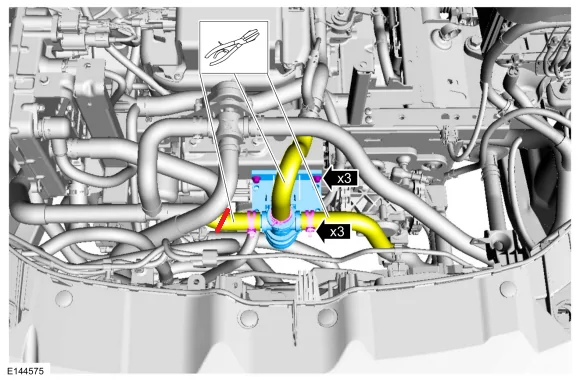
By that point I had spliced a flow meter into the battery loop so I could monitor and pinching that hose dropped flow to ZERO when all of it should have been routing through the chiller side of that valve. After attaching the coolant return directly to the chiller line, bypassing the diverter, cooling has returned to normal. Should anyone else encounter this, you can identify it without the need for a spliced in flow meter. Simply set your diverter to the chiller return position and turn your battery cooling pump on to about 50%. Partially pinch the hose that leads out of the battery loop (which should have no flow in that configuration) and watch the degas bottle. If coolant is routing through that line in error, you will see it start to spray out of the degas line into the bottle. It will be VERY noticeable compared to the normal dribble it has. Attaching a pic to clarify where to pinch - though it is a pic of the Focus hardware.
Also, I'm pretty sure this valve was damaged in an accident - though in an unexpected way. The lines to and from the battery are largely running front to back, parallel to the g-force of a front or rear collision. In a front collision, you'll have a water hammer impulse that travels down those lines and they both meet at that diverter valve. In this case, the position it failed in was the direction that shockwave would be traveling. My battery coolant pump impeller was also damaged and that shockwave would be traveling the opposite direction of normal pump flow.
Hope this helps others.

In my case the battery cooling would switch on whenever the battery hit 97F and it was plugged into L2 or was turned on. But when cooling was started the battery temperature would not drop. On many occasions the cooling would turn on during charging, heat the battery to well above 97F and continue trying to cool for hours into the night before it got cold enough around it to get below that threshold. The extra load from running the compressor was actually heating the system overall. It wrecked one AC compressor ($2700), the chiller block and put another few years of wear on the replacement compressor. The failure produces no fault codes or errors aside from the battery itself throwing codes when it gets too hot. But that is a symptom rather than the problem itself.
Ultimately it turned out the battery coolant diverter valve, that either loops coolant through the chiller block or out into the rest of the system (motor, radiator, DC/DC converter, etc), had broken in the open loop position. This routed all battery coolant out to the rest of the system and around the chiller at all times. The valve itself would report it's position changing normally when changed/viewed with ForScan. It was only when I put a pinch clamp on the hose leading away from the chiller that I was able to see that it was not right.
By that point I had spliced a flow meter into the battery loop so I could monitor and pinching that hose dropped flow to ZERO when all of it should have been routing through the chiller side of that valve. After attaching the coolant return directly to the chiller line, bypassing the diverter, cooling has returned to normal. Should anyone else encounter this, you can identify it without the need for a spliced in flow meter. Simply set your diverter to the chiller return position and turn your battery cooling pump on to about 50%. Partially pinch the hose that leads out of the battery loop (which should have no flow in that configuration) and watch the degas bottle. If coolant is routing through that line in error, you will see it start to spray out of the degas line into the bottle. It will be VERY noticeable compared to the normal dribble it has. Attaching a pic to clarify where to pinch - though it is a pic of the Focus hardware.
Also, I'm pretty sure this valve was damaged in an accident - though in an unexpected way. The lines to and from the battery are largely running front to back, parallel to the g-force of a front or rear collision. In a front collision, you'll have a water hammer impulse that travels down those lines and they both meet at that diverter valve. In this case, the position it failed in was the direction that shockwave would be traveling. My battery coolant pump impeller was also damaged and that shockwave would be traveling the opposite direction of normal pump flow.
Hope this helps others.
Sponsored