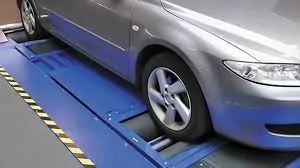
Brake test. Transmission mode.

JF2

Member
First Name
JF
Joined
Mar 16, 2022
Threads
2
Messages
11
Reaction score
6
Location
España
Vehicles
Mustang Mach E RWD Extended Range
Occupation
-
Country flag
Hello everybody.

I have a question regarding the brake test performed on roller benches to measure a vehicle’s braking force. In Spain, this test is conducted every two years to assess the overall condition of the vehicle from a safety standpoint.

The procedure is as follows: the vehicle is positioned on the rollers of the brake tester, and the brakes are applied progressively. This allows the machine to record the braking force. The test is carried out on both the front and rear axles, typically lasting a few seconds, from around 5–10 km/h down to 0 km/h.

My question is: how should the vehicle’s transmission be set to avoid any potential damage to the electric motor?
  • N
  • N + L
  • Activation of emergency towing mode
The driver remains inside the vehicle during the test, with the door closed.

Should the vehicle be set to Whisper mode to minimize regenerative braking?

For reference, the vehicle in question is a rear-wheel drive (RWD) model.

Thank you very much!

Ford Mustang Mach-E Brake test. Transmission mode. Imagen1
Sponsored


Mach-Lee

Well-Known Member
First Name
Lee
Joined
Jul 16, 2021
Threads
262
Messages
11,365
Reaction score
25,025
Location
Wisconsin
Vehicles
2022 Mach-E Premium AWD
Occupation
Sci/Eng
Country flag
Wow, interesting test I've never heard of. I assume it's going to spin up all four wheels and measures the car's ability to stop the spinning mass? In the USA there is only ever a visual inspection of brakes, I've never heard of functional brake testing being required anywhere before.

In standard driving modes with a RWD, only the rear axle will experience regenerative braking until the brake pedal is pushed hard enough to engage the friction brakes. That could cause some odd readings since the front axle will not initially brake.

If you want to test only friction brakes (disable regen), then you should accelerate in D, shift to N, and then brake.

So the short answer is use N.
 

tbrumleve

Well-Known Member
First Name
Tom
Joined
Jan 1, 2023
Threads
2
Messages
752
Reaction score
999
Location
Oregon, USA
Vehicles
2023 Mach-E Premium eAWD Standard Range
Country flag
Neutral disables all regen, 1PD, etc. No need to enable L or anything else for a few seconds.
 
OP
OP

JF2

Member
First Name
JF
Joined
Mar 16, 2022
Threads
2
Messages
11
Reaction score
6
Location
España
Vehicles
Mustang Mach E RWD Extended Range
Occupation
-
Country flag
Wow, interesting test I've never heard of. I assume it's going to spin up all four wheels and measures the car's ability to stop the spinning mass? In the USA there is only ever a visual inspection of brakes, I've never heard of functional brake testing being required anywhere before.

In standard driving modes with a RWD, only the rear axle will experience regenerative braking until the brake pedal is pushed hard enough to engage the friction brakes. That could cause some odd readings since the front axle will not initially brake.

If you want to test only friction brakes (disable regen), then you should accelerate in D, shift to N, and then brake.

So the short answer is use N.

Thank you very much for your reply.

The transmission is never in "D" mode because the rollers sping up the wheels by themselves. Only for your information, the Spanish test measures:

1. Braking Force per Axle
  • The force applied by the brakes on each wheel (front and rear) is measured.
  • This is compared to the vehicle’s weight to assess braking performance.
2. Braking Efficiency
  • Calculated as the percentage of braking force relative to the vehicle’s total weight.
  • Minimum required values:
    • Service brake: ≥ 50% of the vehicle’s weight.
    • Parking brake: ≥ 16% of the vehicle’s weight.
3. Brake Imbalance
  • Measures the difference in braking force between the left and right wheels on the same axle.
  • The imbalance must not exceed 25%.
  • Higher values may indicate issues such as seized calipers or uneven brake wear.
4. Brake Ovality (Force Variation)
  • Detects fluctuations in braking force as the wheel rotates.
  • Irregularities may suggest warped brake discs or uneven drum surfaces.
5. Pedal or Lever Response
  • Assesses whether the brake pedal or handbrake lever has excessive travel, lacks pressure, or shows signs of hydraulic failure.
Best regards
Sponsored


Top