ChasingCoral

Well-Known Member
First Name
Mark
Joined
Feb 3, 2020
Threads
502
Messages
14,306
Reaction score
28,653
Location
Maryland
Vehicles
2021 GB E4X FE, 2022 F-150 Lightning Lariat ER
Occupation
Retired oceanographer
Country flag
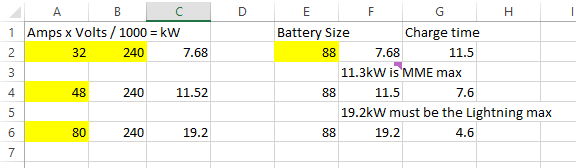
Chasing Coral, I caught this too on the Lightning launch, the Ford Charge Station Pro is an 80-amp compared to the Ford Connected Station of 48-amp (which I ordered in Feb and never received because of the stop ship). BUT Mirak educated me that if the max is 11.3kW, the 48-amp is the max that the MME can take in from a L2. The Lightning's cap must be at 19.2kW.

I was hoping to get the Ford Charge Station Pro, but apparently won't buy me any faster charge time as we're maxed at 11.3kW.

Thank you Mirak for the math formula (attached pict, couldn't upload XLS)

MME Charging.PNG
Actually, Ford has been a bit vague about some of these things. I would love to know the actual cap of the Mach E 240v charge rate. We know it is more than 7.68. We think it is around 11.5. Is it really 11.3? Where did you find that specified by Ford?

As for the Lightning, there is no reason it couldn't take 22.6 if the Mach E takes 11.3. However, the limit for the 80A Ford Pro Charger will be 19.2. Ford may have capped the charger to avoid requiring 120A circuit. As it is, the 80A Ford Pro Charger requires a 100A circuit.

While Darren Palmer hints it might be possible to do vehicle-to-home with the Mach E in the future, the Mach E only has a single 240v charger onboard, so the 80A charger will be no faster than a 48A.
 

ChasingCoral

Well-Known Member
First Name
Mark
Joined
Feb 3, 2020
Threads
502
Messages
14,306
Reaction score
28,653
Location
Maryland
Vehicles
2021 GB E4X FE, 2022 F-150 Lightning Lariat ER
Occupation
Retired oceanographer
Country flag
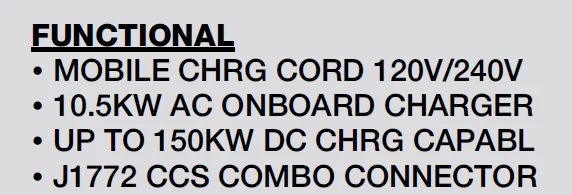
According to my window sticker, we're maxxed at 10.5kW:
1622030768433.png
I believe this is correct. That is one of the only places I've seen Ford state the Mach E charge rate directly. If the Lightning has two of these, that would be a 21kW max -- just over the 19.2 the 80A charger provides.
 

EVmodeler

Well-Known Member
First Name
Doug
Joined
Oct 30, 2020
Threads
10
Messages
132
Reaction score
291
Location
SW Virginia
Vehicles
Mach-E AWD ER IB Job 1
Occupation
Engr Prof emeritus
Country flag
The onboard charger is rated at 10.5 kW Output (DC) just like motors and engines are rated by output power. The onboard charger can draw up to 11.5 kW AC input (240 V * 48 A) for about 91% AC to DC conversion. plus there are parasitic loads like modules powered by the DC-DC converter for 12V, and thermal management (fans, etc) during charging.
The onboard charger is likely limited to about 30 or 32 A DC at the battery voltage ~343 V. As SOC and battery voltage increase, the current and power decrease.


I believe this is correct. That is one of the only places I've seen Ford state the Mach E charge rate directly. If the Lightning has two of these, that would be a 21kW max -- just over the 19.2 the 80A charger provides.
 
Last edited:

ChasingCoral

Well-Known Member
First Name
Mark
Joined
Feb 3, 2020
Threads
502
Messages
14,306
Reaction score
28,653
Location
Maryland
Vehicles
2021 GB E4X FE, 2022 F-150 Lightning Lariat ER
Occupation
Retired oceanographer
Country flag
The onboard charger is rated at 10.5 kW Output (DC) just like motors and engines are rated by output power. The onboard charger can draw up to 11.5 kW input (240 V * 48 A) for about 91% AC to DC conversion. plus there are parasitic loads like modules powered by the DC-DC converter for 12V, and thermal management (fans, etc).
Now that makes sense! Thanks.


benk016

Well-Known Member
First Name
Ben
Joined
Nov 12, 2020
Threads
38
Messages
3,265
Reaction score
5,093
Location
Tulsa, Oklahoma
Vehicles
2021 Mustang Mach-E GT
Country flag
My charge point reports that my MME pulls 11kw while charging on my 60amp line at 48amp.
 
OP
OP
Mirak

Mirak

Banned
Banned
Joined
Oct 8, 2020
Threads
111
Messages
3,754
Reaction score
6,166
Location
Kansas
Vehicles
"Sonic" 2021 MME Grabber Blue First Edition
Country flag
Sorry all for spreading any misinformation. I read the 11.3kW on a few websites. Sounds like the official cap is 10.5kW but maybe the output can actually be a bit higher? Anyway, the AC cap seems to be somewhere in range of 10.5 to 11. Bottom line is there is absolutely no point in buying a home charger greater than 48amps.

Very interesting discussion about the DCFC. I’m not going to pretend to understand all the technicalities, but it sounds like a larger pack with more cells can accept more current, thus enabling the larger F150 battery pack to recharge in roughly the same amount of time as the smaller MME pack.

One of the best aspects of this forum (besides the memes) is the good technical input from very smart people.
 

EV Lab

Well-Known Member
Joined
Oct 18, 2020
Threads
9
Messages
197
Reaction score
233
Location
San Jose CA
Vehicles
IB MME 4XE, Ford F-150, Honda Civic EV conversion
Occupation
Electrical Engineer
Country flag
It's not too hard to understand... and I don't think 150kW max is necessarily bad. The amount of time in the charge curve that close to 150kW is enabled is key to maximizing the charge rate and reducing the overall charge time. Judging by the numbers shared so far, the overall time to charge from 10% to 80% is almost the same for the MME and Lightning, so due to the fact the Lightning has a much higher capacity pack, it must be able to maintain a higher charge rate for longer than the MME.

FWIW, there are still relatively few 350kW stations out there and most BEVs that can support that high of a rate are ~710V nominal (~806V max). While the max charge rate of the CCS spec is 350kW, the max current is 350A (max voltage is 1000V), so the actual max charge rate possible is ~270kW.

4V x 192 x 350A = 268.8kW

where:
4V ≈80% state of charge on a single Lithium-Ion cell
192 = number of series cells in a typical "800V" pack
350A = max allowed charge current in the CCS spec
 

ChasingCoral

Well-Known Member
First Name
Mark
Joined
Feb 3, 2020
Threads
502
Messages
14,306
Reaction score
28,653
Location
Maryland
Vehicles
2021 GB E4X FE, 2022 F-150 Lightning Lariat ER
Occupation
Retired oceanographer
Country flag
It's not too hard to understand... and I don't think 150kW max is necessarily bad. The amount of time in the charge curve that close to 150kW is enabled is key to maximizing the charge rate and reducing the overall charge time. Judging by the numbers shared so far, the overall time to charge from 10% to 80% is almost the same for the MME and Lightning, so due to the fact the Lightning has a much higher capacity pack, it must be able to maintain a higher charge rate for longer than the MME.

FWIW, there are still relatively few 350kW stations out there and most BEVs that can support that high of a rate are ~710V nominal (~806V max). While the max charge rate of the CCS spec is 350kW, the max current is 350A (max voltage is 1000V), so the actual max charge rate possible is ~270kW.

4V x 192 x 350A = 268.8kW

where:
4V ≈80% state of charge on a single Lithium-Ion cell
192 = number of series cells in a typical "800V" pack
350A = max allowed charge current in the CCS spec
I did find the Mach E charges at a bit higher rate on 350kW chargers than 150kW chargers. One part of that is the initial zap at 165kW when on a 350kW charger. Even after it drops down to the two lower plateaus, I recall these were a little higher on the 350s.
 

EV Lab

Well-Known Member
Joined
Oct 18, 2020
Threads
9
Messages
197
Reaction score
233
Location
San Jose CA
Vehicles
IB MME 4XE, Ford F-150, Honda Civic EV conversion
Occupation
Electrical Engineer
Country flag
From looking at various studies of infrastructure cost, and just seeing the ratio of installed 350kW stations vs all other DCFC rates, the bulk of installed stations are 150kW. The study here (https://theicct.org/sites/default/files/publications/ICCT_EV_Charging_Cost_20190813.pdf) also shows the cost of 150kW vs 50kW to be roughly the same, and almost half of a 350kW installation. I think the vast majority for the foreseeable future will be 150kW.

Not sure what configuration you are specifically referring to (MME, Lightning or typical "800V") but I would assume most charge curves start out approximately the same and then scale based on ambient and pack temperature. With my MME I've noticed whether I start at 10% or 50%, it initially starts at ~123 - 150kW then slowly ramps down to ~80 - 90kW before dropping to 11kW at 80%.
 

theo1000

Well-Known Member
First Name
Theo
Joined
Apr 16, 2021
Threads
0
Messages
473
Reaction score
610
Location
Shawnee, KS
Vehicles
Mach-E 2021 IB, Audi Etron, Chevy Volt, BMW I3,
Country flag
FWIW, there are still relatively few 350kW stations out there and most BEVs that can support that high of a rate are ~710V nominal (~806V max). While the max charge rate of the CCS spec is 350kW, the max current is 350A (max voltage is 1000V), so the actual max charge rate possible is ~270kW.
CCS spec max amps is actually 500 amps. There are not too many out in the field for the public though. 500 kw max.
 

EV Lab

Well-Known Member
Joined
Oct 18, 2020
Threads
9
Messages
197
Reaction score
233
Location
San Jose CA
Vehicles
IB MME 4XE, Ford F-150, Honda Civic EV conversion
Occupation
Electrical Engineer
Country flag


Top