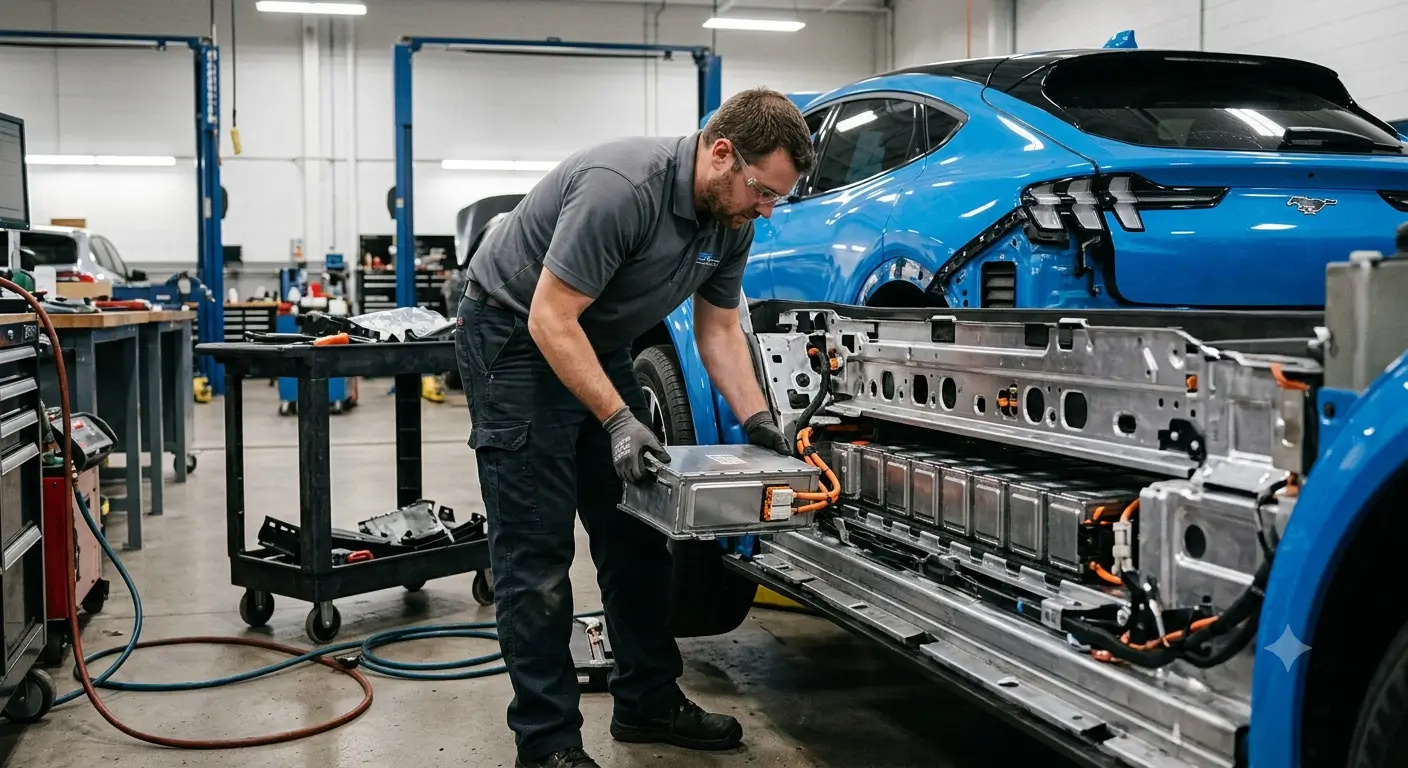
Imagine swapping battery modules at the track: Modular EV Racing

Aaron.Edwards

Member
First Name
Aaron
Joined
Jul 20, 2026
Threads
2
Messages
18
Reaction score
18
Location
A&M
Vehicles
2023 MME GTPE
As an A.I. and Engineering Student - last night's insomnia watching Tesla Racing Channel on YouTube as he removed weight and I thought of this...

You take your Mustang Mach-E to the track, and instead of lugging around a massive, fixed floorboard battery, your setup is completely modular. Depending on what you want to accomplish that day, you tune your weight to match your strategy. Running a quick 1/4-mile drag? Drop half the modules to shed hundreds of pounds. Heading out for a longer endurance session? Slap the full pack back in.

If aftermarket builders and performance brands developed removable battery module kits—paired with intelligent management software that automatically adapts to the changed capacity and cell configuration—we wouldn't just be modding EVs. We’d be spawning an entirely new genre of motorsport.

Imagine the possibilities:

  • Custom Weight & Balance Tuning: Fine-tune your corner weights and center of gravity just like adjusting coil overs or ballast.
  • Team & Builder Competition: Performance shops competing on battery management algorithms, custom high-output pack designs, and quick-swap mechanisms.
  • Extra Batteries: Companies could sell Extra Batteries, Battery Charging Stands, etc. you could bring a trailer of extra batteries and never stop the fun!
The aftermarket industry built its foundation on hot-rodding and modular upgrades. Bringing that same plug-and-play ethos to EV battery architecture could completely open up the tuner scene for cars like the Mach-E.

Gemini made this photo for me, but instead of pulling off the shell, think of rocker panel doors and doors on the front and back - you could slide battery packs in and out.
Ford Mustang Mach-E Imagine swapping battery modules at the track: Modular EV Racing battery pack
Sponsored


Budmen

Active Member
First Name
Bud
Joined
Aug 19, 2025
Threads
6
Messages
33
Reaction score
86
Location
Newark, DE
Vehicles
2025 Ford Mustang Mach-E, 2025 Subaru Soltera, 2016 Jeep Wranger
This is how I envisioned EV battery charging in general.... modular batteries that you could swap in and out. Maybe 3 or 4 that you could carry and use.... 1 battery in for a short trip, 2 for medium, 3 or 4 for road trips. And when you need one, just pop it out and put another one in. I don't think it will ever happen at this point, but it would have been a neat future
 

R/L

Well-Known Member
First Name
Bob
Joined
Apr 16, 2026
Threads
4
Messages
52
Reaction score
59
Location
SW Michigan
Vehicles
2025 Mach-E AWD Ex
Anyone remember this video from 13 years ago?

My understanding is that there were a couple of change stations installed in California as proof of concept, but never caught on.

13 years later, with advances in batteries and charging, this will probably remain a historical point of interest on the EV landscape!
 
Last edited:

NY_Cade69

Well-Known Member
First Name
Cade
Joined
Mar 26, 2026
Threads
14
Messages
920
Reaction score
1,123
Location
PA ON NY
Vehicles
2025 Premium Sport package Molten Magenta Extended Range eAWD Pano
Nio has battery swapping in China and the EU, think they had a prototype in Cali as well...
 
OP
OP
Aaron.Edwards

Aaron.Edwards

Member
First Name
Aaron
Joined
Jul 20, 2026
Threads
2
Messages
18
Reaction score
18
Location
A&M
Vehicles
2023 MME GTPE
It almost seems like certain EVs are coming to market not because it is going to be great but because of Federal Compliance. I wish manufacturers wanted to advance the EV field instead of just keep up with it.


GreaseMonkey

Well-Known Member
First Name
Steve
Joined
Oct 3, 2021
Threads
23
Messages
3,431
Reaction score
5,531
Location
Chicago, IL
Vehicles
24 Mach-E GT
Country flag
I think you are better off advancing batt tech to reduce overall batt size, moving away from liquid cooled, and making the car body more efficient. That should shave a lot of weight off the car as is instead of tinkering with the battery structure. Remember Model Y has the same performance as a MME and is ~500 lb lighter, smaller battery and lower CD. As a first iteration car, the MME is just not optimized for the use case. I feel like 4 miles per kWh should be the goal for a midsized SUV.

The idea of swapping batteries for charging purposes is not a good one. Charging is not a valid reason to remove and replace a battery. That’s why other car makers didn’t follow the one Chinese OEM. It’s a solution looking for a problem. And in this case, use an 800 v architecture to speed up charging (and just be patient).
 

cyeung

Well-Known Member
Joined
Oct 28, 2024
Threads
9
Messages
133
Reaction score
245
Location
Atlanta, GA
Vehicles
2025 Mustang Mach-E Premium
There are several aspects to be accounted for to make this work:
  1. For all permissible combinations, the voltage on the battery pack must remain 400 Volts (or 800 Volts). Too low and your motor will not work. Too high and you blow out all the electronics.
  2. A drag race requires a lot of power in a pulse. Power is Voltage times Current (P = V*I). Removing battery modules means reducing current capacity. This may be acceptable, but at the cost of heating up the batteries.
  3. Now that the drag race is over and you are ready to put the modules back in. Supposing that your battery modules are connected in parallel at the same voltage, they must all be at the same state of charge. Otherwise, one module will be discharging to charge another module.
  4. Removal and installation of battery modules must be safe for even people who have little to no training.
If your school has a design team (e.g., solar car, Formula SAE, etc.), I encourage you to join those to gain some experience on the design of a battery pack.
 
Last edited:

cyeung

Well-Known Member
Joined
Oct 28, 2024
Threads
9
Messages
133
Reaction score
245
Location
Atlanta, GA
Vehicles
2025 Mustang Mach-E Premium
I think you are better off advancing batt tech to reduce overall batt size, moving away from liquid cooled, …
The first generation Nissan Leaf batteries were air-cooled. They did not fare well where the climate is hot. What other way do you propose to get the heat away from the batteries or other electronics?
 

GreaseMonkey

Well-Known Member
First Name
Steve
Joined
Oct 3, 2021
Threads
23
Messages
3,431
Reaction score
5,531
Location
Chicago, IL
Vehicles
24 Mach-E GT
Country flag
The first generation Nissan Leaf batteries were air-cooled. They did not fare well where the climate is hot. What other way do you propose to get the heat away from the batteries or other electronics?
I was eluding to solid state requiring no cooling. We definitely don’t need the air cooling mess!
 
OP
OP
Aaron.Edwards

Aaron.Edwards

Member
First Name
Aaron
Joined
Jul 20, 2026
Threads
2
Messages
18
Reaction score
18
Location
A&M
Vehicles
2023 MME GTPE
I think you are better off advancing batt tech to reduce overall batt size, moving away from liquid cooled, and making the car body more efficient. That should shave a lot of weight off the car as is instead of tinkering with the battery structure. Remember Model Y has the same performance as a MME and is ~500 lb lighter, smaller battery and lower CD. As a first iteration car, the MME is just not optimized for the use case. I feel like 4 miles per kWh should be the goal for a midsized SUV.

The idea of swapping batteries for charging purposes is not a good one. Charging is not a valid reason to remove and replace a battery. That’s why other car makers didn’t follow the one Chinese OEM. It’s a solution looking for a problem. And in this case, use an 800 v architecture to speed up charging (and just be patient).

Funny you mention this—I was actually thinking about Ford's Pikes Peak Mach-E. They went to a much smaller 50 kWh high-performance pack specifically to save weight, which is basically the philosophy I'm getting at.

I'm just taking it one step further: instead of Ford choosing the battery configuration for the specific race, what if the owner could configure it based on the mission?

Full pack for a road trip, fewer modules for track use, different modules for power vs. range, etc.
 
OP
OP
Aaron.Edwards

Aaron.Edwards

Member
First Name
Aaron
Joined
Jul 20, 2026
Threads
2
Messages
18
Reaction score
18
Location
A&M
Vehicles
2023 MME GTPE
There are several aspects to be accounted for to make this work:
  1. For all permissible combinations, the voltage on the battery pack must remain 400 Volts (or 800 Volts). Too low and your motor will not work. Too high and you blow out all the electronics.
  2. A drag race requires a lot of power in a pulse. Power is Voltage times Current (P = V*I). Removing battery modules means reducing current capacity. This may be acceptable, but at the cost of heating up the batteries.
  3. Now that the drag race is over and you are ready to put the modules back in. Supposing that your battery modules are connected in parallel at the same voltage, they must all be at the same state of charge. Otherwise, one module will be discharging to charge another module.
  4. Removal and installation of battery modules must be safe for even people who have little to no training.
If your school has a design team (e.g., solar car, Formula SAE, etc.), I encourage you to join those to gain some experience on the design of a battery pack.
I am looking into similar companies for data engineering internships before graduation.

If Mach-E sales were over 215,000 vehicles in the last five years and the Mustang has always had an enormous performance and aftermarket division, I'd like to see Ford bring that same philosophy to EVs with battery technology, modularity, software, cooling, performance, etc.

I'm not saying "here's the finished engineering solution."
I'm sayin here's a direction Ford has the resources, customer base, and performance heritage to research and eventually turn into an aftermarket product. Maybe I should write them a letter 🤔
Sponsored


Top