How far can EVs go at 70mph constant?

EVer

Well-Known Member
Joined
Apr 21, 2020
Threads
0
Messages
455
Reaction score
456
Location
San Diego, CA
Vehicles
Ford F-150 SuperCrew Cab, Tesla Model 3P
Country flag
And that's the real problem. Especially when their data is used to calculate perhaps the single-most crucial metric for BEVs: RANGE.

Which really only matters much on long trips, which are usually around 70 MPH.
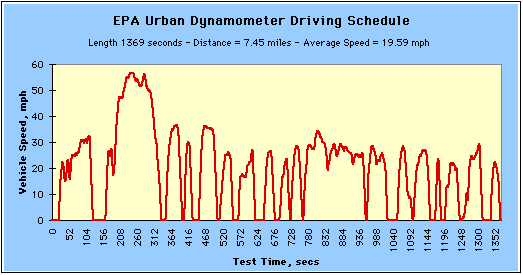
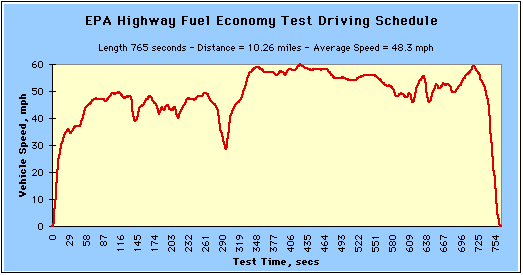
Hopefully as BEVs become more prevalant, EPA will add new cycles. They seem outdated for pretty much all modern cars, however powered. The urban one might still be germane, but the highway one is either much too fast (for congested roads) or much too slow (for open roads).

Ford Mustang Mach-E How far can EVs go at 70mph constant? uddsdds


Ford Mustang Mach-E How far can EVs go at 70mph constant? hwfetdds
Sponsored

 
Last edited:

ChasingCoral

Well-Known Member
First Name
Mark
Joined
Feb 3, 2020
Threads
502
Messages
14,306
Reaction score
28,655
Location
Maryland
Vehicles
2021 GB E4X FE, 2022 F-150 Lightning Lariat ER
Occupation
Retired oceanographer
Country flag
And that's the real problem. Especially when their data is used to calculate perhaps the single-most crucial metric for BEVs: RANGE.

Which really only matters much on long trips, which are usually around 70 MPH.
I'll disagree with the last part @dbsb3233. At least on roads with 70 mph speeds there tends to be a better DCFC charging network. The real problem are those long trips off the interstate where chargers are even more scarce. Range definitely matters on those and things like regeneration make a big difference.

I was on a road trip recently to go camping. First half was interstate. Second half was back roads, hills, and twisties, ending in WV -- the state with no high-speed chargers. No 70 mph there and range really matters.
 

dbsb3233

Well-Known Member
First Name
TimCO
Joined
Dec 30, 2019
Threads
56
Messages
10,100
Reaction score
11,965
Location
Colorado, USA
Vehicles
2021 Mustang Mach-E FE, 2025 Porche Macan Electric
Occupation
Retired
Country flag
I'll disagree with the last part @dbsb3233. At least on roads with 70 mph speeds there tends to be a better DCFC charging network. The real problem are those long trips off the interstate where chargers are even more scarce. Range definitely matters on those and things like regeneration make a big difference.

I was on a road trip recently to go camping. First half was interstate. Second half was back roads, hills, and twisties, ending in WV -- the state with no high-speed chargers. No 70 mph there and range really matters.
Range for a 50 MPH drive is much easier to extrapolate from a combo of the 70 MPH number and the city number (~30 MPH?) than open-ended on the high end though. Extrapolating upward from 48 MPH is much less dependable because different BEVs have different exponential decline as speeds go higher.

I agree that the charger networks are even worse on smaller highways. In fact, 150kW+ is almost non-existent. To the point where doing <1 hour "meal stops" to refuel often isn't possible. Those become more 2+ hour (or overnight) "stays" rather than "stops" at L2 (or maybe 50kW). Range is still very important there too off course, although I suspect the longer, multi-recharge-per-day trips are more likely to be interstate. While the smaller highways are more likely to be medium distance rather than long (general tendency).
 

EVer

Well-Known Member
Joined
Apr 21, 2020
Threads
0
Messages
455
Reaction score
456
Location
San Diego, CA
Vehicles
Ford F-150 SuperCrew Cab, Tesla Model 3P
Country flag
different BEVs have different exponential decline as speeds go higher.
Can you elaborate on this? I can see it being true for BEVs with multiple gears (e.g., Porsche’s), but otherwise isn’t drag the dominant factor?
Maybe some BEV’s have active aero to alter drag coefficient but, failing that and all else equal. power to overcome drag will increase with the cube of velocity.
 

dbsb3233

Well-Known Member
First Name
TimCO
Joined
Dec 30, 2019
Threads
56
Messages
10,100
Reaction score
11,965
Location
Colorado, USA
Vehicles
2021 Mustang Mach-E FE, 2025 Porche Macan Electric
Occupation
Retired
Country flag
Can you elaborate on this? I can see it being true for BEVs with multiple gears (e.g., Porsche’s), but otherwise isn’t drag the dominant factor?
Maybe some BEV’s have active aero to alter drag coefficient but, failing that and all else equal. power to overcome drag will increase with the cube of velocity.
Yes, drag should be the dominant factor (mostly aerodynamics). IIRC correctly, I think it was one of EE's (Jason) videos that said drag has a speed squared component in the formula, meaning as speed increases, the drag coefficient goes up exponentially. So a less aerodynamic shape (like a taller, boxier SUV) will usually see range degrade faster as speed goes up than a sleek sedan (for instance).

I may not have that exactly right, but I think that's the general concept.

So range for an SUV should degrade above EPA 48 MPH at a faster rate than something like a smaller/sleeker Model 3. Making it harder to apply a universal 48 MPH to 70 MPH range degradation factor. One BEV may decline by just 10% and another by 30%.
Sponsored


Top