
Rear Spoiler - functional or aesthetic?

EVer

Well-Known Member
Joined
Apr 21, 2020
Threads
0
Messages
455
Reaction score
456
Location
San Diego, CA
Vehicles
Ford F-150 SuperCrew Cab, Tesla Model 3P
Country flag
BTW, you found the site's troll.
Do'h! Noted.


For those who haven't studied fluid flow extensively, it's easy to intuitively dismiss the impact of minor features. Reading up on Formula 1 rule changes can be enlightening, as they often follow aero innovations that make one team dominant.

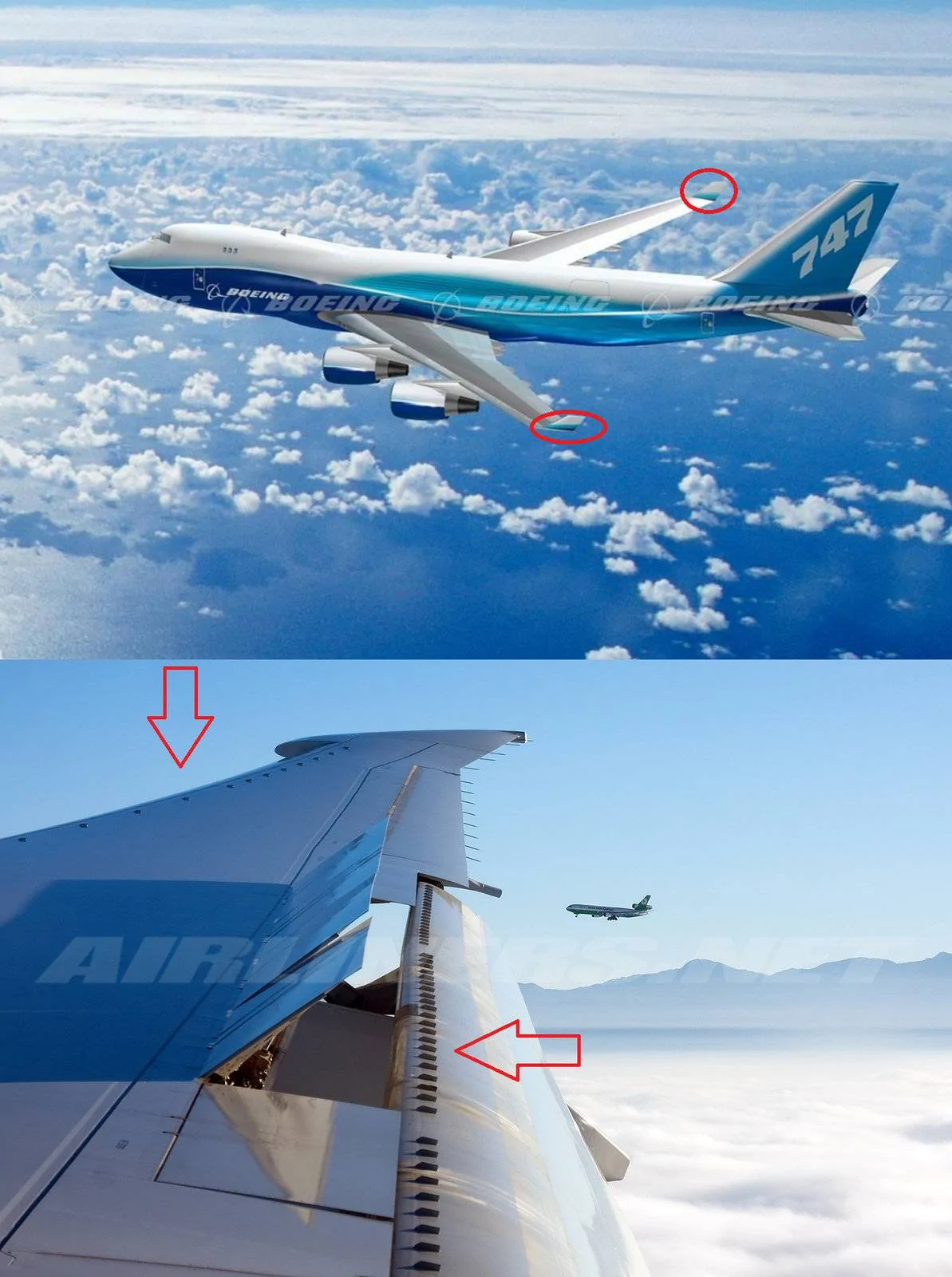
From the airplane world:

The winglets on the 747 (top) probably provide about a 2%-3% total drag reduction to the airplane. That is a huge cost savings for airliners (or would be if they were operating...)

The bumps on the 777 wing (bottom) are vortex generators. The ones on the leading edge allow the plane to pitch to higher angles and still be controllable. The ones on the flap help make the flap functional. Both do so by creating turbulence. Turbulent flow has more energy than laminar flow, and this allows it to remain attached to the wing/flap surface longer against the adverse pressure gradient from the trailing edges. Turbulence isn't always bad.


Ford Mustang Mach-E Rear Spoiler - functional or aesthetic? 747777
 

frinesi2

Well-Known Member
Joined
Nov 18, 2019
Threads
1
Messages
51
Reaction score
66
Location
MD
Vehicles
'15 Golf TDI, '96/97 ZJ 4.0L, '92 Pajero 2.5TD
Country flag
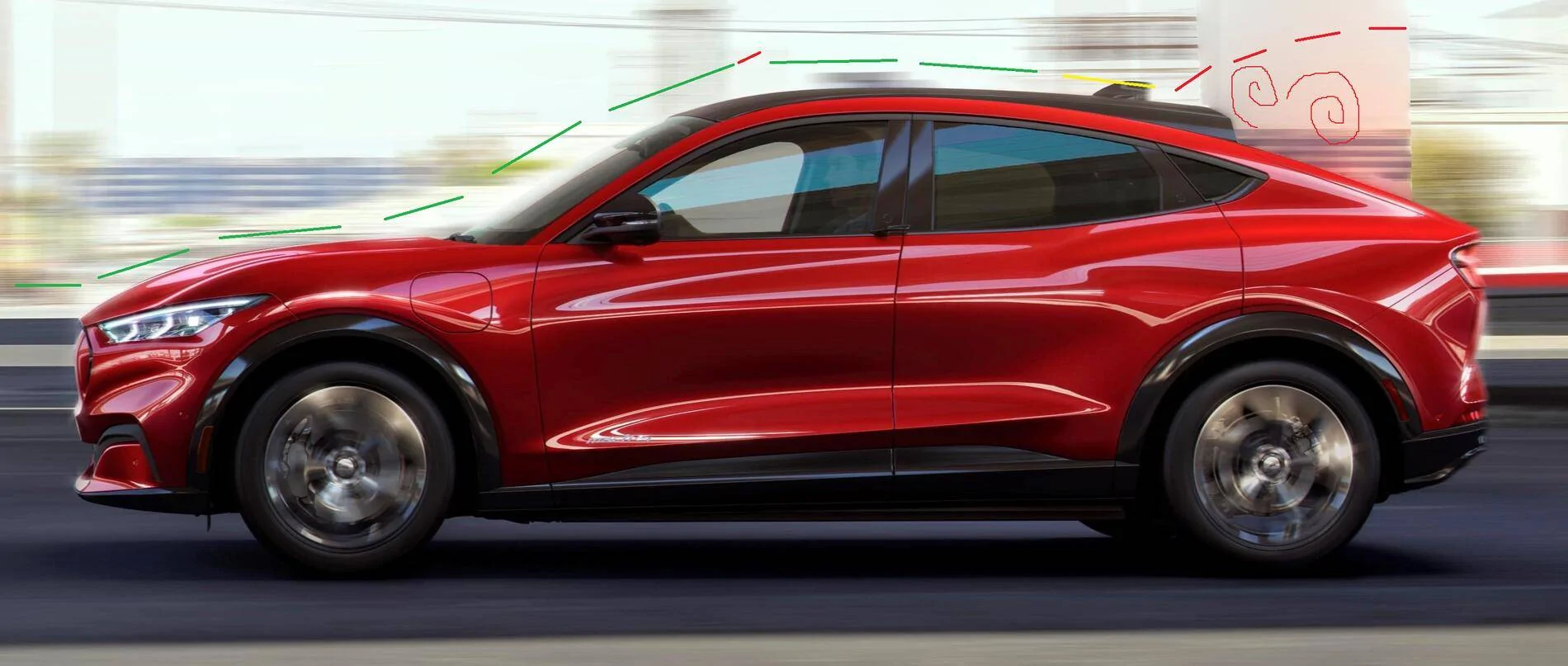
From my armchair aerodynamicist's perspective, the Mach E's rear spoilers (roof and sides) are both functional AND aesthetic.

Functionally, the roof spoiler probably helps reduce lift a little bit at the rear by preventing too much air flow turning downwards, in conjunction with what looks like a diffuser which will direct some air upwards and create a bit of a low pressure zone under the rear of the car. Unlikely that the combination are generating any real down force, but they'll probably help keep the car stable at speed. You could add a gurney flap (see Tesla's Nurburgring Model S) to start netting downforce.

Also functionally they'll help direct the airflow to create a smaller wake to reduce drag - the rear glass meets the roofline at a sharp angle which could cause flow separation too early which would mean a large wake and higher drag. The rotation causes by the air tumbling over the edges of the roof and side spoilers will also help with that wake reduction.

Aesthetically, they look cool.

Personally I would prefer a much more vertical rear glass because I think the new trend of almost-fastback hatches to be pretty ugly and removes the point of having a hatchback, but the spoilers on the Mach E kind of cover that up enough to make it look acceptable.

Do'h! Noted.


For those who haven't studied fluid flow extensively, it's easy to intuitively dismiss the impact of minor features. Reading up on Formula 1 rule changes can be enlightening, as they often follow aero innovations that make one team dominant.

From the airplane world:

The winglets on the 747 (top) probably provide about a 2%-3% total drag reduction to the airplane. That is a huge cost savings for airliners (or would be if they were operating...)

The bumps on the 777 wing (bottom) are vortex generators. The ones on the leading edge allow the plane to pitch to higher angles and still be controllable. The ones on the flap help make the flap functional. Both do so by creating turbulence. Turbulent flow has more energy than laminar flow, and this allows it to remain attached to the wing/flap surface longer against the adverse pressure gradient from the trailing edges. Turbulence isn't always bad.


747777.jpg
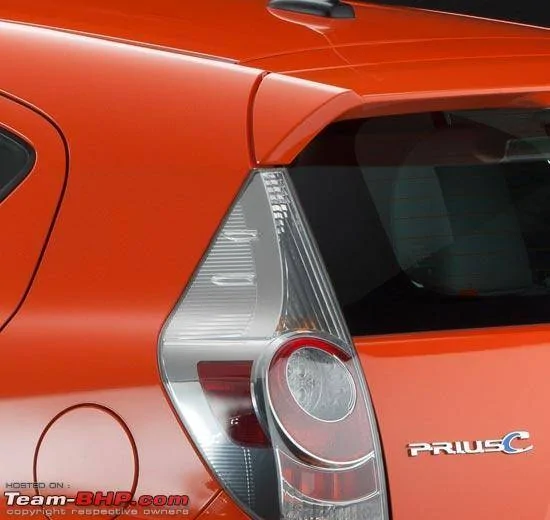
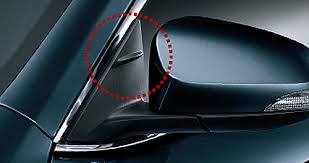
Fun fact - if you look at modern cars, especially Toyotas and most especially the Prius family, you'll see all sorts of little vortex generators around the mirrors and molded in to the tail light lenses and a few other places. Here's some random examples:

Ford Mustang Mach-E Rear Spoiler - functional or aesthetic? priuscvg

Ford Mustang Mach-E Rear Spoiler - functional or aesthetic? download
 

EVer

Well-Known Member
Joined
Apr 21, 2020
Threads
0
Messages
455
Reaction score
456
Location
San Diego, CA
Vehicles
Ford F-150 SuperCrew Cab, Tesla Model 3P
Country flag
Also functionally they'll help direct the airflow to create a smaller wake to reduce drag - the rear glass meets the roofline at a sharp angle which could cause flow separation too early which would mean a large wake and higher drag.
Agreed. This is what I meant in post #10.

If they didn't add the spoiler, the flow would separate somewhere ahead of the sudden joggle from the roofline to the rear hatch. The alternative would be a lower roof line.

Artist's representation of large wake which = additional drag:

Ford Mustang Mach-E Rear Spoiler - functional or aesthetic? Untitled


EVer

Well-Known Member
Joined
Apr 21, 2020
Threads
0
Messages
455
Reaction score
456
Location
San Diego, CA
Vehicles
Ford F-150 SuperCrew Cab, Tesla Model 3P
Country flag
Spoiling is not equivalent to creating drag to get downward "pressure" for traction. Spoiling means spoiling. It could result in decreased lift. It could result in decreased downforce. It could result in decreased or increased drag.

In the case of the Mach E, the intent, clearly, is not to generate downforc - its geometry is entirely incorrect for that application. The intent, clearly, is to decrease drag by better controlling the wake; and probably to reduce lift (which, one should note, is not the same as creating downforce). "Aerodynamics" is just a term for the study of air in motion. Drag is an aerodynamic force. Spoiling drag is the intent of this application.

Do everyone a favor and read something rather than drawing conclusions which do not follow from your interpretation of language

https://www.sae.org/publications/technical-papers/content/2006-01-1631/

If you don't want to pay for it, here is a master thesis which includes CFD simulation on a body with and without spoilers. Spoiler alert! The drag coefficient decreased with the application of the spoiler. https://scholarcommons.scu.edu/cgi/viewcontent.cgi?article=1000&context=mech_mstr


[Yes, I know I was warned that I'm conversing with the site troll, but since this is an interesting topic I'll continue, hoping well meaning members participate]
 
Last edited:

eager2own

Well-Known Member
Joined
Dec 16, 2019
Threads
5
Messages
720
Reaction score
983
Location
Southlake, TX
Vehicles
2015 Porsche Panamera S e-Hybrid
Country flag
[Yes, I know I was warned that I'm conversing with the site troll, but since this is an interesting topic I'll continue, hoping well meaning members participate]
It’s no use. He’ll just continue to repeat the same incorrect statements as facts — such as “spoilers, by definition, create drag.”
I would say that wings generally are designed to provide downforce at the expense of additional drag.

However, as you point out and showed earlier with your illustration, spoilers “spoil” airflow for various reasons, and not always to create drag. Cars with steep breaks in roofline have airflow separation that creates turbulence, a low pressure zone and, therefore, significant drag (it’s not good to have low pressure behind the car). Therefore a spoiler that extends the roofline and “spoils” the airflow that would otherwise create the turbulence may reduce drag.
 

ChasingCoral

Well-Known Member
First Name
Mark
Joined
Feb 3, 2020
Threads
502
Messages
14,306
Reaction score
28,653
Location
Maryland
Vehicles
2021 GB E4X FE, 2022 F-150 Lightning Lariat ER
Occupation
Retired oceanographer
Country flag
Spoiling is not equivalent to creating drag to get downward "pressure" for traction. Spoiling means spoiling. It could result in decreased lift. It could result in decreased downforce. It could result in decreased or increased drag.

In the case of the Mach E, the intent, clearly, is not to generate downforc - its geometry is entirely incorrect for that application. The intent, clearly, is to decrease drag by better controlling the wake; and probably to reduce lift (which, one should note, is not the same as creating downforce). "Aerodynamics" is just a term for the study of air in motion. Drag is an aerodynamic force. Spoiling drag is the intent of this application.

Do everyone a favor and read something rather than drawing conclusions which do not follow from your interpretation of language

https://www.sae.org/publications/technical-papers/content/2006-01-1631/

If you don't want to pay for it, here is a master thesis which includes CFD simulation on a body with and without spoilers. Spoiler alert! The drag coefficient decreased with the application of the spoiler. https://scholarcommons.scu.edu/cgi/viewcontent.cgi?article=1000&context=mech_mstr


[Yes, I know I was warned that I'm conversing with the site troll, but since this is an interesting topic I'll continue, hoping well meaning members participate]
Keep it up. This is really good information on auto aerodynamics I've often wondered about.
 

ChasingCoral

Well-Known Member
First Name
Mark
Joined
Feb 3, 2020
Threads
502
Messages
14,306
Reaction score
28,653
Location
Maryland
Vehicles
2021 GB E4X FE, 2022 F-150 Lightning Lariat ER
Occupation
Retired oceanographer
Country flag
Fun fact - if you look at modern cars, especially Toyotas and most especially the Prius family, you'll see all sorts of little vortex generators around the mirrors and molded in to the tail light lenses and a few other places. Here's some random examples:

priuscvg.jpg

download.jpg
I had no idea there were so many of these little vortex generators. That's pretty amazing. I'm used to seeing the big ones on rooflines but didn't realize that's what some of these small features do.
 

EVer

Well-Known Member
Joined
Apr 21, 2020
Threads
0
Messages
455
Reaction score
456
Location
San Diego, CA
Vehicles
Ford F-150 SuperCrew Cab, Tesla Model 3P
Country flag
Keep it up. This is really good information on auto aerodynamics I've often wondered about.
Full disclosure, while my education is aerospace (not automotive) engineering, I haven't really done much in the way of applied aerodynamics since college. My abity to evaulate boundary layer math is dust in the wind, however I still have the fundamentals straight enough to make educated guesses.

Here's another paper focused on reducing lift on a hatchback with a rear deck spoiler. https://www.matec-conferences.org/articles/matecconf/pdf/2017/04/matecconf_aigev2017_01027.pdf

It concludes that both drag and lift can be reduced, although to achieve the greatest reduction in lift resulted in some drag penalty.

The mach-e's to my eye looks more focused on drag, but it's a qualitative assessment.
 

frinesi2

Well-Known Member
Joined
Nov 18, 2019
Threads
1
Messages
51
Reaction score
66
Location
MD
Vehicles
'15 Golf TDI, '96/97 ZJ 4.0L, '92 Pajero 2.5TD
Country flag
Spoilers with positive angle will direct air flow upwards to reduce lift and maybe net downforce depending on the setup, at the penalty of a larger wake resulting in higher drag. For example, the spoiler on Lightning McQueen. Another example would be Porsche's deployable decklid spoiler.

Spoilers with a neutral or even a negative angle are intended to reduce the wake size to reduce drag, at the penalty of rear downforce generation. For example, the oval setup on Indy cars. Another example would be the Mach E's rear spoilers. Most of the "roof mounted spoilers" you see on hatchbacks and SUVs are neutral or negative angle.

(I realize earlier I said the Mach E's spoiler might help reduce lift but upon further review it's more likely to have a neutral effect or even cause lift - but there is plenty of mass over the rear wheels so that's probably a non-issue dynamically.)

Ford could have had a substantially more vertical rear glass and still had the same drag coefficient with proper spoiler implementation. Look at the Mercedes Bionic Concept.

Also I was under the impression that the sloping upper styling line is more to mimic the mustang coupe's lines, and the black painted roof and spoiler are to allow for more head room without interfering with that styling line. Do you have a link to the specific video you're referencing? Either way, the spoiler will help reduce the drag penalty of that change in the roofline.

A few other points - turbulence does not equal drag. High pressure in front of you and low pressure behind you equals drag. Also, there's a different between turbulence and vorticity. Vorticity can reduce drag by keeping laminar flow going beyond the end of the aerodynamic surface. That's what Gurney flaps do (at minimal drag penalty), for example. Also negative angle roof spoilers on hatchbacks.

Lastly, you can make aerodynamics "start to work" at any speed you want based on how they're designed. There is not magic number where spoilers "work".
 

dbsb3233

Well-Known Member
First Name
TimCO
Joined
Dec 30, 2019
Threads
56
Messages
10,100
Reaction score
11,965
Location
Colorado, USA
Vehicles
2021 Mustang Mach-E FE, 2025 Porche Macan Electric
Occupation
Retired
Country flag
Can't help but to notice that the Teslas have skipped the rear spoilers which is what got me wondering.

*Looks like small spoiler for the X
A spoiler would ruin the curved roof that make Tesla's look like a Prius (or a stretched out VW Beetle). :cool:

Which as you can probably tell, I'm not a fan of. The spoilers that extend the roof line on most Fords and many other automakers' SUVs/CUVs make the vehicle look like it has a taller (and boxier) back end. Thus making it look more like an SUV/CUV than a basic hatchback. It's one of the things that I like about the Mach-e. If it just had the low-sloping roof curve like a Tesla (without the black bump and the spoiler), I'd probably pass on it.
Sponsored


Top