Regen levels for BEV vehicles

RonTCat

Well-Known Member
First Name
Ron
Joined
Jul 21, 2020
Threads
27
Messages
1,137
Reaction score
2,982
Location
USA
Vehicles
Mach-E wannabuy
Country flag
Does anyone have a good source for the estimated regen levels for various BEV vehicles? Something like max power absorption, or typical recovery percentage for city driving, etc.

When I think of braking as a whole, the front wheels do the majority of the braking. If you don't have the drivetrain connected to the front wheels, like in a RWD only vehicle, you lose the majority of your regen energy opportunity, especially in any conditions other than light braking.
Sponsored


 

macchiaz-o

Well-Known Member
First Name
Jonathan
Joined
Nov 25, 2019
Threads
171
Messages
8,580
Reaction score
15,988
Location
}not/A/gr8'Place.2.store-mEyePassword{
Vehicles
MY21 J1 Premium RWD SR
Country flag
Does anyone have a good source for the estimated regen levels for various BEV vehicles? Something like max power absorption, or typical recovery percentage for city driving, etc.

When I think of braking as a whole, the front wheels do the majority of the braking. If you don't have the drivetrain connected to the front wheels, like in a RWD only vehicle, you lose the majority of your regen energy opportunity, especially in any conditions other than light braking.
If the rear wheels are spinning and they aren't being supplied power by the battery, then they are spinning the motor that they are coaxial with.

Now the motor is a generator. The electrical power it generates can be converted from AC to DC and harvested back to the battery.

So I don't think the position of the motor is important here, assuming front and rear wheels are both connected to the ground and spinning the same.
 
Last edited:

JamieGeek

Well-Known Member
Joined
Dec 29, 2019
Threads
82
Messages
3,589
Reaction score
6,823
Location
Southeastern Michigan
Website
spareelectrons.wordpress.com
Vehicles
Escape PHEV, old: Mach-E, Bolt, C-Max Energi, Focus Electric
Country flag
If the rear wheels are spinning and they are being supplied power by the battery, then they are spinning the motor that they are coaxial with.

Now the motor is a generator. The electrical power it generates can be converted from AC to DC and harvested back to the battery.

So I don't think the position of the motor is important here, assuming front and rear wheels are both connected to the ground and spinning the same.
That is true if the car is soley regenerating then, in that instance, the only thing stopping the car is the drive wheels.
 

pt19713

Well-Known Member
Joined
Nov 16, 2020
Threads
0
Messages
524
Reaction score
496
Location
.
Vehicles
.
Country flag
Does anyone have a good source for the estimated regen levels for various BEV vehicles? Something like max power absorption, or typical recovery percentage for city driving, etc.
This one could be tough because there are people that do a lot of highway, some that do mostly city, others that do mixed.

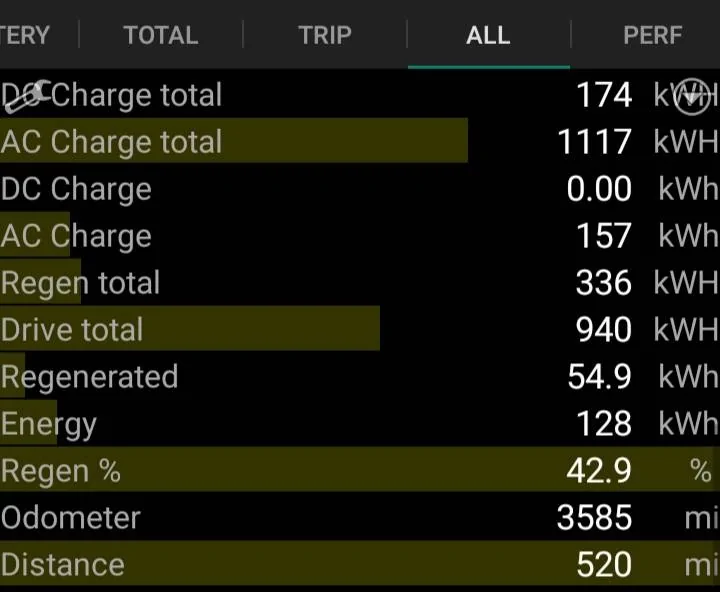
I don't know if other vehicles provide brake regen info but Teslas do not. In the Tesla, additional hardware to tap into the CAN bus is needed and an app is to display the data. That being said, here's a screenshot of my Model Y.

You can see the info over the last 520 miles, along with the 3585 miles. Over the last 520 miles, I've consumed 128 kWh, brake regen back 54.9 kWh, or 42.9%. This is approximately 160 highway miles, 360 city/mixed miles. The Y caps at 75 kW regen and with colder temps coming, there usually some limitations even with 15 minutes of pre-conditioning. I generally have my brake regen limited to 60 kW in the morning.

Ford Mustang Mach-E Regen levels for BEV vehicles 20201124_100554
Sponsored


Top