
Zoticuss
Active Member
- Joined
- Feb 19, 2026
- Threads
- 6
- Messages
- 27
- Reaction score
- 40
- Location
- British Columbia
- Website
- www.InnerPaths.ca
- Vehicles
- 2021 Mach-e Premium AWD
- Occupation
- Therapist
- Thread starter
- #1
I recently completed a round trip in my 2021 Mach-E Premium Standard Range AWD and thought I’d share the experience for anyone curious about winter highway performance, charging, and BlueCruise.
Trip details
My first leg was to Kamloops, about 130 km (80.7 miles), where I picked up my girlfriend. I then did a top-up to 80% at On The Run for $9.72. Where I saw a Charger Daytona, it looked real pretty ^_^.
From there, I drove to Merritt, about 98 km (61 miles), arriving with approximately 29% battery remaining. I charged at BC Hydro to 80%, which took about 40 minutes and cost $11.45.
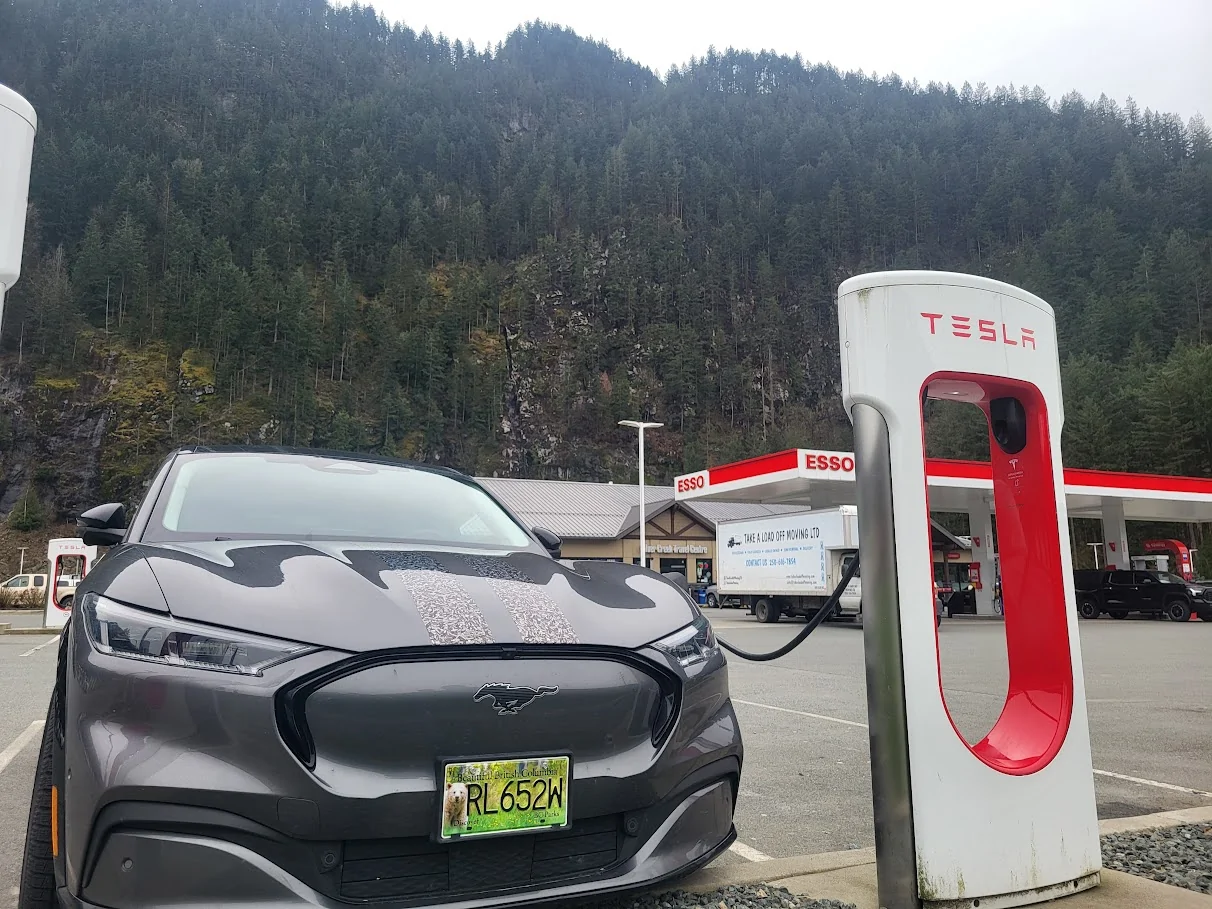
The next stop was Hope, about 120 km (75 miles) later, where I arrived with around 22% remaining. My girlfriend admitted she hit 130 km/h a few times without really noticing because the Mach-E is so smooth at speed . At Hope, the BC Hydro charger kept throwing an internal failure error, even after trying different stalls. At that point, I gave up and moved over to Tesla using an adapter. It actually ended up being cheaper than the Tesla charger in Vernon, where I had first tested the adapter. Since I had already set up my credit card through the BlueOval Charge Network, it started automatically, which was a huge relief and confirmed that there was nothing wrong with the car’s charge port. That session took about 35–40 minutes, charging to 80% for $11.49.
From Hope, it was roughly 170 km (105 miles) to the west coast/Vancouver area, where I arrived with about 24% remaining. My hotel had free Level 2 charging included with the parking pass, so I charged back to 100% overnight and left the next day with a conditioned battery.
The return trip followed a very similar route, with roughly the same km/miles and similar battery percentages on arrival.
Weather and cabin comfort
During the drive, I encountered about 3 hours of heavy snow. The radar became obstructed only once, and only for a few seconds, before clearing up and not causing any further issue.
Cabin temperature was typically kept between 21.5°C and 23°C (70°F–73°F).
The heated steering wheel was used on and off; no heated seats were needed.
The on-screen energy breakdown generally showed:
I also tested BlueCruise on the trip. The map showed that from Kamloops onward, roughly 90% of the route would be covered. There were a few spots where it would disengage for a few seconds, even on some straight stretches. I also turned off predictive speed assist.
Overall, it handled quite nicely, and the lane change assist was surprisingly smooth. I had unlocked that feature using FORScan.
That said, after using it, I’d still rather put my money toward Comma.ai than continue paying for BlueCruise. My girlfriend didn’t really like either BlueCruise or lane keeping and preferred to drive manually, though she did say the Mach-E was a very enjoyable ride.
Return charging costs
Final thoughts
For a winter trip in a standard range 2021 Mach-E Premium, doing legal highway speeds in temperatures averaging around 2°C and dipping to -5°C, I thought it performed quite well. Charging times were manageable, the cabin stayed comfortable, and even with snow and cold, the trip was straightforward overall. The one real inconvenience was the failed BC Hydro experience in Hope, but having the Tesla adapter and BlueOval setup saved the day.

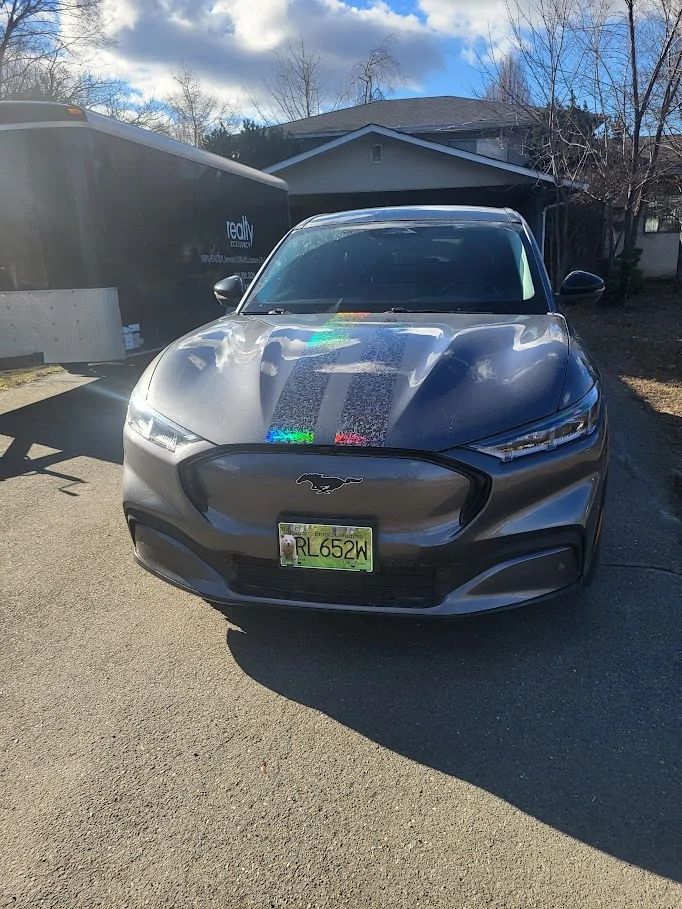
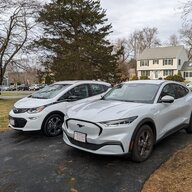
I'm not sold on the stripes; I think they are too thin and far from one another. I'm thinking thicker next time and with carbon fiber vinyl instead of forged carbon... in the end, I may just keep it stripe-free, I know it can be a polarizing topic

Trip details
- Total distance: 1,036 km (643.74 miles)
- Paid charging stops: 5 for round-trip charging sessions
- Highway speeds: Legal highway speeds, typically around 120 km/h (75 mph)
- Average temperature: 2°C
- Coldest temperature: -5°C
My first leg was to Kamloops, about 130 km (80.7 miles), where I picked up my girlfriend. I then did a top-up to 80% at On The Run for $9.72. Where I saw a Charger Daytona, it looked real pretty ^_^.
From there, I drove to Merritt, about 98 km (61 miles), arriving with approximately 29% battery remaining. I charged at BC Hydro to 80%, which took about 40 minutes and cost $11.45.
The next stop was Hope, about 120 km (75 miles) later, where I arrived with around 22% remaining. My girlfriend admitted she hit 130 km/h a few times without really noticing because the Mach-E is so smooth at speed
. At Hope, the BC Hydro charger kept throwing an internal failure error, even after trying different stalls. At that point, I gave up and moved over to Tesla using an adapter. It actually ended up being cheaper than the Tesla charger in Vernon, where I had first tested the adapter. Since I had already set up my credit card through the BlueOval Charge Network, it started automatically, which was a huge relief and confirmed that there was nothing wrong with the car’s charge port. That session took about 35–40 minutes, charging to 80% for $11.49.From Hope, it was roughly 170 km (105 miles) to the west coast/Vancouver area, where I arrived with about 24% remaining. My hotel had free Level 2 charging included with the parking pass, so I charged back to 100% overnight and left the next day with a conditioned battery.
The return trip followed a very similar route, with roughly the same km/miles and similar battery percentages on arrival.
Weather and cabin comfort
During the drive, I encountered about 3 hours of heavy snow. The radar became obstructed only once, and only for a few seconds, before clearing up and not causing any further issue.
Cabin temperature was typically kept between 21.5°C and 23°C (70°F–73°F).
The heated steering wheel was used on and off; no heated seats were needed.
The on-screen energy breakdown generally showed:
- Driving: about 7–10%
- Accessories: about 5%
- Exterior temperature impact: about 9–10%
I also tested BlueCruise on the trip. The map showed that from Kamloops onward, roughly 90% of the route would be covered. There were a few spots where it would disengage for a few seconds, even on some straight stretches. I also turned off predictive speed assist.
Overall, it handled quite nicely, and the lane change assist was surprisingly smooth. I had unlocked that feature using FORScan.
That said, after using it, I’d still rather put my money toward Comma.ai than continue paying for BlueCruise. My girlfriend didn’t really like either BlueCruise or lane keeping and preferred to drive manually, though she did say the Mach-E was a very enjoyable ride.
Return charging costs
- Hope – Tesla: $9.80, about 35 minutes,35% charged to 80%
- Merritt: $14.97, about 45 minutes, 22% charged to 80%
- Kamloops: Arrived with approx 23%, used Level 1 charging for 2 days, returned to 76%
- Vernon: Arrived home with approx 24% remaining
Final thoughts
For a winter trip in a standard range 2021 Mach-E Premium, doing legal highway speeds in temperatures averaging around 2°C and dipping to -5°C, I thought it performed quite well. Charging times were manageable, the cabin stayed comfortable, and even with snow and cold, the trip was straightforward overall. The one real inconvenience was the failed BC Hydro experience in Hope, but having the Tesla adapter and BlueOval setup saved the day.
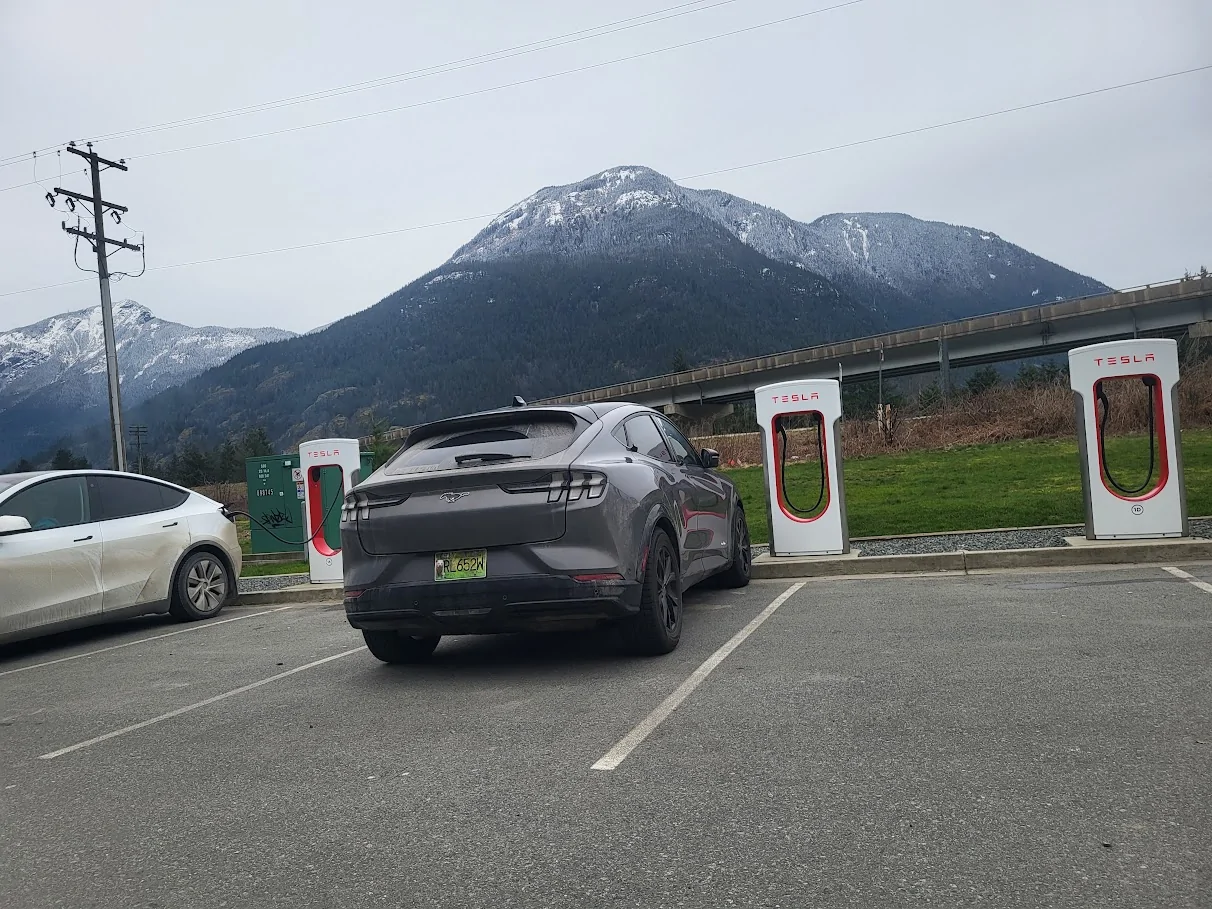
I'm not sold on the stripes; I think they are too thin and far from one another. I'm thinking thicker next time and with carbon fiber vinyl instead of forged carbon... in the end, I may just keep it stripe-free, I know it can be a polarizing topic
Sponsored
Last edited:


 That BC Hydro in downtown Merritt is next to Kekuli Cafe which is indigenous "tacos" (not really tacos, but, you know, a fusion on indigenous cuisine) and bannock, among other things. It's not a particularly fast BC Hydro charger (unless they've upgraded it recently) but I always go there for the food. There's a tiny little "folk museum" and junk trinket antique store there too, so a good stop.


