
State of Charge When Arriving at Charging Station

cyeung

Well-Known Member
Joined
Oct 28, 2024
Threads
9
Messages
129
Reaction score
244
Location
Atlanta, GA
Vehicles
2025 Mustang Mach-E Premium
It recently dawned on me: Why do our route planner apps (I've tried Tesla and Ford's) typically plan to have us at charging stations when the car is at single-digit states of charge? This is very much unlike gas vehicles where the low fuel light comes on when there is approximately two gallons of fuel (typically 50 miles) of fuel left. When that light comes on, that is our cue to get to a gas station ASAP. Why not have the same amount of buffer?

Context: One of my good friends recently made the switch from gas to electric and bought a Tesla. She went from Atlanta to New York on a road trip. When she got back, she talked about all the times she got nervous about having enough range left or pulling into a charging station with little range left.
Sponsored
 

RickMachE

Well-Known Member
Joined
Jul 1, 2021
Threads
267
Messages
17,960
Reaction score
28,000
Location
SE MI
Vehicles
2022 Mach-E Premium 4X, 2022 Lightning Lariat ER
Country flag
You can set the level of minimum charge. Your friend didn't know to do that.

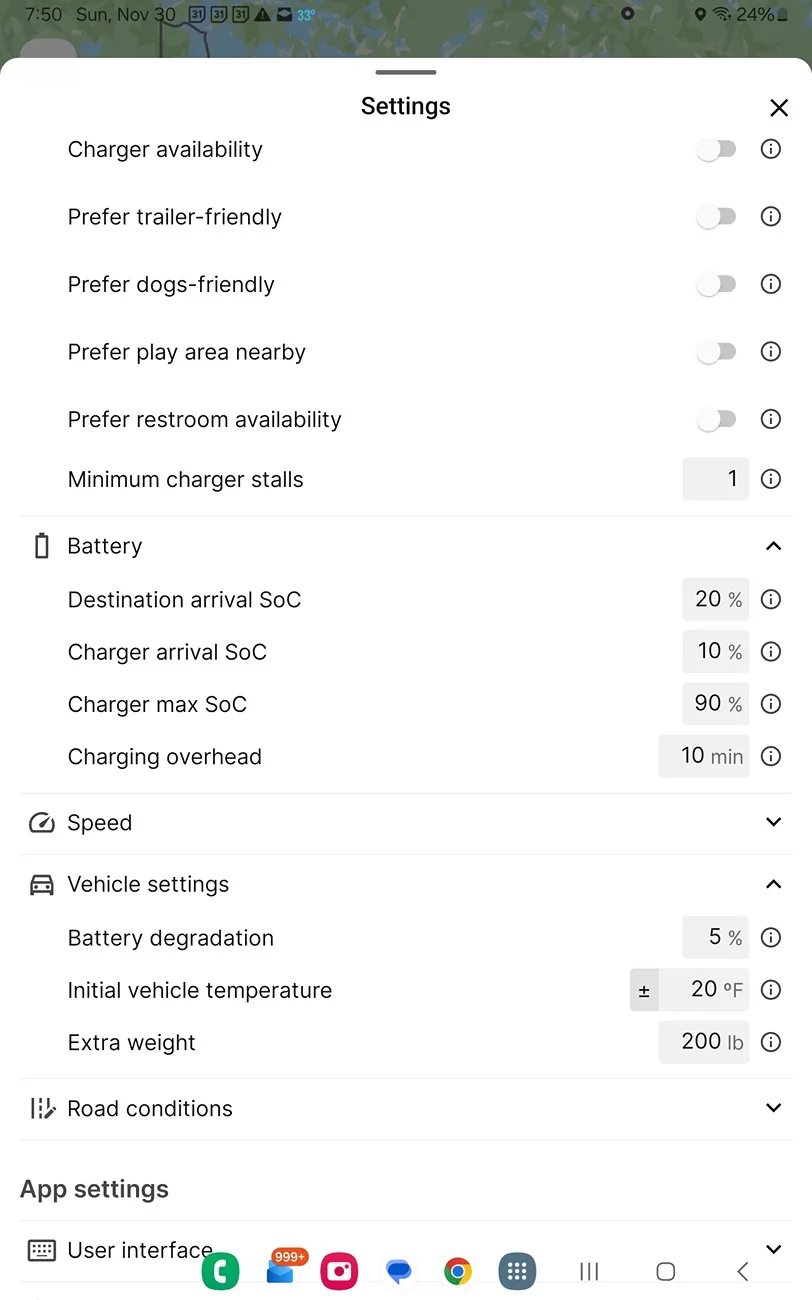
ABRP:

Ford Mustang Mach-E State of Charge When Arriving at Charging Station 1000006705
 

E90alex

Well-Known Member
Joined
Feb 17, 2025
Threads
3
Messages
1,024
Reaction score
1,839
Location
Seattle, WA
Vehicles
ā€˜25 MME GT
The car charges the fastest when the battery is almost empty.

You already have the charger set as the destination and the route planner already takes into account the distance, speed, elevation changes, current energy consumption, sometimes even weather and head or tail winds. It’s usually very accurate. Is not like gas where the light comes on and THEN you start thinking about where you want to stop so you need more of a buffer.

Also with an EV, a 50 mile buffer would be like 20-25% of the battery. That’s not practical or time efficient to stop and charge with that much battery left while on a trip.
 

celestial_knight

Well-Known Member
Joined
Sep 28, 2025
Threads
0
Messages
171
Reaction score
146
Location
United States
Vehicles
ā€˜25 Mach E GT
For best battery longevity as well don’t let it get below ~25 to 20 % soc (state of charge). Going above 80% as well is extremely harsh on the battery

However, there is a tradeoff between your time and the battery’s health; your life is far more important. Going to more charging stations of course spends more time

I’ve found though that unless I’m going on road trips, if I have regular access to L2 AC, I don’t spend any more time DC fast charging / getting to a fast charger than I would filling up at a gas station each week, even factoring in the occasional 1 hour, 1 and a half hour drive

The secret is to never charge to 100, only DC fast charge from ~30 to 40 or 50. This is 5 to 10 minutes charging. This protects the battery and saves time.

In general, only blast to 80 on home L2 AC shortly before an ~hour one way trip (make sure to set departure time so if it’s still plugged in it can precondition), otherwise keep the resting soc closer to 60 for battery health

If at 60 you suddenly decide to go on a longer trip, DC fast charging from 30 to 40ish is quick, and relatively light on the battery. Try to precondition by navigating to the charger with the in built Ford navigation if you’ve been driving hard. You don’t want to fast charge with a hot battery

Treating your battery well will maintain significantly more capacity if you plan on enjoying the car many years down the line. Personally, I do intend to upgrade to a car with even more advanced ADAS in a few years
 
Last edited:

AZBill

Well-Known Member
First Name
Bill
Joined
May 26, 2021
Threads
12
Messages
2,001
Reaction score
2,328
Location
Arizona
Vehicles
MME CA Route 1, Hummer EV SUT, Escalade IQ
Occupation
Retired
Country flag
I paid for 100% of my battery and I use it that way. Personally I have no problem running the battery down to a low percent on trips. It depends entirely on where the most logical charging stop is, I like to go as far as possible. On my last trip I ran it down to 16% each way for my charging stops, but am willing to go lower. I usually do not fast charge to more than 60%, unless we are eating at the stop. The car tells you how much you need to get to the next charger or destination.


RickMachE

Well-Known Member
Joined
Jul 1, 2021
Threads
267
Messages
17,960
Reaction score
28,000
Location
SE MI
Vehicles
2022 Mach-E Premium 4X, 2022 Lightning Lariat ER
Country flag
For best battery longevity as well don’t let it get below ~25 to 20 % soc (state of charge). Going above 80% as well is extremely harsh on the battery

However, there is a tradeoff between your time and the battery’s health; your life is far more important. Going to more charging stations of course spends more time

I’ve found though that unless I’m going on road trips, if I have regular access to L2 AC, I don’t spend any more time DC fast charging / getting to a fast charger than I would filling up at a gas station each week, even factoring in the occasional 1 hour, 1 and a half hour drive

The secret is to never charge to 100, only DC fast charge from ~30 to 40 or 50. This is 5 to 10 minutes charging. This protects the battery and saves time.

In general, only blast to 80 on home L2 AC shortly before an ~hour one way trip (make sure to set departure time so if it’s still plugged in it can precondition), otherwise keep the resting soc closer to 60 for battery health

If at 60 you suddenly decide to go on a longer trip, DC fast charging from 30 to 40ish is quick, and relatively light on the battery. Try to precondition by navigating to the charger with the in built Ford navigation if you’ve been driving hard. You don’t want to fast charge with a hot battery

Treating your battery well will maintain significantly more capacity if you plan on enjoying the car many years down the line. Personally, I do intend to upgrade to a car with even more advanced ADAS in a few years
I saw that and had to laugh. Where is it that you travel that a) a fast charging stop is 5 to 10 minutes? and b) show me where it says that you shouldn't go below 30 or 40 or 50%.

To get off the highway and get to the fast charger is often 5 minutes. That's 10 minutes just for the on/off.

I let ABRP plan my trip, and don't charge until I need to, and then usually to 80%.
 
OP
OP
cyeung

cyeung

Well-Known Member
Joined
Oct 28, 2024
Threads
9
Messages
129
Reaction score
244
Location
Atlanta, GA
Vehicles
2025 Mustang Mach-E Premium
The reason planning to arrive at a charging station with such a low state of charge is for contingencies like an inoperative charging station. I would want some range to move on or backtrack to one that works.
 

profdraper

Well-Known Member
First Name
Paul
Joined
Jul 10, 2024
Threads
2
Messages
114
Reaction score
85
Location
Brisbane, Australia
Vehicles
2023 Mach-e Select
Country flag
For best battery longevity as well don’t let it get below ~25 to 20 % soc (state of charge). Going above 80% as well is extremely harsh on the battery

However, there is a tradeoff between your time and the battery’s health; your life is far more important. Going to more charging stations of course spends more time

I’ve found though that unless I’m going on road trips, if I have regular access to L2 AC, I don’t spend any more time DC fast charging / getting to a fast charger than I would filling up at a gas station each week, even factoring in the occasional 1 hour, 1 and a half hour drive

The secret is to never charge to 100, only DC fast charge from ~30 to 40 or 50. This is 5 to 10 minutes charging. This protects the battery and saves time.

In general, only blast to 80 on home L2 AC shortly before an ~hour one way trip (make sure to set departure time so if it’s still plugged in it can precondition), otherwise keep the resting soc closer to 60 for battery health

If at 60 you suddenly decide to go on a longer trip, DC fast charging from 30 to 40ish is quick, and relatively light on the battery. Try to precondition by navigating to the charger with the in built Ford navigation if you’ve been driving hard. You don’t want to fast charge with a hot battery

Treating your battery well will maintain significantly more capacity if you plan on enjoying the car many years down the line. Personally, I do intend to upgrade to a car with even more advanced ADAS in a few years
These comments assume there is only one kind of battery chemistry in the Mach-E - incorrect. LFP is used in the Select and best case usage is nothing like you describe here for NMC battery chemistry.

Personally, after having owned both NMC & LFP batteries in EVs over the years, I would never go back to NMC. LFP only & just ike say, the entire BYD range.
 

E90alex

Well-Known Member
Joined
Feb 17, 2025
Threads
3
Messages
1,024
Reaction score
1,839
Location
Seattle, WA
Vehicles
ā€˜25 MME GT
For best battery longevity as well don’t let it get below ~25 to 20 % soc (state of charge). Going above 80% as well is extremely harsh on the battery

However, there is a tradeoff between your time and the battery’s health; your life is far more important. Going to more charging stations of course spends more time

I’ve found though that unless I’m going on road trips, if I have regular access to L2 AC, I don’t spend any more time DC fast charging / getting to a fast charger than I would filling up at a gas station each week, even factoring in the occasional 1 hour, 1 and a half hour drive

The secret is to never charge to 100, only DC fast charge from ~30 to 40 or 50. This is 5 to 10 minutes charging. This protects the battery and saves time.

In general, only blast to 80 on home L2 AC shortly before an ~hour one way trip (make sure to set departure time so if it’s still plugged in it can precondition), otherwise keep the resting soc closer to 60 for battery health

If at 60 you suddenly decide to go on a longer trip, DC fast charging from 30 to 40ish is quick, and relatively light on the battery. Try to precondition by navigating to the charger with the in built Ford navigation if you’ve been driving hard. You don’t want to fast charge with a hot battery

Treating your battery well will maintain significantly more capacity if you plan on enjoying the car many years down the line. Personally, I do intend to upgrade to a car with even more advanced ADAS in a few years
Absolutely do not follow this advice unless you want a 5 hour road trip to turn into 10 hours.

In general, yes charging to a lower level is slightly better for long term battery health, but only if it’s practical for your use case and no need to take it to the extreme especially on a trip. I normally only charge to 60% for daily use but will not hesitate to charge to 100% or run it down to single digits if needed.

There is no harm in going low in the battery at all. There is zero evidence of this borne out in any testing. You just don’t want to run it until it’s completely dead, but the computer wont ever let that happen and Ford leaves a bottom buffer so 0% is not truly 0% at the cell level.

Nor is there any harm going high in the battery eg 100% if you need it. It’s only bad to charge to 100% and then leave it sitting there at home and depart for a long trip. But even then Ford also leaves a top buffer so 100% is not truly 100%.

You own the car, the car doesn’t own you. Use it in the way that is most convenient for you.
 
Last edited:

Tampamike

Well-Known Member
First Name
Mike
Joined
Feb 19, 2021
Threads
25
Messages
2,076
Reaction score
2,814
Location
Tampa, FL
Vehicles
ā€˜24 Mach E Premium RWD
Country flag
Mike’s rule of thumb - unless you’re next stop is home (low cost/kw) or a hotel with free charging, charge to 80% while attached to a working DCFC whose price you like. You need x amount of kw’s to make it to your destination and back home. You can charge 20-30% and make 6 stops or 40-60% and make three stops. You won’t be saving any time if the next stop has a line or there are broken chargers. I also don’t think you’re saving time with many short stops because of the time burned getting on and off the highway twice as many times. YMMV, literally, but that’s what I do, unless I just need to stop for some other reason.
 

Mach-Lee

Well-Known Member
First Name
Lee
Joined
Jul 16, 2021
Threads
262
Messages
11,382
Reaction score
25,072
Location
Wisconsin
Vehicles
2022 Mach-E Premium AWD
Occupation
Sci/Eng
Country flag
The reason planning to arrive at a charging station with such a low state of charge is for contingencies like an inoperative charging station. I would want some range to move on or backtrack to one that works.
Correct me if I’m wrong, but last I checked Ford’s route planning targets arrival of 20%, which is actually quite high for an EV. I personally shoot for 10% left (15% in winter) to reduce the number of stops required. If you use quality charging stations like Tesla and IONNA, you shouldn’t have to worry about failures or backtracking, there are enough chargers there is redundancy if one doesn’t work. You should also check PlugShare to beforehand to double check if stations are good. Once you trust the process, you won’t be worried about going down to single digits. I’ve never had to backtrack before.

You can also argue why pay for a big battery if you are only willing to use say 75% of it? Road trips are the time to use as much of your battery as possible.

DC charge to 80% at each stop, not 50%. 80% is totally fine for the battery.
 

dan_meh

Well-Known Member
First Name
Daniel
Joined
Aug 12, 2024
Threads
41
Messages
566
Reaction score
1,089
Location
Alexandria, VA
Vehicles
2024 Mustang Mach-e Premium Extended AWD
Occupation
Technical Writer
Country flag
Why do our route planner apps (I've tried Tesla and Ford's) typically plan to have us at charging stations when the car is at single-digit states of charge?
Is your Ford nav really delivering you to charging stations at single digits? My experience is that it tries to arrive at 15-20%. Same thing with Apple Maps.

I actually want to tell Ford and Apple to arrive at a lower state of charge. A Better Route Planner allows you to set the charger arrival state of charge.
 

Fremont Kid

Well-Known Member
First Name
Steve
Joined
Oct 8, 2022
Threads
12
Messages
773
Reaction score
667
Location
Colorado Springs, CO
Vehicles
2022 Mustang Mach e Premium AWD
Occupation
Retired IT
Country flag
Can someone enlighten us why DCFC charging to 90% or 100% is bad? The charging rate decreases beyond 80% to reduce heat and battery degradation, correct?
 

ChrisO

Well-Known Member
Joined
Jan 11, 2025
Threads
9
Messages
998
Reaction score
992
Location
US
Vehicles
.
Can someone enlighten us why DCFC charging to 90% or 100% is bad? The charging rate decreases beyond 80% to reduce heat and battery degradation, correct?
The reason I don’t do it normally is time. I have charge from 20% to 80% in the same amount of time it takes to go from 80% to 90%. I have done it a couple of times only because I was waiting on my wife anyways and at the Rover station that has many open charges.

To go from 80% to 100% can easily take more than twice as long than going from 20% to 80% an usually there are people waiting and in some cases certain charges have limits like 85%.

If the question only stemmed from ā€œis it bad for the batteryā€ I wouldn’t think it would be that bad every once in a while.
 
Last edited:

E90alex

Well-Known Member
Joined
Feb 17, 2025
Threads
3
Messages
1,024
Reaction score
1,839
Location
Seattle, WA
Vehicles
ā€˜25 MME GT
Can someone enlighten us why DCFC charging to 90% or 100% is bad? The charging rate decreases beyond 80% to reduce heat and battery degradation, correct?
It’s not bad because its bad for the battery.

It’s bad because it’s a complete waste of time. You end up hogging the charger for 2-3x the amount of time it would need to just stop at 80%, which would be especially inconsiderate if it’s a busy charger and people are waiting. Some fast chargers may even limit you to 80 or 90% and will not allow the car to charge any higher.

Now of course there may be circumstances where you truly NEED that extra 10-20% in order to make it to the next charger, but that’s exceedingly rare these days with ever expanding infrastructure. If that’s really the case then do what you need to do. But 99% of the time it will actually be much faster to stop charging at 80% or less and make another charge stop rather than charge to 100%.
Sponsored


Top