
1Kw charging rate from 110 outlet at home?

KevinS

Well-Known Member
Joined
Oct 11, 2021
Threads
34
Messages
1,515
Reaction score
2,831
Location
Maryland
Vehicles
2021 Mach-E (sold), 2023 Ioniq 6 SEL
Country flag
Charging with 110v will be painful for any EV or PHEV. I do it when visiting my in-laws, but we're usually staying over so it's at least a 24hr charge and worthwhile.
Sponsored
 

AhardFSU

Well-Known Member
First Name
Antonio
Joined
Apr 10, 2022
Threads
3
Messages
777
Reaction score
730
Location
Riverview
Vehicles
2022 Mustang Mach E
Country flag
Charging with 110v will be painful for any EV or PHEV. I do it when visiting my in-laws, but we're usually staying over so it's at least a 24hr charge and worthwhile.
Yep I do the same thing when visiting family....like I'm doing this week. At home I charge on a level 2 EVSE hardwired to a 60 amp breaker.
 

Just Lurking

Well-Known Member
First Name
Paul
Joined
Dec 31, 2022
Threads
8
Messages
635
Reaction score
599
Location
Washington
Vehicles
2022 Mach-E GT
Country flag
plugging in to the 110 outlet
A standard 115v outlet

If your electric panel is in the garage, you can add a 220v
Charging with 110v will be painful for any EV or PHEV.
FYI the standard single-family home target voltage in almost all of the US and Canada is 120V and 240V. Yes there is an acceptable range above and below, but 120V is the nominal target for typical outlets. The meter in my office outlet is sitting at just under 123V right now and has briefly fluctuated between 119 and 124 over the last 24 hours while maintaining an average right around 123V.

This may seem overly pedantic but in a thread where people are trying to calculate amps x volts = watts it will make a difference to the calculations. :)


A standard 115v outlet is current limited to 15 amps. 115 x 15 = 1,725 watts. So your absolute maximum AC power output is 1.7 kWh.

Take 10% off for efficiency and you get to 1.5kWh. You can use that to estimate charge times.
That's not quite right, because an EV charger is considered a "continuous" load, and continuous loads must be rated at no more than 80% of maximum, which would be 12 amps on a common 15-amp circuit.

So 12 amps is the theoretical max charge rate of any L1 charger on a 120V circuit, or approximately 1440W to the EVSE. The actual power delivered to the car will be a little less, and the actual power delivered to the battery will be further reduced by losses in the A/C to DC conversion process and in the various power-using components that the car will keep awake during the charging process (not to mention charging of the 12V battery, etc.)

However, Ford appears to be extra conservative as my mobile charger appears to max out at just under 11 amps. (Which is perhaps not unreasonable - even with an 80% de-rating some cheap / worn outlets may have issues over the long-term with extended max amp draws.)
 

Maquis

Well-Known Member
First Name
Dave
Joined
Dec 21, 2020
Threads
34
Messages
5,698
Reaction score
8,086
Location
Illinois
Vehicles
2021 Mach E4X, 2023 Lightning Lariat ER
Country flag
FYI the standard single-family home target voltage in almost all of the US and Canada is 120V and 240V. Yes there is an acceptable range above and below, but 120V is the nominal target for typical outlets. The meter in my office outlet is sitting at just under 123V right now and has briefly fluctuated between 119 and 124 over the last 24 hours while maintaining an average right around 123V.

This may seem overly pedantic but in a thread where people are trying to calculate amps x volts = watts it will make a difference to the calculations. :)


That's not quite right, because an EV charger is considered a "continuous" load, and continuous loads must be rated at no more than 80% of maximum, which would be 12 amps on a common 15-amp circuit.

So 12 amps is the theoretical max charge rate of any L1 charger on a 120V circuit, or approximately 1440W to the EVSE. The actual power delivered to the car will be a little less, and the actual power delivered to the battery will be further reduced by losses in the A/C to DC conversion process and in the various power-using components that the car will keep awake during the charging process (not to mention charging of the 12V battery, etc.)

However, Ford appears to be extra conservative as my mobile charger appears to max out at just under 11 amps. (Which is perhaps not unreasonable - even with an 80% de-rating some cheap / worn outlets may have issues over the long-term with extended max amp draws.)
Ford limits L1 charge rate to 12A max regardless of what the EVSE can deliver. You can buy a 24A L1 EVSE and install it on a 30A circuit, but the car will still not charge over 12A.
 

KevinS

Well-Known Member
Joined
Oct 11, 2021
Threads
34
Messages
1,515
Reaction score
2,831
Location
Maryland
Vehicles
2021 Mach-E (sold), 2023 Ioniq 6 SEL
Country flag
FYI the standard single-family home target voltage in almost all of the US and Canada is 120V and 240V. Yes there is an acceptable range above and below, but 120V is the nominal target for typical outlets. The meter in my office outlet is sitting at just under 123V right now and has briefly fluctuated between 119 and 124 over the last 24 hours while maintaining an average right around 123V.

This may seem overly pedantic but in a thread where people are trying to calculate amps x volts = watts it will make a difference to the calculations. :)
Original post said 110v, so I replied that to not muddy the intent of answering their question that it's going to be freaking slow.


VannDamage

Active Member
First Name
Matt
Joined
Nov 1, 2023
Threads
2
Messages
33
Reaction score
55
Location
Texas
Vehicles
2023 TRX, 2022 Bronco SAS/BAD/LUX/ 2023 MachGTPE
Country flag
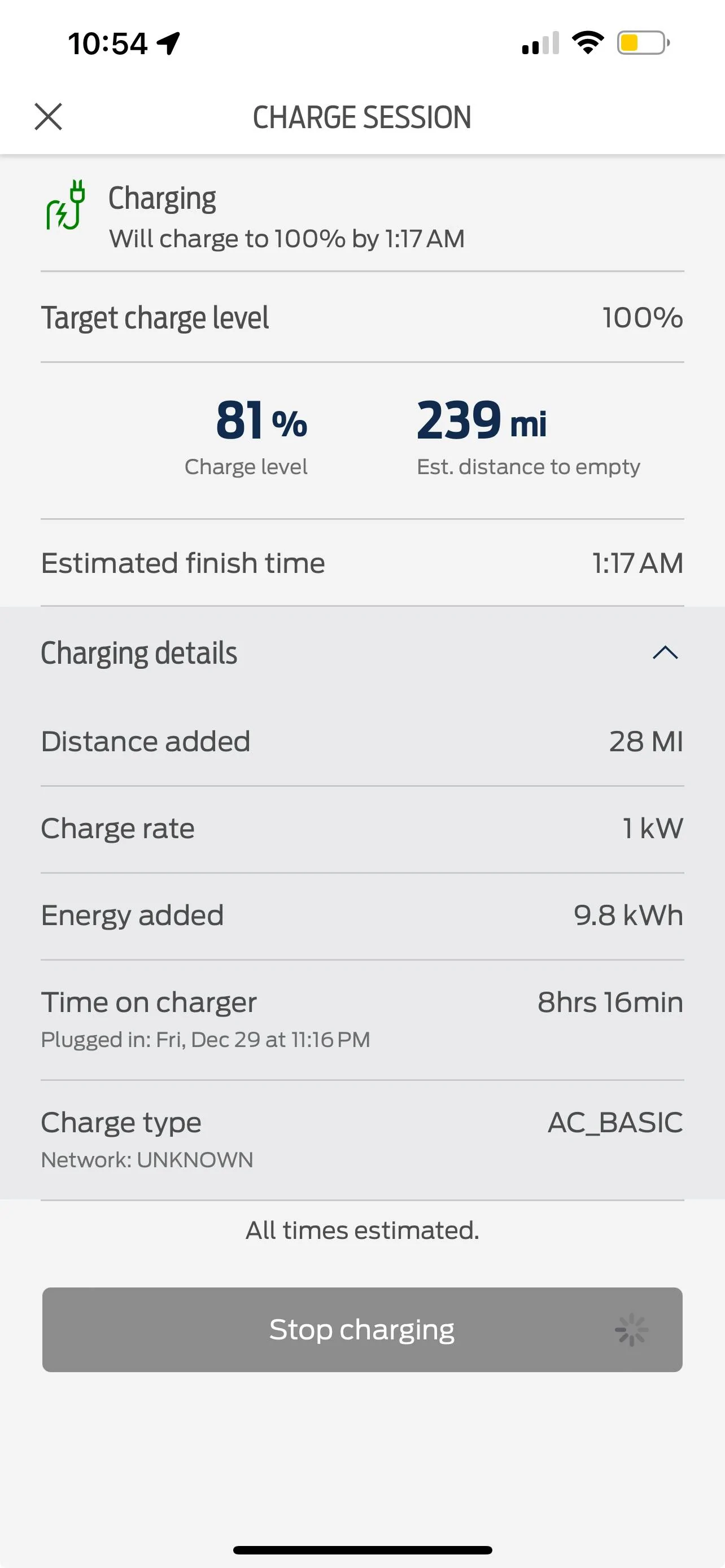
Just got my MachE 2 days ago (California Hwy 1). When I try to charge at home by plugging in to the 110 outlet, I get a charge rate 1 kW. In 8 hours and 15 minutes of charging the MachE added 9.8 kWh. I got the same result with my Escape PHEV charge and MachE "mobile charger". Shouldn't I see a slighter higher rate than 1 kW and 28 miles added after 8.25 hours on the charger?

Btw I dont' usually drive more than 25 miles in a day so this would be fine, but i assumed I'd get a little more than 3.3 miles per hour charging. I got about 5 miles per hour of charging on the Escape. Doe this charge rate seem normal to you? FWIW it's between 50 and 70 degrees outside for the past 2 days ... so no extreme hot or cold.

IMG_B08F271E006A-1.jpeg
This is normal, that's why I installed a L2 charger (Tesla Universal).
 

n2585722

Well-Known Member
First Name
Danny
Joined
Apr 17, 2023
Threads
3
Messages
126
Reaction score
100
Location
Cedar Park, Tx
Vehicles
2024 Mach E GT
Occupation
Retired
Country flag
I got a Splitvolt splitter and charger and share the dryer outlet in the garage with the Dryer and charger for the car. I have a 10-30 dryer outlet. I am getting about 5kw per hour of charge. So it takes almost 10 hours to recharge a weeks worth of use on the car. We just make sure and not use the dryer while the car is charging. The charging can be done at night when we don't normally run the dryer anyway.
 

thedoc

Well-Known Member
First Name
Staffan
Joined
Jan 17, 2023
Threads
0
Messages
47
Reaction score
25
Location
Höllviken Sweden
Vehicles
Ford Mach-e 2021
Country flag
Before I got the "proper" charger, I got 10A * 230V (= 2300W) with the Ford charger. It took forever.. 15A*120V must be painfully slow. I got the 16A*230V*3 phases charger, and suddenly I got some decent charge times (11kW). (Sweden)
 
OP
OP

phasornc

Member
First Name
Michael
Joined
Dec 29, 2023
Threads
3
Messages
7
Reaction score
4
Location
Miami
Vehicles
2023 Mach E4x California, 2018 Honda Clarity PHEV
Country flag
Thanks all! There was quite a bit of helpful info in here. FWIW this is my fourth plug-in car, but my first all-electric.

I had a Honda Accord Plug-in and still have a Honda Clarity, and both get about 5 miles from the 120. My Escape PHEV got about 4.5 miles per hour using the same outlet. It's kind of a bummer that the FordPass Charge Logs only show "mileage" added and not kW added. It makes sense that the MachE's estimate of miles per kW would be lower since, at the time of this post, I've had the car for 1 complete day, and let's just say my day 1 driving was NOT efficient.

Anyway, I have an electrician coming by this week to plan out how to install 240. Now, the big question is, should I simply get an outlet installed and use the mobile charger? Or get a better EVSE? I rarely drive more than 30 miles in a day, and it's usually more like 20. So fast charging speed is not terribly important to me, but efficiency is, so thanks again everyone for all the great info.
 

Coffs

Well-Known Member
Joined
May 19, 2023
Threads
13
Messages
128
Reaction score
122
Location
PA
Vehicles
Mach E, Explorer, Busa
Country flag
What's your Mile/kWh while driving?

If you're getting say 3.3 miles per Kilowatt-hour then charging at 1kW will never exceed that. In much colder climates you're still getting 1Kw charging but maybe 2 miles per hour range.
 

4sallypat

Well-Known Member
First Name
Pat
Joined
Mar 30, 2022
Threads
103
Messages
2,806
Reaction score
2,463
Location
Southern California
Website
www.kudo-ume-farms.com
Vehicles
'23 MME delivered May '23 + '22 Lightning July '22
Occupation
Network Tech
Country flag
Before we got a BEV, we had a PHEV and used a 3rd party dual voltage travel charger (Duosida) cord that allowed higher L1 charges due to the higher draw at 16A.

With almost 2kW out - it did speed up charging.

Required a 5-20R outlet which was on a 20A breaker.

Worked like a charm for years.
 

KevinS

Well-Known Member
Joined
Oct 11, 2021
Threads
34
Messages
1,515
Reaction score
2,831
Location
Maryland
Vehicles
2021 Mach-E (sold), 2023 Ioniq 6 SEL
Country flag
Anyway, I have an electrician coming by this week to plan out how to install 240. Now, the big question is, should I simply get an outlet installed and use the mobile charger? Or get a better EVSE? I rarely drive more than 30 miles in a day, and it's usually more like 20. So fast charging speed is not terribly important to me, but efficiency is, so thanks again everyone for all the great info.
I have a ChargePoint plug-in unit on a 50A circuit but configured to run at 32A. Works fine for me and is more than adequate for overnight charging on my Select range battery.
 

OrchidMania

Well-Known Member
Joined
Feb 26, 2021
Threads
11
Messages
799
Reaction score
551
Location
Miami Beach
Vehicles
Grabber Blue Premium ER
Occupation
Retired IT, School Math Volunteer
Country flag
After the new panel my husband installed a 50 amp outlet . I purchased a Grizzle charger plugged it into outlet , we dialed it back to 32 amps based on suggestions on the blog. I get 7kwh I think you can get the kw usage by multiplying the % charged by 91% (I have a 91kw battery).
or take time on the charger and multiply by your chargers kWh

I think!
 
Last edited:

ARK

Well-Known Member
Joined
Aug 21, 2020
Threads
45
Messages
2,938
Reaction score
4,297
Location
Los Angeles
Vehicles
'21 Premium SR AWD
Country flag
Thanks all! There was quite a bit of helpful info in here. FWIW this is my fourth plug-in car, but my first all-electric.

I had a Honda Accord Plug-in and still have a Honda Clarity, and both get about 5 miles from the 120. My Escape PHEV got about 4.5 miles per hour using the same outlet. It's kind of a bummer that the FordPass Charge Logs only show "mileage" added and not kW added. It makes sense that the MachE's estimate of miles per kW would be lower since, at the time of this post, I've had the car for 1 complete day, and let's just say my day 1 driving was NOT efficient.

Anyway, I have an electrician coming by this week to plan out how to install 240. Now, the big question is, should I simply get an outlet installed and use the mobile charger? Or get a better EVSE? I rarely drive more than 30 miles in a day, and it's usually more like 20. So fast charging speed is not terribly important to me, but efficiency is, so thanks again everyone for all the great info.
You should get a better EVSE, people who have used the Ford mobile charger long term have found it to not to be very durable. See if your local utility offers any sort of incentive, some have it for specific brands.
 

apwelsh

Well-Known Member
First Name
Armand
Joined
Dec 15, 2023
Threads
0
Messages
157
Reaction score
42
Location
Riverside, CA
Vehicles
2023 Mustang Mach-e Standard
Occupation
Programmer
Country flag
Just got my MachE 2 days ago (California Hwy 1). When I try to charge at home by plugging in to the 110 outlet, I get a charge rate 1 kW. In 8 hours and 15 minutes of charging the MachE added 9.8 kWh. I got the same result with my Escape PHEV charge and MachE "mobile charger". Shouldn't I see a slighter higher rate than 1 kW and 28 miles added after 8.25 hours on the charger?

Btw I dont' usually drive more than 25 miles in a day so this would be fine, but i assumed I'd get a little more than 3.3 miles per hour charging. I got about 5 miles per hour of charging on the Escape. Doe this charge rate seem normal to you? FWIW it's between 50 and 70 degrees outside for the past 2 days ... so no extreme hot or cold.

IMG_B08F271E006A-1.jpeg
This is normal. A 110 outlet is typically only 15amp service. If you pull a full 15 you will pop the breaker if there is anything else on the circuit that is drawing any amount of current — including phantom loads for powered off devices.
if you have a 20amp out you may want to try plugging into that and using 15amp charge rate.
You really should consider a level 2 charger. A 30 amp level 2 charge at 220 is equal to a 60 amp charge at level 1, because you have two 30 amp 110 power lines. I got a juice box for home for under $500 USD and will be installing that soon. I expect to get a full charge every night out of it. Until then, I too am charging at 1kW for now. It’s enough, and actually saves battery longevity because the charge rate is much slower so less heat. Still? It’s not practical, as it means I have to charge for several days before I take it on a drive to Vegas for a weekend. So that means for now, I have to plan ahead and visit a dc fast charge to prep before heading out.
If you want to try 20amp level 1 charge, look for the outlet that has the little horizontal notch on it. That will get you more current without popping the breaker.
Sponsored


Top