
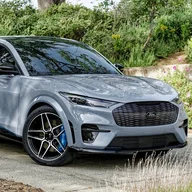
Increased efficiency with 255/45 20 Hankook Ion on my GT (updated OP)

markboris

Well-Known Member
First Name
Mark
Joined
Nov 13, 2019
Threads
44
Messages
5,754
Reaction score
16,455
Location
Sonora, CA
Vehicles
Currently: '20 Shelby GT500 FPB '24 Mach-E GTP GGM
Occupation
Retired
Country flag
Wider tires always weigh more…… than a skinnier version of the same tire.

Science experiment 101- stick with 1 variable. ?

You not only changed width, you changed wheel size, wheel width, sidewall height and tire brand!

In general, less weight is better for efficiency.
Yes you are right. I changed everything. I was just making the statement that you can have wider tires than OEM that are lighter. I also have larger wheels in both width and diameter and they are also lighter than OEM wheels. I’m a total of 8 lbs lighter at each corner.
Sponsored


tuminatr

Well-Known Member
First Name
Brian
Joined
Apr 22, 2020
Threads
51
Messages
2,185
Reaction score
2,224
Location
Saint Paul,MN
Vehicles
2021 MME GTPE
Occupation
sales
Country flag
I would state that many of the things everyone thinks about tires can be wrong.

Here is the Hankook Ion web site for Europe. If you don't already know tire labels in Europe rate efficiency. A 225/55/18 is rated B so it is less efficient than a 305/30/21 that is rated A

It's not always the case wider is less efficient. In most brands 20-30mm differences in width have almost no effect on efficiency

https://www.hankooktire.com/uk/en/tire/ion/evo.html

When it comes to weight less weight will handle better be less fatiguing for the diver, acceleration will be better but will actually hurt regenerative braking
 

Mach1E

Well-Known Member
Joined
Sep 5, 2021
Threads
93
Messages
10,509
Reaction score
13,296
Location
Florida
Vehicles
69 Mach 1, 11 GT, 21 GTPE- sold, 24 Taycan 4S, 20 F type R
Country flag
I would state that many of the things everyone thinks about tires can be wrong.

Here is the Hankook Ion web site for Europe. If you don't already know tire labels in Europe rate efficiency. A 225/55/18 is rated B so it is less efficient than a 305/30/21 that is rated A

It's not always the case wider is less efficient. In most brands 20-30mm differences in width have almost no effect on efficiency

https://www.hankooktire.com/uk/en/tire/ion/evo.html

When it comes to weight less weight will handle better be less fatiguing for the diver, acceleration will be better but will actually hurt regenerative braking
You can’t compare a 30 series tire on a 21” wheel to a 55 series on an 18” wheel.

Regen gains from a heavier tire will be less than the efficiency losses from the heavier tire. So it doesn’t really factor in.

FWIW, I went with 255 tires recently instead of 245. Anyone going to try to argue this will help my efficiency?
 

tuminatr

Well-Known Member
First Name
Brian
Joined
Apr 22, 2020
Threads
51
Messages
2,185
Reaction score
2,224
Location
Saint Paul,MN
Vehicles
2021 MME GTPE
Occupation
sales
Country flag
You can’t compare a 30 series tire on a 21” wheel to a 55 series on an 18” wheel.

Regen gains from a heavier tire will be less than the efficiency losses from the heavier tire. So it doesn’t really factor in.

FWIW, I went with 255 tires recently instead of 245. Anyone going to try to argue this will help my efficiency?
Sorry buddy, I sure can compare them. The 305 in the Hankook Ion is more efficient. The Euro letter grades are from the tire being physically tested for rolling resistance.

Here is an article on the letter grades. Honestly, I wish we did there here there would be less misunderstanding on the subject.

https://www.tyrereviews.com/Article/EU-Tire-Label-Current-status-and-challenges.htm

I stand by what I say a 245/45/20 and a 255/45/20 are very close in efficiency. In the same brand and model tire. A Hankook Ion is likely more efficient than the factory Pirelli summer tires that come with a GTPE.

Tire and wheel combos are very complicated and making general statements difficult.

I also stand by what I say about the weight it's also complicated. But efficiency from regenerative braking is negatively affected by less weight.
 
Last edited:

markboris

Well-Known Member
First Name
Mark
Joined
Nov 13, 2019
Threads
44
Messages
5,754
Reaction score
16,455
Location
Sonora, CA
Vehicles
Currently: '20 Shelby GT500 FPB '24 Mach-E GTP GGM
Occupation
Retired
Country flag
Brian, you mentioned the EU tire label rating which is something I do look at even though it doesn't affect my decision when buying tires. I only look at it for my info. The Hankook iON EVO 245/45/20 (OEM GTPE tire size) has a "B" efficiency rating which is the same as the Michelin Pilot Sport S 5 275/35/21 tire I am running right now. Although range is at the bottom of my list when it comes to tire features I am interested in, I was happy to know my new tires would be around the same efficiency as those particular Hankook's. Both tires have a 103 load rating so would be inflated to the same recommended 39 psi.


Mach1E

Well-Known Member
Joined
Sep 5, 2021
Threads
93
Messages
10,509
Reaction score
13,296
Location
Florida
Vehicles
69 Mach 1, 11 GT, 21 GTPE- sold, 24 Taycan 4S, 20 F type R
Country flag
Sorry buddy, I sure can compare them. The 305 in the Hankook Ion is more efficient. The Euro letter grades are from the tire being physically tested for rolling resistance.

Here is an article on the letter grades. Honestly, I wish we did there here there would be less misunderstanding on the subject.

https://www.tyrereviews.com/Article/EU-Tire-Label-Current-status-and-challenges.htm

I stand by what I say a 245/45/20 and a 255/45/20 are very close in efficiency. In the same brand and model tire. A Hankook Ion is likely more efficient than the factory Pirelli summer tires that come with a GTPE.

Tire and wheel combos are very complicated and making general statements difficult.

I also stand by what I say about the weight it's also complicated. But efficiency from regenerative braking is negatively affected by less weight.
Sure, you can do whatever you want as far as comparisons go, but when you change multiple variables all you do is confuse the situation and it becomes impossible to draw a conclusion.

If you want less misunderstanding like you say, this isn’t the way to go about it.

Your note about regenerative braking also just confuses the situation more. While it may be true, like I said, that impact is less than the negative impact of added weight.

If people are looking for more efficient tires, in general they should go with smaller and lighter.

Not sure why you’re trying to confuse them with exceptions to the rule of larger tires that may be lighter.

Those same tires you are using as examples would likely be more efficient if they went with a narrower width.


If you want to be absolutely sure how this works, go with an extreme example.

Anyone who has owned a truck knows what happens to fuel economy when they put wider tires on the truck- it gets worse.
 
OP
OP
mkhuffman

mkhuffman

Well-Known Member
First Name
Mike
Joined
Nov 19, 2020
Threads
29
Messages
6,878
Reaction score
9,514
Location
Virginia
Vehicles
2025 Rivian R1T Tri-Max, Jeep GC-L, VW Jetta
Country flag
I have read that wider tires actually have a smaller contact patch on the ground, which reduces rolling resistance. It doesn't make sense to me, but that is what "they" say. Of course, wider tires are less aerodynamic, and so at higher speeds that would have an impact.

I don't think a blanket statement that wider tires of the same model tire are less efficient is accurate.
 

Mach1E

Well-Known Member
Joined
Sep 5, 2021
Threads
93
Messages
10,509
Reaction score
13,296
Location
Florida
Vehicles
69 Mach 1, 11 GT, 21 GTPE- sold, 24 Taycan 4S, 20 F type R
Country flag
I have read that wider tires actually have a smaller contact patch on the ground, which reduces rolling resistance. It doesn't make sense to me, but that is what "they" say. Of course, wider tires are less aerodynamic, and so at higher speeds that would have an impact.

I don't think a blanket statement that wider tires of the same model tire are less efficient is accurate.
It’s the weight.

And no, wider tires don’t have a smaller contact patch.

If they did, they wouldn’t have better traction for acceleration and handling.

It’s a wider, but shorter contact patch…..roughly the same overall area though. Not smaller.

https://www.roadandtrack.com/car-cu...ght-you-knew-points-of-contact-tire-patches/#

This argument isn’t just theoretical, it’s been tested for decades.

Sports cars don’t have wide tires and economy cars thin tires just for looks.
 

tuminatr

Well-Known Member
First Name
Brian
Joined
Apr 22, 2020
Threads
51
Messages
2,185
Reaction score
2,224
Location
Saint Paul,MN
Vehicles
2021 MME GTPE
Occupation
sales
Country flag
Sure, you can do whatever you want as far as comparisons go, but when you change multiple variables all you do is confuse the situation and it becomes impossible to draw a conclusion.

If you want less misunderstanding like you say, this isn’t the way to go about it.

Your note about regenerative braking also just confuses the situation more. While it may be true, like I said, that impact is less than the negative impact of added weight.

If people are looking for more efficient tires, in general they should go with smaller and lighter.

Not sure why you’re trying to confuse them with exceptions to the rule of larger tires that may be lighter.

Those same tires you are using as examples would likely be more efficient if they went with a narrower width.


If you want to be absolutely sure how this works, go with an extreme example.

Anyone who has owned a truck knows what happens to fuel economy when they put wider tires on the truck- it gets worse.
This is exactly the point I was trying to make it's extremely complicated.

Below are the general statements I feel are accurate.

1 Wider tires have little effect on efficiency

2 Tire pressure has a huge effect on efficiency especially at highway speeds.

3 Weight both hurts and helps if the MME was an ICE it would be simple less weight is preferred. But because if regenerative braking it hurts so it's hard to quantify.

I remember an old example from Ford on the 2.3l 4cyl where they used a heavy flywheel to make the engine more efficient at highway speeds.

On my premium, I tried 18x8 TSW Bathurst 18.6lb wheels and lightweight 225/60/18 they had a noticeably negative effect on efficiency. The much heavier 30lb+ CR1 wheels and tires from the TSW combo were much more efficient. This could also illustrate how aerodynamic wheels affect efficiency and how heavier wheels help with regenerative braking. This was done in city driving conditions at a max of 45mph.

So it depends on your priorities Lighter weight will accelerate faster and corner better but may not be more efficient.

4 Other factors are in play like wheel design

5 Driving style makes a difference

What the OP of this post is saying makes sense to me a 255/45/20 105 Hanklook Ion is likely more efficient than a 245/45/20 103 Continental Procontact RX. Now, if you lowered the pressure on the Hankook as you should (because of the higher load rating) the Hankook would probably be less efficient. So in this case a 245/45/20 103 Hankook ion would probably be more efficent because you should run at stock 39psi. The only reason to go with the bigger size is to run at less pressure and have a more comfortable ride.
 
Last edited:

Mach1E

Well-Known Member
Joined
Sep 5, 2021
Threads
93
Messages
10,509
Reaction score
13,296
Location
Florida
Vehicles
69 Mach 1, 11 GT, 21 GTPE- sold, 24 Taycan 4S, 20 F type R
Country flag
This is exactly the point I was trying to make it's extremely complicated.

Below are the general statements I feel are accurate.

1 Wider tires have little effect on efficiency

2 Tire pressure has a huge effect on efficiency especially at highway speeds.

3 Weight both hurts and helps if the MME was an ICE it would be simple less weight is preferred. But because if regenerative braking it hurts so it's hard to quantify.

I remember an old example from Ford on the 2.3l 4cyl where they used a heavy flywheel to make the engine more efficient at highway speeds.

On my premium, I tried 18x8 TSW Bathurst 18.6lb wheels and lightweight 225/60/18 they had a noticeably negative effect on efficiency. The much heavier 30lb+ CR1 wheels and tires from the TSW combo were much more efficient. This could also illustrate how aerodynamic wheels affect efficiency and how heavier wheels help with regenerative braking. This was done in city driving conditions at a max of 45mph.

So it depends on your priorities Lighter weight will accelerate faster and corner better but may not be more efficient.

4 Other factors are in play like wheel design

5 Driving style makes a difference

What the OP of this post is saying makes sense to me a 255/45/20 105 Hanklook Ion is likely more efficient than a 245/45/20 103 Continental Procontact RX. Now, if you lowered the pressure on the Hankook as you should (because of the higher load rating) the Hankook would probably be less efficient. So in this case a 245/45/20 103 Hankook ion would probably be more efficent because you should run at stock 39psi. The only reason to go with the bigger size is to run at less pressure and have a more comfortable ride.
For sure many factors, but for your #3 it’s pretty straightforward-

More weight hurts efficiency.

Sure, you get some of those losses back from regeneration, but not all.

1 and 2 are opposing forces for the reason you said-you run a higher pressure with skinnier tires and lower pressure with wider tires.

So yup, I agree, it’s complicated…….except with weight.

More weight will always hurt efficiency. You may be able to counteract the weight with other factors, but all else being equal, weight is the enemy of efficiency.

Hypermilers will run the smallest, lightest tires at the highest pressures for these reasons.
 

grein002

Well-Known Member
First Name
Scott
Joined
Mar 5, 2024
Threads
9
Messages
268
Reaction score
418
Location
Durham, NC
Vehicles
2023 Mach-E GTPE, Red w/Gray interior
Country flag
WRT heavier tires improving regen, what is the theory behind this? Is it that heavier tires have more rotational mass, which contributes to additional regen to slow the wheel in addition to the vehicle? If so, wouldn't that be more than offset by the additional energy spent spinning up the wheel in the first place? This would suggest to me that heavier wheels would have a slight negative impact on regen overall.
 
OP
OP
mkhuffman

mkhuffman

Well-Known Member
First Name
Mike
Joined
Nov 19, 2020
Threads
29
Messages
6,878
Reaction score
9,514
Location
Virginia
Vehicles
2025 Rivian R1T Tri-Max, Jeep GC-L, VW Jetta
Country flag
More weight will always hurt efficiency. You may be able to counteract the weight with other factors, but all else being equal, weight is the enemy of efficiency.
Not at steady highway speeds. At steady highway speeds, rolling resistance and aerodynamics are all that matters. And I only care about highway efficiency, which is why I did the test on the highway.
 
OP
OP
mkhuffman

mkhuffman

Well-Known Member
First Name
Mike
Joined
Nov 19, 2020
Threads
29
Messages
6,878
Reaction score
9,514
Location
Virginia
Vehicles
2025 Rivian R1T Tri-Max, Jeep GC-L, VW Jetta
Country flag
OP
OP
mkhuffman

mkhuffman

Well-Known Member
First Name
Mike
Joined
Nov 19, 2020
Threads
29
Messages
6,878
Reaction score
9,514
Location
Virginia
Vehicles
2025 Rivian R1T Tri-Max, Jeep GC-L, VW Jetta
Country flag
WRT heavier tires improving regen, what is the theory behind this? Is it that heavier tires have more rotational mass, which contributes to additional regen to slow the wheel in addition to the vehicle? If so, wouldn't that be more than offset by the additional energy spent spinning up the wheel in the first place? This would suggest to me that heavier wheels would have a slight negative impact on regen overall.
Your reasoning is correct. It takes more energy to accelerate, but also more energy to stop when the wheel is heavier. When stopping, you can recapture some of that energy with regen, but of course not as much as is lost when accelerating. How much is hard to know, but my guess is you can recapture at least half of the energy lost due to weight, maybe more.
 
OP
OP
mkhuffman

mkhuffman

Well-Known Member
First Name
Mike
Joined
Nov 19, 2020
Threads
29
Messages
6,878
Reaction score
9,514
Location
Virginia
Vehicles
2025 Rivian R1T Tri-Max, Jeep GC-L, VW Jetta
Country flag
The only reason to go with the bigger size is to run at less pressure and have a more comfortable ride.
I did lower the pressure to 34 psi, and that trip still had better efficiency than four of the five OEM trips. I totally agree that lowering the pressure reduces efficiency, and it was the worst of the five Ion trips.

On a side note, I don't think the only reason for the bigger size is so I can reduce tire pressure for more comfort. They do look better. And while I have no way to prove it, I think less rotational air resistance at 80 mph is another reason they are more efficient.

If I changed tires frequently like you do, maybe I would get some 245 Ions and see if they are just as efficient as the 255s. That would prove it either way. But alas, I am not up for that.

I am very happy with the results, regardless of the reason.

Next up: Eibach lowering springs efficiency test. Will lowering the car by 1" improve efficiency? In theory it should, but it might not be measurable.
Sponsored


Top