
Deleted member 19900
Guest
- Thread starter
- #1
Delete
Sponsored
Last edited by a moderator:


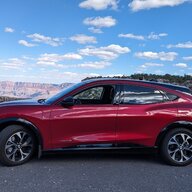
Slightly off topic, but how do you like your LFP equipped Mach-E? How are the range/charging times?The tax credits are overrated. They do nothing for me as a retiree who has no tax liability.
They should be structured where anyone gets money off the vehicle to make them fair. They're penalizing renters and retirees, etc.
They may not do anything for you because either you can't use them, or you choose not to use them. By that I mean - you need to have a tax liability to use them. Retirees often don't normally have one.The tax credits are overrated. They do nothing for me as a retiree who has no tax liability.
They should be structured where anyone gets money off the vehicle to make them fair. They're penalizing renters and retirees, etc.
Thanks! The ability to daily charge to 100% is a big advantage imo, I just wish the range were slightly longer.I like it a lot. One of the recent charges was around 23% to 100%. I set it to charge at 7:00 pm and it was finished at 4:30 am.
I'm not tracking the range really hard. I would guess I'm getting 200-210 miles when there is a lot of 65 MPH use. 1/3 of that is climate control use. Temperature at 76 degrees, heated seats on two, some steering wheel heat use.
It's a perfect city car. But I don't trust going north or east into the desert due to the lack of charging availability. Or risking them being out of order.

There is also the issue of RMDs (required minimum distributions) from IRAs and IRA-SEPs that generate taxable income. RMDs kick in when you turn 72.They may not do anything for you because either you can't use them, or you choose not to use them. By that I mean - you need to have a tax liability to use them. Retirees often don't normally have one.
To create a tax liability, you create income. To create income, you can do many things. One is to convert an IRA to a Roth IRA. In doing so, you achieve two goals. First, you shelter assets from future taxation in retirement. Two, you use the tax credit. We did this in 2021 and 2022. There are retirement accounts you can do this with, i.e. moving 401K money to a Roth IRA, or a Roth 401K.
Another way to use the credit is to create capital gains. You do this by selling assets that have gained in value, such as mutual funds.
I have sales I need to make, or Roth conversions I need to do, by end of year to fully utilize our 2023 tax credit as well as the tax credit for our 2nd EVSE purchase and connections.
So, a retiree can use non-refundable tax credits should he / she want to do so. Just takes some tax planning.
Note - make sure to consult your tax professional if you utilize one.
Edit - the amount of income or capital gain you need to generate will depend on your particular situation, because you may have pension income, dividend and interest income, and other capital gains to account for.
True. But not there yet. And it will be 73 or later for us. And, I hope to have very little taxable retirement income left, I'm already like 86% Roth.There is also the issue of RMDs (required minimum distributions) from IRAs and IRA-SEPs that generate taxable income. RMDs kick in when you turn 72.

I don't think it makes difference in real life. For daily use, you don't need to charge to 100%, and for long trips you DC charge to 80% anyway because the charging speed drops after that.Thanks! The ability to daily charge to 100% is a big advantage imo, I just wish the range were slightly longer.


