
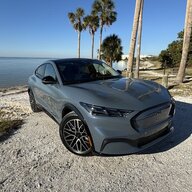
Is this normal?

Tampamike

Well-Known Member
First Name
Mike
Joined
Feb 19, 2021
Threads
24
Messages
2,069
Reaction score
2,806
Location
Tampa, FL
Vehicles
‘24 Mach E Premium RWD
Country flag
I don’t have another EVSE. I only use the included Ford mobile. I don’t charge everyday - usually only once every week or so. Yeah, it started giving me the amber light over the summer but it keeps working. It just slows down but not unacceptably slow. It will still charge fully overnight. It’s working better now that it has cooled down. I have a service appointment next week for a cracked roof and I also mentioned the charger so I’m hoping to get a new one. If not, I’ll keep using the old one until it stops working.
Sponsored

 

jgillmer

Well-Known Member
First Name
Joe
Joined
Jun 26, 2021
Threads
20
Messages
252
Reaction score
145
Location
Alexandria, VA
Vehicles
Shadow Black MME GT w Panoramic Roof & BlueAssist
Occupation
Nonprofit Executive
Country flag
Range is based on the opposite if a gas vehicle. We have 35 to 50 mph roads in Our area so we avg summer 285 to 298 in our GTPE. Highway at 65mph a.c. on 68 in 80 deg weather and run 3 kWh vs in town 3.5 to 4.1 Now winter range is 238 avg so far. 85mph is probably under 2 kWh so it's probably normal.
Concur with this post.
With a GT (not PE), here's roughly what I get (mix of city and highway weekly with highway usually between 50-75 in the DC area and trips to Philly). Also note that I rarely use the heater in winter unless my windows fog - the heated seats and steering wheel typically keep me warm enough). I do use AC in the summer.

-Fall: 250-290
-Winter: 230-250
-Spring: 260-300
-Summer: 250-285
 

DaMeatMan

Well-Known Member
First Name
Joe
Joined
Feb 26, 2021
Threads
46
Messages
497
Reaction score
1,191
Location
Toronto, ON, Canada
Vehicles
Mustang Mach-E Premium AWD Extended Range Battery
Country flag
I've had my Mach E since May and have had a handful of issues with it. Some have been resolved(so it seems) and some i'm waiting for software updates, I got my vehicle back from my local dealership after they had it for two weeks. They replaced the PCM and the wire harness and updated the software, all this to fix an issue with my unbridled extend tripping a service alert and not working correctly. I also had an issue with speed warning turning on and unable to turn off which still isn't resolved. Despite these few issues i have been generally happy with my vehicle and when stopped by people or asked I'm always quick to talk about how great the vehicle is. But my opinion is slowly changing. After my update my range on my vehicle has dropped significantly. Before the udpate i was getting around 236 miles on a full charge, it slowly got worse. I just got home from a road trip down from northern california down to souther california(around 390 miles) and my range was 190 miles and i was getting 1.7-1.9 mi/kwh and that was using smart cruise control set to 85 mph and with little to no traffic for most the trip until getting to LA and it going to 3.0 mi/kwh in bumper to bumper traffic. I'm also now experiencing issues with my home charger showing an amber light on the charger as well.
Is that range normal? Or am i having something going on with my car? I've talked with ford about the home charger issue and they want me to go into the dealership, the dealership is so far behind that they're saying it's 7-10 days to even diagnose the vehicle and even longer possibly to get it fixed. And Ford is saying that the charger is on nationwide backorder. At this point i'm seriously contemplating looking into selling this car.
Sorry you feel that way, but you unfortunately need to adjust your expectations based on the nature of EV vehicles. Although it is a car, it is NOT and internal combustion engine vehicle, and what you think you know about vehicles stops there.

Please spend some time on the forum searching "cold weather range", and look up "GOM", and spend some time on Google researching "things I should know before buying an EV". EV's are the opposite of ICE vehicles in that they get better efficiency in city driving with stop and go traffic due to regen breaking and get worse efficiency with highway driving. Whereas ICE vehicles do better on highway driving because the vehicle can coast at 2000 - 3000 RPM, while in city driving they get horrible efficiency because the engine is still turning over at around 1000 RPM sitting at a stop light but isn't going anywhere.

Cabin heating is another huge one, where the heat is essentially "free" wasted energy that is just blown out into the atmosphere with an ICE vehicle, and when you turn on the heat it's simply redirecting some of that waste heat into the cabin. Not so with an EV where heating the cabin requires you to use (stored energy) from the battery to make heat that could have otherwise gone into efficiently moving you forward. Add to that today's battery chemistry also loses some of its energy density in cold, and becomes less efficient.

The GOM (the range number on dash) is just a guess, and some brand vehicles display the same EPA number no matter the users driving style, weather or terrain, while Ford is extremely conservative and pessimistic giving you a number that immediately low balls real world range figures as soon as we head into colder months in anticipation of how they think you will use your vehicle to ensure you see a range number on screen that you can actually achieve. They probably do this knowing that allot of their customers are new to EV'S, and it turns out they would have been better off lying to you with high numbers THAT CANNOT BE ACHIEVED given real world conditions like Tesla does, because human nature being what it is many seem to think Ford "took something" from them when Ford gives you a low ball GUESS of what range they think you will get in the real world. Funny enough nobody seems to look at this number or even care on an ICE vehicle, but again range anxiety and lack of knowledge means folks approach EV's in a particular way based upon lack of knowledge.

The transition to EV vehicle ownership can sometimes be scary, and lead to disappointing experiences particularly if one does not take the time to UNDERSTAND the technology. But if you take a bit of time to do your homework, and you know what to expect with realistic expectations then I think you will find that allot of those unpleasant experiences due to ignorance go away, and what your left with is a far more enjoyable experience.

That said EV's are superior to ICE vehicles in allot of ways, particularly when it comes down to raw performance per dollar spent. But they are not (yet) superior in every way, and it's on you as the guy who's spending all that $$ to make sure you understand what it is that you are buying.

With all of that aside, I think you will also find that most folks tend to get peeved with posts like these, and folks tend to flame and tease people when they post these questions. Quite honestly it's frustrating for many of us to see so many people walk into such a big purchase without understanding what they are even buying, and then turning around and bashing the car or the brand for "issues" that are actually not issues at all, but rather completely normal traits of this technology.
 

jgillmer

Well-Known Member
First Name
Joe
Joined
Jun 26, 2021
Threads
20
Messages
252
Reaction score
145
Location
Alexandria, VA
Vehicles
Shadow Black MME GT w Panoramic Roof & BlueAssist
Occupation
Nonprofit Executive
Country flag
Sorry you feel that way, but you unfortunately need to adjust your expectations based on the nature of EV vehicles. Although it is a car, it is NOT and internal combustion engine vehicle, and what you think you know about vehicles stops there.

Please spend some time on the forum searching "cold weather range", and look up "GOM", and spend some time on Google researching "things I should know before buying an EV". EV's are the opposite of ICE vehicles in that they get better efficiency in city driving with stop and go traffic due to regen breaking and get worse efficiency with highway driving. Whereas ICE vehicles do better on highway driving because the vehicle can coast at 2000 - 3000 RPM, while in city driving they get horrible efficiency because the engine is still turning over at around 1000 RPM sitting at a stop light but isn't going anywhere.

Cabin heating is another huge one, where the heat is essentially "free" wasted energy that is just blown out into the atmosphere with an ICE vehicle, and when you turn on the heat it's simply redirecting some of that waste heat into the cabin. Not so with an EV where heating the cabin requires you to use (stored energy) from the battery to make heat that could have otherwise gone into efficiently moving you forward. Add to that today's battery chemistry also loses some of its energy density in cold, and becomes less efficient.

The GOM (the range number on dash) is just a guess, and some brand vehicles display the same EPA number no matter the users driving style, weather or terrain, while Ford is extremely conservative and pessimistic giving you a number that immediately low balls real world range figures as soon as we head into colder months in anticipation of how they think you will use your vehicle to ensure you see a range number on screen that you can actually achieve. They probably do this knowing that allot of their customers are new to EV'S, and it turns out they would have been better off lying to you with high numbers THAT CANNOT BE ACHIEVED given real world conditions like Tesla does, because human nature being what it is many seem to think Ford "took something" from them when Ford gives you a low ball GUESS of what range they think you will get in the real world. Funny enough nobody seems to look at this number or even care on an ICE vehicle, but again range anxiety and lack of knowledge means folks approach EV's in a particular way based upon lack of knowledge.

The transition to EV vehicle ownership can sometimes be scary, and lead to disappointing experiences particularly if one does not take the time to UNDERSTAND the technology. But if you take a bit of time to do your homework, and you know what to expect with realistic expectations then I think you will find that allot of those unpleasant experiences due to ignorance go away, and what your left with is a far more enjoyable experience.

That said EV's are superior to ICE vehicles in allot of ways, particularly when it comes down to raw performance per dollar spent. But they are not (yet) superior in every way, and it's on you as the guy who's spending all that $$ to make sure you understand what it is that you are buying.

With all of that aside, I think you will also find that most folks tend to get peeved with posts like these, and folks tend to flame and tease people when they post these questions. Quite honestly it's frustrating for many of us to see so many people walk into such a big purchase without understanding what they are even buying, and then turning around and bashing the car or the brand for "issues" that are actually not issues at all, but rather completely normal traits of this technology.
Another good practice is to track your range manually, at least a few times in each typical day of a season, to get a real sense of what your car's range performance is. Before I bought my MME GT in Oct. 2021, I owned a Honda Clarity PHEV with a 17 kWh battery and about 50-60 miles of all electric range. The first winter, the range meter suddenly dropped to the 30s for a few charges. I was about to lose my gourd over it until I manually tracked it for several charges and found it was actually in the upper 40s (EPA estimate was 47 anyway). The drop to the 30s was because I had it in the shop and the mechanic must have had the heater on while working on a cabin light issue. The range meter then tries to calculate estimates based on recent driving and heater usage patterns, hence the sudden (false) drop in range. Most of the winter I floated between 45-52 miles per full charge equivalent, and when the weather climbed by to the 70s in May, it was, once again peaking near 60. BTW, that was a really good PHEV. I had a lifetime MPG of 199.9 - only reason it wasn't higher was because the meter didn't go higher. I filled the 7 gallon tank 10 times in 3.5 years. Nearly all were from driving from DC to Philly visit family. In the PHEVs they rarely have DCFC capability, so long trips the best I could do was leave with a full charge and plug in at a nearby L2 while visiting so I had another 50 or so miles back, minimizing gas use to 4 gallons of gas (45 mpg on gas alone).
 

jgillmer

Well-Known Member
First Name
Joe
Joined
Jun 26, 2021
Threads
20
Messages
252
Reaction score
145
Location
Alexandria, VA
Vehicles
Shadow Black MME GT w Panoramic Roof & BlueAssist
Occupation
Nonprofit Executive
Country flag
Another good practice is to track your range manually, at least a few times in each typical day of a season, to get a real sense of what your car's range performance is. Before I bought my MME GT in Oct. 2021, I owned a Honda Clarity PHEV with a 17 kWh battery and about 50-60 miles of all electric range. The first winter, the range meter suddenly dropped to the 30s for a few charges. I was about to lose my gourd over it until I manually tracked it for several charges and found it was actually in the upper 40s (EPA estimate was 47 anyway). The drop to the 30s was because I had it in the shop and the mechanic must have had the heater on while working on a cabin light issue. The range meter then tries to calculate estimates based on recent driving and heater usage patterns, hence the sudden (false) drop in range. Most of the winter I floated between 45-52 miles per full charge equivalent, and when the weather climbed by to the 70s in May, it was, once again peaking near 60. BTW, that was a really good PHEV. I had a lifetime MPG of 199.9 - only reason it wasn't higher was because the meter didn't go higher. I filled the 7 gallon tank 10 times in 3.5 years. Nearly all were from driving from DC to Philly visit family. In the PHEVs they rarely have DCFC capability, so long trips the best I could do was leave with a full charge and plug in at a nearby L2 while visiting so I had another 50 or so miles back, minimizing gas use to 4 gallons of gas (45 mpg on gas alone).
To clarify - not suggesting manually check multiple times per day in a season, but rather, check manually a few days OF each season during typical/average weather. Sorry about that - when I re-read my post, I realized it could be taken as having to track hundreds of times a year. Another way to do it, by the way, is to keep track of average miles per kWh used - that will also give you a better sense than the range on the dash, if you think the range on the dash may be off.
Sponsored


Top