Measuring battery size DIY (via OBD/Car Scanner)

satchel prefect

Well-Known Member
Joined
Sep 2, 2022
Threads
9
Messages
157
Reaction score
274
Location
South Florida, USA
Vehicles
Crusty old PHEV
Country flag
Apologies if this has been posted before. If so, I hope the original post can be added as a sticky since this comes up so often.

Many new owners are surprised by the estimated range shown by the car, especially if their early experience is in colder weather. In some cases, this leads to the concern that the wrong battery was installed.

The first step is to relax and not panic. It is highly unlikely that the wrong battery was installed in your car. The indicated range is an approximation and not a reliable way to gauge battery size. This "range" will update based on its observation of how you use the car, over the course of the short term and longer term. It could take weeks or months to stabilize, and even then will drift with weather changes.

Measuring battery size is actually a simple procedure involving "CarScanner" (a free/inexpensive phone app) and an OBD connector, many of which are available on Amazon with prices ranging from ~$50-$150 for ones of reasonable quality. The publishers of CarScanner have a list of recommendations here.

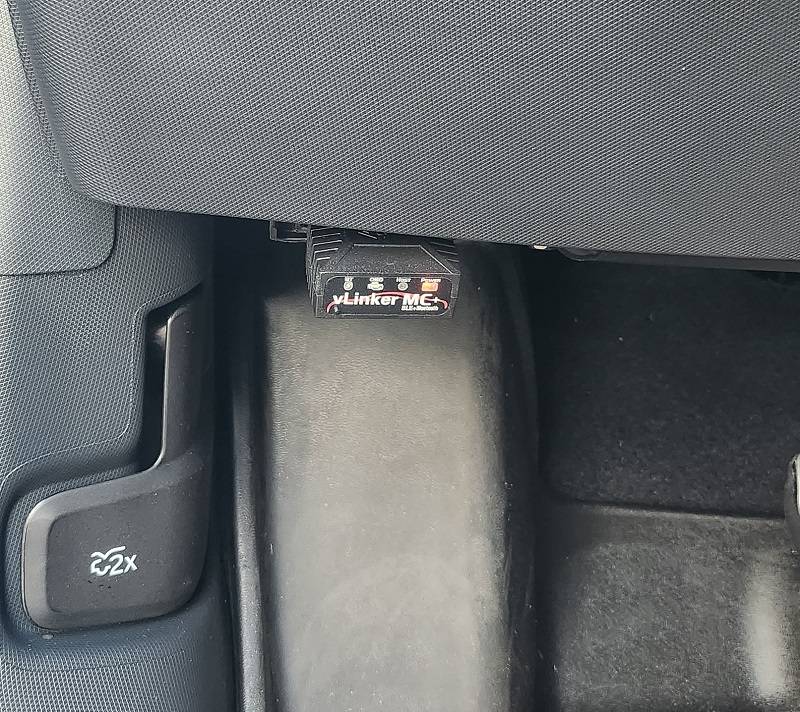
The OBD connector plugs in here:

Ford Mustang Mach-E Measuring battery size DIY (via OBD/Car Scanner) obd


Once connected, the process of pairing and taking readings from the CarScanner app is detailed in the app, and is not much different from connecting with any bluetooth device.

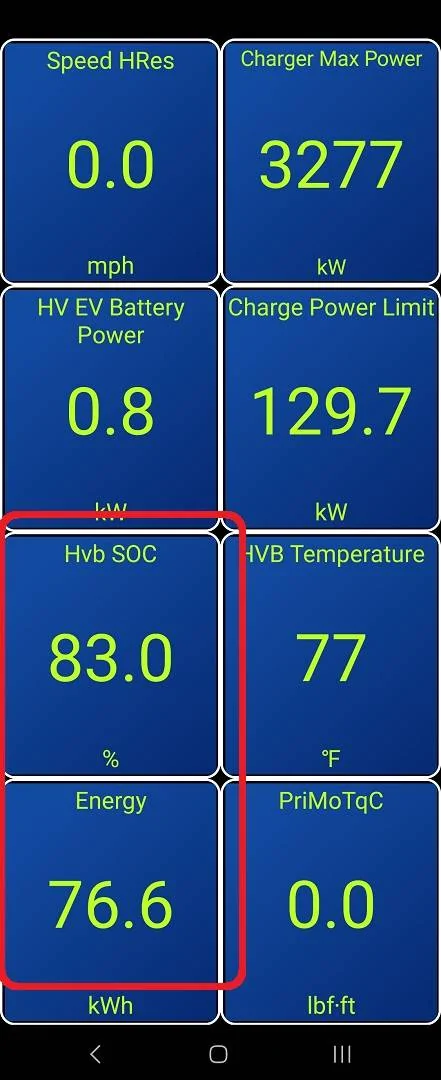
As of this writing, CarScanner has a dedicated profile for the Mach E/F150 Lightning. One of the built-in dashboards (page 7 of 16 on my particular version) shows state of charge and energy:

Ford Mustang Mach-E Measuring battery size DIY (via OBD/Car Scanner) car scanner soc-energy


From these two, you can calculate the battery's approximate capacity.

In the example above, 76.6 kwh / 0.83 = 92.3 kwh, so this is clearly an extended range battery. (Note: this was captured at 80F outside temp; lower temperatures will yield lower total capacity)

Also for for your reading pleasure with specific Mach E content:

Winter & Cold Weather EV Range Loss in 7,000 Cars

How Temperature Affects EV Range

Hope this helps.
Sponsored
 

bshaw

Well-Known Member
Joined
May 18, 2020
Threads
14
Messages
1,562
Reaction score
2,181
Location
Boston, MA
Vehicles
2021 Mustang Mach E 4X (Job 1)
Country flag
Thank you for posting this definitive way to check.

Isn’t the side door logo still presented with an X for the extended range battery? And the window sticker also indicates extended range was part of the purchase? If you don’t believe those indicators, then please check using the process above.

What I am thinking is that the “Do I have the wrong battery?” question is more indicative of someone who bought an EV without understanding the different expectations from an ice vehicle. And/or just generally took a leap without enough research and is now nervous about their decision. Depending on where you / your family lives, there are a lot of EV doubters wanting to burst your bubble. (I went thru it)

It’s a great car! You’ll have different limitations from an ice car, but learn what they are and embrace it.
 
OP
OP

satchel prefect

Well-Known Member
Joined
Sep 2, 2022
Threads
9
Messages
157
Reaction score
274
Location
South Florida, USA
Vehicles
Crusty old PHEV
Country flag
Thank you for posting this definitive way to check.

Isn’t the side door logo still presented with an X for the extended range battery? And the window sticker also indicates extended range was part of the purchase?
I had understood that folks questioning the size of the battery delivered to them was based on an assembly flaw rather than sleight of hand by the dealer.

Now that I think of it though, with enough data we might be able to arrive at a transfer function (y=f(x)) to calculate approximate battery capacity as a function of temperature and battery health level, both of which are reported in CarScanner. It may be necessary to involve model year/date of manufacture as well in case there are differences in BMS. And I'm guessing it would be different for the SR and ER battery.

What do you think? I would just need anyone interested to provide the following under a variety of conditions:

model year
battery size (ER/SR)
from CarScanner: battery age, battery health rating, HVB temperature, HVB SOC, and Energy.
 

mkhuffman

Well-Known Member
First Name
Mike
Joined
Nov 19, 2020
Threads
29
Messages
6,875
Reaction score
9,507
Location
Virginia
Vehicles
2025 Rivian R1T Tri-Max, Jeep GC-L, VW Jetta
Country flag
Good effort. But if all you want to know is whether or not you have an ER battery, all you have to do is charge to 100% and check the capacity to empty in CarScanner.
 
OP
OP

satchel prefect

Well-Known Member
Joined
Sep 2, 2022
Threads
9
Messages
157
Reaction score
274
Location
South Florida, USA
Vehicles
Crusty old PHEV
Country flag
Good effort. But if all you want to know is whether or not you have an ER battery, all you have to do is charge to 100% and check the capacity to empty in CarScanner.
It would be interesting to see how well doing the math with the indicated SOC compares with an actual reading from 100% charge. For me personally, I reserve the 100% charging sessions for when I really need it; the math is simple enough and the readings are very accessible.

Regarding the transfer function, it could be quite useful for planning charging routes or sanity-checking ones provided by an app.

For example, if we knew that at 45F, an ER battery has an effective capacity of 80 KWH, we can combine that with our expected efficiency rating to estimate a range, convert that to a discharge amount, and compare that to the SOC estimates provided on ABRP for each charging stop. If they track well, that could be a step toward reducing range anxiety.

Or, if a new owner is surprised and disappointed by a calculated range reduction, simply plugging a few basic numbers into the model and comparing its output to what's implied by the GOM may put minds at ease.

Either way, it can be fun to get under the surface of what seems to be top of mind: range and power consumption. I guess one could say it's the 2020s version of poking around under the hood.


mkhuffman

Well-Known Member
First Name
Mike
Joined
Nov 19, 2020
Threads
29
Messages
6,875
Reaction score
9,507
Location
Virginia
Vehicles
2025 Rivian R1T Tri-Max, Jeep GC-L, VW Jetta
Country flag
It would be interesting to see how well doing the math with the indicated SOC compares with an actual reading from 100% charge. For me personally, I reserve the 100% charging sessions for when I really need it; the math is simple enough and the readings are very accessible.

Regarding the transfer function, it could be quite useful for planning charging routes or sanity-checking ones provided by an app.

For example, if we knew that at 45F, an ER battery has an effective capacity of 80 KWH, we can combine that with our expected efficiency rating to estimate a range, convert that to a discharge amount, and compare that to the SOC estimates provided on ABRP for each charging stop. If they track well, that could be a step toward reducing range anxiety.

Or, if a new owner is surprised and disappointed by a calculated range reduction, simply plugging a few basic numbers into the model and comparing its output to what's implied by the GOM may put minds at ease.

Either way, it can be fun to get under the surface of what seems to be top of mind: range and power consumption. I guess one could say it's the 2020s version of poking around under the hood.
I think the BMS and GOM does all that hard work for us. In my experience, the GOM is a pretty good estimate of what you are likely to achieve. It uses the current battery condition (probably more than the variables you listed) and our driving history to determine the estimated range. I have relied on the estimated charge at destination from the navigation system (basically the GOM) many times - it adjusts in real time based on how you are driving right now. If I am going significantly over the speed limit, it usually gradually decreases as I drive. If the estimated charge at destination gets too low, I can adjust the way I am driving to stop the decline, or even reverse it.

Not to be discouraging, but I wouldn't get a lot of utility out of it other than it would be interesting to see if the calculation matches the GOM. And I doubt a BEV newbie, someone like my wife for example, would use it to verify anything. It makes the driving process even more complicated, and it would frustrate her. She just wants to get in and drive with no extra thought. Which is what we do in ICE vehicles. New BEV owners expect to be able to do the same thing.
 

Mach-Lee

Well-Known Member
First Name
Lee
Joined
Jul 16, 2021
Threads
262
Messages
11,344
Reaction score
24,963
Location
Wisconsin
Vehicles
2022 Mach-E Premium AWD
Occupation
Sci/Eng
Country flag
Just be careful using this method with a cold battery. A cold extended range pack can have a similar capacity to a warm standard range pack. I've gotten 72 kWH from this method with my extended pack due to cold temps. I recommend plugging in and setting a departure time to warm the pack before reading the data.
 
OP
OP

satchel prefect

Well-Known Member
Joined
Sep 2, 2022
Threads
9
Messages
157
Reaction score
274
Location
South Florida, USA
Vehicles
Crusty old PHEV
Country flag
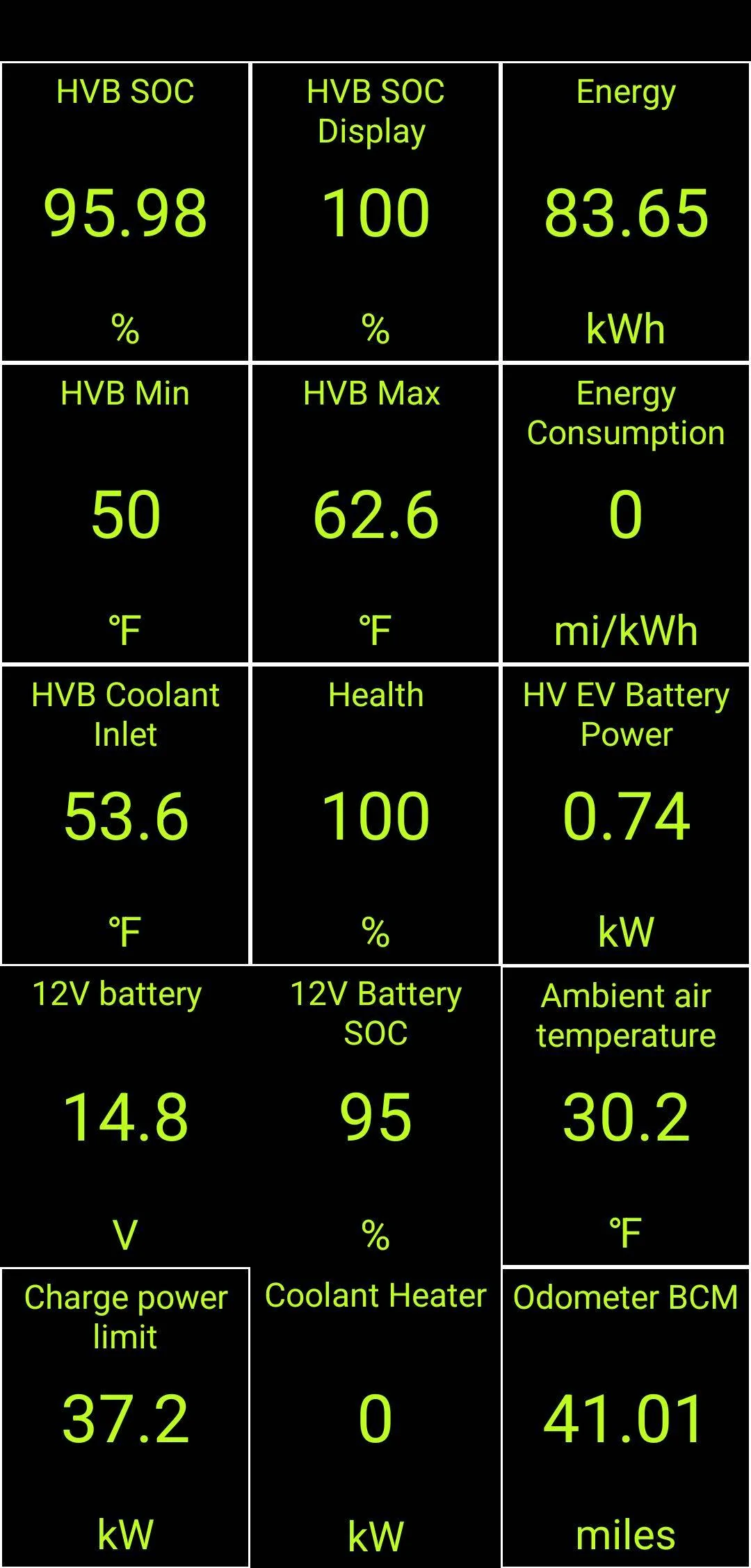
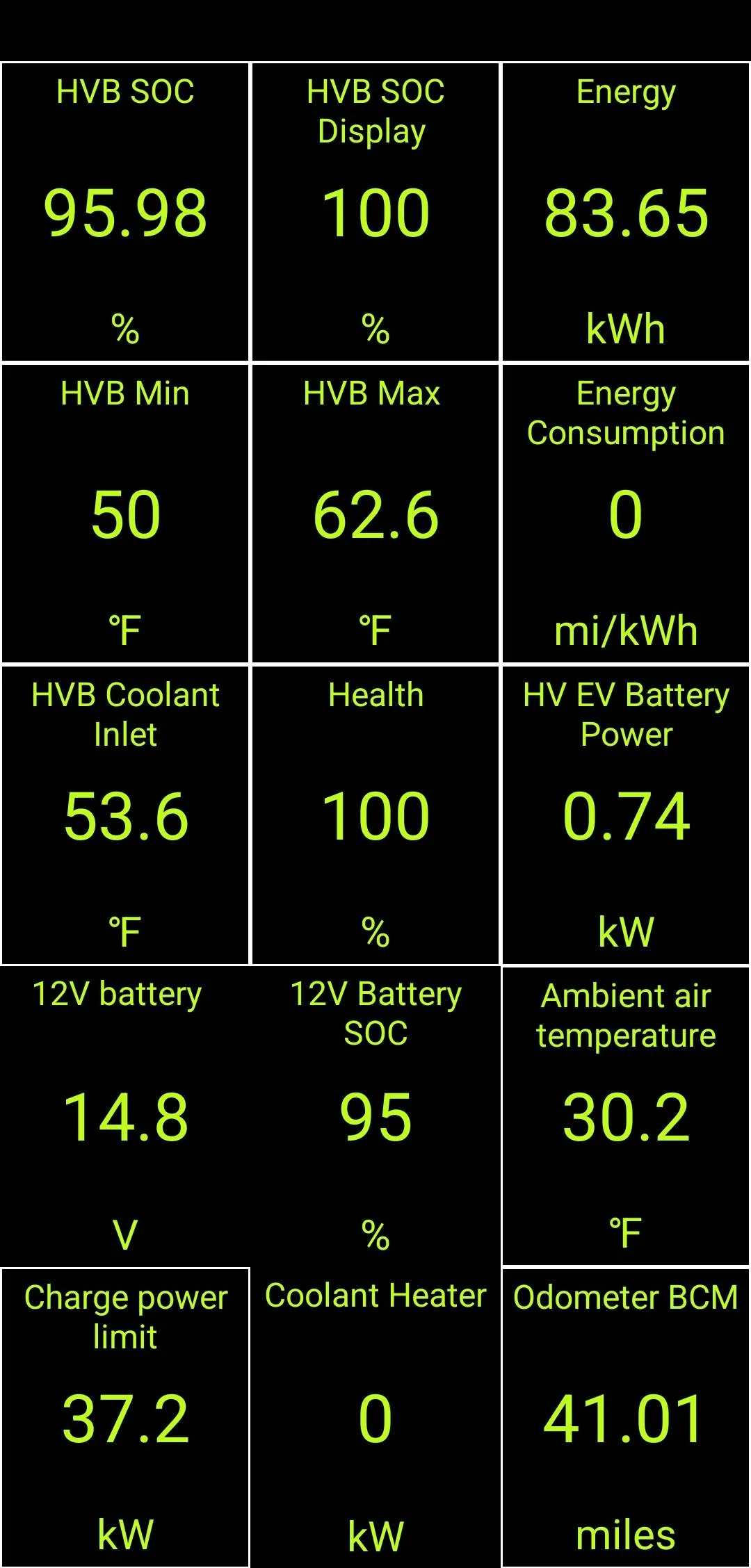
I did a baseline reading when I purchased my 2022 GTPE.
Screenshot_20221209-064614.jpg
Thanks for this! It looks like it was pretty cold out at the time, yet your capacity appears to be about 87kwh (83.65 kwh / .9598) which is great, and quite a bit higher than I would have thought at 30F ambient.

Was the car running for some time or just coming off the charger when you measured this? I'm hypothesizing that the HVB temp might be a better factor to consider than the ambient temp, and your coolant inlet at 53.6 makes me wonder if the battery was warm at this point.

Either way, really appreciate you providing this data point. I'll add it to my own observations.

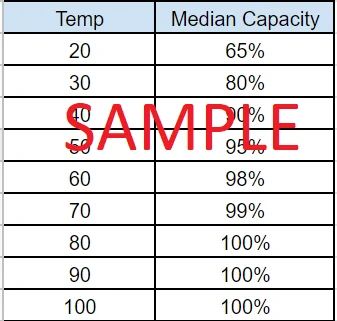
If the relationship is strong enough, I'm hoping to create a chart that shows something like this:

Ford Mustang Mach-E Measuring battery size DIY (via OBD/Car Scanner) 1672867935034


If this works out, then this could be combined with one's mi/kwh rating to either project or sanity check range in different temperature conditions. This could be helpful in these scenarios:

  • Potential buyer interested in ballpark worst-case scenario range
  • A new buyer who is shocked by the GOM reading and not completely reassured by anecdotal advice, especially from folks that they don't yet recognize as experts if new to the forum
  • Planning or verifying a charging route
 

mkhuffman

Well-Known Member
First Name
Mike
Joined
Nov 19, 2020
Threads
29
Messages
6,875
Reaction score
9,507
Location
Virginia
Vehicles
2025 Rivian R1T Tri-Max, Jeep GC-L, VW Jetta
Country flag
I'm hypothesizing that the HVB temp might be a better factor to consider than the ambient temp, and your coolant inlet at 53.6 makes me wonder if the battery was warm at this point.
I think you will find the HVB temp is strongly correlated with capacity, and ambient temp is poorly correlated with capacity.
 

21FE

Member
First Name
Alan
Joined
Dec 2, 2022
Threads
2
Messages
17
Reaction score
6
Location
Port Angeles Earth
Vehicles
2022 GTPE
Country flag
Thanks for this! It looks like it was pretty cold out at the time, yet your capacity appears to be about 87kwh (83.65 kwh / .9598) which is great, and quite a bit higher than I would have thought at 30F ambient.

Was the car running for some time or just coming off the charger when you measured this? I'm hypothesizing that the HVB temp might be a better factor to consider than the ambient temp, and your coolant inlet at 53.6 makes me wonder if the battery was warm at this point.

Either way, really appreciate you providing this data point. I'll add it to my own observations.

If the relationship is strong enough, I'm hoping to create a chart that shows something like this:

1672867935034.png


If this works out, then this could be combined with one's mi/kwh rating to either project or sanity check range in different temperature conditions. This could be helpful in these scenarios:

  • Potential buyer interested in ballpark worst-case scenario range
  • A new buyer who is shocked by the GOM reading and not completely reassured by anecdotal advice, especially from folks that they don't yet recognize as experts if new to the forum
  • Planning or verifying a charging route
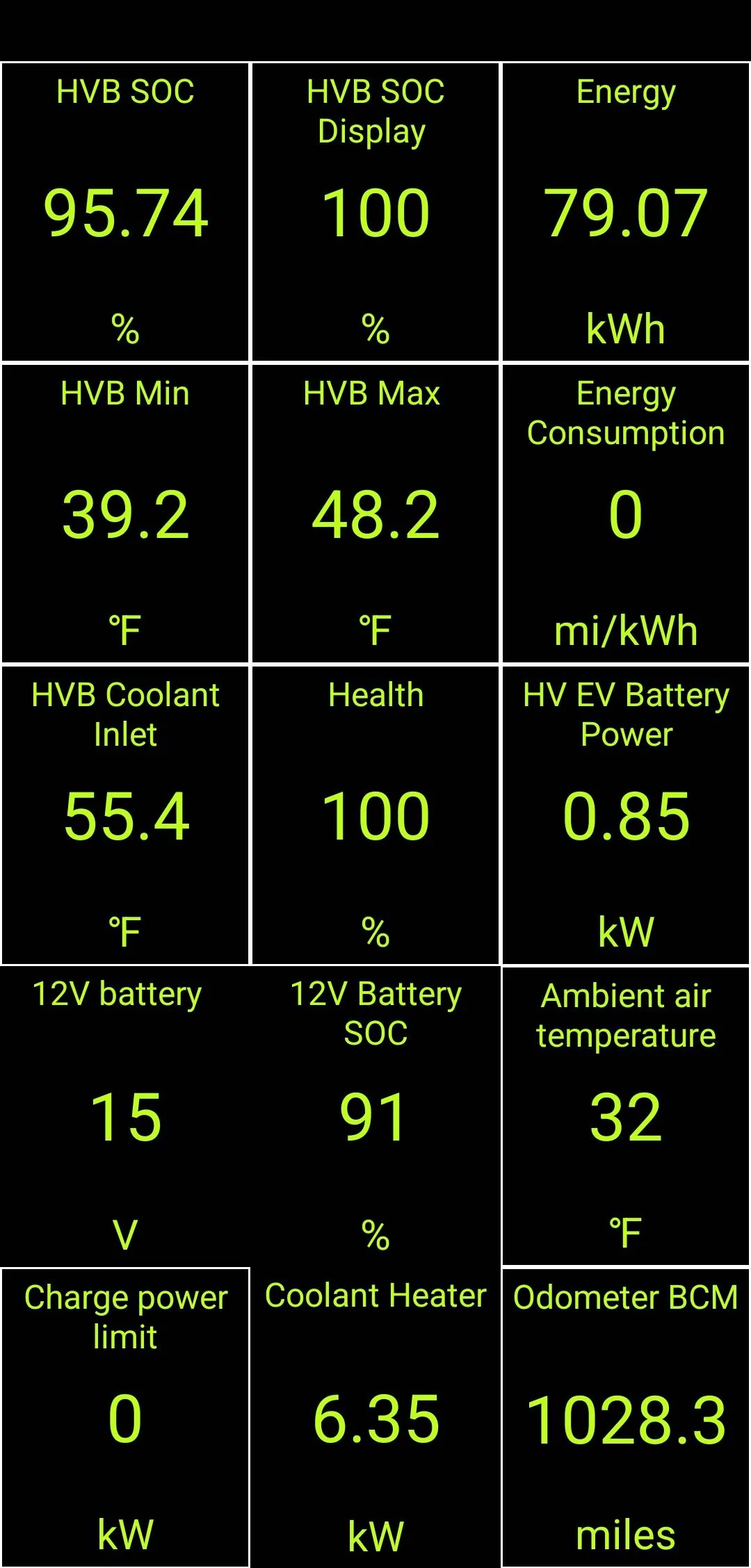
I take these after the car has been sitting for a few hours. (Plugged in).
Attached is the one I took New Years Day.
Ford Mustang Mach-E Measuring battery size DIY (via OBD/Car Scanner) 3
 
OP
OP

satchel prefect

Well-Known Member
Joined
Sep 2, 2022
Threads
9
Messages
157
Reaction score
274
Location
South Florida, USA
Vehicles
Crusty old PHEV
Country flag
I take these after the car has been sitting for a few hours. (Plugged in).
Attached is the one I took New Years Day.
Did the charge complete just before taking these readings, and did you perhaps set a departure time? It's interesting that the HVB coolant inlet temp is so much higher than ambient, and the difference is consistently 23.4F in both of your readings.

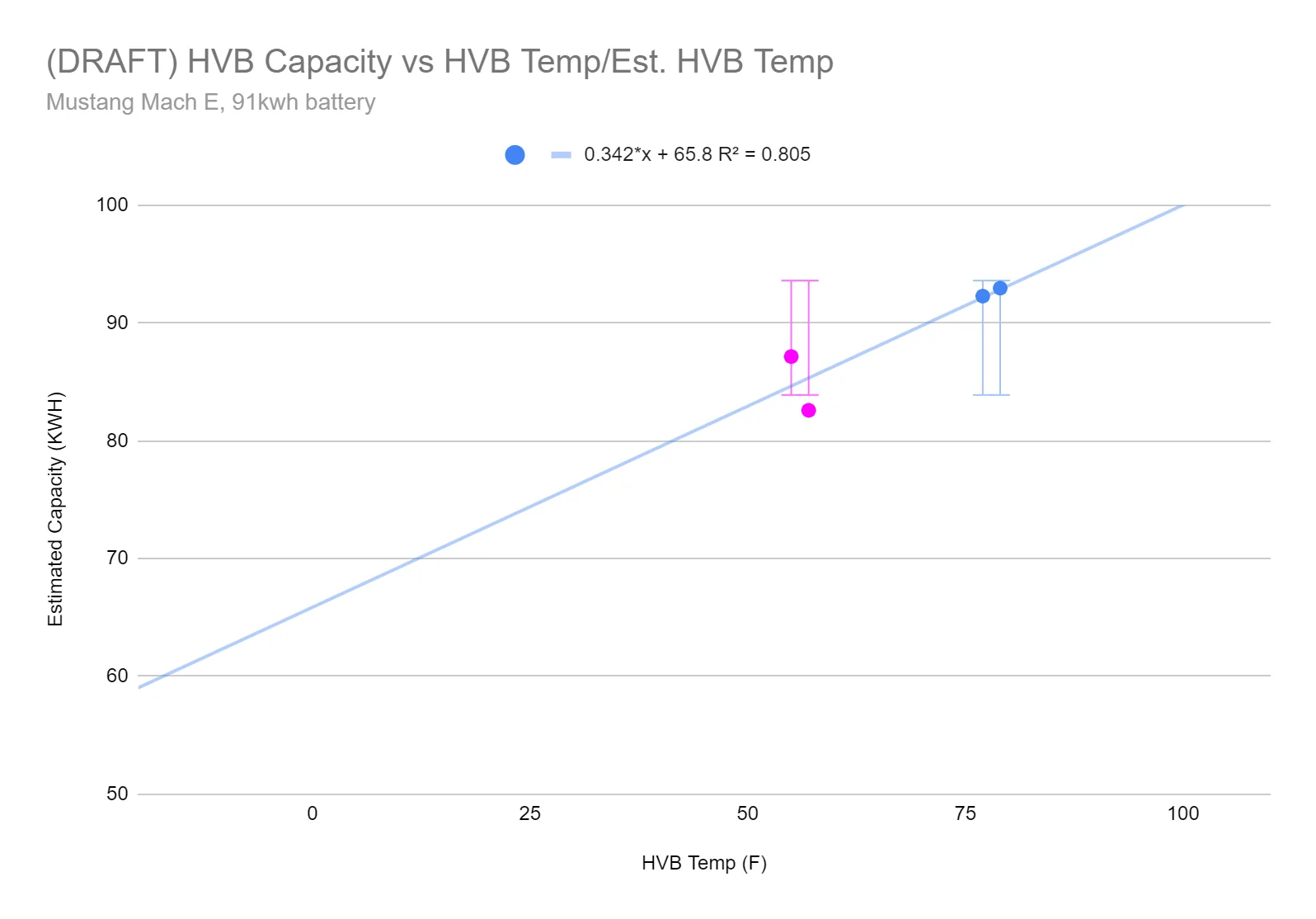
I just took another measurement on my car, and there was a 2F difference between HVB temp and ambient. I used this to approximate HVB temp for your two measurements and arrived at this:

Ford Mustang Mach-E Measuring battery size DIY (via OBD/Car Scanner) 1672971587580


Being based on 4 data points, with two of them inferred from coolant inlet rather than battery temp, I definitely wouldn't trust this yet, and it seems unlikely that the relationship will be linear across a realistic temperature range. If we can get more data in here, hopefully we can arrive at something with more confidence. But we can play with this anyhow:

My day-to-day 25 mile commute on mostly slow-and-go surface streets yields an indicated 3.6 mi/kwh. Based on this equation, at 75F my battery will store:

The model predicts: 0.342 x 75 + 65.8 = 91.45 kwh

Yielding a nice weather range of:

91.45 kwh x 3.6 mi/kwh = 329 miles
. This is very close to what the GOM shows


If I were to drive in 25F weather and using plenty of climate control, I will use a swag of 2.4 mi/kwh

The model predicts: 0.342 x 24 + 65.8 = 74.35 kwh

Yield a cold weather range of:

74.35 kwh x 2.4 mi/kwh = 178 miles
. This seems consistent with what I gather from posts here.

So, not a bad start, but far from convincing. Hopefully we'll get more data to plug in. If the primitive spreadsheet analytics hit a wall, I'll move over to something more robust.

Thanks for sharing.
 

mkhuffman

Well-Known Member
First Name
Mike
Joined
Nov 19, 2020
Threads
29
Messages
6,875
Reaction score
9,507
Location
Virginia
Vehicles
2025 Rivian R1T Tri-Max, Jeep GC-L, VW Jetta
Country flag
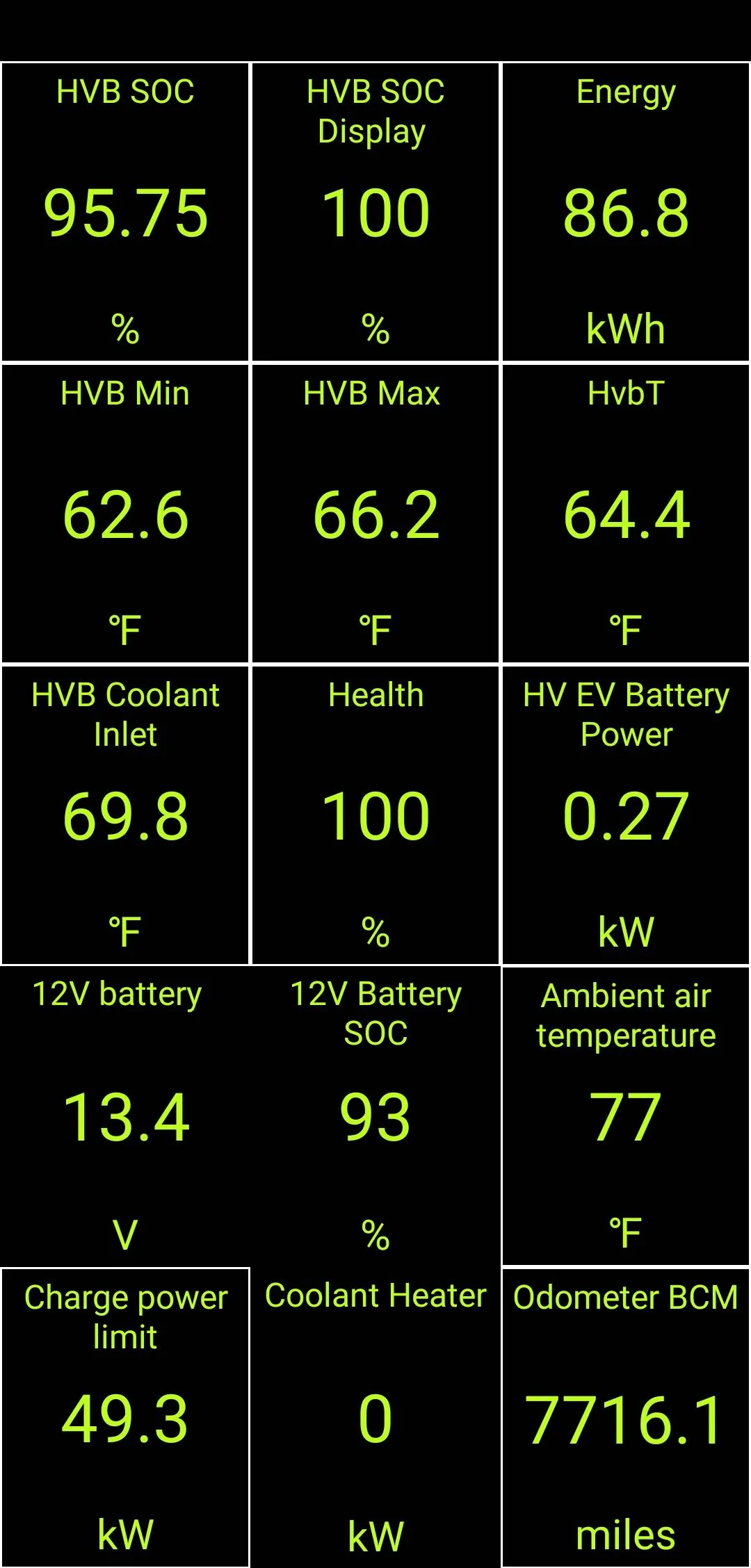
Here's a spring time 100%.
And my first 100%.
Screenshot_20230513_093911.jpg
2.jpg
Very interesting. 86.8/91 is not 100% SoH. I suspect your SoH will decline soon if your 100% charges are consistently in that range.

My 100% charge is around 84 kWh, and my SoH is 92%.
Sponsored


Top