Mach-Lee
Well-Known Member
- First Name
- Lee
- Joined
- Jul 16, 2021
- Threads
- 262
- Messages
- 11,365
- Reaction score
- 25,026
- Location
- Wisconsin
- Vehicles
- 2022 Mach-E Premium AWD
- Occupation
- Sci/Eng

- Thread starter
- #1
With Canadian wildfire smoke becoming a more frequent and persistent problem each year, it’s worth considering how it affects air quality inside vehicles, especially on heavy smoke days. To investigate this, I tested particle levels in my cabin using a portable particulate matter (PM) sensor while driving through smoky conditions.
Yesterday we had moderately bad air quality (AQI 100+):


Keep in mind I'm using Ford's premium cabin air filter, the micronAir proTect, which is designed to capture smaller particles like diesel and wildfire smoke. Particle counts are measured in micrograms per cubic meter (µg/m³), which differs from the Air Quality Index (AQI) commonly used by the public. Also, the sensor I used hasn’t been calibrated or validated yet, so the actual levels might vary slightly.
The outside particle count was about 32–36 µg/m³ (PM2.5; other sizes were similar), roughly corresponding to an AQI of 100 (orange, unhealthy for sensitive groups).
Unfortunately, due to an unforeseen glitch, only a small portion of the data I collected was saved, so I’m unable to show the graphs I had planned (perhaps another time).
Cabin Filter Performance
If you're dealing with wildfire smoke, do these two things:
Conclusion
Overall, the HVAC system and cabin filter performed well in reducing airborne particles during wildfire smoke conditions. Even with moderate outdoor pollution levels (AQI ~110), the system consistently maintained “good” air quality levels inside the cabin during normal operation. When recirculation mode was enabled, particle counts dropped to near-zero within minutes, demonstrating the HVAC system can function like an air purifier when used strategically.
These results suggest that even without specialized equipment or modifications, most modern vehicles equipped with a quality cabin air filter can offer significant protection against wildfire smoke. While the filter didn’t achieve its advertised efficiency under high airflow conditions, it still reduced particle levels by over 60%, which is meaningful for anyone with respiratory sensitivities and improves overall comfort on smoky days.
For those living in areas regularly affected by wildfire smoke, simply using the recirculate function can significantly reduce your exposure to harmful fine particulate matter, which helps protect your lungs and health during wildfire smoke season.
Yesterday we had moderately bad air quality (AQI 100+):
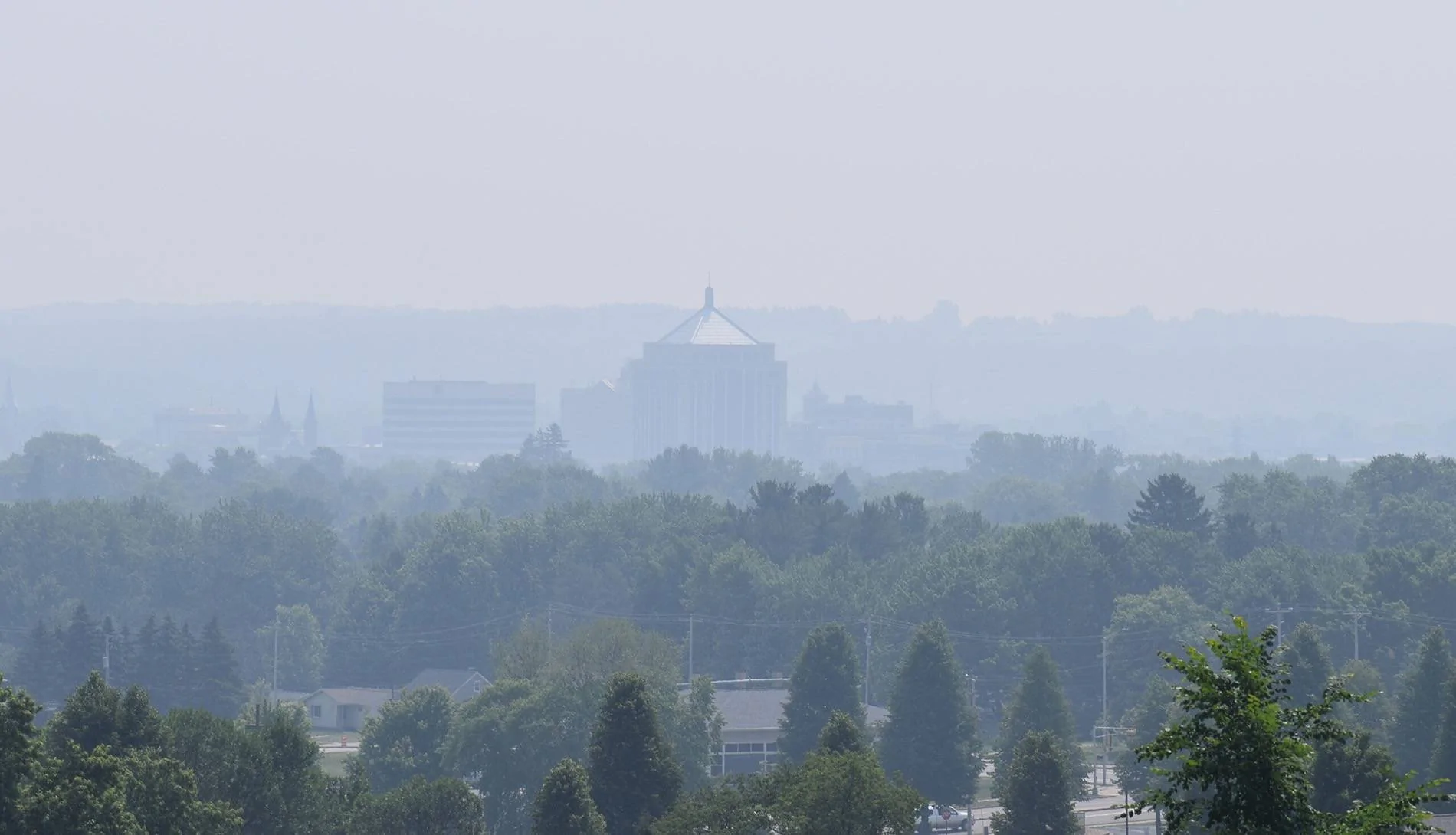

Keep in mind I'm using Ford's premium cabin air filter, the micronAir proTect, which is designed to capture smaller particles like diesel and wildfire smoke. Particle counts are measured in micrograms per cubic meter (µg/m³), which differs from the Air Quality Index (AQI) commonly used by the public. Also, the sensor I used hasn’t been calibrated or validated yet, so the actual levels might vary slightly.
The outside particle count was about 32–36 µg/m³ (PM2.5; other sizes were similar), roughly corresponding to an AQI of 100 (orange, unhealthy for sensitive groups).
Unfortunately, due to an unforeseen glitch, only a small portion of the data I collected was saved, so I’m unable to show the graphs I had planned (perhaps another time).
Cabin Filter Performance
- HVAC AUTO Mode: With the HVAC set to 72ºF on AUTO 2, cabin particle levels stabilized between 7 and 12 µg/m³, corresponding to an AQI below 50 (good air quality).
- Recirculation Mode: Turning on the recirculate function (which stops outside air intake) dropped particle counts to around 0.5 µg/m³ over 30 minutes, indicating very clean air. Usually, the HVAC system cancels recirculation after some time to prevent fogging, but since the weather was mild (60ºF), it didn’t cancel (recirculation typically lasts only 5 minutes in colder weather). However, CO₂ levels inside the cabin rose to about 2000 ppm over time.
- Defrost Mode: Selecting the defrost function sucks outside air at higher speeds—a worst-case scenario for the filter. Particle counts increased to 8–14 µg/m³, still representing about a 65% reduction compared to outside air. This is less than the filter’s stated 95% efficiency, but that figure is typically achieved only at very low fan speeds.
- Recirculation Recovery Time: Switching back to recirculate mode, it took about 5 minutes at high fan speed for cabin particle counts to drop to 1.0 µg/m³, as expected. I like to call this “air purifier mode,” since it functions similarly to a home air purifier in how effectively it cleans the air inside the cabin.
If you're dealing with wildfire smoke, do these two things:
- Install a premium cabin air filter capable of filtering small particles (PM2.5).
- Use the recirculate button whenever outdoor air quality is poor.
Conclusion
Overall, the HVAC system and cabin filter performed well in reducing airborne particles during wildfire smoke conditions. Even with moderate outdoor pollution levels (AQI ~110), the system consistently maintained “good” air quality levels inside the cabin during normal operation. When recirculation mode was enabled, particle counts dropped to near-zero within minutes, demonstrating the HVAC system can function like an air purifier when used strategically.
These results suggest that even without specialized equipment or modifications, most modern vehicles equipped with a quality cabin air filter can offer significant protection against wildfire smoke. While the filter didn’t achieve its advertised efficiency under high airflow conditions, it still reduced particle levels by over 60%, which is meaningful for anyone with respiratory sensitivities and improves overall comfort on smoky days.
For those living in areas regularly affected by wildfire smoke, simply using the recirculate function can significantly reduce your exposure to harmful fine particulate matter, which helps protect your lungs and health during wildfire smoke season.
Sponsored
Last edited: