
ChasingCoral
Well-Known Member
- First Name
- Mark
- Joined
- Feb 3, 2020
- Threads
- 506
- Messages
- 14,337
- Reaction score
- 28,720
- Location
- Maryland
- Vehicles
- 2021 GB E4X FE, 2022 F-150 Lightning Lariat ER
- Occupation
- Retired oceanographer

- Thread starter
- #1
https://www.greencarreports.com/new...e-standard-will-harmonize-systems-up-to-11-kw
Wireless EV charging gets a boost: Single standard will harmonize systems up to 11 kw

STEPHEN EDELSTEIN OCTOBER 23, 2020
The Society of Automotive Engineers (SAE) on Thursday announced the first global standard for wireless electric-car charging, which could help accelerate the technology's rollout.
The standard—officially SAE J2954—applies to inductive-charging systems up to 11 kilowatts. As with existing SAE standards for other charging methods, J2954 will harmonize new systems, allowing for increased interoperability between hardware and vehicles from different manufacturers.

BMW 5-Series plug-in hybrid wireless charging system
Inductive charging works by creating a magnetic-resonance field between a transmitting pad on the ground (which is physically connected to the grid) and a receiving pad on the underside of the vehicle. Wireless signals sent between the vehicle and charging system initiate and stop charging.
"Charging your EV should be as simple as parking and walking away—the wireless charging SAE J2954 standard gives freedom to do exactly that, safely and automatically," Jesse Schneider, chair of the SAE J2954 task force, said in a statement.
It's taken a long time just to get to this point (the task force began its work in 2007), but that has brought the technology to the point where, with a 10-inch ground clearance, systems are achieving 94% grid-to-battery efficiency, according to an SAE press release. With additional elements outline in the J2954 standard, wireless charging also fulfills requirements for autonomous cars to charge themselves without human interaction, the SAE said.

Functional diagram - SAE J2954 standard for wireless charging
This could be a turning point for the availability of wireless EV charging, which was hyped several years ago but was slow to catch on because of several competing standards that were only compatible (if at all) at very low power.
BMW has been offering a trial of the BMW 530e plug-in hybrid with wireless charging at 3.2 kw—but BMW and many other automakers have expressed that they'll have more interest in the technology when this standard is set.
There's been some consolidation in the business over the past several years. One of the major players, Qualcomm, sold its wireless tech to another wireless-tech powerhouse, WiTricity, last year—and we've included a video from them, just below, that gives a good top-level view on how the hardware and the physics work.
High-power wireless charging—providing the equivalent of DC fast charging, but over an air gap—is another future possibility. But this standard doesn't cover that. Although this has been primarily limited to trucks so far, earlier this year, a trial in Norway started, testing Momentum Dynamics hardware and Jaguar I-Pace taxis.
Dynamic wireless charging is another future technology that might prove useful for trucks on frequently-traveled freight routes. Tests with commercial trucks on a small stretch of road in Sweden began last year.
Wireless EV charging gets a boost: Single standard will harmonize systems up to 11 kw

STEPHEN EDELSTEIN OCTOBER 23, 2020
The Society of Automotive Engineers (SAE) on Thursday announced the first global standard for wireless electric-car charging, which could help accelerate the technology's rollout.
The standard—officially SAE J2954—applies to inductive-charging systems up to 11 kilowatts. As with existing SAE standards for other charging methods, J2954 will harmonize new systems, allowing for increased interoperability between hardware and vehicles from different manufacturers.

BMW 5-Series plug-in hybrid wireless charging system
Inductive charging works by creating a magnetic-resonance field between a transmitting pad on the ground (which is physically connected to the grid) and a receiving pad on the underside of the vehicle. Wireless signals sent between the vehicle and charging system initiate and stop charging.
"Charging your EV should be as simple as parking and walking away—the wireless charging SAE J2954 standard gives freedom to do exactly that, safely and automatically," Jesse Schneider, chair of the SAE J2954 task force, said in a statement.
It's taken a long time just to get to this point (the task force began its work in 2007), but that has brought the technology to the point where, with a 10-inch ground clearance, systems are achieving 94% grid-to-battery efficiency, according to an SAE press release. With additional elements outline in the J2954 standard, wireless charging also fulfills requirements for autonomous cars to charge themselves without human interaction, the SAE said.
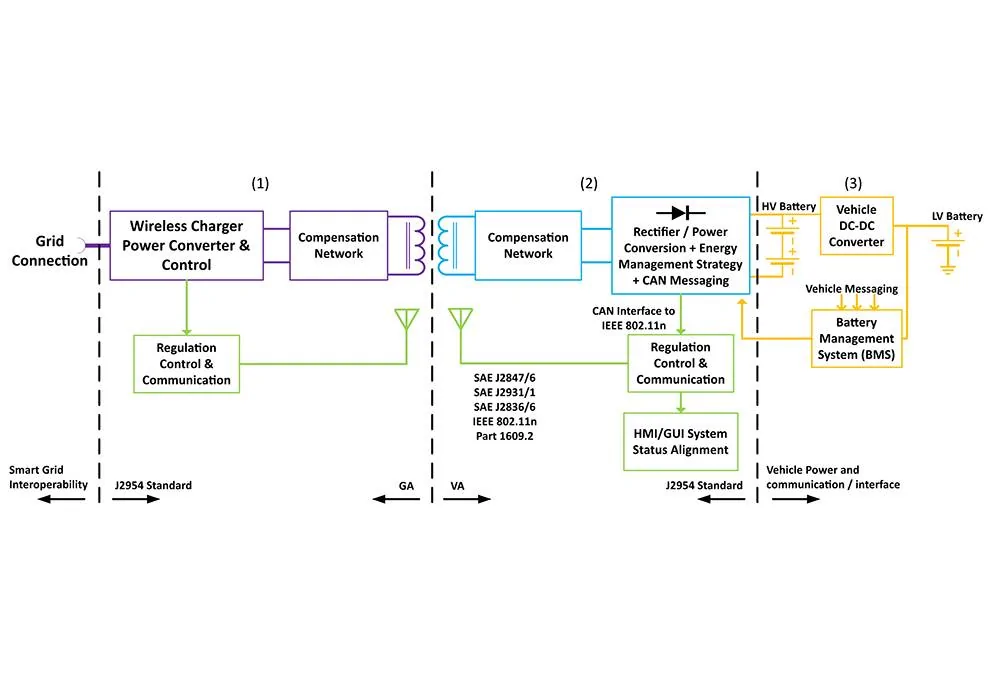
Functional diagram - SAE J2954 standard for wireless charging
This could be a turning point for the availability of wireless EV charging, which was hyped several years ago but was slow to catch on because of several competing standards that were only compatible (if at all) at very low power.
BMW has been offering a trial of the BMW 530e plug-in hybrid with wireless charging at 3.2 kw—but BMW and many other automakers have expressed that they'll have more interest in the technology when this standard is set.
There's been some consolidation in the business over the past several years. One of the major players, Qualcomm, sold its wireless tech to another wireless-tech powerhouse, WiTricity, last year—and we've included a video from them, just below, that gives a good top-level view on how the hardware and the physics work.
High-power wireless charging—providing the equivalent of DC fast charging, but over an air gap—is another future possibility. But this standard doesn't cover that. Although this has been primarily limited to trucks so far, earlier this year, a trial in Norway started, testing Momentum Dynamics hardware and Jaguar I-Pace taxis.
Dynamic wireless charging is another future technology that might prove useful for trucks on frequently-traveled freight routes. Tests with commercial trucks on a small stretch of road in Sweden began last year.
Sponsored


