What’s ‘NORMAL’ for L3 charging speeds?

Maquis

Well-Known Member
First Name
Dave
Joined
Dec 21, 2020
Threads
34
Messages
5,698
Reaction score
8,087
Location
Illinois
Vehicles
2021 Mach E4X, 2023 Lightning Lariat ER
Country flag
Folks are too quick to dismiss level 1, it's likely sufficient for a good percentage of people. Not having L2 is often cited as a reason not to buy an EV, or as a large secondary expense when you do. While I plan to eventually add L2, I've been using L1 for a while and it's been plenty for my use.

Back to the OP, I used L3 exclusivity for my first few months, and have made a few multi-state road trips, so have done several dozen L3 charges. Typically see 150-160 at startup, but it quickly drops down, and as others have said if the pack is cold it'll suffer a slow charge.

Tesla and EA both have worthwhile memberships if your charging multiple times a month, though I just saw a price increase with EA here, so keep an eye on that. Ionna just opened here and seem to have the best prices around without a membership.
Except that level 1 is very inefficient. About 30% in losses. Higher speed level 2 losses are less than 10%. You can do the math and see what the cost difference is.
Sponsored


Jerrytball

Well-Known Member
First Name
Jerry
Joined
Feb 21, 2024
Threads
30
Messages
2,152
Reaction score
1,136
Location
Gulfport MS
Vehicles
2026 bmw i4 M50
Occupation
Retired
Country flag
You know guys I know this is Mustang form, but this is some interesting. New data since they have now started delivery of some of the new BMW ix3’s overseas. This is from a guy that actually went ahead and did a pretty good test run on it this past week now that he got it.. The kilometers convert basically from the first set of kilometers about 286 miles. Up to 372 miles.


RANGE: "We drove the car in cold weather, about 2–5 degrees. On the highway, at speeds of 130–140 km/h, the consumption was 25.1 kWh/100 km, which means a highway range in cold weather of over 400 km. On national roads, at speeds of 80–100 km/h in Comfort mode, the consumption drops to 21.4 kWh/100 km, and if we engage Eco mode and drive more carefully, we reach 18.8 kWh/100 km, which is the equivalent of a real range of 600 km."

CHARGING: "We arrived with 15% of the battery. After just two minutes, the charging power reached a maximum of almost 373 kW (officially, 400 kW), at 46% of the battery the charging power was still over 300 kW, and at 80%, it was still charging with 122 kW.

The result was an average charging power of over 229 kW and a 15–80% charging time of 20 minutes and 32 seconds. This means that the standard 20–80% charge took about 15–16 minutes."
 

kens

Well-Known Member
First Name
Ken
Joined
Jan 27, 2025
Threads
8
Messages
419
Reaction score
432
Location
IL, USA
Vehicles
2022 GT
Except that level 1 is very inefficient. About 30% in losses. Higher speed level 2 losses are less than 10%. You can do the math and see what the cost difference is.
True enough, and one of the reasons I plan to install L2. Although from a pure cost perspective it's going to take a very long time to recoup the cost to upgrade the ESVE from the heat loss savings. So long that I'll never see the install cost repaid at this house, and my install will be on the lower cost end.

I was just wanting to point out it's entirely possible to live with L1 if that's all you have, so many folks never consider it as viable.
 

Mach-Lee

Well-Known Member
First Name
Lee
Joined
Jul 16, 2021
Threads
262
Messages
11,381
Reaction score
25,066
Location
Wisconsin
Vehicles
2022 Mach-E Premium AWD
Occupation
Sci/Eng
Country flag
True enough, and one of the reasons I plan to install L2. Although from a pure cost perspective it's going to take a very long time to recoup the cost to upgrade the ESVE from the heat loss savings. So long that I'll never see the install cost repaid at this house, and my install will be on the lower cost end.

I was just wanting to point out it's entirely possible to live with L1 if that's all you have, so many folks never consider it as viable.
L1 is not viable if you have to drive more than 30-50 miles per day or live where the temperature gets well below freezing. Battery will not stay warm and you won’t be able to keep up with charging. I happily plopped down the cash for L2 before the car was delivered to not deal with that. But maybe if you’re retired or WFH in a southern state it would be fine.
 

devmach-e

Well-Known Member
First Name
David
Joined
Sep 8, 2021
Threads
1
Messages
2,028
Reaction score
2,482
Location
SF Bay Area
Vehicles
2022 Premium RWD ER, 2016 Toyota Highlander Hybrid
Occupation
Unix Sysadmin
Country flag
The speed is modified to protect the battery. It is critical to do so

Even modern Teslas rarely charge at more than 200 kw/hr

It’s actually not good to do ultra fast (350 etc) as that will damage the battery more. However, time spent charging at “pretty fast” is still dangerous, and “pretty fast” takes longer than super ultra fast - but that’s when the difference we are taking about is 33% faster (ie 150 vs 200), not 200% faster (50 vs 150); in that case 50 is slow enough to be much safer and why the charging curve behaves that way

800 volt architecture (Ford and Tesla are 400v), advanced cooling and control may mean 350+ kw/hr becomes safer; not sure. Bears some investigating

Anyway, for practical purposes and less theory, only fast charge from about 15-25 percent (ideally closer to 25), to 60, never going over 60 through fast charging, as that puts an enormous strain on the battery, aging the battery (loses some capacity)

Too high or too low = bad. Too hot or too cold = bad. Always precondition for fast charging. If you’re uncomfortable, the battery is uncomfortable
The car is engineered to use the battery from 100% all the way down to 0%. And it is engineered to withstand fast charging from 0% to 100% everyday if necessary. If the amount of degradation from doing those events was so severe, Ford wouldn't have an 8-year/100K mile warranty. This sort of fear mongering about charging needs to stop.


Maquis

Well-Known Member
First Name
Dave
Joined
Dec 21, 2020
Threads
34
Messages
5,698
Reaction score
8,087
Location
Illinois
Vehicles
2021 Mach E4X, 2023 Lightning Lariat ER
Country flag
The car is engineered to use the battery from 100% all the way down to 0%. And it is engineered to withstand fast charging from 0% to 100% everyday if necessary. If the amount of degradation from doing those events was so severe, Ford wouldn't have an 8-year/100K mile warranty. This sort of fear mongering about charging needs to stop.
The 8/100 EV battery warranty is mandated by the feds. Ford cannot not have it regardless of how the battery acts.
 

devmach-e

Well-Known Member
First Name
David
Joined
Sep 8, 2021
Threads
1
Messages
2,028
Reaction score
2,482
Location
SF Bay Area
Vehicles
2022 Premium RWD ER, 2016 Toyota Highlander Hybrid
Occupation
Unix Sysadmin
Country flag
The 8/100 EV battery warranty is mandated by the feds. Ford cannot not have it regardless of how the battery acts.
I haven't been able to find the actual BEV federal warranty mandate. Whether or not the mandate exists, Ford isn't about to have a battery that can fail within the warranty period because people use the car as intended.
 

devmach-e

Well-Known Member
First Name
David
Joined
Sep 8, 2021
Threads
1
Messages
2,028
Reaction score
2,482
Location
SF Bay Area
Vehicles
2022 Premium RWD ER, 2016 Toyota Highlander Hybrid
Occupation
Unix Sysadmin
Country flag
I haven't been able to find the actual BEV federal warranty mandate. Whether or not the mandate exists, Ford isn't about to have a battery that can fail within the warranty period because people use the car as intended.
I did find the regulation that mandates the 8-year/100K mile warranty. However there's two problems.

1) it isn't actually supposed to go into effect until the 2027 model year,
and
2) the current administration has supposedly withdrawn it.

See:
https://www.ecfr.gov/current/title-.../subpart-V/section-85.2103#p-85.2103(d)(1)(v)
and
https://www.federalregister.gov/doc...ars-2027-and-later-light-duty-and-medium-duty
 

YeOldeTraveller

Well-Known Member
First Name
Clark
Joined
Jul 12, 2024
Threads
6
Messages
332
Reaction score
386
Location
Ann Arbor, MI, USA
Vehicles
2024 MME Rally
Country flag
My question for the community is this: am I seeing typical charge speeds? I thought these cars could charge closer to 180KW.
I don't have good cold weather values, but I can answer on the overall capability of the car.
My 2024 Mustang Mach-E Rally has a claimed rating of 150 KW for peak charging. The limiting factor is actually the current. My Rally with the 91 KWh usable battery can draw up to 450 A at pack voltage when the SoC is low.

While testing charging before a long road trip, I reported a session at a Pilot using a 350 KW Delta system maintained by EVgo. Peak was 152 KW from the dispenser. I did 5-80% in 38.5 minutes.

I posted a chart of a different session in different thread. That chart is typical of the curve on large NMC batteries for 2024 years and newer. Older cars should have received an update that gets them close to this as well.
 
OP
OP
inmyrightmind

inmyrightmind

Active Member
First Name
Matt
Joined
Dec 19, 2025
Threads
3
Messages
44
Reaction score
44
Location
Northern Ohio
Vehicles
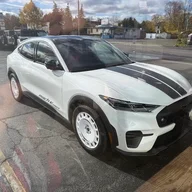
2024 Mach-e Rally (white)
Occupation
retired
First, let me thank all of the forum members for their good information and constructive advice. As a new MME owner, I find this forum extremely helpful! The tips and tricks, pictures, and personal experiences, are helping me to get the most out of my new car.

I’ve had a lot of people who’ve known me for decades say things like, “I never pictured you as EV guy!“ I told them that 700 pound feet of torque and not being held hostage by the price of premium gasoline might make them change their minds as well.

My other “car“ is a King Ranch F350 super crew diesel. Ever since I got the MME, the truck has been collecting a lot of dust in the garage. And at five dollars a gallon for diesel, I think it’s gonna get even dustier until I absolutely have to have an 8 foot bed to do some work.
 

Kamuelaflyer

Well-Known Member
First Name
Bill
Joined
Feb 18, 2020
Threads
11
Messages
11,376
Reaction score
23,003
Location
Hawaii
Vehicles
2021 Premium Infinite Blue. ER AWD. 2020 Raptor, 2021 Ranger.
Country flag
I haven't been able to find the actual BEV federal warranty mandate. Whether or not the mandate exists, Ford isn't about to have a battery that can fail within the warranty period because people use the car as intended.
I did find the regulation that mandates the 8-year/100K mile warranty. However there's two problems.

1) it isn't actually supposed to go into effect until the 2027 model year,
and
2) the current administration has supposedly withdrawn it.

See:
https://www.ecfr.gov/current/title-.../subpart-V/section-85.2103#p-85.2103(d)(1)(v)
and
https://www.federalregister.gov/doc...ars-2027-and-later-light-duty-and-medium-duty
David, there are two considerations in the Federally mandated warranty requirement. First is the enabling legislation which is part of the Clean Air Act. The second is the administrative regulations implementing the law. The EPA has a degree of latitude in the latter and none in the former.

To effectively end federal warranty mandates, “they” have to repeal the Clean Air Act section requiring the warranty.

There’s more though. Since you live in California, state law requires a HVB warranty as well. This is entirely separate from federal law and is currently in effect for new EV sales this year.
 

devmach-e

Well-Known Member
First Name
David
Joined
Sep 8, 2021
Threads
1
Messages
2,028
Reaction score
2,482
Location
SF Bay Area
Vehicles
2022 Premium RWD ER, 2016 Toyota Highlander Hybrid
Occupation
Unix Sysadmin
Country flag
David, there are two considerations in the Federally mandated warranty requirement. First is the enabling legislation which is part of the Clean Air Act. The second is the administrative regulations implementing the law. The EPA has a degree of latitude in the latter and none in the former.

To effectively end federal warranty mandates, “they” have to repeal the Clean Air Act section requiring the warranty.

There’s more though. Since you live in California, state law requires a HVB warranty as well. This is entirely separate from federal law and is currently in effect for new EV sales this year.
My point is that prior to April 18th, 2024, there was no federal mandate to cover the battery in an electric vehicle. And that mandate was going to go into effect for model year 2027. And that mandate has be subsequently withdrawn:
https://www.federalregister.gov/doc...ing-and-motor-vehicle-greenhouse-gas-emission

California does not have a BEV warranty requirement, either. They had a 10-year/150K-mile warranty for hybrids through 2017, and plug-in hybrids through 2025, but that has been subsequently stopped. Supposedly there is a new mandated warranty period in process, but that is up in the air given the current administration.

https://ww2.arb.ca.gov/resources/fact-sheets/california-vehicle-and-emissions-warranty-periods

Ford supplies with a generous battery warranty not due to the Feds or California demanding it.
 

devmach-e

Well-Known Member
First Name
David
Joined
Sep 8, 2021
Threads
1
Messages
2,028
Reaction score
2,482
Location
SF Bay Area
Vehicles
2022 Premium RWD ER, 2016 Toyota Highlander Hybrid
Occupation
Unix Sysadmin
Country flag
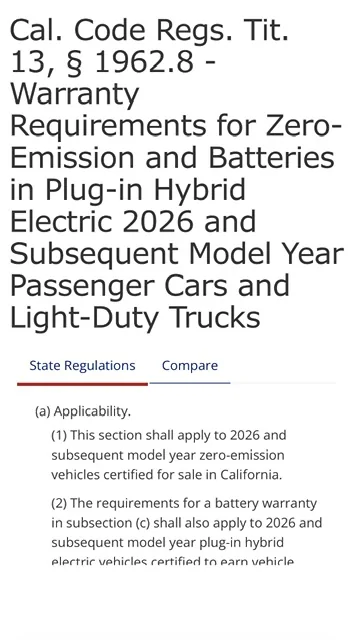
IMG_2868.webp


13 CCR § 1962.8

See also, 13 CCR §1962.4

It has been in effect since 2022.
While it might have been in effect since 2022, it hasn’t applied to any vehicles until this year (or late last year). My 2022 certainly wouldn’t be covered by the new mandate by the state.
 

Kamuelaflyer

Well-Known Member
First Name
Bill
Joined
Feb 18, 2020
Threads
11
Messages
11,376
Reaction score
23,003
Location
Hawaii
Vehicles
2021 Premium Infinite Blue. ER AWD. 2020 Raptor, 2021 Ranger.
Country flag
While it might have been in effect since 2022, it hasn’t applied to any vehicles until this year (or late last year). My 2022 certainly wouldn’t be covered by the new mandate by the state.
California does not have a BEV warranty requirement, either.
Ford provides the absolute minimum that they can get away with, and not a meter or minute more. In addition, the California battery warranty requirements were well publicized long before the implementing rule was adopted.
Sponsored


Top