Charging at home via 110?

DBC

Well-Known Member
First Name
Don
Joined
Oct 1, 2020
Threads
8
Messages
1,224
Reaction score
1,430
Location
San Diego
Vehicles
Volt ELR
Country flag
You will need an EVSE that can limit the charging current to 24 amps. If you use the portable unit included with your MME, it will try to charge at 40 amps and trip your breaker.
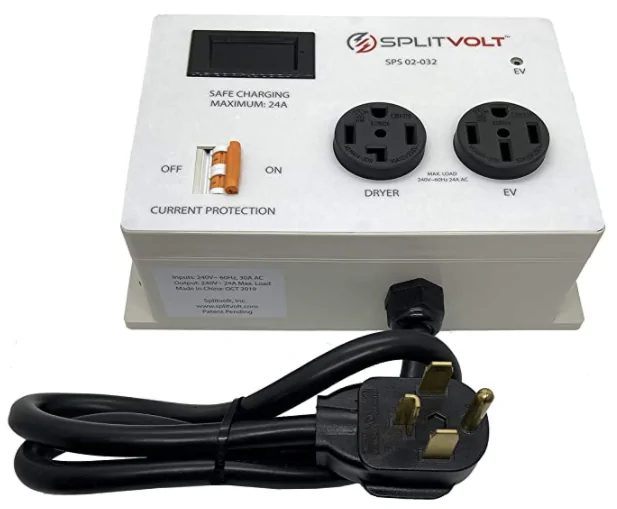
AFAIK the Ford portable charger pulls 30A but yes, the Splitter says not to plug in an appliance which uses more than 24A, which seemingly defeats the purpose.
Sponsored

 
Last edited:

bkboygenius

Well-Known Member
First Name
Sean
Joined
Mar 10, 2021
Threads
2
Messages
49
Reaction score
61
Location
Long Island, NY
Vehicles
2021 Grabber Blue MME FE
Occupation
IT Security
Country flag
I ordered Splitvolt splitter that sits on 240v dryer outlet and automatically switches between a dryer and an EV. Hope to avoid ordering a multi-thousand dollar installation of a dedicated charger.
Haven't tried it yet.
1615669035408.png
I just bought and received this (10-30 and 14-50 outlet version) today. Connected it to my dryer outlet, connected the other cables (the cable that comes with the MME charger and the dryer cable) and it charges Level 2 (24A) without issue thus far. I have not tested the auto-switch function that is supposed to kick in when the dryer is being used. So far, I give it a big THUMBS UP!
 

DBC

Well-Known Member
First Name
Don
Joined
Oct 1, 2020
Threads
8
Messages
1,224
Reaction score
1,430
Location
San Diego
Vehicles
Volt ELR
Country flag
I ordered Splitvolt splitter that sits on 240v dryer outlet and automatically switches between a dryer and an EV.
Is there an alternative product? This says current should be limited to 24A but dryers and the Ford charger pulls 30A. Look in your electrical box. My guess is the dryer is on a 40A circuit. If this is the case then your electrical system will support 30A but this device doesn't.
 

dbsb3233

Well-Known Member
First Name
TimCO
Joined
Dec 30, 2019
Threads
56
Messages
10,100
Reaction score
11,965
Location
Colorado, USA
Vehicles
2021 Mustang Mach-E FE, 2025 Porche Macan Electric
Occupation
Retired
Country flag
The portable charger pulls 30A, which is what electric dryers usually pull. In fact I think Ford did this purposefully so the portable charger could use a dryer outlet. So it won't trip the breakers on the panel. However the Splitter says not to plug in an appliance which uses more than 24A, which seemingly defeats its entire purpose.
Dryers typically pull ~24A, which is why they need a dedicated 30A circuit. Same 80% rule applies.

https://products.geappliances.com/appliance/gea-support-search-content?contentId=34592

The Ford Mobile Charger will need a 40A (or higher) circuit to use 240V.
 

RedStallion

Banned
Banned
Joined
Mar 9, 2021
Threads
50
Messages
1,393
Reaction score
1,770
Location
People's Republic of California
Vehicles
Mach-E, et al
Country flag
You will need an EVSE that can limit the charging current to 24 amps. If you use the portable unit included with your MME, it will try to charge at 40 amps and trip your breaker.
Ford's web page states "Ford Mobile Charger using 240V/30A NEMA 14-50 wall outlet". It's still above 24A and may trip the 30A breaker. If that happens I will probably buy Grizzl-e, it has selectable amperage.


NoMoShocks

Well-Known Member
First Name
Larry
Joined
Jul 9, 2020
Threads
19
Messages
347
Reaction score
526
Location
Camas, WA
Vehicles
2017 Chevy Bolt Premier EV, 2018 Mitsubishi Outlander GT PHEV
Occupation
Electrical product safety engineer
Country flag
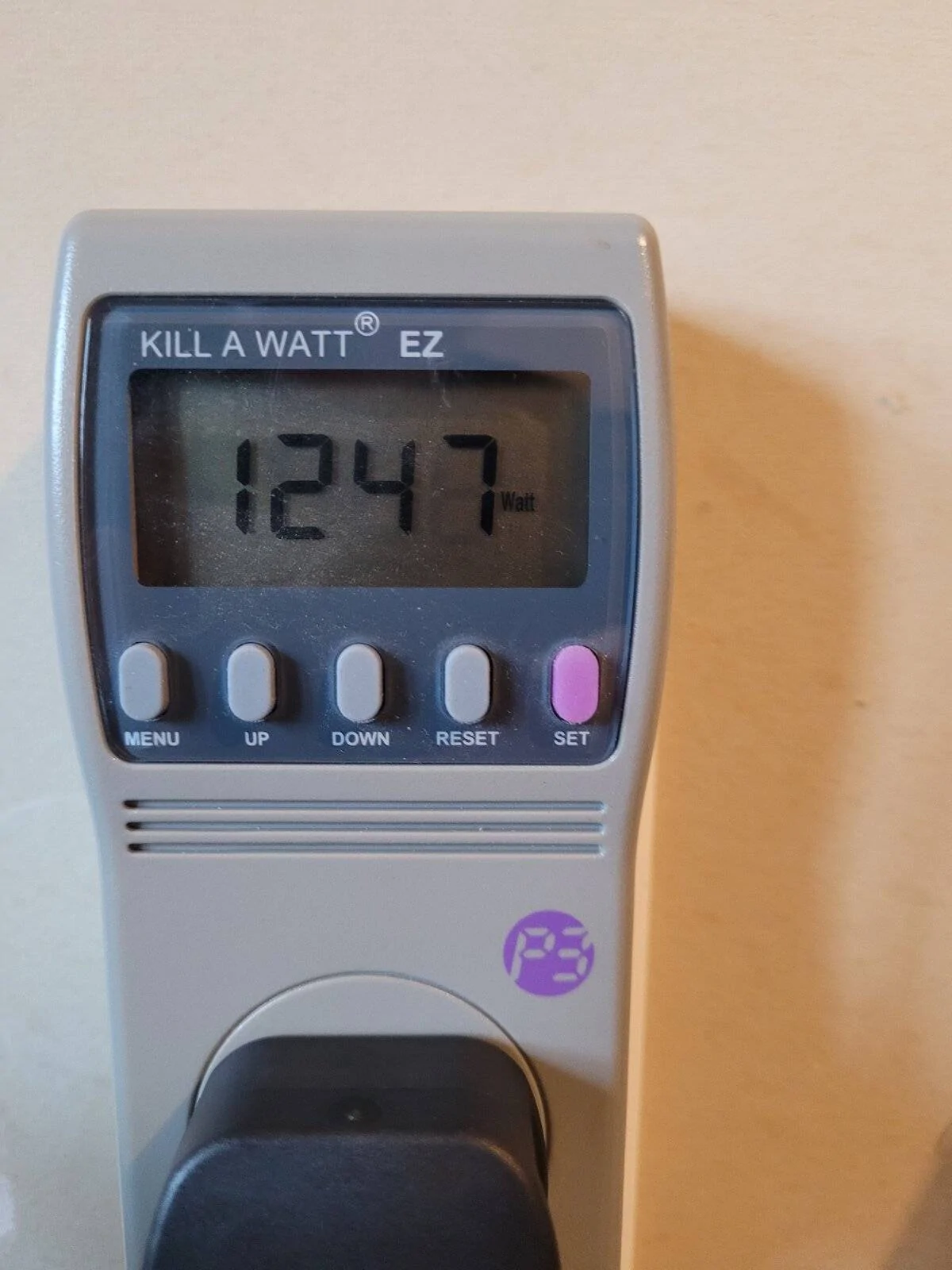
OK, I was wrong. I forgot I had a Kill-A-Watt meter for 120V. So I went out and plugged the included charger into it and started charging. It was drawing 10.97A and 1.247 kW.

Figure about a 10% loss in the charging process, that's 1.1 kW per hour added. At 3 miles/kWh, that's about 3.3 miles.

20210313_144706.jpg
I would go so far as to say that the slower you charge, the better it is for the car, but someone brought up a good point about the efficiency might be a little lower. I am sure the efficiency loss is no where near those Stupid Wireless Car Chargers. They might be OK for public charging.

As far as the KILL A WATT meter, mine did not like carrying 12 Amps for extended periods of time. After about six months of 16 hours a day and longer on weekends, I noticed the receptacle that resembles a little face emoji was browning and frowning. Too much heat, even though it is rated for 15A.
 

dbsb3233

Well-Known Member
First Name
TimCO
Joined
Dec 30, 2019
Threads
56
Messages
10,100
Reaction score
11,965
Location
Colorado, USA
Vehicles
2021 Mustang Mach-E FE, 2025 Porche Macan Electric
Occupation
Retired
Country flag
I would go so far as to say that the slower you charge, the better it is for the car, but someone brought up a good point about the efficiency might be a little lower. I am sure the efficiency loss is no where near those Stupid Wireless Car Chargers. They might be OK for public charging.

As far as the KILL A WATT meter, mine did not like carrying 12 Amps for extended periods of time. After about six months of 16 hours a day and longer on weekends, I noticed the receptacle that resembles a little face emoji was browning and frowning. Too much heat, even though it is rated for 15A.
Yep, I wouldn't leave it plugged in to the Kill-A-Watt for an extended period for this much power. I was using it in my small greenhouse on a space heater set at the 700w setting, just to measure how much it was coming on during Spring pre-planting nights. But even that was likely just coming on for 10-15 minutes at a time until the thermostat kicked it off. Plus the thermostat was set at 40F, so it was still plenty cool. It was just to keep the greenhouse from dropping below freezing on the chilliest nights.

I've read that low power charging is better, but that advantage peters out below L2 power (~7 kW). Below that you gain nothing and actually lose a little more in the AC-DC conversion. All pretty nominal though.
 

bkboygenius

Well-Known Member
First Name
Sean
Joined
Mar 10, 2021
Threads
2
Messages
49
Reaction score
61
Location
Long Island, NY
Vehicles
2021 Grabber Blue MME FE
Occupation
IT Security
Country flag
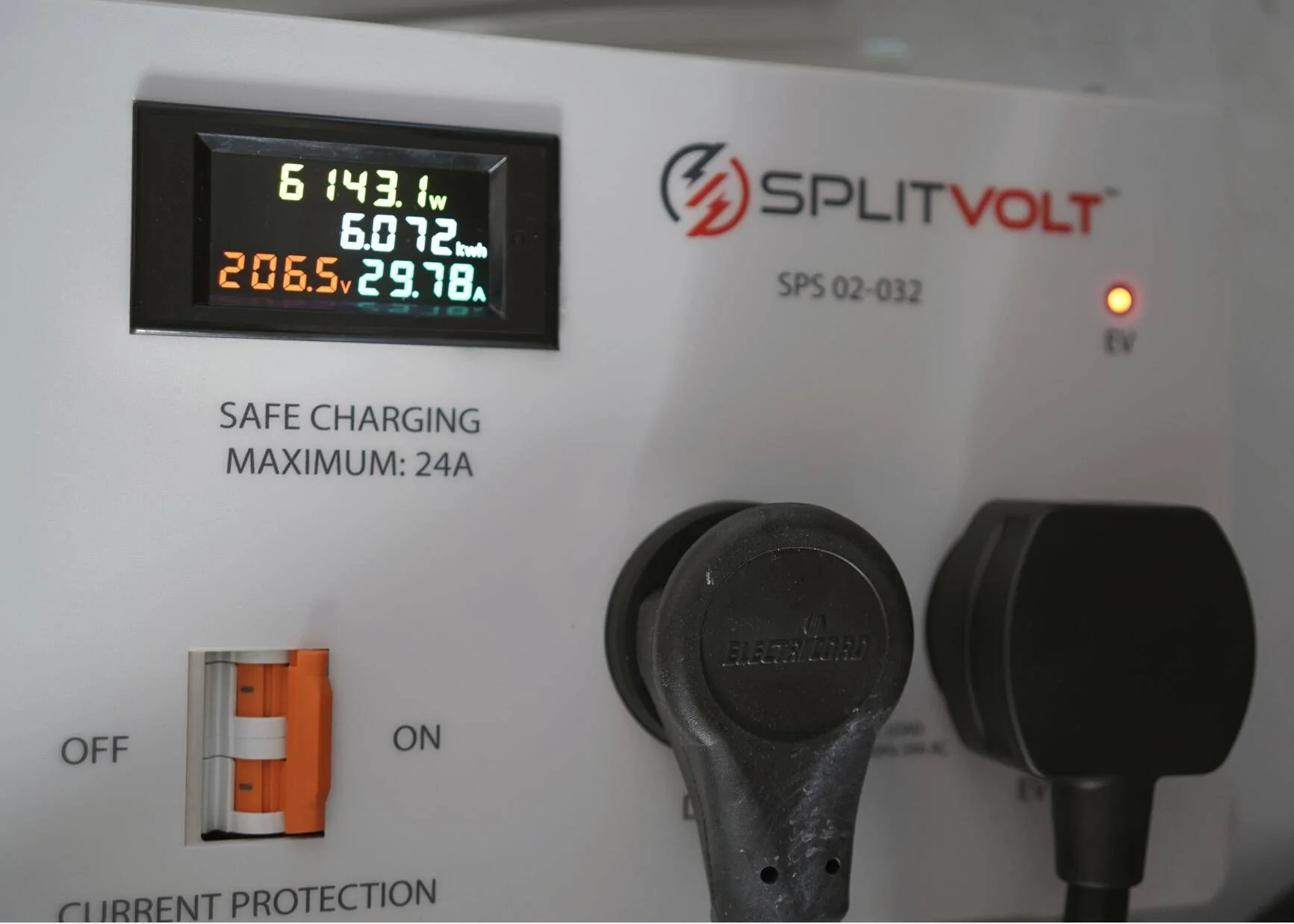
Just plugged in the splitter to try. The car draws a hair shy of 30 amps. Voltage dropped from 211V to 206.5V, which represents about 135W (2%) of losses in the circuit and wires.
1615680129972.png
Are you running any extension cord on the NEMA 14-50?
 

DBC

Well-Known Member
First Name
Don
Joined
Oct 1, 2020
Threads
8
Messages
1,224
Reaction score
1,430
Location
San Diego
Vehicles
Volt ELR
Country flag
Dryers typically pull ~24A, which is why they need a dedicated 30A circuit. Same 80% rule applies.

...

The Ford Mobile Charger will need a 40A (or higher) circuit to use 240V.
AFAIK you can plug a device rated for the ampacity of an outlet into that outlet. So an appliance which pulls 30A can plug into a 6-30R. Of course an appliance which pulls less than 30A can also plug into that outlet. Just as you can plug a lamp which uses 100W into a circuit which supports 1500W, so can you plug a dryer which pulls 24A into a 6-30R which supports 30A.

This doesn't mean the wiring and breakers of the 6-30R are rated for 30A. An outlet which allows a 30A appliance to plug in should have the wire and breakers for 40A.

Putting these together, the Ford Mobile Charger draws 30A so it should be able to plug into a 30A outlet assuming the circuit supports 30A, meaning the wire and breakers support 40A.

Note that it's recommended to downsize the breakers to fit a device if the device is expected to be the only one plugged into that circuit. If you plugged the Ford Mobile Charger into a 14-50R, which presumably supports 50A, it wouldn't be unusual to have the breakers be 40A, which is what you'd also expect them to be on a 6-30R circuit.
 

DBC

Well-Known Member
First Name
Don
Joined
Oct 1, 2020
Threads
8
Messages
1,224
Reaction score
1,430
Location
San Diego
Vehicles
Volt ELR
Country flag
I would go so far as to say that the slower you charge, the better it is for the car, but someone brought up a good point about the efficiency might be a little lower.
With 240V AC charging, even at 48A the charge rate is still close to 1/10 C. Can't imagine charging at 1/20 C is any better as far as battery longevity is concerned.

Charging losses are generally proportional to the square of the charging current. Voltage doesn't have any significant effect on charging losses but higher voltage reduces the charging time. Consequently charging at 12A 240V will have fewer losses than charging at 12A 120V because the time will be shorter, and charging at 12A 240V will be more efficient than charging at 24A 240V because the losses will be less.
 

dbsb3233

Well-Known Member
First Name
TimCO
Joined
Dec 30, 2019
Threads
56
Messages
10,100
Reaction score
11,965
Location
Colorado, USA
Vehicles
2021 Mustang Mach-E FE, 2025 Porche Macan Electric
Occupation
Retired
Country flag
AFAIK you can plug a device rated for the ampacity of an outlet into that outlet. So an appliance which pulls 30A can plug into a 6-30R. Of course an appliance which pulls less than 30A can also plug into that outlet. Just as you can plug a lamp which uses 100W into a circuit which supports 1500W, so can you plug a dryer which pulls 24A into a 6-30R which supports 30A.

This doesn't mean the wiring and breakers of the 6-30R are rated for 30A. An outlet which allows a 30A appliance to plug in should have the wire and breakers for 40A.

Putting these together, the Ford Mobile Charger draws 30A so it should be able to plug into a 30A outlet assuming the circuit supports 30A, meaning the wire and breakers support 40A.

Note that it's recommended to downsize the breakers to fit a device if the device is expected to be the only one plugged into that circuit. If you plugged the Ford Mobile Charger into a 14-50R, which presumably supports 50A, it wouldn't be unusual to have the breakers be 40A, which is what you'd also expect them to be on a 6-30R circuit.
That's why I said "circuit", not outlet. You need a 40A+ circuit for a 32A charger (or the 30A charger like the Ford Mobile, since breakers are usually rated in increments of 10A).

A dryer is usually 24A, which is why it works on a 30A circuit.
 

DBC

Well-Known Member
First Name
Don
Joined
Oct 1, 2020
Threads
8
Messages
1,224
Reaction score
1,430
Location
San Diego
Vehicles
Volt ELR
Country flag
That's why I said "circuit", not outlet. You need a 40A+ circuit for a 32A charger (or the 30A charger like the Ford Mobile, since breakers are usually rated in increments of 10A).

A dryer is usually 24A, which is why it works on a 30A circuit.
A dryer that pulls 30A might work perfectly fine on a 30A circuit. People plug their 30A dryer into a 30A circuit -- wire, breakers, outlet -- all the time. It just depends on how long the drying cycle lasts.

But how many amps the dryer uses is irrelevant when it comes to a circuit for your EVSE. The EVSE is a different use case because the charging cycle is longer than the drying cycle. Referencing the dryer doesn't add (or subtract) anything significant from the discussion. It's like referencing a 100W lamp when deciding if a circuit will support a 2000W hair dryer.

My other point was that you don't want what you might call a 40A+ circuit. Having thicker cable is great but ideally you want the breakers to match the EVSE.

From this POV the splitter box doesn't seem like a good solution. It only supports 24A and the Mobile Charger is going to pull 30A from the get-go.
Sponsored


Top