
OK to charge when battery has 40-50 percent left back to 80% ?

hls811

Well-Known Member
First Name
Howard
Joined
Oct 30, 2021
Threads
10
Messages
95
Reaction score
147
Location
Central NJ
Vehicles
2021 Mustang Mach-E Premium AWD SR
Country flag
Remember that the ER battery is 98kW. We can use 91kW. 91/98 = 92.9% of actual battery.

100% charge is 92.9%.
Just saying, I paid for 100% of the car not 80% or 90%. There is an eight year warranty on the battery so run the crap out of it you're covered.
Came to post this same thing. If 100% was really a problem it wouldn’t be possible to do it. Ford has accounted for it.
I will not have this car in 8 years, but regardless, that wouldn’t change the way I use it. I paid for 100% of the battery and I want it available for when I need it.
Sponsored


 

dbsb3233

Well-Known Member
First Name
TimCO
Joined
Dec 30, 2019
Threads
56
Messages
10,100
Reaction score
11,965
Location
Colorado, USA
Vehicles
2021 Mustang Mach-E FE, 2025 Porche Macan Electric
Occupation
Retired
Country flag
Came to post this same thing. If 100% was really a problem it wouldn’t be possible to do it. Ford has accounted for it.
I will not have this car in 8 years, but regardless, that wouldn’t change the way I use it. I paid for 100% of the battery and I want it available for when I need it.
Ford allows you to red-line an ICE car for hours straight too, but it doesn't mean it's good for the car. But that's fine, nothing says a car owner has to treat the car in a way that will help it last longer. Or has to follow the recommendations of the manufacturer. Some people don't change the oil regularly either. To each their own.
 
  • Like
Reactions: ARK

SnBGC

Well-Known Member
First Name
Greg
Joined
Apr 20, 2020
Threads
46
Messages
5,962
Reaction score
9,778
Location
Phoenix
Vehicles
2021 Mach-E FE, 2021 Wrangler 4xe High Altitude
Occupation
Manager
Country flag
Came to post this same thing. If 100% was really a problem it wouldn’t be possible to do it. Ford has accounted for it.
I will not have this car in 8 years, but regardless, that wouldn’t change the way I use it. I paid for 100% of the battery and I want it available for when I need it.
Charging to 100% displayed isn't really much of a problem provided your car is used regularly. You are still using your HVB no matter what the state of charge.

Ford recommends 65 psi for the tires in my pickup but they can accept up to 80 psi for max loads. I drove that truck as a daily driver for 16 years and most of that time the tires were set to 80 psi because I never knew when I needed the extra load capacity (construction work). There was likely a small penalty such as rougher ride and uneven tire wear but I softened the ride with air bags and the tire wear issue was so minor it wasn't worth worrying about.

Same with your battery. If you need the energy storage then use it. If not then it is quite alright to charge up to a lower percentage. Whatever suits your needs best IMO.
 

hls811

Well-Known Member
First Name
Howard
Joined
Oct 30, 2021
Threads
10
Messages
95
Reaction score
147
Location
Central NJ
Vehicles
2021 Mustang Mach-E Premium AWD SR
Country flag
Ford allows you to red-line an ICE car for hours straight too, but it doesn't mean it's good for the car. But that's fine, nothing says a car owner has to treat the car in a way that will help it last longer. Or has to follow the recommendations of the manufacturer. Some people don't change the oil regularly either. To each their own.
I get what you're saying, but don't think thats quite the same analogy.. The radio volume goes to 30, but I wouldn't necessarily want that maxed out all of the time either.
This would be the equivalent of Ford (or any manufacturer) saying you have a 20 gallon gas tank, but only fill it to 16 gallons. In this case you're paying for a certain capacity - unlike iCE cars, its actually an option for which size battery you select and the capacity you get. I think Ford handled it right by building in the buffer so you aren't truly going to 100% if its not safe to or would do damage. They can make the recommendation for 80/90% - but theres also not a single warning in the manual saying 100% is causing any damage.
 

dbsb3233

Well-Known Member
First Name
TimCO
Joined
Dec 30, 2019
Threads
56
Messages
10,100
Reaction score
11,965
Location
Colorado, USA
Vehicles
2021 Mustang Mach-E FE, 2025 Porche Macan Electric
Occupation
Retired
Country flag
I get what you're saying, but don't think thats quite the same analogy.. The radio volume goes to 30, but I wouldn't necessarily want that maxed out all of the time either.
This would be the equivalent of Ford (or any manufacturer) saying you have a 20 gallon gas tank, but only fill it to 16 gallons. In this case you're paying for a certain capacity - unlike iCE cars, its actually an option for which size battery you select and the capacity you get. I think Ford handled it right by building in the buffer so you aren't truly going to 100% if its not safe to or would do damage. They can make the recommendation for 80/90% - but theres also not a single warning in the manual saying 100% is causing any damage.
The gas tank analogy doesn't fit because there's zero negative impact to filling the tank to 20 vs 16. That's the whole point - there is (some) negative impact to the car (battery) if always filling the battery to 100%. Any analogy has to be something that includes a negative impact to the car. Cranking up the radio has no negative impact to the car either. That's why I mentioned redlining the engine, or not doing enough oil changes.

It could certainly be argued that the extra battery degradation may not be enough negative impact to be concerned with. Nobody really knows whether we're talking a 2% difference, 5%, 10%, or more after a number of years. And even when that's more quantifiable with experience, it's still something every owner will treat differently. Some will value the range more and treat the battery better, while others will say it's just not worth messing with. Pretty similar to how we treat our cell phone charging now. There are best practicies for charging that help the battery last longer, but many don't want to mess with it and just live with buying a new phone more frequently. That's fine too.
 
  • Like
Reactions: ARK


Alan UK

Member
First Name
Alan
Joined
Feb 7, 2022
Threads
0
Messages
22
Reaction score
13
Location
Ripon, Yorkshire, UK
Vehicles
Mustang Mach-E RWD Long range
Occupation
Retired
Country flag
Is it ok to charge when battery has 40-50 percent left back to 80 percent, or best to allow to deplete further before recharge?
As I understand it it there are two real no-nos with charging. Don't charge to 100% with a rapid charger (the car won't let you do this in any case). Don't leave the car in your garage for days charged at 100%. If you're not going to use the car for a week or two (eg: going on holiday) leave it charged around 50%.
There is no issue charging the car to 100% at home overnight if you are driving it the next morning.
 

Chuck518

Active Member
First Name
Chuck
Joined
Aug 31, 2021
Threads
8
Messages
38
Reaction score
4
Location
Ray Brook, NY 12977
Vehicles
Ford Mustang Mach-e
Country flag
I charge it to 85% off my home trickle-charger, and charge it to 95% whenever I get free charging, which is most of my shopping trips around here. I pretty much run it off free electricity most of the time, and rarely actually achieve 95%. I use the car less than 500 miles/month.
 

ZuleMME

Well-Known Member
First Name
Zule
Joined
Apr 23, 2021
Threads
10
Messages
1,018
Reaction score
1,487
Location
Denver, CO
Vehicles
21' Job1 P4X MME, 22' MYP
Occupation
Implementation Engineer
Country flag
The gas tank analogy doesn't fit because there's zero negative impact to filling the tank to 20 vs 16. That's the whole point - there is (some) negative impact to the car (battery) if always filling the battery to 100%. Any analogy has to be something that includes a negative impact to the car. Cranking up the radio has no negative impact to the car either. That's why I mentioned redlining the engine, or not doing enough oil changes.

It could certainly be argued that the extra battery degradation may not be enough negative impact to be concerned with. Nobody really knows whether we're talking a 2% difference, 5%, 10%, or more after a number of years. And even when that's more quantifiable with experience, it's still something every owner will treat differently. Some will value the range more and treat the battery better, while others will say it's just not worth messing with. Pretty similar to how we treat our cell phone charging now. There are best practicies for charging that help the battery last longer, but many don't want to mess with it and just live with buying a new phone more frequently. That's fine too.
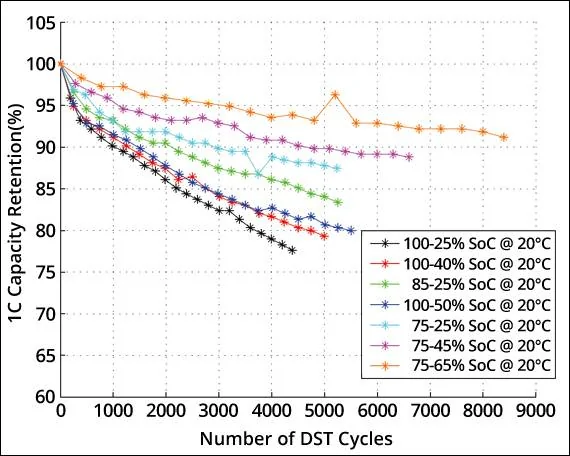
ill put this here. This is about the best research we have right now.

Ford Mustang Mach-E OK to charge when battery has 40-50 percent left back to 80% ? 1653942656992
 

dbsb3233

Well-Known Member
First Name
TimCO
Joined
Dec 30, 2019
Threads
56
Messages
10,100
Reaction score
11,965
Location
Colorado, USA
Vehicles
2021 Mustang Mach-E FE, 2025 Porche Macan Electric
Occupation
Retired
Country flag
ill put this here. This is about the best research we have right now.

1653942656992.webp
I've seen that one too. It suggests that the degradation should only be a few% in the first 100k miles. For the AWD ER (270 mile range), 100k miles is only 370 cycles (barely more than a third of the way into that first slice). For the worst line, looks like roughly 7% (living in the 25-100% area regularly); 5% for the 25-85% area; 3% for the 45-75% area.

But that's at ideal conditions (68F). Add real world weather (hot/freezing), hard use, constant rattling, and other stress factors, and it's probably worse than that. Also depends on how well the BMS does it's thing to condition the battery. It's those real-world results that probably won't be well quantified until some MMEs actually start approaching 100k miles.
 

Mach1E

Well-Known Member
Joined
Sep 5, 2021
Threads
93
Messages
10,511
Reaction score
13,298
Location
Florida
Vehicles
69 Mach 1, 11 GT, 21 GTPE- sold, 24 Taycan 4S, 20 F type R
Country flag
I've seen that one too. It suggests that the degradation should only be a few% in the first 100k miles. For the AWD ER (270 mile range), 100k miles is only 370 cycles (barely more than a third of the way into that first slice). For the worst line, looks like roughly 7% (living in the 25-100% area regularly); 5% for the 25-85% area; 3% for the 45-75% area.

But that's at ideal conditions (68F). Add real world weather (hot/freezing), hard use, constant rattling, and other stress factors, and it's probably worse than that. Also depends on how well the BMS does it's thing to condition the battery. It's those real-world results that probably won't be well quantified until some MMEs actually start approaching 100k miles.
So….. 3700 cycles is a million miles?

I think your math is wrong.

The mileage/cycle will be different for each line on that chart. Part of the reason the chart is deceptive!

Use the Orange line for example. It’s only charging 10% per cycle. So 27 miles.

So after 5,000 “cycles,” it’s gone 135,000 miles.

The black line (worst) is charging 75% per cycle, so 202.5 miles. After 5000 cycles, it will have traveled over 1 million miles! No wonder it has worse degradation!

The chart should be based on MILES driven and time, not based on uneven charging cycles!

Edit: I googled “DST cycle” and this article says pretty much the same thing. It also is unclear if this is even a car battery they’re comparing. Doesn’t seem so:

https://accubattery.zendesk.com/hc/...-Battery-Degradation-for-Cell-Life-Assessment

Double edit:

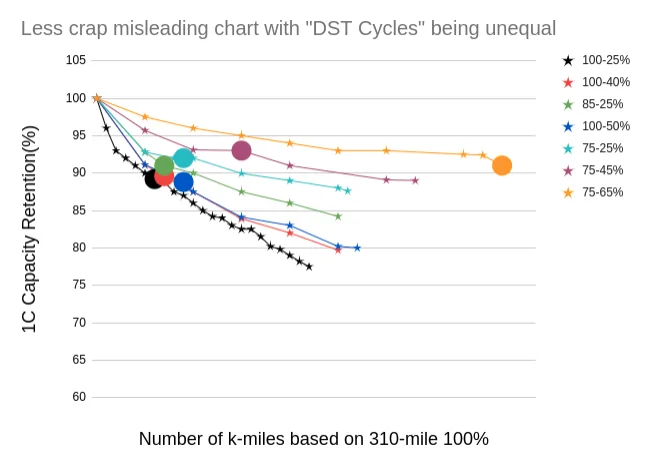
Tesla nerds figured out the same thing I did and normalized the chart for mileage:
https://teslamotorsclub.com/tmc/thr...art-made-less-crappy-you-know-the-one.165387/

Ford Mustang Mach-E OK to charge when battery has 40-50 percent left back to 80% ? CA97C2D9-EFD6-4B8C-9B51-A6817269DFFE
 
Last edited:

dbsb3233

Well-Known Member
First Name
TimCO
Joined
Dec 30, 2019
Threads
56
Messages
10,100
Reaction score
11,965
Location
Colorado, USA
Vehicles
2021 Mustang Mach-E FE, 2025 Porche Macan Electric
Occupation
Retired
Country flag
So….. 3700 cycles is a million miles?

I think your math is wrong.

The mileage/cycle will be different for each line on that chart. Part of the reason the chart is deceptive!

Use the Orange line for example. It’s only charging 10% per cycle. So 27 miles.

So after 5,000 “cycles,” it’s gone 135,000 miles.

The black line (worst) is charging 75% per cycle, so 202.5 miles. After 5000 cycles, it will have traveled over 1 million miles! No wonder it has worse degradation!

The chart should be based on MILES driven and time, not based on uneven charging cycles!

Edit: I googled “DST cycle” and this article says pretty much the same thing. It also is unclear if this is even a car battery they’re comparing. Doesn’t seem so:

https://accubattery.zendesk.com/hc/...-Battery-Degradation-for-Cell-Life-Assessment

Double edit:

Tesla nerds figured out the same thing I did and normalized the chart for mileage:
https://teslamotorsclub.com/tmc/thr...art-made-less-crappy-you-know-the-one.165387/

CA97C2D9-EFD6-4B8C-9B51-A6817269DFFE.webp
I remember this was a topic of debate a year ago regarding this chart, as to whether a "cycle" refers to full battery capacity, or just the partial amount being charged? Usually it refers to the a full battery capacity, such that a 50% charge would count as a half of one cycle.

But it's possible it means the latter for that chart. It was really unclear.
 

Mach1E

Well-Known Member
Joined
Sep 5, 2021
Threads
93
Messages
10,511
Reaction score
13,298
Location
Florida
Vehicles
69 Mach 1, 11 GT, 21 GTPE- sold, 24 Taycan 4S, 20 F type R
Country flag
I remember this was a topic of debate a year ago regarding this chart, as to whether a "cycle" refers to full battery capacity, or just the partial amount being charged? Usually it refers to the a full battery capacity, such that a 50% charge would count as a half of one cycle.

But it's possible it means the latter for that chart. It was really unclear.
First time I’ve looked at the chart, but it does seem like it’s the latter.

How could you use 100% of the capacity if you never charge it to 100% nor run it to zero?

Either way, it also seems to be a lab test, not on an actual BEV, so kinda hard to extrapolate.

Also, we can’t even charge our batteries to 100%. And charging to 100% seems to be the only statistically significant difference.
 

dbsb3233

Well-Known Member
First Name
TimCO
Joined
Dec 30, 2019
Threads
56
Messages
10,100
Reaction score
11,965
Location
Colorado, USA
Vehicles
2021 Mustang Mach-E FE, 2025 Porche Macan Electric
Occupation
Retired
Country flag
First time I’ve looked at the chart, but it does seem like it’s the latter.

How could you use 100% of the capacity if you never charge it to 100% nor run it to zero?

Either way, it also seems to be a lab test, not on an actual BEV, so kinda hard to extrapolate.

Also, we can’t even charge our batteries to 100%. And charging to 100% seems to be the only statistically significant difference.
As you say, charts like this that use units of cycles are typically lab tests by engineers, normalized to units of full 0-100% cycles. Not intended to equate to a partial user charge. Otherwise "cycle" would mean something different each time.

But "DST" may refer to a different type of cycle here.
 

honourx

Active Member
First Name
Andrew
Joined
Apr 19, 2022
Threads
3
Messages
40
Reaction score
26
Location
New Jersey
Vehicles
Mustang Mach E GT 2021
Occupation
Marketing Manager
Country flag
I plug mine in every night, as a matter of habit. No sense micro-managing a thing like a car. It's meant to be driven. I charge mine to 90% every single night, whether it has 20% left or 89% left. Ford designed this car to be driven and charged on a daily basis. It's not a delicate little flower that has to be massaged and micro-managed. Don't worry, you'll be fine. Charge it to 90% daily, and if going on a longer trip, 100%.
Perfectly stated!
 

ZuleMME

Well-Known Member
First Name
Zule
Joined
Apr 23, 2021
Threads
10
Messages
1,018
Reaction score
1,487
Location
Denver, CO
Vehicles
21' Job1 P4X MME, 22' MYP
Occupation
Implementation Engineer
Country flag
As you say, charts like this that use units of cycles are typically lab tests by engineers, normalized to units of full 0-100% cycles. Not intended to equate to a partial user charge. Otherwise "cycle" would mean something different each time.

But "DST" may refer to a different type of cycle here.
Thus the reason I indicated this was about the best "guess" of information we have right now. This chart is based on general Li-Ion technology so expect minor changes based on the type of cells. But being what ours are it's pretty on par for showing the general outcome variability based on usage range of the battery. In general; the more you do to stay in the middle of the battery the better. The more you use the top and bottom end the higher your degradation. Based on user expectations in lifetime of the battery this can go from not mattering at all to mattering a whole lot pretty quickly. Ford's warranty is based on the idea that it's unlikely you'll loose more than 30% in 8 years and they are willing to bet money on that. Doesn't mean it's a wise idea to do whatever if you care about the 10-15% you MAY loose. Understanding li-ion battery care doesn't matter much with a $50 or under cell phone battery. Matters a whole lot more with a $14,000 wholesale car battery that with labor is $20k+.
Sponsored


Top