Highway speed to dead stop traffic with Adaptive Cruise enabled --- do you trust it?

HuntingPudel

Well-Known Member
First Name
Steve
Joined
Mar 23, 2021
Threads
88
Messages
12,927
Reaction score
17,370
Location
Bay Area, CA
Vehicles
2024 MME GT with Performance Upgrade, 1979 Fire-Am, 1972 K/5 Blazer
Occupation
Engineering
Country flag
Reminds me that I hate the BlueCruise commercial on TV that shows the driver engage BC then have an ASL conversation with the person in the passenger seat. Eyes were clearly not on the road. Come on, @Ford Motor Company get your marketing team in line. ??
Sponsored
 

ChasingCoral

Well-Known Member
First Name
Mark
Joined
Feb 3, 2020
Threads
502
Messages
14,306
Reaction score
28,653
Location
Maryland
Vehicles
2021 GB E4X FE, 2022 F-150 Lightning Lariat ER
Occupation
Retired oceanographer
Country flag
True. But the OP already had the poo scared out of em on the freeway. Guarantee they're not gonna do that again. No need for 10 strangers to roost them. They've got it. They're good ??
But apparently not scared enough to look in the manual before posting :rolleyes:
 

kltye

Well-Known Member
Joined
May 21, 2021
Threads
19
Messages
1,100
Reaction score
1,733
Location
Chicago
Vehicles
IB MME Premium RWD
Country flag
Me watching the op get roasted unnecessarily:

cringe-no.gif


Yes yes. It's a driver assistant system. We all know that. That horse has been beat to death on so many threads

But yeah the car does not do well with slowing down unless there's a car within 3-4 car lengths of you. Anything more and it's completely oblivious to the situation.

Tesla's system is in fact MUCH better at slowing down in a reasonable distance. But it's not perfect at that either.

Mach E has the cameras and absolutely could use that to assist (assuming the image processor can handle that)
I don't think we have stereoscopic cameras, which is required to be able to calculate distance, so I don't think we'll ever get anything more than generic image recognition.

Have I learned something new?, Namely that Ford does not detect and help prevent hitting a pedestrian or bicyclist? My 2019 RAV4 does, and so does General Motors and Tesla. I am hoping that another system from Ford does that. This would be a game stopper for me buying a Mach E.
No, that's not the same thing. Firstly, I hope you aren't driving 70 mph on the same road as a pedestrian or bicyclist is using - the system has a lot more time to slow down to a stop, from the same distance to the stationary object, from 30 mph than at 70 mph. Secondly, the system does react and hits the brakes as referenced above; it just does it much later than a normal human would.
 

mpshizzle

Well-Known Member
Joined
Mar 22, 2021
Threads
65
Messages
1,274
Reaction score
1,605
Location
Utah
Vehicles
Mustang Mach E 4X
Country flag
I don't think we have stereoscopic cameras, which is required to be able to calculate distance, so I don't think we'll ever get anything more than generic image recognition.
Didn't even consider that. Makes sense
 

ChasingCoral

Well-Known Member
First Name
Mark
Joined
Feb 3, 2020
Threads
502
Messages
14,306
Reaction score
28,653
Location
Maryland
Vehicles
2021 GB E4X FE, 2022 F-150 Lightning Lariat ER
Occupation
Retired oceanographer
Country flag
Have I learned something new?, Namely that Ford does not detect and help prevent hitting a pedestrian or bicyclist? My 2019 RAV4 does, and so does General Motors and Tesla. I am hoping that another system from Ford does that. This would be a game stopper for me buying a Mach E.
I think you haven't learned the difference between marketing material, engineering tests, and legal disclaimers.

Note this from Ford way back in 2014:

Ford Motor Company is rolling out a new driver-assist system that can reduce the severity of or even eliminate some frontal collisions involving vehicles and pedestrians.

Pre-Collision Assist with Pedestrian Detection uses radar and camera technology to scan the roadway ahead and, if a collision risk with a vehicle or pedestrian is detected, provides a warning to the driver. If the driver does not respond in time, the system can automatically apply up to full braking force to help reduce the severity of or even eliminate some frontal collisions. Pre-Collision Assist may help drivers avoid rear end collisions with other vehicles at all speeds, while Pedestrian Detection can help the driver avoid pedestrians at lower speeds – both may reduce the severity of forward collisions or even prevent certain forward collisions.

“This technology adds to the already impressive list of driver-assist technologies Ford customers benefit from today,” said Raj Nair, Ford group vice president, Global Product Development.

Pre-Collision Assist with Pedestrian Detection will debut as available technology on the 2015 Ford Mondeo on sale in Europe this year. It will then roll out to other Ford and Lincoln products around the world.

While the new system may be especially helpful in unexpected situations, it does not replace the driver and has limitations including nighttime, low and harsh lighting conditions, vehicles moving in a different direction and certain weather conditions.

Detecting pedestrians
In daylight and clear weather conditions, the new technology may detect people in or near the road ahead, or pedestrians crossing the vehicle’s path. If a pedestrian is detected in front of the car and a collision is imminent, the driver first receives an audible and visual warning. Should the driver not respond, the system improves brake responsiveness by reducing the gap between brake pads and discs. If there is still no response from the driver, the brakes are applied automatically and vehicle speed is reduced.

The system processes information collected from a windshield-mounted camera and radar located near the bumper; it then checks the information against a database of pedestrian shapes to help distinguish people from typical roadside scenery and objects.

Ford engineers tested the system on closed test tracks using rigs fitted with manikins to replicate pedestrians. They then spent months refining the technology on roads around the world to test system reliability.

“This real-world testing was an important part of the development, because pedestrians in an urban setting can present a wide range of potential situations,” said Scott Lindstrom, Ford manager, Driver Assist Technologies. “We covered more than 300,000 miles on three continents that included a wide range of settings and situations.”

Other driver-assist technologies available from Ford include lane-keeping system with lane-keeping aid, Blind Spot Information System (BLIS®) with cross-traffic alert, adaptive cruise control and collision warning with brake support, and active park assist. For more information on these technologies, go to www.ford.com


https://media.ford.com/content/ford...llision-assist-with-pedestrian-detection.html

Now, let's check the manual from that 2019 RAV4 of yours. Situations where the collision detection systems won't work include:
  • People may not be detected if they are wearing certain types of clothing.
  • If a vehicle ahead is a child sized bicycle, a bicycle that is carrying a large load, a bicycle ridden by more than one person, or a uniquely shaped bicycle (bicycle with a child seat, tandem bicycle, etc.)
  • If a pedestrian/or the riding height of a bicyclist ahead is shorter than approximately 3.2 ft. (1 m) or taller than approximately 6.5 ft. (2 m)
  • If a pedestrian/bicyclist is wearing oversized clothing (a rain coat, long skirt, etc.), making their silhouette obscure
  • If a pedestrian is bending forward or squatting or bicyclist is bending forward
  • If a pedestrian/bicyclist is moving fast
  • If a pedestrian is pushing a stroller, wheelchair, bicycle or other vehicle
So, from your adamant response, are we to assume that you never use or rely on those systems in any of those situations?

I'll leave it to you to look up all of General Motors and Tesla but will leave you with this video:


thekat03

Well-Known Member
First Name
Kat
Joined
May 2, 2023
Threads
5
Messages
808
Reaction score
1,508
Location
China, Maine
Vehicles
2023 Mustang Mach-E CR-1, 2022 Volvo C40
Occupation
Physician
Country flag
I don't think we have stereoscopic cameras, which is required to be able to calculate distance, so I don't think we'll ever get anything more than generic image recognition.


No, that's not the same thing. Firstly, I hope you aren't driving 70 mph on the same road as a pedestrian or bicyclist is using - the system has a lot more time to slow down to a stop, from the same distance to the stationary object, from 30 mph than at 70 mph. Secondly, the system does react and hits the brakes as referenced above; it just does it much later than a normal human would.
Many of us take for granted having 2 forward facing eyeballs that work together to give us depth perception. Our cars do not see the roads the way we do. I don't think any cars have stereoscopic cameras, even Tesla. Instead, hopefully LIDAR will help with longer distance terrain mapping, to help future cars better slow and stop when approaching stopped traffic.
 

ChasingCoral

Well-Known Member
First Name
Mark
Joined
Feb 3, 2020
Threads
502
Messages
14,306
Reaction score
28,653
Location
Maryland
Vehicles
2021 GB E4X FE, 2022 F-150 Lightning Lariat ER
Occupation
Retired oceanographer
Country flag
I don't think we have stereoscopic cameras, which is required to be able to calculate distance.
You might want to read up a little about how these systems operate:
.
 

kltye

Well-Known Member
Joined
May 21, 2021
Threads
19
Messages
1,100
Reaction score
1,733
Location
Chicago
Vehicles
IB MME Premium RWD
Country flag
Many of us take for granted having 2 forward facing eyeballs that work together to give us depth perception. Our cars do not see the roads the way we do. I don't think any cars have stereoscopic cameras, even Tesla. Instead, hopefully LIDAR will help with longer distance terrain mapping, to help future cars better slow and stop when approaching stopped traffic.
You're right - I was mistaken about Tesla Vision. It's crazy they use a neural net to figure out distance...
 

ChehRob

Well-Known Member
First Name
Rob
Joined
Aug 24, 2023
Threads
13
Messages
958
Reaction score
568
Location
Seattle WA
Vehicles
MME Premium AWD Ext. Range (Job2)
Occupation
ret
Country flag
But their legal department point blank says it does not recognize pedestrians on the road. There are numerous Tesla YouTubes showing Tesla detecting pedestrians on the road. Does Ford do as well? I am still undecided as to whether it will be Tesla, GM, or Ford when I buy next year.

And yes, I can tell the difference between bulls**t and legal warnings. I also somewhat drive and operate based on probabilities. ADAS can greatly improve my chances of avoiding an accident and injuring myself and even more importantly others - especially careless children. If one of the three companies I am considering is substantially better, that will determine which brand I buy.

ps - I do appreciate your lengthy post. It has the sort of wonky information I like.
 

Mach-Lee

Well-Known Member
First Name
Lee
Joined
Jul 16, 2021
Threads
262
Messages
11,344
Reaction score
24,963
Location
Wisconsin
Vehicles
2022 Mach-E Premium AWD
Occupation
Sci/Eng
Country flag
Have I learned something new?, Namely that Ford does not detect and help prevent hitting a pedestrian or bicyclist? My 2019 RAV4 does, and so does General Motors and Tesla. I am hoping that another system from Ford does that. This would be a game stopper for me buying a Mach E.
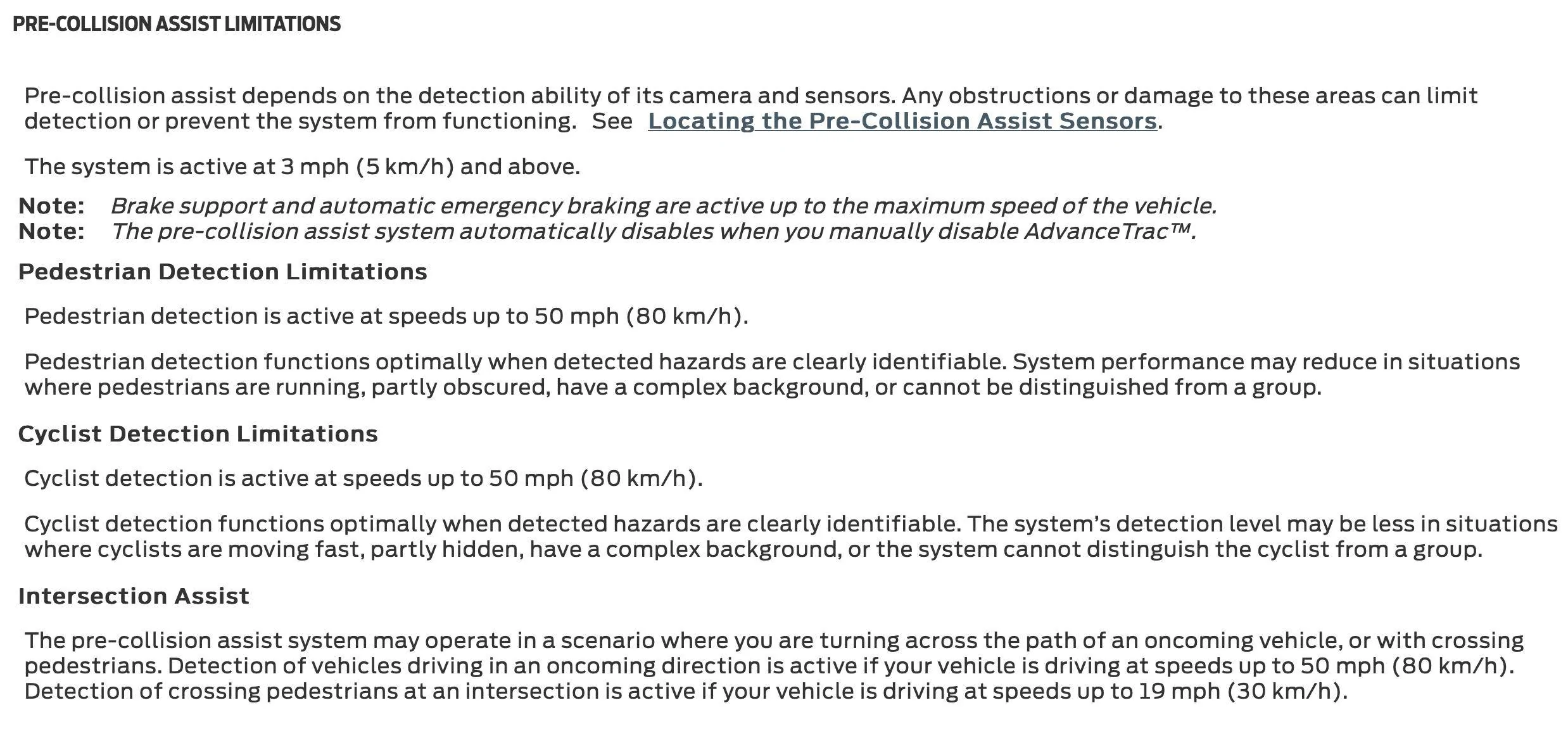
The Mach-E can detect pedestrians and bicyclists if you are driving slower than 50 MPH. Detection is primarily focused around city environments with speeds 20-40 MPH. At faster speeds they may not be detected. See below video of tests:


Ford Mustang Mach-E Highway speed to dead stop traffic with Adaptive Cruise enabled --- do you trust it? Screenshot 2023-08-29 at 11.40.29 AM
 
Last edited:

ChasingCoral

Well-Known Member
First Name
Mark
Joined
Feb 3, 2020
Threads
502
Messages
14,306
Reaction score
28,653
Location
Maryland
Vehicles
2021 GB E4X FE, 2022 F-150 Lightning Lariat ER
Occupation
Retired oceanographer
Country flag

ChehRob

Well-Known Member
First Name
Rob
Joined
Aug 24, 2023
Threads
13
Messages
958
Reaction score
568
Location
Seattle WA
Vehicles
MME Premium AWD Ext. Range (Job2)
Occupation
ret
Country flag
Just for context, I look at ADAS somewhat like I would an aviation or boating AP. Their huge advantage is that they maintain course and speed (I've been a boater, but not a pilot). The driver can then use their cognitive attention for situational awareness. Drivers do lose awareness for a second or two (maybe 3) from time to time. A good ADAS has its faults, but losing attention is not generally one of them. Adding being alert and a good ADAS means that likely you or the car is catching about everything on the road that contributes to safety.

I first realized how powerful such teamwork ca be not long after getting my RAV4. I was on an 80 mile trip, when a storm of unexpected intensity hit. Rain and wind such that traffic on the freeway was slowing below 40mph at times. Hydroplaning - stability control, distance to car in front of me - adaptive cruise control, lane keeping - doing most of the steering. keeping track of cars just behind me - blind spot monitoring. I stayed high alert and was doing a lot of looking around, keeping track of traffic. I was surprising at how relaxed I felt.

When I served on destroyers, I noticed that the captain, or officer of the deck did not do any actual driving of the ship. Helmsman, engine, radar, even lookout persons did that. The guy in the captain's chair was expected to have situational awareness, those other chores took cognitive attention away from that.
 

AZBill

Well-Known Member
First Name
Bill
Joined
May 26, 2021
Threads
12
Messages
1,987
Reaction score
2,314
Location
Arizona
Vehicles
MME CA Route 1, Hummer EV SUT, Escalade IQ
Occupation
Retired
Country flag
There is a generic ISO specification for Adaptive Cruise Control systems, and it includes test cases, ISO 15622. In that specification it states "It is not a requirement that the ACC system be designed to respond to the presence of stationary targets". It also states the owners manual shall include this warning.
 

xxiii

Well-Known Member
First Name
Dave
Joined
Sep 2, 2023
Threads
14
Messages
85
Reaction score
58
Location
Utah
Vehicles
Mach-E GTPE 2023.5
Occupation
Network Engineer
Country flag
Hm, this is somewhat disturbing, depending on what assumptions everyone is making. And I guess it depends on what you mean by "highway speeds to dead stop".

My current car with a much less advanced system handles this just fine as long as the transition is reasonable. Otherwise it hands things over to collision avoidance, but I never let it get that far.

My main concern is when people in front of me (or behind me) do let it get that far, and I can't see around/over them to know its coming. I use a proper following distance due to this factor (and I don't use "1" on the adaptive cruise. I've gotten comfortable with 2, I started out on 4, but that's an invitation for people to constantly cut you off). those aren't car lengths, i'm not sure what they are, but they all increase following distance with increased speed. ex: on "1", 1 car length at 20mph, 3 car lengths at 60, etc. I assume/hope BC has a similar concept. (people love to tailgate here).

Even so, I get a blood-curdling stomp on the brakes once or twice a year (because that's what the person in front of me just did), followed by gluing my eyes to the rear-view mirror. Which is why I want a taller car now (considering mach-e rally for this reason).
Sponsored


Top