
dtbaker61
Well-Known Member
- First Name
- Dan
- Joined
- May 11, 2020
- Threads
- 126
- Messages
- 4,822
- Reaction score
- 4,525
- Location
- santa fe,nm
- Website
- www.envirokarma.org
- Vehicles
- MME (delivered 2/26/21), DIY eMiata BEV
- Occupation
- Solar Sales/install

- Thread starter
- #1
Last night we had a massive lightning storm in Santa Fe... knocked out power in my corner of town from 5pm yesterday afternoon to 5am this morning. I was kinda thrilled to get a chance to put my ePony thru the paces and power my 'whole house' as an emergency generator for a solid 12 hours.
ran the house like a champ:

[updated 8/12/24 to give approximate cost of items used to fabricate the system]
------------------------------------ materials needed ------:
[$75 in matls] - custom 2awg cables I fabricated connected to 12v+ and - connection points... capable of sustained export of 1500 watts (<150amps)... require some tools,labor and expertise to fabricate; MSRP for pre-fabricated set probably around $200.
[$300] - 3000 watt pure sine 12vDC->120vAC inverter
I have mine 'packaged' in a [$50] toolbox for easy storage and protection. MSRP for inverter pre-installed in a case, around $450
[$50 in matls] - custom output (10awg) cable, 30a powercon at one end, NEMA 14-50 plug with L1-L2 jumpered to other. Or, if I didn't have a 240v outlet, I've used 2x male-male 120vAC adaptors to run 'regular' extension cords to nearest household outlets to energize both 'legs'. Enables up to 3000watts to either/both legs, but will not support any 240v loads (on purpose since I don't have any critical 240v loads). MSRP for pre-fabricated cord, or pair of 120v M-M probably around $100
=====
total cost less than $500 in materials if you can DIY everything yourself, or
MSRP of a pre-fabricated 'package' would cost closer to $750
-------------------------------------- using the system -----
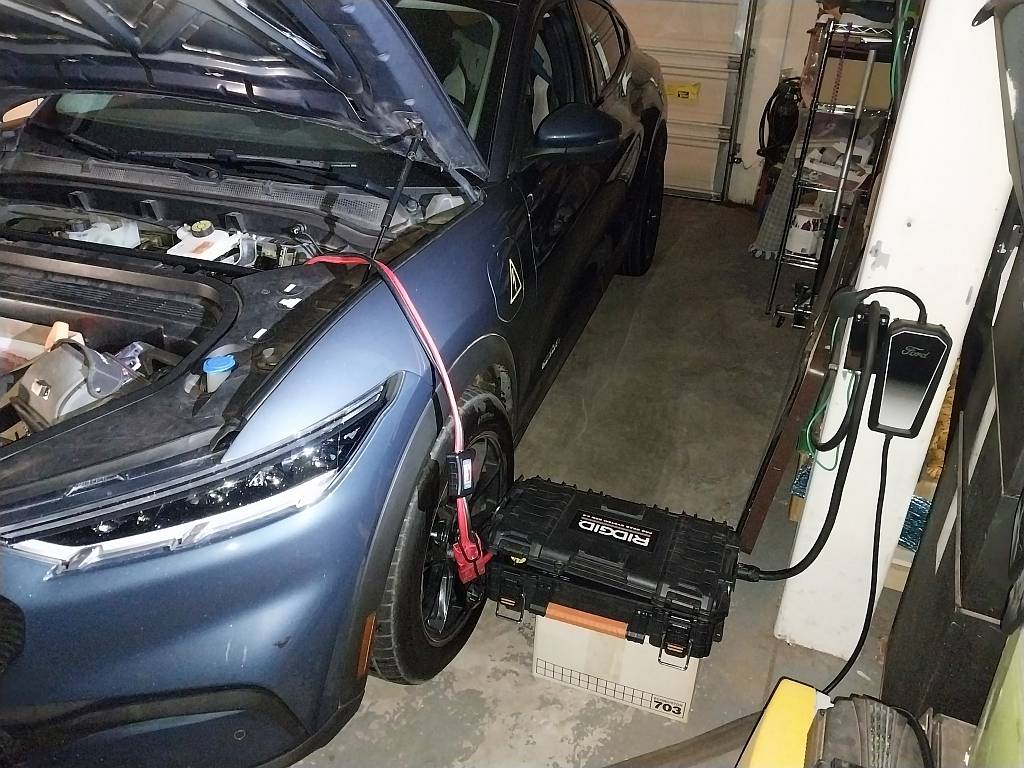
After turning off all 240v branch circuits, and my 200a main to isolate from the grid, I plug MME 12v to inverter, and inverter output to NEMA 14-50 outlet I use for my L2 home charging with Mobile Charger... turn on the inverter, and turn 120v branch circuits back on.
The MME has to be 'on'
auto-timeout has to be 'off'
headlights and heat&A/C should also be 'off'
===================================
A few important safety reminders using any Generator:
1. Don't forget to disconnect your home from Grid before doing anything else. You MUST turn off your 'main' breaker first! You do not want your backup generator to energize the Grid, and you do not want the Grid to come back on and argue with your generator.
1b. If you have Grid-tied Solar backfeeding thru your main panel, you must turn this circuit off as well as your main Grid breaker! You do not want to 'wake up' the Solar because there is nowhere for that energy to go.
2. you *should* turn ALL branch circuits off before starting Generator so all the loads don't hit at once. Then, turn your load circuits on one by one.
3. if you turn on the generator before plugging in your 'backfeed adaptors' there will be exposed plug prongs that are energized, and present a significant shock hazard. You MUST make all connections from Generator to outlet(s) before turning the Generator on, and then
4. turn on only the branch circuits that you want to power... in my case, only the critical 120v loads like a few lights, refrigerator, and the internet/modem.
---------------- How long can your MME run your house ?
Considering that background load including refrigerator, lights, internet modem bounced around 200-350 watts, and the background load of the MME internal systems seems to be around 200watts. You can *probably* run your home's critical loads for about 2 hrs for every kWhr you have in the tank.
So, If my SR battery had 60 kWhr on board, I could run the house for around 100-120hrs.....
FIVE DAYS !

and running the coffepot bumped the peak load up for a few minutes....
gotta say, I'm pretty happy to confirm that the MME can easily run my house for DAYS if needed.
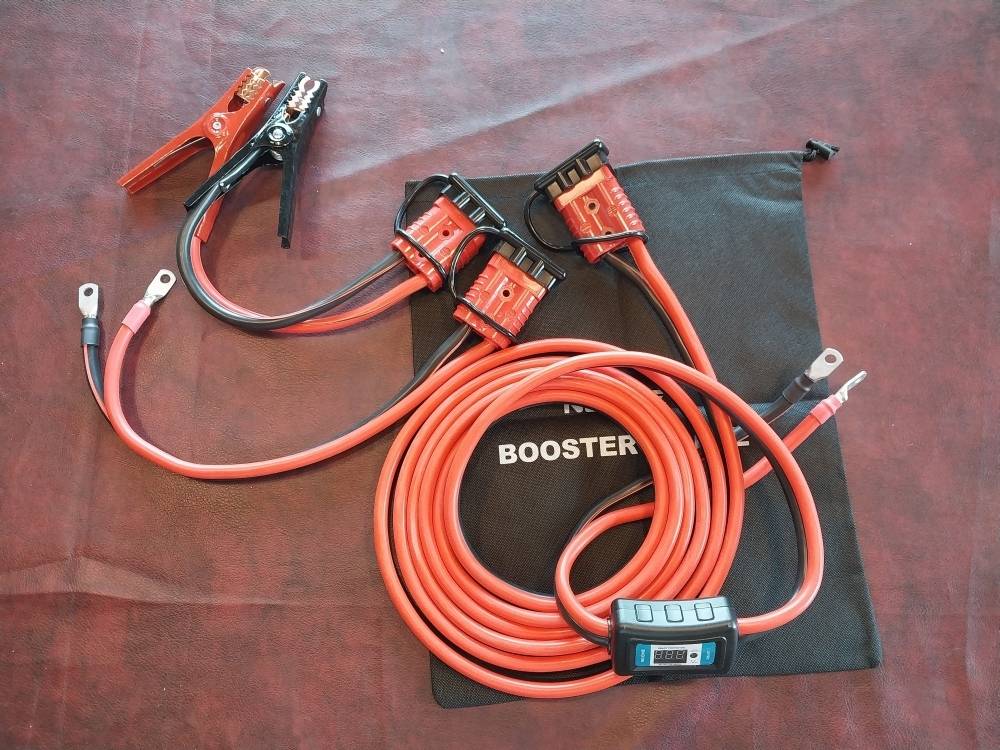
...and these are the cables I fabricated and installed on the 12v to get a good solid connection capable of carrying 150amps. It is important to use big fat wire rated to carry up to 150a , with good terminals bolted securely to the connection points. The 'extra' alligator clamps are only for giving/getting a temporary 'jump' because they do not provide enough contact area to pass much current without heating up.

ran the house like a champ:
[updated 8/12/24 to give approximate cost of items used to fabricate the system]
------------------------------------ materials needed ------:
[$75 in matls] - custom 2awg cables I fabricated connected to 12v+ and - connection points... capable of sustained export of 1500 watts (<150amps)... require some tools,labor and expertise to fabricate; MSRP for pre-fabricated set probably around $200.
[$300] - 3000 watt pure sine 12vDC->120vAC inverter
I have mine 'packaged' in a [$50] toolbox for easy storage and protection. MSRP for inverter pre-installed in a case, around $450
[$50 in matls] - custom output (10awg) cable, 30a powercon at one end, NEMA 14-50 plug with L1-L2 jumpered to other. Or, if I didn't have a 240v outlet, I've used 2x male-male 120vAC adaptors to run 'regular' extension cords to nearest household outlets to energize both 'legs'. Enables up to 3000watts to either/both legs, but will not support any 240v loads (on purpose since I don't have any critical 240v loads). MSRP for pre-fabricated cord, or pair of 120v M-M probably around $100
=====
total cost less than $500 in materials if you can DIY everything yourself, or
MSRP of a pre-fabricated 'package' would cost closer to $750
-------------------------------------- using the system -----
After turning off all 240v branch circuits, and my 200a main to isolate from the grid, I plug MME 12v to inverter, and inverter output to NEMA 14-50 outlet I use for my L2 home charging with Mobile Charger... turn on the inverter, and turn 120v branch circuits back on.
The MME has to be 'on'
auto-timeout has to be 'off'
headlights and heat&A/C should also be 'off'
===================================
A few important safety reminders using any Generator:
1. Don't forget to disconnect your home from Grid before doing anything else. You MUST turn off your 'main' breaker first! You do not want your backup generator to energize the Grid, and you do not want the Grid to come back on and argue with your generator.
1b. If you have Grid-tied Solar backfeeding thru your main panel, you must turn this circuit off as well as your main Grid breaker! You do not want to 'wake up' the Solar because there is nowhere for that energy to go.
2. you *should* turn ALL branch circuits off before starting Generator so all the loads don't hit at once. Then, turn your load circuits on one by one.
3. if you turn on the generator before plugging in your 'backfeed adaptors' there will be exposed plug prongs that are energized, and present a significant shock hazard. You MUST make all connections from Generator to outlet(s) before turning the Generator on, and then
4. turn on only the branch circuits that you want to power... in my case, only the critical 120v loads like a few lights, refrigerator, and the internet/modem.
---------------- How long can your MME run your house ?
Considering that background load including refrigerator, lights, internet modem bounced around 200-350 watts, and the background load of the MME internal systems seems to be around 200watts. You can *probably* run your home's critical loads for about 2 hrs for every kWhr you have in the tank.
So, If my SR battery had 60 kWhr on board, I could run the house for around 100-120hrs.....
FIVE DAYS !
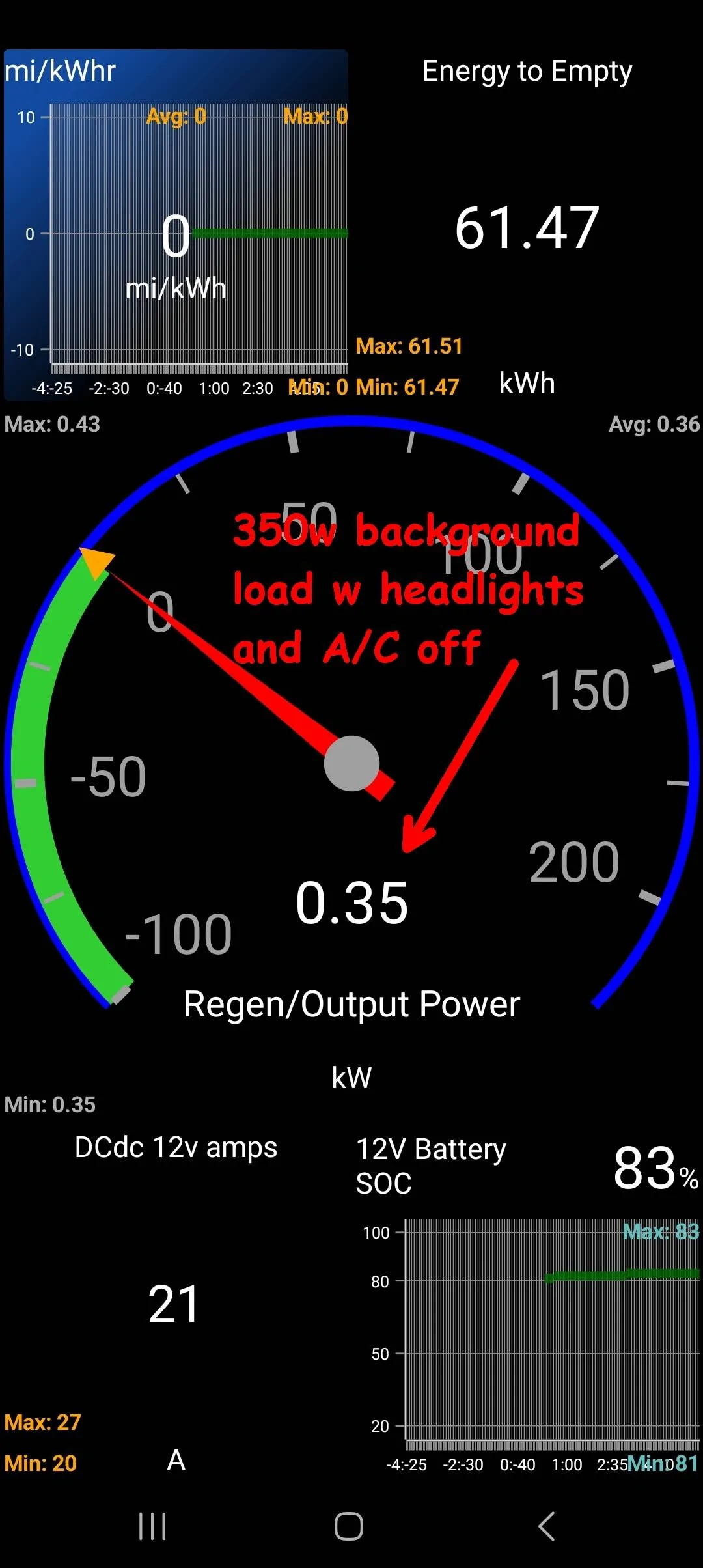
and running the coffepot bumped the peak load up for a few minutes....
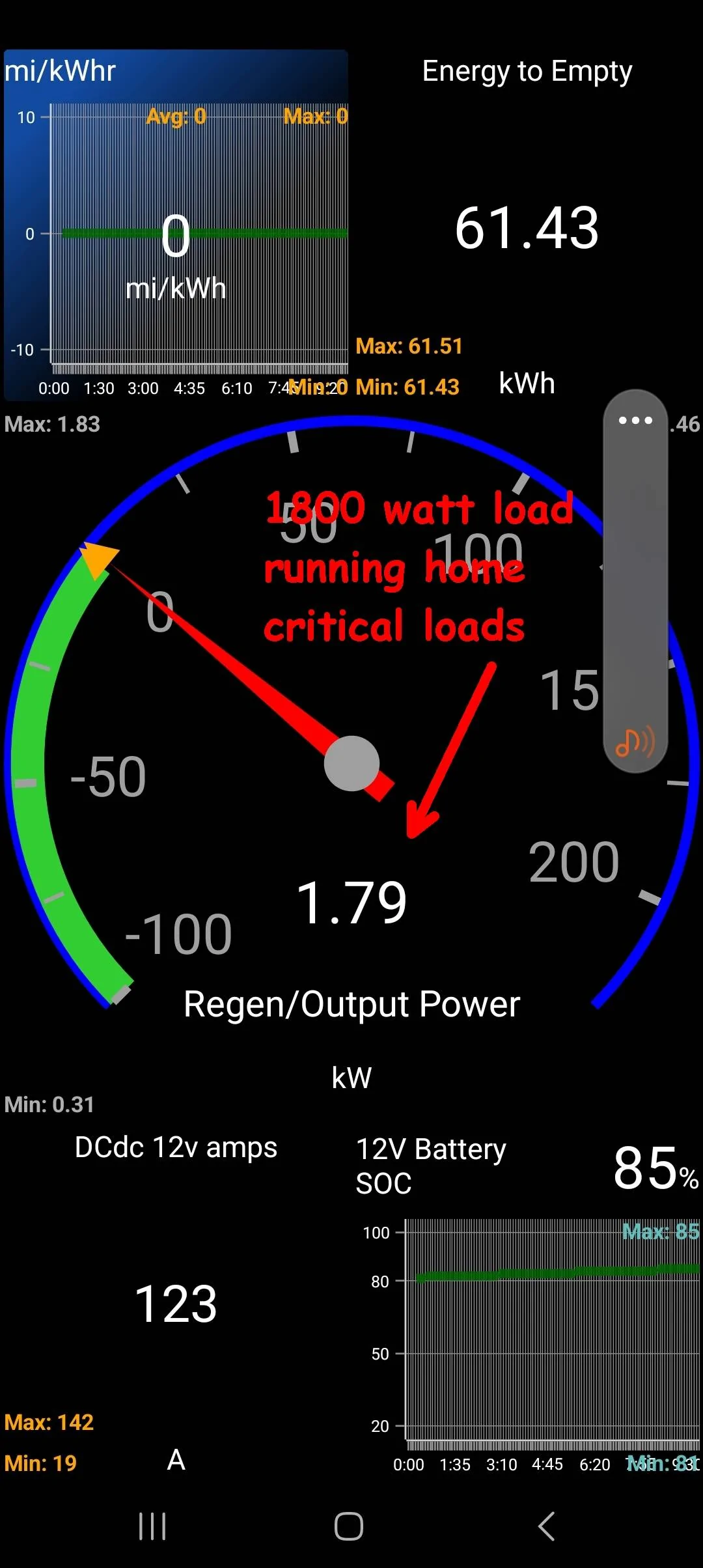
gotta say, I'm pretty happy to confirm that the MME can easily run my house for DAYS if needed.
...and these are the cables I fabricated and installed on the 12v to get a good solid connection capable of carrying 150amps. It is important to use big fat wire rated to carry up to 150a , with good terminals bolted securely to the connection points. The 'extra' alligator clamps are only for giving/getting a temporary 'jump' because they do not provide enough contact area to pass much current without heating up.
Sponsored
Last edited: