

Mache_Nor
Well-Known Member
- Joined
- Feb 12, 2022
- Threads
- 22
- Messages
- 531
- Reaction score
- 718
- Location
- Norway
- Vehicles
- MachE LR RWD

Also worth noting that you should read the OBD several times and take the average of it as well to check outside temperature. My first reading was 89%, then a month later 91.5, and yesterday it was 90%. Temperature range on the tests was 17-25 degrees Celsius, so will have to wait until it’s 25 again to get a new reading.
Btw: great topic, hope it keeps traction over time. Nothing like having actual datapoints to inform users / buyers
Btw: great topic, hope it keeps traction over time. Nothing like having actual datapoints to inform users / buyers
Last edited:

Teslaeata
Well-Known Member
- First Name
- Mark
- Joined
- Sep 28, 2022
- Threads
- 9
- Messages
- 3,470
- Reaction score
- 4,210
- Location
- Nottingham, England, UK
- Vehicles
- Red June ‘21 RWD ER Premium MME
- Occupation
- Forensic vehicle examiner, motor insurance assessor, expert witness

That’s interesting, thnx.Also worth noting that you should read the OBD several times and take the average of it as well to check outside temperature. My first reading was 89%, then a month later 91.5, and yesterday it was 90%. Temperature range on the tests was 17-25 degrees Celsius, so will have to wait until it’s 25 again to get a new reading.
Btw: great topic, hope it keeps traction over time. Nothing like having actual datapoints to inform users / buyers
May explain why mine read 89% at around 85,000 miles and 91% at 91,000.
I put it down to SoC, 80% first time, 100% second time.
Would’ve thought temperatures would be fairly similar as car ALWAYS garaged and temperatures shouldn’t vary too much though you very may well be correct and I don’t know for sure about temperature as I didn’t measure it.
In light of your thoughts I will check temp at SoH test in future.
Again, thnx.
Edit: one other thing is the SoH test at 89% SoH was without a charge, the 91% SoH followed a full charge.
Edit: just did a SoH check at 27% HV SoC and 18degC ambient showing 91% SoH @ 92,560 miles just after HVBJB replacement.
Last edited:

lanebk
Well-Known Member
- First Name
- Brian
- Joined
- Mar 13, 2022
- Threads
- 2
- Messages
- 158
- Reaction score
- 148
- Location
- Warrenton, MO
- Vehicles
- NQY 2022 Mach E Premium ER AWD
- Occupation
- AH64LCT Test

My 2022.5 Ex AWD at 35000 is 93-93.5
flapjake314
Well-Known Member
- Joined
- Jan 8, 2022
- Threads
- 38
- Messages
- 682
- Reaction score
- 747
- Location
- NYC
- Vehicles
- Mach-E Select AWD
did you already start pulling responses into a spreadsheet / any interest in letting me hijack this thread via a google sheets survey that people can submit and review analytics on their own rather than you manually transposing? i'll DM you
OP
OP

AngryMan
Well-Known Member
- First Name
- Jim
- Joined
- Aug 19, 2023
- Threads
- 11
- Messages
- 737
- Reaction score
- 966
- Location
- Ohio
- Vehicles
- OLD 2021 Select , NEW 2023 GT...RED !
- Occupation
- Living the good life
- Thread starter
- #81
Yeah I pulled the latest results ( #68) and did a little deep dive in posts 69.did you already start pulling responses into a spreadsheet / any interest in letting me hijack this thread via a google sheets survey that people can submit and review analytics on their own rather than you manually transposing? i'll DM you
PS If you guys got a thumbs up from me I have your readings but haven't added them yet to the spreadsheet . Every time I do it daily someone comes in just minutes later with a new reading .
Doh .
Don't wanna blow up this thread needlessly so I'll post new results maybe every other day as long as new reports come in .
Thanks to all who've replied so far .

Last edited:
OP
OP
AngryMan
Well-Known Member
- First Name
- Jim
- Joined
- Aug 19, 2023
- Threads
- 11
- Messages
- 737
- Reaction score
- 966
- Location
- Ohio
- Vehicles
- OLD 2021 Select , NEW 2023 GT...RED !
- Occupation
- Living the good life
- Thread starter
- #82
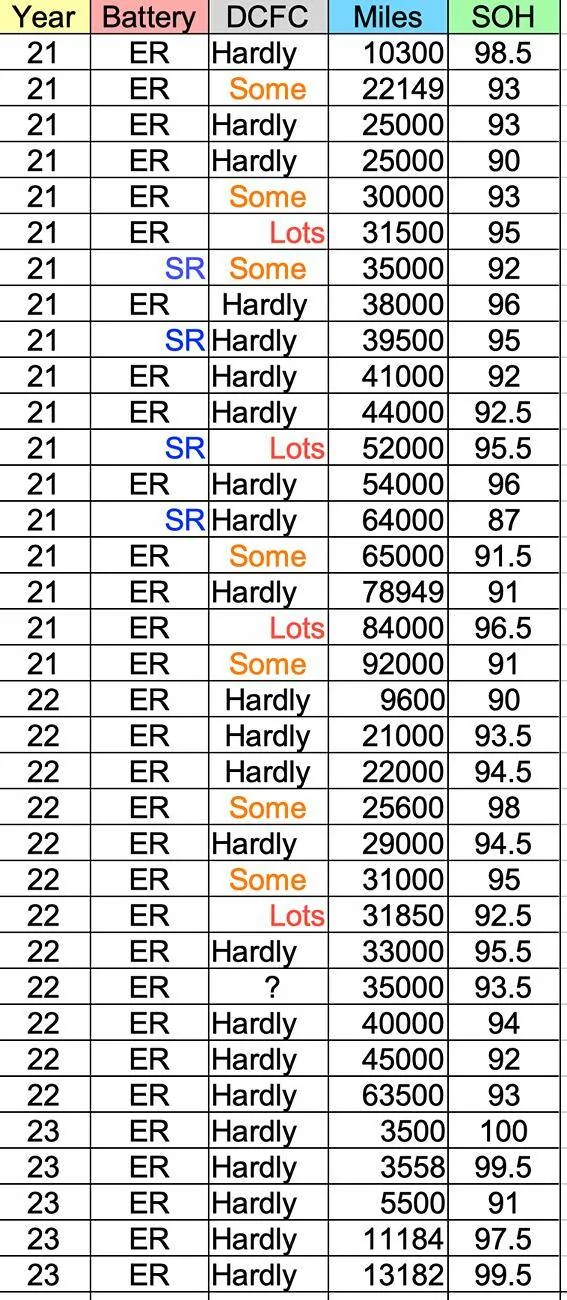
The interesting part will be when the LFP batteries start reporting . IF you have one and are reporting please bring it to our attention . 
flapjake314
Well-Known Member
- Joined
- Jan 8, 2022
- Threads
- 38
- Messages
- 682
- Reaction score
- 747
- Location
- NYC
- Vehicles
- Mach-E Select AWD
i ended up creating a google forms and self-updating analytics so angryman doesn't need to manually type everyone's inputs over and over again
i made a new thread here but also fine to merge the two threads, goal is just to have a long term tracking of this topic for all our users
i already uploaded all of angryman's work so far so no one here needs to redo
i made a new thread here but also fine to merge the two threads, goal is just to have a long term tracking of this topic for all our users
i already uploaded all of angryman's work so far so no one here needs to redo
Regulus7
Well-Known Member
- Joined
- Dec 24, 2021
- Threads
- 6
- Messages
- 278
- Reaction score
- 264
- Location
- NYC
- Vehicles
- 993 C4 Cab, Macan S, SantaFe, Ice Blue MME GT
- Occupation
- Money Manager
So i finally figured out Car Scanner.
37,914 miles
GT with 29.14 months of service on it (march 2022 build)
SOH = 96%
very seldom DFHC - still have not used Ford's free high speed charging
I charge for free at work on L2 charger, so I usually charge to 100% most of the time, I seldom let it go below 30%
Normal driving, still have stock tires.
37,914 miles
GT with 29.14 months of service on it (march 2022 build)
SOH = 96%
very seldom DFHC - still have not used Ford's free high speed charging
I charge for free at work on L2 charger, so I usually charge to 100% most of the time, I seldom let it go below 30%
Normal driving, still have stock tires.
ctenidae
Well-Known Member
- First Name
- Alex
- Joined
- Jan 19, 2022
- Threads
- 37
- Messages
- 1,403
- Reaction score
- 1,852
- Location
- Stamford, CT
- Vehicles
- DMG GT; Taycan, Q7, Sienna Hybrid
- Occupation
- Solver of problems
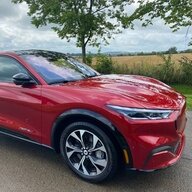
'22 GT, 41,358 miles, hardly ever DCFC, SOH 95.5%. I generally charge at home to 90% over night
Mach-Lee
Well-Known Member
- First Name
- Lee
- Joined
- Jul 16, 2021
- Threads
- 262
- Messages
- 11,382
- Reaction score
- 25,071
- Location
- Wisconsin
- Vehicles
- 2022 Mach-E Premium AWD
- Occupation
- Sci/Eng
FYI after taking a road trip with multiple 10% to 100% charges, my SoH increased 1.0% to 94.5%.
If you only charge to 70-80% daily with shallow charge cycles (best for battery health), you may see a drop in the SoH due to insufficient BMS calibration data. If you do not charge to 100% often, performing a BMS calibration with deep charge cycles will likely increase the SoH estimate by 0.5%-3%. The actual battery condition will remain unchanged, you are just updating the software estimate of your battery's capacity. My recommendation is to perform a deep charge cycle every 6 months or so (every month with LFP) to keep the BMS updated.
If you only charge to 70-80% daily with shallow charge cycles (best for battery health), you may see a drop in the SoH due to insufficient BMS calibration data. If you do not charge to 100% often, performing a BMS calibration with deep charge cycles will likely increase the SoH estimate by 0.5%-3%. The actual battery condition will remain unchanged, you are just updating the software estimate of your battery's capacity. My recommendation is to perform a deep charge cycle every 6 months or so (every month with LFP) to keep the BMS updated.

MuckyMach-e
Well-Known Member
- First Name
- Mark
- Joined
- Apr 29, 2022
- Threads
- 10
- Messages
- 314
- Reaction score
- 420
- Location
- Liverpool, United Kingdom
- Vehicles
- Ford Mustang Mach-e AWD Extended Range
'21 Premium ER AWD, 39,175 miles, hardly ever DCFC, SOH 96.5%. I generally charge at home to 80% over night
thenew3
Well-Known Member
- Joined
- Mar 12, 2023
- Threads
- 8
- Messages
- 516
- Reaction score
- 358
- Location
- Central Coast CA
- Vehicles
- BMW X7, BMW X3, MME Premium 4X
DId you have the HVBJB recall work done yet? I have the same car and had the same SOH (96.5) at 40k miles right before the HVBJB recall work. Right after the recall was done, the SOH dropped to 92%. Some how the recall ( with its various module software updates) caused the HV SOH to drop by 4.5%'21 Premium ER AWD, 39,175 miles, hardly ever DCFC, SOH 96.5%. I generally charge at home to 80% over night
OP
OP
AngryMan
Well-Known Member
- First Name
- Jim
- Joined
- Aug 19, 2023
- Threads
- 11
- Messages
- 737
- Reaction score
- 966
- Location
- Ohio
- Vehicles
- OLD 2021 Select , NEW 2023 GT...RED !
- Occupation
- Living the good life
- Thread starter
- #90
I don't know if it would "correct" your readings but maybe try what Lee described in comment #87.DId you have the HVBJB recall work done yet? I have the same car and had the same SOH (96.5) at 40k miles right before the HVBJB recall work. Right after the recall was done, the SOH dropped to 92%. Some how the recall ( with its various module software updates) caused the HV SOH to drop by 4.5%
He's our resident guru
Sponsored
Similar threads

- Replies
- 49
- Views
- 7,776


