Consequences of never charging to 100%?

RVAtom

Well-Known Member
First Name
Adam
Joined
Jul 21, 2020
Threads
26
Messages
207
Reaction score
309
Location
RVA
Vehicles
Mustang Mach E
Country flag
Yeah it needs some time for the cell voltages to stabilize after driving so it can get an accurate read on all of them with no voltage drop. It will then calculate updated capacity. After a drive I was down to 4% and parked it, when it came back a few hours later it was up to 7% magically. That shows there was some capacity error.
This is really interesting and makes some sense. I only explore the bottom 50% of capacity a handful of times a year, but this makes me think I should make it a point to get down there and stay there after a trip for one day to see how my car reacts as well.

It does feel a bit like playing chicken though.
Sponsored

 

JoeBeach

Well-Known Member
First Name
Joe
Joined
Mar 14, 2022
Threads
8
Messages
103
Reaction score
45
Location
Central Florida
Vehicles
Mach E Premium 2WD ER, F150
Occupation
Retired
Country flag
As long as you swap your electron filters regularly, this shouldn't be an issue.
I hear the new flux capacitors have taken care of that problem.
 

Mach-Lee

Well-Known Member
First Name
Lee
Joined
Jul 16, 2021
Threads
262
Messages
11,373
Reaction score
25,044
Location
Wisconsin
Vehicles
2022 Mach-E Premium AWD
Occupation
Sci/Eng
Country flag
I recently started the 40-70% maintenance charging. I'm a little confused with going below 10% for maintaining accuracy in range. I get the idea but if the accuracy is off, then I'd be very concerned about "running out" trying to get it to and below 10%. Playing chicken with the range isn't my idea of fun.
Unless you have a LFP you haven't charged to 100% in a month or it's very cold outside, you can safely go down to 10%. It won't be off that far. Just don't go below 5% if you're worried.


Fremont Kid

Well-Known Member
First Name
Steve
Joined
Oct 8, 2022
Threads
12
Messages
773
Reaction score
667
Location
Colorado Springs, CO
Vehicles
2022 Mustang Mach e Premium AWD
Occupation
Retired IT
Country flag
I've run down to ~10% twice since I've owned it. I just couldn't help but slap it on the charger as soon as I could. I felt like I owed it an apology for going that low lol. (damn that 'never run you tank less than 1/4 full' BS I was fed for years.)
Depends on the rationale. Not going lower than 1/4 tank prevents 'gunk' at the tank bottom from being pulled into the fuel pump and up to the spark plugs. This is the only reason I would caution going lower than 1/4 tank. More reasonably probably close to empty might suck the gunk into the fuel pump.
 

65MustangBoy

Well-Known Member
First Name
Les
Joined
Jan 27, 2023
Threads
8
Messages
197
Reaction score
239
Location
Indiana
Vehicles
65 Mustang, 2023 Mach E Premium
Occupation
Retired
Country flag
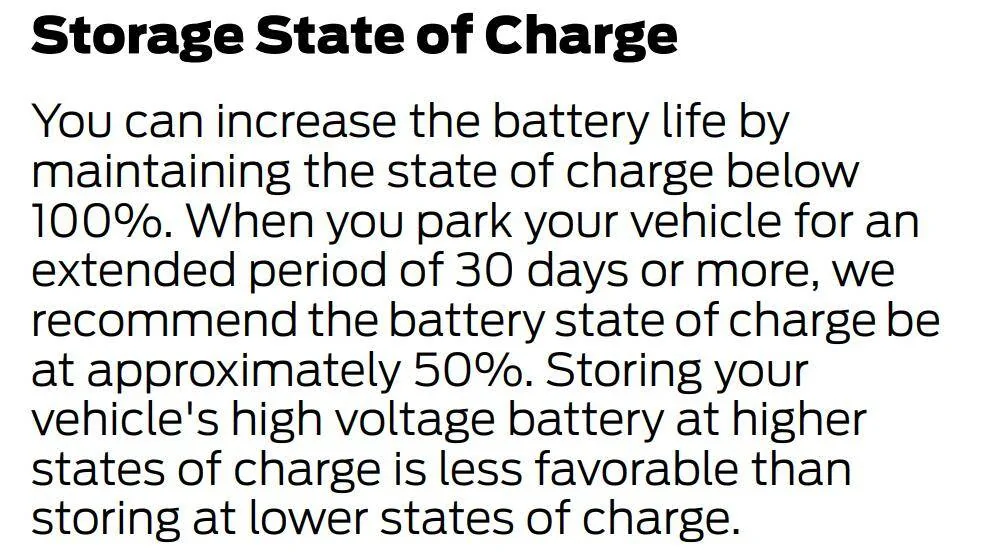
I've seen threads on this topic before. And I was reminded of the following straight from the Mach E owner's manual.
For daily driving......

Ford Mustang Mach-E Consequences  of never charging to 100%? Battery1


And for extended storage.
Ford Mustang Mach-E Consequences  of never charging to 100%? Battery2
 

azerik

Well-Known Member
First Name
Erik
Joined
Jan 8, 2023
Threads
79
Messages
4,545
Reaction score
4,558
Location
Chandler/Flagstaff, AZ
Vehicles
'21 Spacey Prem4x, '21 RX450H, 13 Focus EV
Occupation
DevSecNetOps, General PITA
Country flag
Depends on the rationale. Not going lower than 1/4 tank prevents 'gunk' at the tank bottom from being pulled into the fuel pump and up to the spark plugs. This is the only reason I would caution going lower than 1/4 tank. More reasonably probably close to empty might suck the gunk into the fuel pump.
This.
I have seen high HP vehicles starve the pumps at low fuel levels when the pump is mounted towards the front (I’m pointing at my Gen2 Lightning). With closed loop pumps it’s less of a possible problem but even that little hiccup could be catastrophic if pressure drops or a bunch of air sucked into the line.
 

phil

Well-Known Member
Joined
Jun 6, 2021
Threads
13
Messages
3,160
Reaction score
4,211
Location
USA
Vehicles
LS400
Country flag
Things also get worse with time as the cells age and diverge from each other increasingly more in capacity. You're limited in range by the weakest cell in your pack.
I did not quite understand this comment, about the need for a buffer to prevent capacity estimation errors at the 'bottom' of the battery that could potentially cause the last few percent of capacity to disappear quickly. Are you saying that this risk is unavoidable with an older battery, or can the risk still be minimized by charging occasionally to 100% and leaving it occasionally at 5 or 10%, even when the battery is a few years old?

In the spirit of proper maintenance, I followed the advice above and ran the battery down to 4% last night. It seemed to behave fine, at least down to 4%, but it did pop back up to 5% before I started to recharge this morning.
 

Mach-Lee

Well-Known Member
First Name
Lee
Joined
Jul 16, 2021
Threads
262
Messages
11,373
Reaction score
25,044
Location
Wisconsin
Vehicles
2022 Mach-E Premium AWD
Occupation
Sci/Eng
Country flag
I did not quite understand this comment, about the need for a buffer to prevent capacity estimation errors at the 'bottom' of the battery that could potentially cause the last few percent of capacity to disappear quickly. Are you saying that this risk is unavoidable with an older battery, or can the risk still be minimized by charging occasionally to 100% and leaving it occasionally at 5 or 10%, even when the battery is a few years old?
There are 376 pouch cells in the Mach-E extended pack. They will not all have the same capacity, and the differences between cells will diverge with time. When the cells are new, their capacities are all within 2% of each other, for an aged pack it could be as high as 15% capacity variance between cells. That means some will run down faster than others when discharging the pack. The BMS keeps track of this and adjusts the overall available capacity based on the weakest cell in the entire pack. The goal is to not have a cell voltage go crashing down suddenly at the bottom of the range. When I talk about capacity variance, that is not the same as buffer, the BMS will try to maintain the same top and bottom buffer the entire time so you still have some emergency range left when you hit 0%, but the bottom buffer especially gets more difficult to maintain when the pack is aged.

You should complete the battery calibration several times a year throughout the life of the pack to maintain accuracy, which helps prevent range crashing at the end. Regular calibration is more important the older the pack gets.
 

Snakebitten

Well-Known Member
Joined
Mar 1, 2024
Threads
0
Messages
2,263
Reaction score
3,779
Location
Coastal Texas
Vehicles
2023.5 Mach-E
Country flag
There are 376 pouch cells in the Mach-E extended pack. They will not all have the same capacity, and the differences between cells will diverge with time. When the cells are new, their capacities are all within 2% of each other, for an aged pack it could be as high as 15% capacity variance between cells. That means some will run down faster than others when discharging the pack. The BMS keeps track of this and adjusts the overall available capacity based on the weakest cell in the entire pack. The goal is to not have a cell voltage go crashing down suddenly at the bottom of the range. When I talk about capacity variance, that is not the same as buffer, the BMS will try to maintain the same top and bottom buffer the entire time so you still have some emergency range left when you hit 0%, but the bottom buffer especially gets more difficult to maintain when the pack is aged.

You should complete the battery calibration several times a year throughout the life of the pack to maintain accuracy, which helps prevent range crashing at the end. Regular calibration is more important the older the pack gets.
Excellent explanation.

And many folks owning a Leaf learned about the importance of the delta between the lowest/highest voltage cell as the HVB SOC dropped into the lower range. (30% or less)

Fortunately there were some good PIDs for monitoring that delta, so at least you would know if the future wasn't looking so bright.

The Mach-E battery and its thermal management are far superior, of course. But I still care more about monitoring that cell voltage delta far more than the infamous carscanner SOH value. :)
Sponsored


Top