Heat pump vs non heat pump. What is the difference in efficiency

ChehRob

Well-Known Member
First Name
Rob
Joined
Aug 24, 2023
Threads
13
Messages
965
Reaction score
572
Location
Seattle WA
Vehicles
MME Premium AWD Ext. Range (Job2)
Occupation
ret
Country flag
When I bought a condo, I read all of the documentation from the time the land was being purchased, permitting, etc. Then ALL of the minutes from the first HOA meeting to the last. Yet there still were some bad bomb shells (grossly dysfunctional but brilliant board president)
Sponsored
 

Fixbear

Well-Known Member
First Name
Frank
Joined
Jun 15, 2022
Threads
5
Messages
642
Reaction score
276
Location
ADK. foothills, NY
Vehicles
2001 SelectMachE4 SR , Mini SE
Occupation
retired, Construction Mechanic, Refrigeration tech, Ford, GMC, Chevy tech,
Country flag
You would be wrong. They work very well these days. Down to -20F or lower.
It's all in who spec'd it for the location. Often they just use what the closest NWS data is. But there are many micro-climate conditions in different areas and terrains. To be effective and reliable, the spec has to e very close.
 

devmach-e

Well-Known Member
First Name
David
Joined
Sep 8, 2021
Threads
1
Messages
2,028
Reaction score
2,481
Location
SF Bay Area
Vehicles
2022 Premium RWD ER, 2016 Toyota Highlander Hybrid
Occupation
Unix Sysadmin
Country flag
It's all in who spec'd it for the location. Often they just use what the closest NWS data is. But there are many micro-climate conditions in different areas and terrains. To be effective and reliable, the spec has to e very close.
When spec'ing the system, a lot of factors go into it, including the number of heating days, heat-loss/load of the building, and average overnight temps for 99% of the time. The system isn't going to be completely thrown off kilter if there are a few nights where it gets down to -25F instead of the design temp of -20F. I live in an area with a lot of microclimates and we have NWS stations all over the area to accommodate the diversity of the area.
 

Fixbear

Well-Known Member
First Name
Frank
Joined
Jun 15, 2022
Threads
5
Messages
642
Reaction score
276
Location
ADK. foothills, NY
Vehicles
2001 SelectMachE4 SR , Mini SE
Occupation
retired, Construction Mechanic, Refrigeration tech, Ford, GMC, Chevy tech,
Country flag
When spec'ing the system, a lot of factors go into it, including the number of heating days, heat-loss/load of the building, and average overnight temps for 99% of the time. The system isn't going to be completely thrown off kilter if there are a few nights where it gets down to -25F instead of the design temp of -20F. I live in an area with a lot of microclimates and we have NWS stations all over the area to accommodate the diversity of the area.
What you have sited is correct, but one should also do a complete heat study and consider prevailing winds and moisture. High ambient humidity at low temps will make a lot of Rhine ice. Thus making a excessive ice load on the evaporator. Mitigating it requires a lot of specific changes to take-down and air flow. As well as higher back-up heat for the defrost period. I haven't done one in 10 years, Results have never been sufficient in my area. Only the geo-thermal have been somewhat decent, but the cost is high. Unless you have a moving water source that has adequate flow.


tuminatr

Well-Known Member
First Name
Brian
Joined
Apr 22, 2020
Threads
51
Messages
2,185
Reaction score
2,222
Location
Saint Paul,MN
Vehicles
2021 MME GTPE
Occupation
sales
Country flag

Mach-Lee

Well-Known Member
First Name
Lee
Joined
Jul 16, 2021
Threads
262
Messages
11,373
Reaction score
25,043
Location
Wisconsin
Vehicles
2022 Mach-E Premium AWD
Occupation
Sci/Eng
Country flag
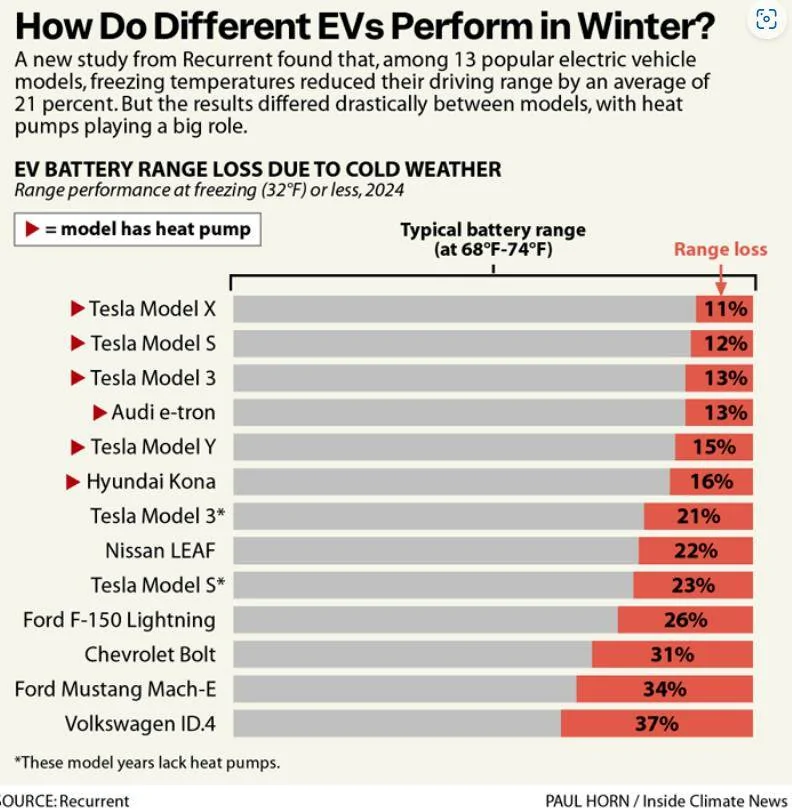
Same flawed Recurrent data being used again. Since it's based on remote vehicle telemetry rather than actual measurements like a real scientific study would be, view it with skepticism. We all know how much the Mach-E range meter varies with cold (which is the data Recurrent used), so the Mach-E range loss effect is likely exaggerated here.

Really the only decent comparisons you can make are within the same brand and model. The Tesla Model 3 saw an 8% improvement and the Model S 11% improvement in range loss with the heat pump.

So roughly a 10% range improvement in below freezing conditions is expected, however this depends a lot on the speed you're driving and the outdoor temperature. The improvement will be less pronounced at high speeds and low temperatures.
 

YeOldeTraveller

Well-Known Member
First Name
Clark
Joined
Jul 12, 2024
Threads
6
Messages
332
Reaction score
385
Location
Ann Arbor, MI, USA
Vehicles
2024 MME Rally
Country flag
Same flawed Recurrent data being used again. Since it's based on remote vehicle telemetry rather than actual measurements like a real scientific study would be, view it with skepticism. We all know how much the Mach-E range meter varies with cold (which is the data Recurrent used), so the range loss effect is likely exaggerated here.

Really the only decent comparisons you can make are within the same brand and model. The Tesla Model 3 saw an 8% improvement and the Model S 11% improvement with the heat pump.

So roughly a 10% range improvement in below freezing conditions is expected, however this depends a lot on the speed you're driving and the outdoor temperature.
I have not been impressed with their methods or explanations.

Also, I'm seeing much closer to 20% loss at lower temperatures, so I'm not sure how they are getting that value.
 

Mosworthy

Well-Known Member
First Name
Shane
Joined
Nov 19, 2021
Threads
7
Messages
234
Reaction score
221
Location
Thunder Bay, ON, Can
Vehicles
2021 Ford Mustang Mach-E Premium AWD SR
Occupation
Manager of Paper Operations
Country flag
I drive a Mach-E in the Yukon. A heat pump would definitely be great to have but it's not a dealbreaker.
My guess is you wouldn't notice...
Too cold
Sponsored


Top