Any Ford 48-amp Charge Station users?

Maquis

Well-Known Member
First Name
Dave
Joined
Dec 21, 2020
Threads
34
Messages
5,687
Reaction score
8,068
Location
Illinois
Vehicles
2021 Mach E4X, 2023 Lightning Lariat ER
Country flag
A recent amendment to the National Electric Code requires that a GFCI breaker be installed on a 240VAC outlet when used for EVSE (electric vehicle charging). This is intended as a safety enhancement because many models of 240VAC outlets are not intended for frequent plug/unplug cycles, and wear out, presenting a shock and fire hazard.
However, this is incompatible with most EVSE and EVs, since most of these have internal GFCI, and they test the ground connection in a way that results in nuisance tripping of the outlet GFCI.
The EVSE will frequently nuisance trip the outlet GFCI because it tests the ground connection by putting a current on the ground wire. This means that the NEC amendment for GFCI on EVSE outlets is incorrect because it doesn't include a way to prevent these nuisance trips. In effect, this is a ban on using 240VAC outlets for EVSE and a requirement for hard-wiring EVSE, and I find this unacceptable. Most consumer EVSE are sold with 14-50 plugs, and if an electrician installs a compliant 14-50 outlet with GFCI, after a few nuisance trips residents will just swap out the GFCI breaker with a standard one. What the industry needs to figure out is how to have a GFCI on a 240VAC outlet and plug in an EVSE without nuisance trips.
I found these articles among many that discuss the incompatibility of the GFCI built in to EVSE and the GFCI installed for outlets:

https://qmerit.com/blog/nema-14-50-and-gfci-breakers-connecting-ev-charging-stations/

I found an answer to my question on GFCI for EVSE in a FAQ PDF from Williams Electric:
Q: WHY does the code require GFCI BREAKERS for EV charging outlets?
A: EVSE outlets are NOT like the outlets behind your dryer or your stove, which are out-of reach and accessed once every 10 years. This is a live, 240-volt, high-current outlet on the wall inside your garage, where kids can get at it and the floor could be wet. It’s different, and the safety rules are different.

My soap box response:
This answer sounds like FUD to me: “kids can get at it”, “floor could be wet”. Someone who says the oven and dryer outlets are “out of reach” and not “where kids can get at it” has never had kids. But still, the perception seems to be a safety problem during cycling (pulling or inserting) the plug, so why can’t I put a padlock on the plug to prevent unauthorized unplugging instead of installing an outlet GFCI which, due to being redundant to the GFCI in the EVSE, will exhibit nuisance tripping? The only reason I can see is that this is not considered in the NEC. My EVSE and outlet actually are under lock and key.

The FAQ answer also refers to a rationalization I have heard for the GFCI requirement on 240VAC outlets when used for EVSE, which is that high cycle use (plugging and unplugging many times) wears out the connector making it unreliable and unsafe, and the GFCI adds safety margin for a worn outlet. Why is this an issue just for EVSE, and not for RV parks which also use the NEMA 14-50? And why is this an issue for a permanently installed EVSE, and not just for portable EVSE?

https://www.williamselectric.net/documents/FAQs-NEMA-1450-outlets-pkg-20210919.pdf
As of the 2020 NEC, all receptacle outlets installed at a dwelling unit outdoors or in a garage that are 50A or less and 150V to ground or less require GFCI. The intended use of the outlet is irrelevant.

A properly designed plug-in EVSE will not trip a GFCI. A class A GFCI must not trip at 4ma or less. A properly engineered ground detection circuit will not shunt anywhere near 4ma to ground.
Sponsored
 

averyintucson

Active Member
First Name
Avery
Joined
Jun 17, 2022
Threads
0
Messages
28
Reaction score
14
Location
Tucson, Arizona
Vehicles
2022 Ford Mustang Mach E, 2016 Nissan Leaf
Occupation
Engineer
Country flag
Please provide links to documentation that refutes the documents in the links in my post.
 

ChasingCoral

Well-Known Member
First Name
Mark
Joined
Feb 3, 2020
Threads
502
Messages
14,306
Reaction score
28,653
Location
Maryland
Vehicles
2021 GB E4X FE, 2022 F-150 Lightning Lariat ER
Occupation
Retired oceanographer
Country flag
You should watch this video that shows why hard-wiring is best.


Then figure out how much charging power you need:


Then look into what charger to buy:

and


Maquis

Well-Known Member
First Name
Dave
Joined
Dec 21, 2020
Threads
34
Messages
5,687
Reaction score
8,068
Location
Illinois
Vehicles
2021 Mach E4X, 2023 Lightning Lariat ER
Country flag
It's my understanding that GFCI is not required if the EVSE is hardwired. Is that correct?
That’s correct.
Unless the EVSE is mounted outdoors and you’re on the 2023 NEC.
 

averyintucson

Active Member
First Name
Avery
Joined
Jun 17, 2022
Threads
0
Messages
28
Reaction score
14
Location
Tucson, Arizona
Vehicles
2022 Ford Mustang Mach E, 2016 Nissan Leaf
Occupation
Engineer
Country flag
You should watch this video that shows why hard-wiring is best.
I never said that hard-wiring is not the best, my question is whether the NEMA 14-50 is good enough. Hard wiring is highly inconvenient to say the least for portable EVSE and informal charging. I am seriously considering replacing my NEMA 14-50 plug for a hard-wired connection because that will allow me (per the EVSE installation manual) to install a 60 Amp breaker and charge up to 48A (11kW), which the Mach-E is supposed to support, and GFCI not required for hard-wired connection.

I did find some additional information on minimizing GFCI nuisance tripping with EVSE:

"There are 5mA trip gfci breakers and 30mA trip breakers. You need the latter."
https://www.kiaevforums.com/threads/evse-and-gfci-conundrum.4352/

Here is a likely model:
GFEP250 - Eaton - 30 mA GFEP Circuit Breaker
Plug-In - 50 Amp - 2 Pole - 240 Volt
Here is a link:
https://www.simplybreakers.com/products/gfep250

An important part of electrical safety is inspecting an outlet before using it and not plugging in if it has any sign damage or excessive wear. Here is an outlet safety checklist:
https://www.hoffmannbros.com/electrical/outlets/safety-checklist
 

Maquis

Well-Known Member
First Name
Dave
Joined
Dec 21, 2020
Threads
34
Messages
5,687
Reaction score
8,068
Location
Illinois
Vehicles
2021 Mach E4X, 2023 Lightning Lariat ER
Country flag
I never said that hard-wiring is not the best, my question is whether the NEMA 14-50 is good enough. Hard wiring is highly inconvenient to say the least for portable EVSE and informal charging. I am seriously considering replacing my NEMA 14-50 plug for a hard-wired connection because that will allow me (per the EVSE installation manual) to install a 60 Amp breaker and charge up to 48A (11kW), which the Mach-E is supposed to support, and GFCI not required for hard-wired connection.

I did find some additional information on minimizing GFCI nuisance tripping with EVSE:

"There are 5mA trip gfci breakers and 30mA trip breakers. You need the latter."
https://www.kiaevforums.com/threads/evse-and-gfci-conundrum.4352/

Here is a likely model:
GFEP250 - Eaton - 30 mA GFEP Circuit Breaker
Plug-In - 50 Amp - 2 Pole - 240 Volt
Here is a link:
https://www.simplybreakers.com/products/gfep250

An important part of electrical safety is inspecting an outlet before using it and not plugging in if it has any sign damage or excessive wear. Here is an outlet safety checklist:
https://www.hoffmannbros.com/electrical/outlets/safety-checklist
A 30ma GFEP cannot be used to meet code where it requires GFCI.
 
OP
OP

valfam

Well-Known Member
First Name
Ruben
Joined
Dec 28, 2023
Threads
15
Messages
223
Reaction score
77
Location
Florida
Vehicles
JK and a WKII both gone :-( Now 23 MMEP Sta
Occupation
network admin
Country flag
Yes. I just had the Ford 48 amp wall charger installed in the garage last week. It works great with my MME 23.5. I get 10kwh charging speed.
I'm wondering what kind of data do you get from the EVSE? I see the data my Ford app provides.
 

ChasingCoral

Well-Known Member
First Name
Mark
Joined
Feb 3, 2020
Threads
502
Messages
14,306
Reaction score
28,653
Location
Maryland
Vehicles
2021 GB E4X FE, 2022 F-150 Lightning Lariat ER
Occupation
Retired oceanographer
Country flag

macchiaz-o

Well-Known Member
First Name
Jonathan
Joined
Nov 25, 2019
Threads
171
Messages
8,577
Reaction score
15,986
Location
}not/A/gr8'Place.2.store-mEyePassword{
Vehicles
MY21 J1 Premium RWD SR
Country flag
I'm wondering what kind of data do you get from the EVSE? I see the data my Ford app provides.
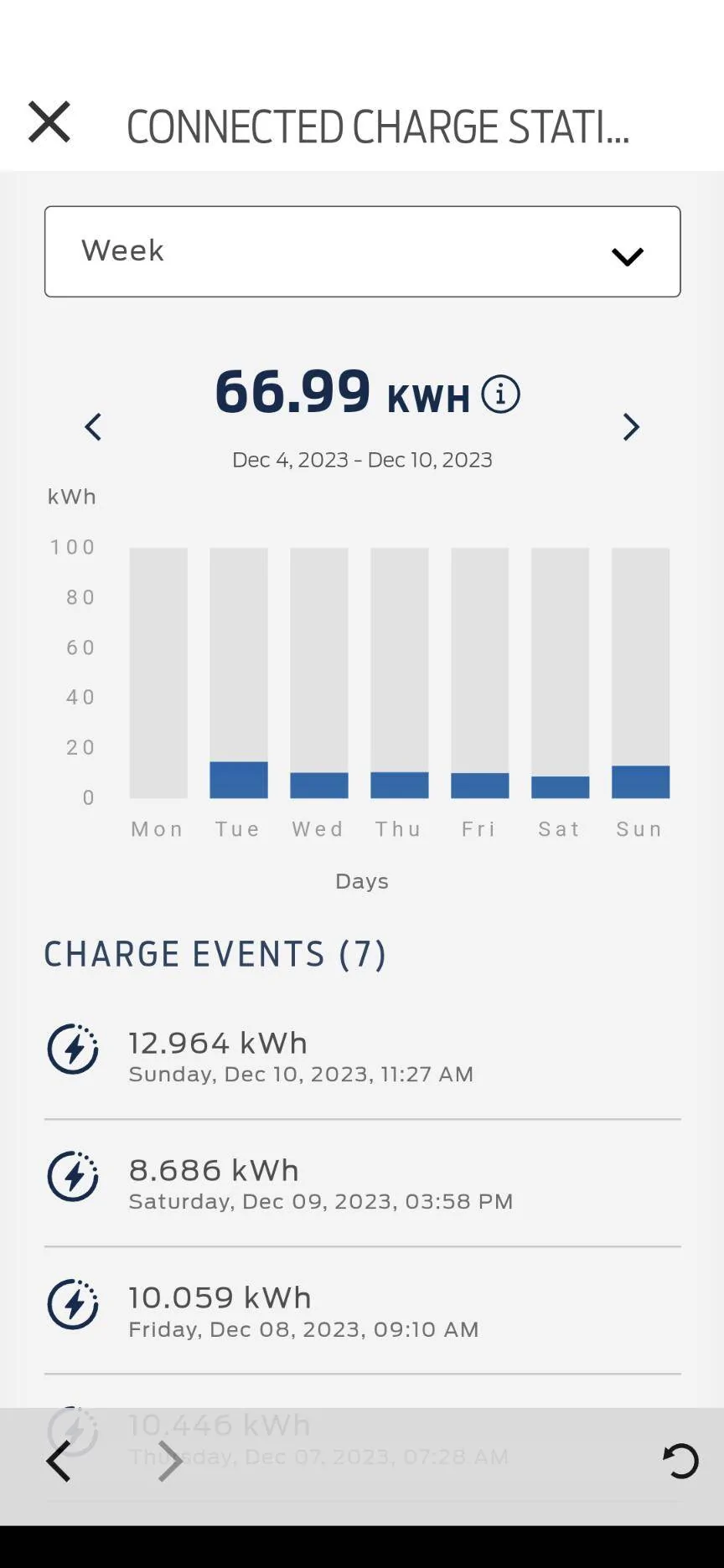
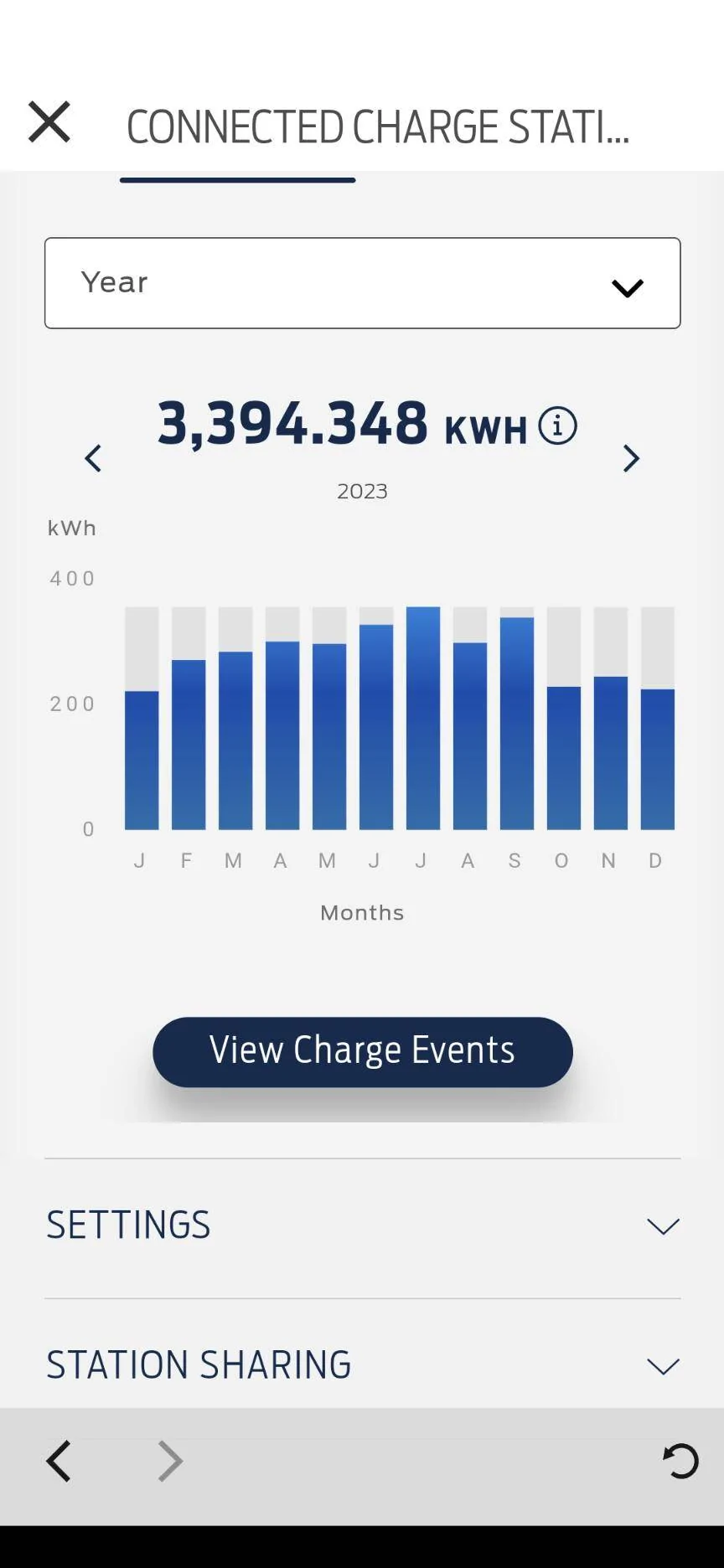
I use the Ford Connected Charge Station. You can only access its data and settings from within the FordPass app. Here are some examples of what it shows me, and this is pretty much all it can do in terms of data/analysis:

Ford Mustang Mach-E Any Ford 48-amp Charge Station users? Screenshot_20240110-233941


Ford Mustang Mach-E Any Ford 48-amp Charge Station users? Screenshot_20240110-233957
 
OP
OP

valfam

Well-Known Member
First Name
Ruben
Joined
Dec 28, 2023
Threads
15
Messages
223
Reaction score
77
Location
Florida
Vehicles
JK and a WKII both gone :-( Now 23 MMEP Sta
Occupation
network admin
Country flag
thanks for the screen shots.
 

averyintucson

Active Member
First Name
Avery
Joined
Jun 17, 2022
Threads
0
Messages
28
Reaction score
14
Location
Tucson, Arizona
Vehicles
2022 Ford Mustang Mach E, 2016 Nissan Leaf
Occupation
Engineer
Country flag
.

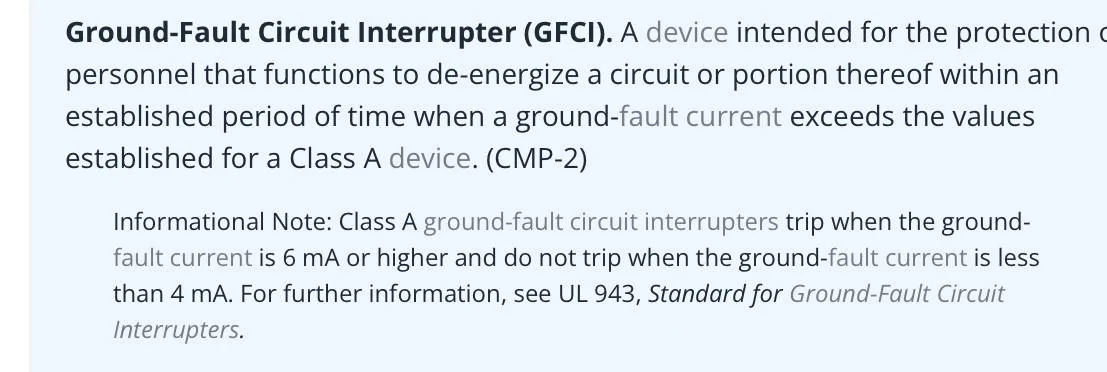
here is the NEC definition.
IMG_0766.jpeg
This does not answer my question. This is a definition of the Class A GFCI. Are there not other GFCIs for other classes of devices? Is a Class A GFCI required for an EVSE?
Sponsored


Top