Maquis
Well-Known Member
- First Name
- Dave
- Joined
- Dec 21, 2020
- Threads
- 34
- Messages
- 5,687
- Reaction score
- 8,068
- Location
- Illinois
- Vehicles
- 2021 Mach E4X, 2023 Lightning Lariat ER

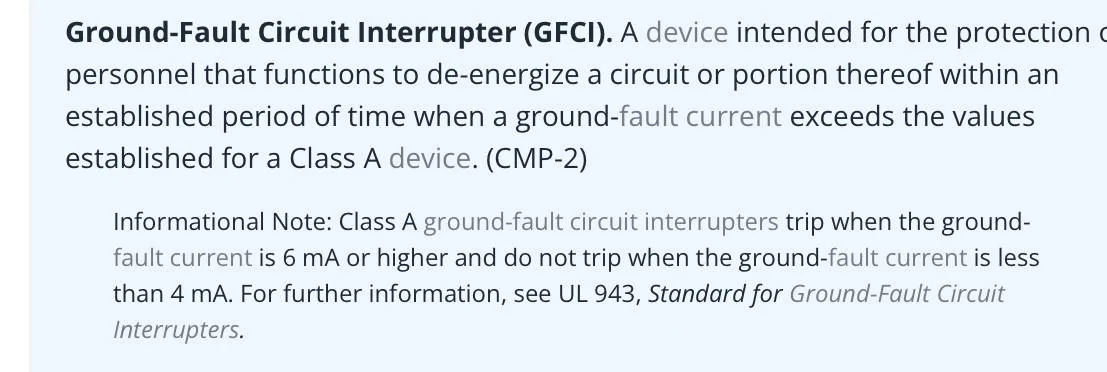
As of the 2020 NEC, all receptacle outlets installed at a dwelling unit outdoors or in a garage that are 50A or less and 150V to ground or less require GFCI. The intended use of the outlet is irrelevant.A recent amendment to the National Electric Code requires that a GFCI breaker be installed on a 240VAC outlet when used for EVSE (electric vehicle charging). This is intended as a safety enhancement because many models of 240VAC outlets are not intended for frequent plug/unplug cycles, and wear out, presenting a shock and fire hazard.
However, this is incompatible with most EVSE and EVs, since most of these have internal GFCI, and they test the ground connection in a way that results in nuisance tripping of the outlet GFCI.
The EVSE will frequently nuisance trip the outlet GFCI because it tests the ground connection by putting a current on the ground wire. This means that the NEC amendment for GFCI on EVSE outlets is incorrect because it doesn't include a way to prevent these nuisance trips. In effect, this is a ban on using 240VAC outlets for EVSE and a requirement for hard-wiring EVSE, and I find this unacceptable. Most consumer EVSE are sold with 14-50 plugs, and if an electrician installs a compliant 14-50 outlet with GFCI, after a few nuisance trips residents will just swap out the GFCI breaker with a standard one. What the industry needs to figure out is how to have a GFCI on a 240VAC outlet and plug in an EVSE without nuisance trips.
I found these articles among many that discuss the incompatibility of the GFCI built in to EVSE and the GFCI installed for outlets:
https://qmerit.com/blog/nema-14-50-and-gfci-breakers-connecting-ev-charging-stations/
I found an answer to my question on GFCI for EVSE in a FAQ PDF from Williams Electric:
Q: WHY does the code require GFCI BREAKERS for EV charging outlets?
A: EVSE outlets are NOT like the outlets behind your dryer or your stove, which are out-of reach and accessed once every 10 years. This is a live, 240-volt, high-current outlet on the wall inside your garage, where kids can get at it and the floor could be wet. It’s different, and the safety rules are different.
My soap box response:
This answer sounds like FUD to me: “kids can get at it”, “floor could be wet”. Someone who says the oven and dryer outlets are “out of reach” and not “where kids can get at it” has never had kids. But still, the perception seems to be a safety problem during cycling (pulling or inserting) the plug, so why can’t I put a padlock on the plug to prevent unauthorized unplugging instead of installing an outlet GFCI which, due to being redundant to the GFCI in the EVSE, will exhibit nuisance tripping? The only reason I can see is that this is not considered in the NEC. My EVSE and outlet actually are under lock and key.
The FAQ answer also refers to a rationalization I have heard for the GFCI requirement on 240VAC outlets when used for EVSE, which is that high cycle use (plugging and unplugging many times) wears out the connector making it unreliable and unsafe, and the GFCI adds safety margin for a worn outlet. Why is this an issue just for EVSE, and not for RV parks which also use the NEMA 14-50? And why is this an issue for a permanently installed EVSE, and not just for portable EVSE?
https://www.williamselectric.net/documents/FAQs-NEMA-1450-outlets-pkg-20210919.pdf
A properly designed plug-in EVSE will not trip a GFCI. A class A GFCI must not trip at 4ma or less. A properly engineered ground detection circuit will not shunt anywhere near 4ma to ground.
Sponsored