
squirrels2nuts
Well-Known Member
- First Name
- squirrelly
- Joined
- Jun 13, 2023
- Threads
- 12
- Messages
- 181
- Reaction score
- 140
- Location
- Ontario
- Vehicles
- 2022 GTPE
- Occupation
- Pharmacy
- Thread starter
- #31
i love to observe mating ?
Sponsored

Isn't that most sales associates? Their job is to sell, not educate. Surely most adults at this point in their life truly don't expect sales associates who push dozens of models to actually have real knowledge about them?I've found that car dealers generally know very little about the products that they sell.
Ford’s installation instructions for a home charger recommends installing 50 amp GFCI breaker in the panel regardless of any protection built into the MME.The EVSE has a GFI internal for that purpose.
That's all true, but if you put a device with built-in GFCI on a circuit with a GFCI breaker it can cause false trips. The Mobile charger doesn't have a GFCI built-in (thus the guidance), but most aftermarket EVSE do.Ford’s installation instructions for a home charger recommends installing 50 amp GFCI breaker in the panel regardless of any protection built into the MME.
Also, the concern for water and electricity is that if there is an event and a person becomes part of the electrical circuit (gets a “nasty” shock), the presence of water changes the resistance in the bodywhich results in electrocution. This is why the NEC requires GFCIs anywhere near a water source in and outside of a home for electrical outlets. The GFCI will shut the circuit with the most minuscule of changes in resistance on the circuit.
As mentioned in post 17, be sure the EVSE is UL listed if you want to be sure this feature is included.The EVSE has a GFI internal for that purpose.
The GFCI breaker protects against shocks when plugging/unplugging. The requirement to GFCI protect receptacle outlets rated over 20A started in the 2020 NEC. Many areas are still on older versions.Ford’s installation instructions for a home charger recommends installing 50 amp GFCI breaker in the panel regardless of any protection built into the MME.
Also, the concern for water and electricity is that if there is an event and a person becomes part of the electrical circuit (gets a “nasty” shock), the presence of water changes the resistance in the bodywhich results in electrocution. This is why the NEC requires GFCIs anywhere near a water source in and outside of a home for electrical outlets. The GFCI will shut the circuit with the most minuscule of changes in resistance on the circuit.
Every UL listed EVSE has built-in GFCI protection including the Mobile Charger. Cascading GFCIs doesn’t in itself cause tripping.That's all true, but if you put a device with built-in GFCI on a circuit with a GFCI breaker it can cause false trips. The Mobile charger doesn't have a GFCI built-in (thus the guidance), but most aftermarket EVSE do.
From this link here:The GFCI breaker protects against shocks when plugging/unplugging. The requirement to GFCI protect receptacle outlets rated over 20A started in the 2020 NEC. Many areas are still on older versions.
Every UL listed EVSE has built-in GFCI protection including the Mobile Charger. Cascading GFCIs doesn’t in itself cause tripping.
Appliances that trip GFCIs are either defective or incorporate surge protection circuitry that has leakage current to ground.
NopeDo you operate the pharmacy out of the GTPE ? ?
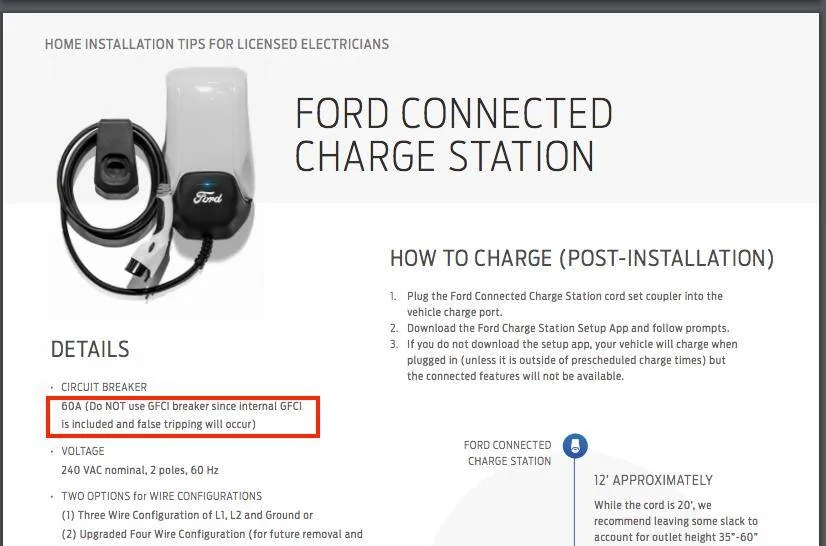
It does NOT give the reason for nuisance tripping as its internal GFCI. Because it’s not the reason.From this link here:
![]()
And on the mobile charger section of the same document it recommends a GFCI breaker without the same caveat
I'm really not interested in arguing semantics. This topic was argued about 2 years ago with Ford engineers supplying the information I repeated.It does NOT give the reason for nuisance tripping as its internal GFCI. Because it’s not the reason.
That sentence is telling us two things:
1) Don't use a GFCI breaker due to nuisance tripping.
2) Don’t worry, because the EVSE provides GFCI protection (like all UL listed EVSEs).
All good.I'm really not interested in arguing semantics. This topic was argued about 2 years ago with Ford engineers supplying the information I repeated.
In this thread it was suggested that people should have a GFCI breaker, and I replied that the advice was contradictory to the EVSE manufacturers' guidance because GFCI breakers will cause issues. I supplied copies of that guidance AGAINST GFCI breakers from the first 2 manufacturers I thought of.
Fair enough?