
• NOTE: THE MEMBERS MARKETPLACE SECTION IS FOR PERSONAL USE ONLY - I.E. SELLING ITEMS/PARTS FROM YOUR PERSONAL VEHICLE ONLY. ANY SALES OF ITEMS MADE FOR COMMERCIAL PURPOSES (I.E. MAKING/SELLING MULTIPLE ITEMS, TAKING ORDERS, ETC) BY ACCOUNTS NOT AUTHORIZED TO CONDUCT COMMERCIAL SALES ON THE SITE IS A DIRECT VIOLATION OF OUR FORUM RULES AND TERMS OF SERVICE AND WILL RESULT IN THE PERMANENT SUSPENSION OF YOUR ACCOUNT.

    ATTENTION SELLERS: All users who wish to sell in the marketplace are now required to abide by the following RULES. If a sales thread/post does not comply, it is subject to DELETION without notice.

    ATTENTION BUYERS: If you see a non-compliant sales thread, please REPORT the thread and take CAUTION when transacting.

    Rule #1 - Post a picture of the actual item you are selling (NO stock photos).
    Rule #2 - The picture must include a REAL piece of paper with your Username and the Date written on it next to the product you are selling. NO photoshop or digitally edited photos are allowed.
    Rule #3 - NO "feeler" threads are permitted. This section is only for items that are actually available and ready to be sold currently.
    Rule #4 - The listing must include an asking price. OBO (or best offer) is allowed but it must be accompanied by an asking price.
    Rule #5 - No "threadcrapping." Classifieds threads are not meant for negative discussions. Comments on pricing are not allowed. Only people with genuine questions and interest in the item for sale should be posting in the classifieds threads.

Mississippi Cooling the battery before charging

dbrown310

New Member
First Name
Darrell
Joined
Oct 15, 2021
Threads
2
Messages
3
Reaction score
2
Location
Terry, MS
Vehicles
Mach-E Select RWD
Country flag
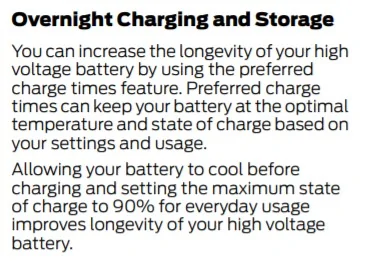
According to the manual...
Ford Mustang Mach-E Cooling the battery before charging Overnight charging

...you should allow the battery to cool before charging.
Unfortunately, Ford doesn't provide any guidance on the length of time you should wait.
How long would you recommend waiting for the batteries to cool before plugging in?
Sponsored


 

macchiaz-o

Well-Known Member
First Name
Jonathan
Joined
Nov 25, 2019
Threads
171
Messages
8,579
Reaction score
15,987
Location
}not/A/gr8'Place.2.store-mEyePassword{
Vehicles
MY21 J1 Premium RWD SR
Country flag
According to the manual...
Overnight charging.jpg

...you should allow the battery to cool before charging.
Unfortunately, Ford doesn't provide any guidance on the length of time you should wait.
How long would you recommend waiting for the batteries to cool before plugging in?
Don't wait. Just plug in when you get home.

If you're on a time of use plan, set the vehicle to charge during the hours where you pay the lowest rates... The car will sit and cool down, while plugged in, and will start charging on the schedule you set.
 

RickMachE

Well-Known Member
Joined
Jul 1, 2021
Threads
267
Messages
17,931
Reaction score
27,930
Location
SE MI
Vehicles
2022 Mach-E Premium 4X, 2022 Lightning Lariat ER
Country flag
That assumes you don't park it during the off-peak hours. Our peak is 11am - 7 pm M-F, so we can drive it in the early morning and arrive home at 10AM and begin charging.

And, driving on the highway and using DC chargers allows no cooling time. Ford knows this. They design the vehicle for it.

Relax, and drive your car. If you live in a very hot climate, then maybe make adjustments to the charging schedule.

And remember, Ford's goal is to significant beat their warranty promise of 70% battery capacity in 8 years / 100,000 miles. I don't expect to keep the Mach-E that long due to ever changing technology including range improvements.
 

John_C

Well-Known Member
First Name
John
Joined
Oct 12, 2020
Threads
5
Messages
76
Reaction score
193
Location
Woodside CA
Vehicles
2021 Premium RWD Ext Range Infinite Blue 3/3/2021
Occupation
TV
Country flag
According to the manual...
Overnight charging.jpg

...you should allow the battery to cool before charging.
Unfortunately, Ford doesn't provide any guidance on the length of time you should wait.
How long would you recommend waiting for the batteries to cool before plugging in?
I've been poking around on the internet for some information about EV battery degradation for a while now -- ever since I took delivery on my Mach E in March. The best thing I've seen is this article from Electrek, which is a great online newsletter covering the EV industry.

This is the relevant part of the article:
---
A persistent concern among some EV drivers is the long-term health of the battery. All batteries lose some storage capacity over time. But how might that degradation affect your driving range a few years down the line? To help answer that question, we can now look to Geotab, a leading telematics-fleet-management company with access to a lot of EVs. Lo and behold, the losses are minor.

Geotab created its so-called EV Battery Degradation Tool by pulling data directly from the 6,300 EVs from its fleets. What’s super-cool is the interactive nature of the tool, allowing users to drill down to 21 specific electric models.

You can use the tool to slice and dice the data for yourself.

In June 2018, Geotab acquired FleetCarma, a forerunner in providing technology support the use of EVs in fleets.

Here’s a quick rundown of what the data revealed:
  • If current degradation rates are maintained, the vast majority of batteries will outlast the usable life of the vehicle.
  • The average decline in energy storage is 2.3% per year. For a 150-mile EV, you’re likely to lose 17 miles of accessible range after five years.
  • EV batteries decline in a non-linear fashion. There’s an early drop, but the rate of decline slows down in subsequent years.
  • Liquid-cooled batteries decline slower than air-cooled packs. Geotab saw that a 2015 Tesla Model S with liquid cooling had an average annual degradation rate of 2.3%, compared to an air-cooled 2015 Nissan Leaf’s rate of 4.2%.
  • Battery-powered vehicles that have bigger state-of-charge buffers fare better. In other words, some carmakers use a smaller percentage of the battery’s capacity, which reduces usable range. But the conservative approach slows down the degradation rate, most notably in early versions of the Chevrolet Volt plug-in hybrid.
  • Higher vehicle use does not necessarily equal higher battery degradation.
  • Vehicles driven in hot temperatures show a faster decline in battery health.
  • The use of DC fast-chargers speeds up the process of degradation, but there’s not much difference in battery health based on frequent use of Level 1 versus Level 2 charging. Losses that happen with frequent DC charging are made worse in hot climates.
---

Here's a link to the full article. The comments section has some interesting feedback on the long-term decline in charging speeds as well:

https://electrek.co/2019/12/14/8-lessons-about-ev-battery-health-from-6300-electric-cars/

In hot weather I'm trying to use my Level 1 Ford home charger more now and high-speed DC charging less (which is too bad, because there's a great multi-port Electrify America depot about 10 minutes from my house). And here in Northern California we had a lot of hot weather this summer.

Like @RickMachE I'm trying not to worry about this too much because I expect to change models not too far from now as the technology improves. But it's still a good question ...

Right now I'm one very happy camper with my 2021 ...
 

raitchison

New Member
First Name
Robert
Joined
Jul 1, 2023
Threads
0
Messages
1
Reaction score
0
Location
West Hills, CA, US
Vehicles
2017 Chevy Bolt, 2023 Ford Mach-E
Occupation
Small Business Owner
Country flag
Liquid-cooled batteries decline slower than air-cooled packs. Geotab saw that a 2015 Tesla Model S with liquid cooling had an average annual degradation rate of 2.3%, compared to an air-cooled 2015 Nissan Leaf’s rate of 4.2%.
Not all liquid cooled batteries are created equal, and just having a liquid cooling system doesn't help you much if your car's BMS is loath to use it because the automaker didn't want to hear complaints from customers of "lost range" when parked on a hot day.

I'm new to the Mach-E world but I've had a Bolt since early 2018, the Bolt has a capable battery cooling system, that the BMS only dares to use under an extremely limited set of circumstances. I've recorded battery temperatures as high as 37C (~99F) without the car doing anything to cool it.

The use of DC fast-chargers speeds up the process of degradation, but there’s not much difference in battery health based on frequent use of Level 1 versus Level 2 charging. Losses that happen with frequent DC charging are made worse in hot climates.
It's likely that most of the harm from DCFC use is due to the heat that fast charging induces in the battery, with cars that are smart enough to pre-cool the battery as you are approaching a charging stop (or in theory, cars that trust their drivers enough to allow them to initiate battery cooling manually) able to do better here. Again with my Bolt (my only point of reference) the battery cooling will kick in as soon as you plug into any charger (so long as the battery is above ~27C and you leave the car turned on) but the best it can do is keep up with the heat generated by DCFC. So a common scenario has you immediately start tapering the charge (which tops out at ~55kW under the most ideal situations) while the battery cooling system works to maintain a battery temp in the 33C-35C range.
Sponsored


Top