nvabill
Well-Known Member
- First Name
- Bill
- Joined
- Jan 11, 2021
- Threads
- 57
- Messages
- 2,375
- Reaction score
- 1,907
- Location
- Virginia Beach, Va.
- Vehicles
- F-150, '22 California Route 1
Cool I was wondering when someone would revive this thread.
Sponsored
Cool I was wondering when someone would revive this thread.
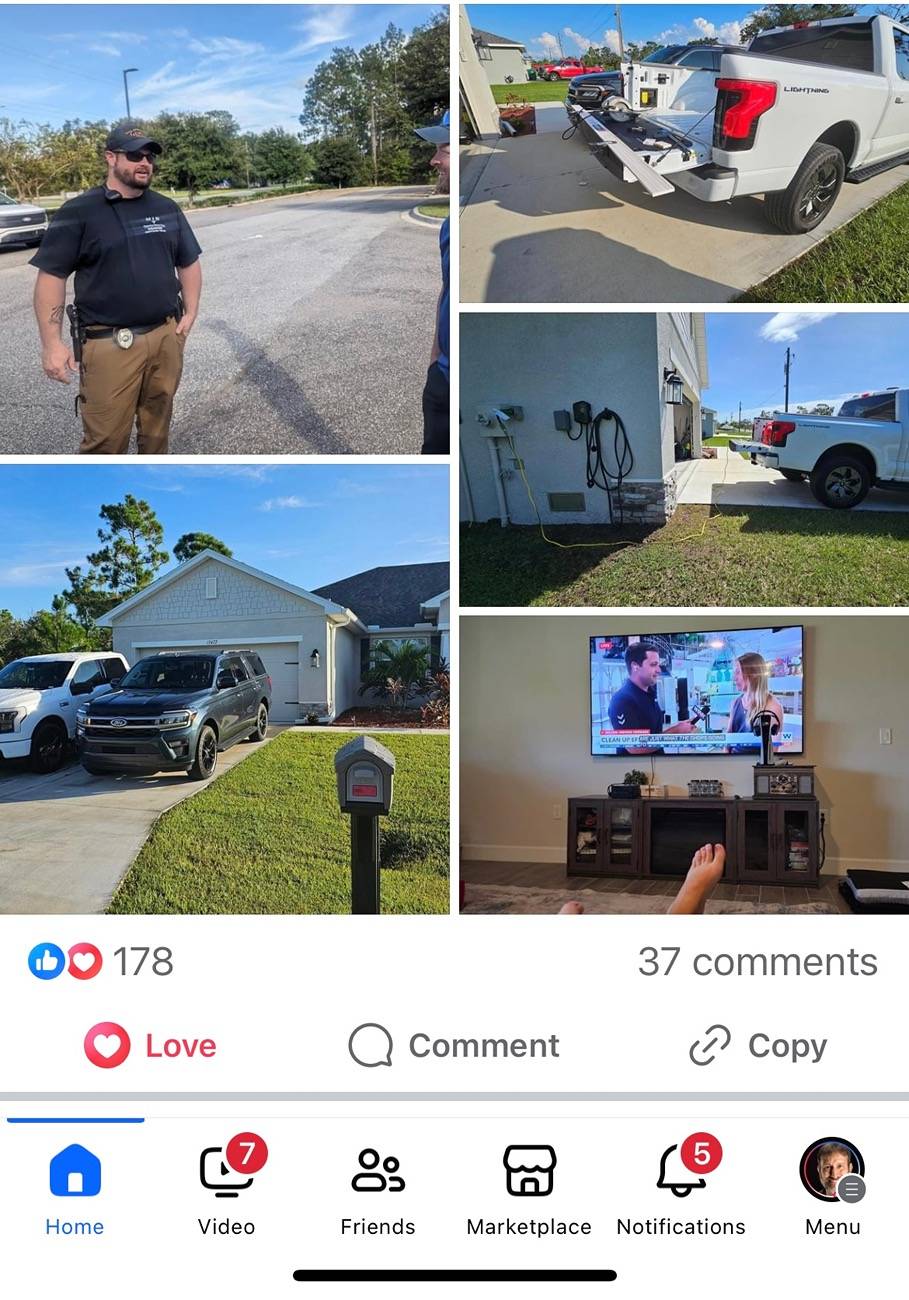
A good reminder of how much things have changed in the past few years. Thanks for posting this Mark.
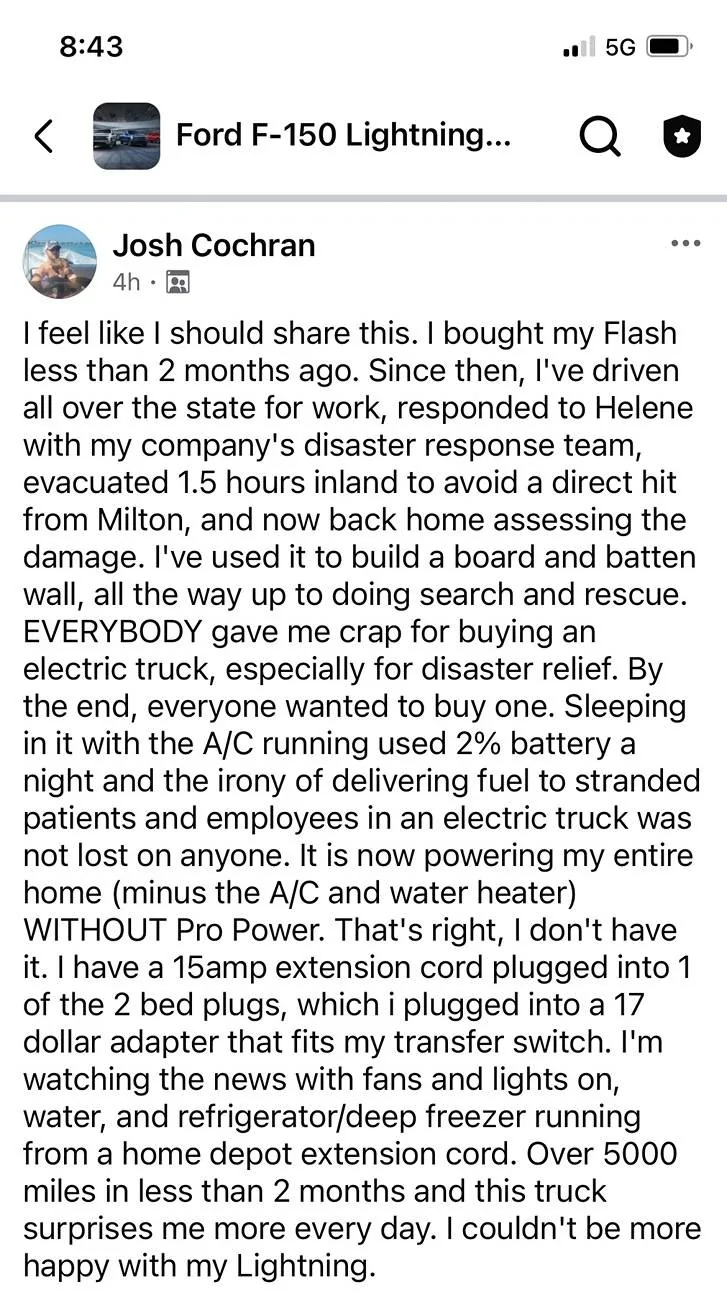
I think what is missing from this post is how he managed to keep his Lightning charged when there are widespread power outages, including the one at his home. I am not calling BS on the post, but really I want to know how he did it.A good reminder of how much things have changed in the past few years. Thanks for posting this Mark.
It probably depends on how widespread the outage is. His power might be out, but maybe 30 miles away there are some operational DC chargers he can use.I think what is missing from this post is how he managed to keep his Lightning charged when there are widespread power outages, including the one at his home. I am not calling BS on the post, but really I want to know how he did it.
Tampa area was just hit by a major storm. But if I pull up Tesla SC’s map it’s not hard to find super chargers within your range, even ones without a wait currently that have power.I think what is missing from this post is how he managed to keep his Lightning charged when there are widespread power outages, including the one at his home. I am not calling BS on the post, but really I want to know how he did it.
I saw that also. However, how did he do it?Tampa area was just hit by a major storm. But if I pull up Tesla SC’s map it’s not hard to find super chargers within your range, even ones without a wait currently that have power.
Assuming you are in an area it’s actually safe to drive, if not, better off using your EV to power the house and wait for the power to come back.
You also can’t pump gas without power and there are gas shortages.
In most situations I can come up with it will be easier to find power for your EV than gas.
The benefit of the ev in this situation is massive range at low speed (one user reported 800 mile range at 25 mph on a different site ), being able to keep climate on for possibly a month (if 3 percent drain for 24 hours, which depends a lot on temp), being able to drive through high water (depending on the vehicle you are comparing to and whether it has a snorkel), and the ability to charge, at least slowly, anywhere there is power (eg, a gas station with a garage, ask to use the 220v they have for the welder, if you have the right adapter, or any house... At least you get some range out of 110 but a lot more if you find an l2 or a house with a dryer socket).The weather channel just did a piece on the issues with EVs for anyone evacuating hurricane Ian. If you get stuck in traffic or end up in a charging dead zone an EV could be a huge liability. For instance a few years ago tens of thousands of people evacuated towards Atlanta from the Tampa area. With a high volume of people evacuating the spaces at charging stations will be very limited. Then you have the issue of potentially out of service charging stations when you attempt to return after an hurricane.
Definitely something to think about.
This.The benefit of the ev in this situation is massive range at low speed (one user reported 800 mile range at 25 mph on a different site ), being able to keep climate on for possibly a month (if 3 percent drain for 24 hours, which depends a lot on temp), being able to drive through high water (depending on the vehicle you are comparing to and whether it has a snorkel), and the ability to charge, at least slowly, anywhere there is power (eg, a gas station with a garage, ask to use the 220v they have for the welder, if you have the right adapter, or any house... At least you get some range out of 110 but a lot more if you find an l2 or a house with a dryer socket).
Being able to charge to dull at home without braving a last minute gas station.... With the down side that you can't fill up mid trip.
Honestly i will take the ev any time.
How I did it…I saw that also. However, how did he do it?
Would have been cheaper and better to buy a regular F150 and a generator.
I think it’s the same after the storm as a BEV is in normal use.The benefit of the ev in this situation is massive range at low speed (one user reported 800 mile range at 25 mph on a different site ), being able to keep climate on for possibly a month (if 3 percent drain for 24 hours, which depends a lot on temp), being able to drive through high water (depending on the vehicle you are comparing to and whether it has a snorkel), and the ability to charge, at least slowly, anywhere there is power (eg, a gas station with a garage, ask to use the 220v they have for the welder, if you have the right adapter, or any house... At least you get some range out of 110 but a lot more if you find an l2 or a house with a dryer socket).
Being able to charge to full at home without braving a last minute gas station.... With the down side that you can't fill up mid trip or carry a gas can to top up....
Honestly i will take the ev any time.
Just another example showing how “some people would be fine.”For the long distance drives, people who evacuated several days in advance of the storm probably were fine. My nephew flew out the Sunday before the storm, and if he were driving instead, that probably would have been just as doable. His school closed for the week, which made that more feasible. An EV would probably have been more pleasant for those slow moving traffic jams as well, since their range improves while the ICEV range worsens, but I don't think I would want to drive out of Florida in the massive traffic jams I saw Tuesday in any car.