E90alex

Well-Known Member
Joined
Feb 17, 2025
Threads
3
Messages
1,016
Reaction score
1,835
Location
Seattle, WA
Vehicles
‘25 MME GT
It’s not so much the fact the cable is left plugged in, but the battery needs to be at rest for several hours so the voltages can stabilize and the BMS can gather resting cell voltage readings.
Sponsored
 
OP
OP
Mach-Lee

Mach-Lee

Well-Known Member
First Name
Lee
Joined
Jul 16, 2021
Threads
262
Messages
11,365
Reaction score
25,025
Location
Wisconsin
Vehicles
2022 Mach-E Premium AWD
Occupation
Sci/Eng
Country flag
Just an update here, but it appears Ford has changed the BECM software this year, which makes it much harder to increase the state of health reading with calibration.

I did my semi-annual battery calibration, but I was only able to get an increase from 89.0% to 90.0% SoH after several deep calibration cycles. Last year I got a 5% increase (from 90 to 95%) for comparison.

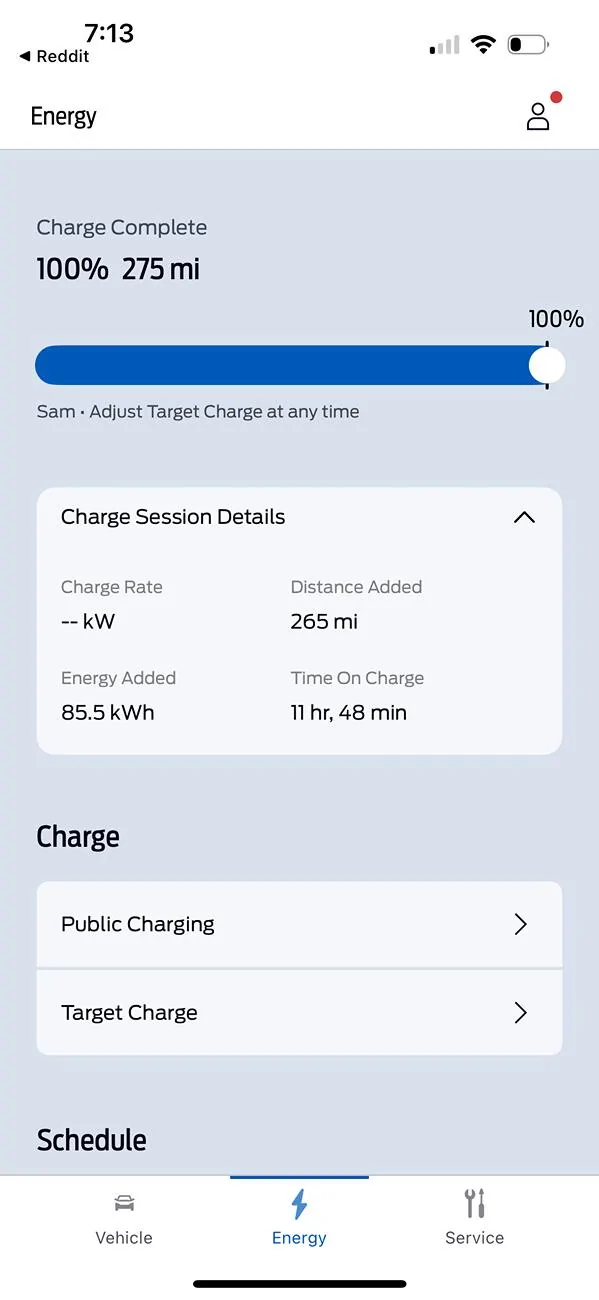
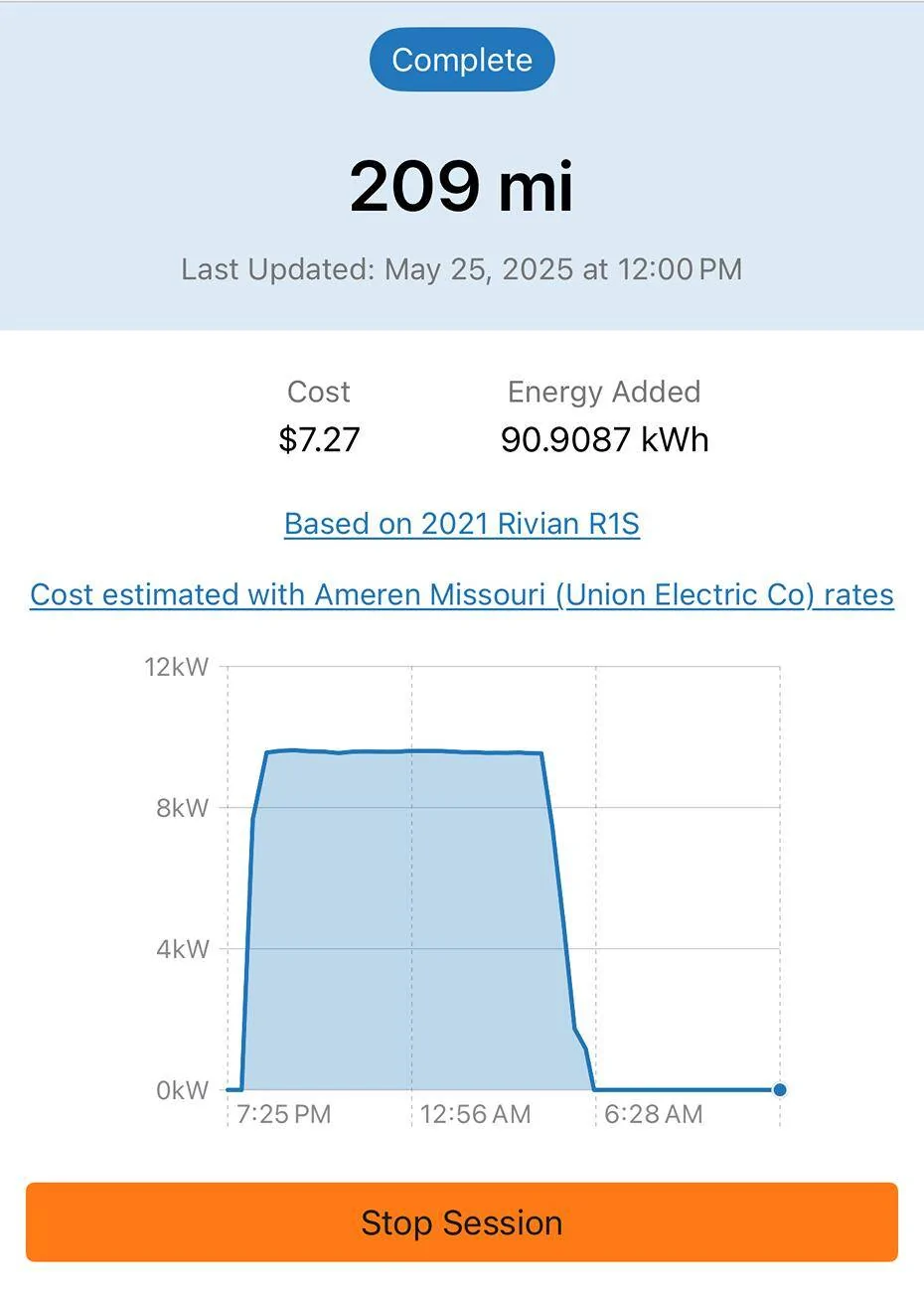
This was a charge session from 3.5% SoC displayed to 100%:

Ford Mustang Mach-E HV Battery Calibration Procedure IMG_0695

Ford Mustang Mach-E HV Battery Calibration Procedure IMG_6800


The car took 90.9 kWh from the wall and put 85.5 kWh into the battery (94% efficient charging at 40A) to add 96.5% of charge.

85.5/.965 = 88.6 kWh usable capacity after 3 years and 33k miles. If we assume 91 kWh usable, my actual battery state of health is around 97%. But it's only reading at 90%. Therefore the SoH reading is no longer reliable in latest software, it's probably artificially low, especially if you charge often and shallow like I do.

Again I repeated the procedure several times (below 5% to 100%) with no improvement. I also checked my battery health in FDRS, I have about 1% capacity variation between the cells but otherwise no "weak" cells to cause that kind of discrepancy. It's just the software causing the low SoH readings, battery is fine.

Based on voltage readings, I'm getting 388V down to 322V from the pack (94S), which seems like pretty much the full range. I don't like to go below 320V resting because that's the edge of the voltage cliff at the end of the discharge curve. My goal is to arrive at the charger with about 330V left during road trips, which is happening around 10% displayed.
 

Kamuelaflyer

Well-Known Member
First Name
Bill
Joined
Feb 18, 2020
Threads
11
Messages
11,358
Reaction score
22,940
Location
Hawaii
Vehicles
2021 Premium Infinite Blue. ER AWD. 2020 Raptor, 2021 Ranger.
Country flag
Just an update here, but it appears Ford has changed the BECM software this year, which makes it much harder to increase the state of health reading with calibration.

I did my semi-annual battery calibration, but I was only able to get an increase from 89.0% to 90.0% SoH after several deep calibration cycles. Last year I got a 5% increase (from 90 to 95%) for comparison.

This was a charge session from 3.5% SoC displayed to 100%:

IMG_0695.webp

IMG_6800.webp


The car took 90.9 kWh from the wall and put 85.5 kWh into the battery (94% efficient charging at 40A) to add 96.5% of charge.

85.5/.965 = 88.6 kWh usable capacity after 3 years and 33k miles. If we assume 91 kWh usable, my actual battery state of health is around 97%. But it's only reading at 90%. Therefore the SoH reading is no longer reliable in latest software, it's probably artificially low, especially if you charge often and shallow like I do.

Again I repeated the procedure several times (below 5% to 100%) with no improvement. I also checked my battery health in FDRS, I have about 1% capacity variation between the cells but otherwise no "weak" cells to cause that kind of discrepancy. It's just the software causing the low SoH readings, battery is fine.

Based on voltage readings, I'm getting 388V down to 322V from the pack (94S), which seems like pretty much the full range. I don't like to go below 320V resting because that's the edge of the voltage cliff at the end of the discharge curve. My goal is to arrive at the charger with about 330V left during road trips, which is happening around 10% displayed.
Interesting Lee. I’m in the process of going my 6 month calibration. I’ll likely hit 5%< on Sunday in my 2021. I’ll post how things workout when I’m done though I doubt I’ll magically end up with a correct reading from the obd2 reader.
 
Last edited:

Mache_Nor

Well-Known Member
Joined
Feb 12, 2022
Threads
22
Messages
529
Reaction score
718
Location
Norway
Vehicles
MachE LR RWD
Country flag
Just an update here, but it appears Ford has changed the BECM software this year, which makes it much harder to increase the state of health reading with calibration.

I did my semi-annual battery calibration, but I was only able to get an increase from 89.0% to 90.0% SoH after several deep calibration cycles. Last year I got a 5% increase (from 90 to 95%) for comparison.

This was a charge session from 3.5% SoC displayed to 100%:

IMG_0695.jpg

IMG_6800.jpg


The car took 90.9 kWh from the wall and put 85.5 kWh into the battery (94% efficient charging at 40A) to add 96.5% of charge.

85.5/.965 = 88.6 kWh usable capacity after 3 years and 33k miles. If we assume 91 kWh usable, my actual battery state of health is around 97%. But it's only reading at 90%. Therefore the SoH reading is no longer reliable in latest software, it's probably artificially low, especially if you charge often and shallow like I do.

Again I repeated the procedure several times (below 5% to 100%) with no improvement. I also checked my battery health in FDRS, I have about 1% capacity variation between the cells but otherwise no "weak" cells to cause that kind of discrepancy. It's just the software causing the low SoH readings, battery is fine.

Based on voltage readings, I'm getting 388V down to 322V from the pack (94S), which seems like pretty much the full range. I don't like to go below 320V resting because that's the edge of the voltage cliff at the end of the discharge curve. My goal is to arrive at the charger with about 330V left during road trips, which is happening around 10% displayed.
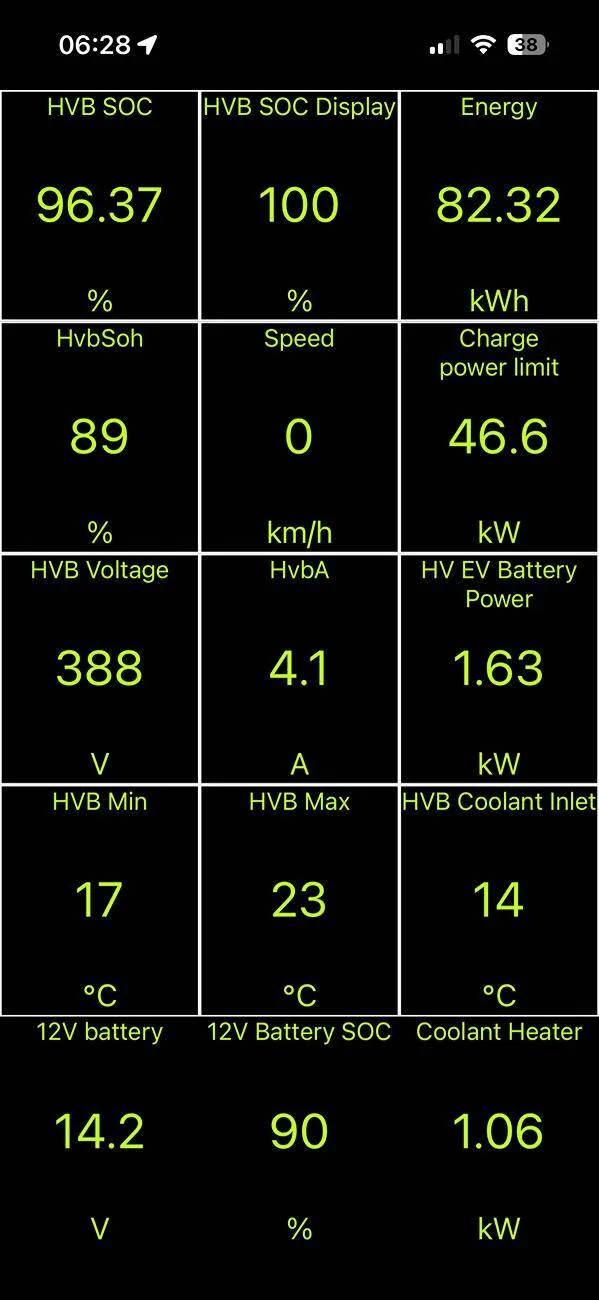
Seems I get similar results. Bear in mind that this is a reading below the recommended 25C temperature as well that it’s 30 min after car stopped charging, but by same measurements as you it would be around 94% SoH. Car has driven close to 128 000 km / 80 000 miles (21’ job 2).

Edit: reading done though Car Scanner Pro.

Edit 2: also added around 89 kWh energy from charger with around 8% battery
according to charger (before loses).

Ford Mustang Mach-E HV Battery Calibration Procedure IMG_1259
 
Last edited:

HughJazzol

Well-Known Member
First Name
Norman
Joined
Jan 27, 2025
Threads
37
Messages
442
Reaction score
223
Location
Miami
Vehicles
2024 MachE Premium RWD
Occupation
Project Manager & Swim coach
Just an update here, but it appears Ford has changed the BECM software this year, which makes it much harder to increase the state of health reading with calibration.
Lee
Is this happening to all model years or specific ones? And did the becm software get updated with a specific or recent update?


OP
OP
Mach-Lee

Mach-Lee

Well-Known Member
First Name
Lee
Joined
Jul 16, 2021
Threads
262
Messages
11,365
Reaction score
25,025
Location
Wisconsin
Vehicles
2022 Mach-E Premium AWD
Occupation
Sci/Eng
Country flag
Lee
Is this happening to all model years or specific ones? And did the becm software get updated with a specific or recent update?
Not sure in all model years, but if it affects me it likely affects at least 21-23 models as well.

I manually update to latest software, but this will eventually come to everyone via OTA. Expect a drop in the SOH reading after a powertrain update, again the battery is still fine.
 

AllTheThings55

Well-Known Member
First Name
David
Joined
Aug 11, 2024
Threads
5
Messages
116
Reaction score
96
Location
Mesa, AZ
Vehicles
2023 Mach E Select w/AWD
Occupation
Professional Services (IT)
Country flag
Maybe this explains my 23.5 having such a low SOH (91) with less than 7k miles….
 

HughJazzol

Well-Known Member
First Name
Norman
Joined
Jan 27, 2025
Threads
37
Messages
442
Reaction score
223
Location
Miami
Vehicles
2024 MachE Premium RWD
Occupation
Project Manager & Swim coach
Not sure in all model years, but if it affects me it likely affects at least 21-23 models as well.

I manually update to latest software, but this will eventually come to everyone via OTA. Expect a drop in the SOH reading after a powertrain update, again the battery is still fine.
Thanks again Lee.
Last question, your honor.

In your instructions you mention to leave the car plugged in for 3+ hours after charging to 100%. What's the reason for it?
 
OP
OP
Mach-Lee

Mach-Lee

Well-Known Member
First Name
Lee
Joined
Jul 16, 2021
Threads
262
Messages
11,365
Reaction score
25,025
Location
Wisconsin
Vehicles
2022 Mach-E Premium AWD
Occupation
Sci/Eng
Country flag
Thanks again Lee.
Last question, your honor.

In your instructions you mention to leave the car plugged in for 3+ hours after charging to 100%. What's the reason for it?
The cells need time to top balance and the BECM needs to measure the precise resting voltages to determine an accurate SoC. This can only be done while the battery pack is completely idle (not driving or charging). It can take several hours for the voltages to fully settle down to stable millivolts after current flow.
 

Kamuelaflyer

Well-Known Member
First Name
Bill
Joined
Feb 18, 2020
Threads
11
Messages
11,358
Reaction score
22,940
Location
Hawaii
Vehicles
2021 Premium Infinite Blue. ER AWD. 2020 Raptor, 2021 Ranger.
Country flag
Not sure in all model years, but if it affects me it likely affects at least 21-23 models as well.

I manually update to latest software, but this will eventually come to everyone via OTA. Expect a drop in the SOH reading after a powertrain update, again the battery is still fine.
Just finished the calibration. 2021 Job 1 with the latest OTA updates (which are behind the 24s and 23s). SOH health readout jumped by an entire single percentage point and more than 4% off the value from charge added, charge remaining and battery capacity. That calculation put the number just over 98%, which is closer to previous years' numbers. The final 5% was painfully slow on the 100% charge btw.
 

Mache_Nor

Well-Known Member
Joined
Feb 12, 2022
Threads
22
Messages
529
Reaction score
718
Location
Norway
Vehicles
MachE LR RWD
Country flag
Did the calibration in a 23C environment: 91% SoH which is 2% up from before calibration. Energy capacity was 84.04 at 96.14% battery, which would mean it if doing the Lee’s calculation is 96% SoH (84.14 / 0.9614 / 91).
 
Last edited:

Mache_Nor

Well-Known Member
Joined
Feb 12, 2022
Threads
22
Messages
529
Reaction score
718
Location
Norway
Vehicles
MachE LR RWD
Country flag
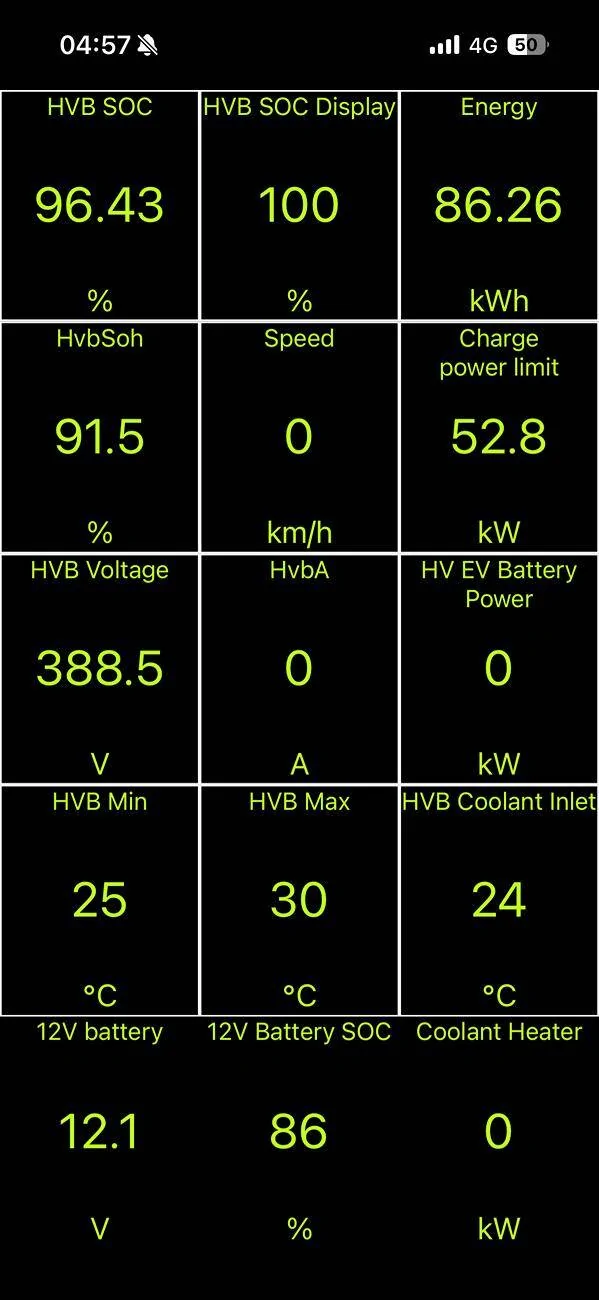
Hmm, seems like there still is some to it about this calibration. I’m currently on a road trip, and tonight I again parked in a warm garage after a day of driving in the 20-80% range. 1 hour after charging was complete I read the following values (car was off, hence limited numbers). On two days I have gone from 89-91.5% SoH on a 21’ job 2 car with 129 000 km driven.

Ford Mustang Mach-E HV Battery Calibration Procedure IMG_1336
 

rreddy3

Well-Known Member
First Name
Richard
Joined
Mar 25, 2024
Threads
5
Messages
988
Reaction score
1,060
Location
Virginia
Vehicles
2023 Mach e Premium AWD X
Country flag
I did this calibration a couple of days ago after completing the return leg of a 500 mile plus round trip. On the return I charged to 81% enroute. 80% is my typical max charge. I figured 81% is close enough for this drill. I arrived home with about 14%.

I drove the car without recharging down to 8% SoCD, 8.5% shown on CarScanner (CS). (12.5% on CS SoC including buffer.) I let the car set overnight before L2 charging at home the following day to 100% SoCD. The charge was continuous, and the car stayed on plug for > 3 hours after the charge. Car is a 23.5 X range with about 6815 miles at the time of the 100% charge.

I noticed the SoH display in CS had sometime within the past 2 or 3 months dropped to 95%, from a consistent 98.5%. My gut reaction was the 95% just wasn't' correct. I didn't know why it wasn't correct until reading @Mach-Lee 's update above.

I'm now in the next phase of the procedure, driving the car to under 50% SoC after the full charge.

The numbers: kwH delivered from ChargePoint 48A = 88.16 kwH
kwH accepted by the car per FP = 82 kwH
efficiency, accepted/delivered ~ 93 %
% SoC added per FP and car = 92%
Calculated useable kwH, accepted kwH/% SoC added,
= 89.13 kwH
[CS display of energy at 100% SoCD = 89.9 kwH]
Calculated SoH, useable kwH/91 stipulated max useable capacity,
based on FP derived 89.13 kwH useable ~ 98 % SoH
based on CS displayed 89.9 kwH energy ~ 98.9% SoH

My takeaways; The battery is fine; I'm not going to worry about SoH display on CS; I like the CS derived 98.9% SoH calc but suspect that's an aggressive number and not the real SoH; That said, I don't know how CS determines the 'energy' number, the numerator in that calc; I am making a presumption that the 'energy' number displayed by CS is its estimate of useable max capacity at 100 % SoCD; Obviously, I could be wrong; Although, to my non-scientific eye it seems to correlate reasonably well with the calculated max useable kwH based on the FordPass statements of accepted kwH and % SoC added.

I'll look at numbers again after driving to < 50% SoCD and charging back up to my routine 80%. My typical pattern is to keep the car between 50 or 60, usually closer to 60%, and 80%. Obviously shallow charges. Mileage is pretty low, so I can go for days at a time w/o L2 at home charge.

One last takeaway, I absolutely love this car. (And, the 8.5x20 Atomic AWZZ black wheels, Pirelli P Zeros AS plus 3 in 245/45 x 20, Eibach anti-roll bars, front camber adjusting bolts, and the Air Design/Ford accessory lip splitter, deck lid spoiler, and under rear bumper diffuser don't hurt, not to mention the euro cargo rings in the back luggage area, longer Bosch wiper blades, and Forscan tweaks, and the front middle speaker replacement don't hurt! Except may the wheels hurt range, but they look good and only weigh 21.5 # each, so who cares.)


Top