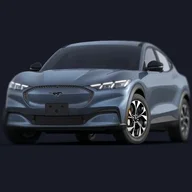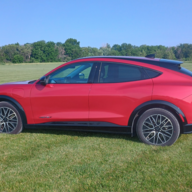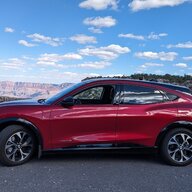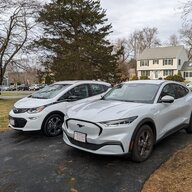
It’s a Miracle!!….Range has Increased Over First Year!!!!!

Doobster6

Well-Known Member
First Name
Len
Joined
Aug 1, 2024
Threads
19
Messages
225
Reaction score
278
Location
Exton, PA
Vehicles
2024 Mach-E Premium extended battery, Vapor Blue
Occupation
Retired manufacturing executive
Country flag
Not Really…..that would violate the known laws of chemistry physics. Then again………

So here’s what’s going on. When I first took delivery of my 2004 Premium 4-ER at the end of July in 2024, it was delivered with 7 miles on the odometer, a 100% charge and 303 miles showing for range. Throughout the colder winter months, I saw that range drop to as low as 255, accounting for the lower efficiency of cold batteries as well as the perpetual use of the traction battery to heat the cabin. I’ve been waiting for the warm weather to return so that I could re-evaluate the amount of range loss after one year.

A couple of weeks ago I re-set the driving history so that a new average mi/KWh would be measured and used by the car’s computer to calculate predicted range; one based now on warmer-weather efficiency. I’m a month shy of the one year anniversary as I write this and when I looked this morning the overnight recharge to 90% reported a 289 mile range. These figures imply a total range of 321+ miles, a nearly 6% INCREASE in range!

This is yet again another example of the GOM (guess-O-meter) being unreliable, right? Or is it? The car’s computer probably does something no more complicated that multiplying the percentage of charge available by what it has ‘observed’ as the driver’s actual day-to-day mi/KWh; an easily determined value based on watching the actual flow of battery power measured against the actual miles driven; a number that evolves over time as more data is accumulated. At ‘birth’ and without having a history of actual driving data, it might use a ‘factory-preset’ value that dovetails with the 99 MPGe figure published on my car’s window sticker. I calculate that Ford’s ‘expected’ typical driver mi/KWh is 3.32 for my car (303/91.1).

But I always drive in ‘Whisper’ mode and in a manner that reflects my more casual retired lifestyle (as opposed to the more ‘dynamic’ days of my youth). Using the ‘My Trip’ app, I regularly see 4.1-4.3 mi/KWh in non-highway driving and only drop down to 3.3-3.5 when on the highway doing 75+ mph. I trust the ‘My Trip’ real-time calculations because I think it an easy thing for the car to determine, and since my regularly observed efficiency (4.15) is 25% better than Ford’s (apparent) expectation of 3.32, shouldn’t I be able to trust my improved range calculation? And BTW, while I regularly see 4.1-4.2, I also throw in enough highway miles so that the invisible calculation I can’t see (the accumulated mi/KWh since the last reset), is actually the number the car is using in its predicted range calculation.

Because of that I never expect to see a range prediction as high as 378, which is what 4.15 mi/KWh would deliver for a 91.1 KWh battery pack. But theoretically at least, anyone ‘casually’ driving along flat roads at 45 mph or less, and stopping frequently at intersections and thus constantly recharging the battery, might actually be able to travel that far on a full charge.

Maybe the GOM isn’t as bad as we’ve been lead tro believe?
Sponsored

 
OP
OP

Doobster6

Well-Known Member
First Name
Len
Joined
Aug 1, 2024
Threads
19
Messages
225
Reaction score
278
Location
Exton, PA
Vehicles
2024 Mach-E Premium extended battery, Vapor Blue
Occupation
Retired manufacturing executive
Country flag
Well then, there you have it! BTW, I don’t drive ‘slow’; I’m usually a tick or two (or three) quicker than the surrounding traffic, and am never holding anyone up.
 

phil

Well-Known Member
Joined
Jun 6, 2021
Threads
13
Messages
3,160
Reaction score
4,211
Location
USA
Vehicles
LS400
Country flag
anyone ‘casually’ driving along flat roads at 45 mph or less, and stopping frequently at intersections and thus constantly recharging the battery, might actually be able to travel that far
Driving slow improves mileage greatly.

Stopping frequently at intersections reduces mileage, despite regenerative braking. You'd go much farther at a constant 45 mph.


stoopid

Well-Known Member
Joined
Feb 6, 2025
Threads
5
Messages
269
Reaction score
389
Location
Las Vegas, NV
Vehicles
2024 MME Select, RWD, Standard Range, Ford Charge Station Pro
Driving slow improves mileage greatly.

Stopping frequently at intersections reduces mileage, despite regenerative braking. You'd go much farther at a constant 45 mph.
Exactly, regen when stopping only recaptures a smallish amount of power (usually enough to "pay for the braking"). Driving slowish (on flat terrain) and not using heat/AC are the biggest power consumption savings.
 

vsguru

Well-Known Member
First Name
Dennis
Joined
Aug 10, 2023
Threads
5
Messages
199
Reaction score
176
Location
Pacific NW - USA
Vehicles
2023 MME Premium AWD ER
Country flag
Those 2004 Premium ER's are very rare, so treat yours carefully! I'm curious, what does the charging port look like in a 2004? ;)
 

Dana3502

Well-Known Member
First Name
Dana
Joined
Apr 5, 2025
Threads
7
Messages
94
Reaction score
69
Location
Des Moines
Vehicles
2024 Mach-E
Exactly, regen when stopping only recaptures a smallish amount of power (usually enough to "pay for the braking"). Driving slowish (on flat terrain) and not using heat/AC are the biggest power consumption savings.
So are you saying the brake coaching numbers are way off? I'm one who looks ahead and lets off as soon as I see a light turn red. Most of the time I was seeing 95%-100% energy return. Then again, I use Whisper mode most of the time so I can't normally see brake coaching.
 

stoopid

Well-Known Member
Joined
Feb 6, 2025
Threads
5
Messages
269
Reaction score
389
Location
Las Vegas, NV
Vehicles
2024 MME Select, RWD, Standard Range, Ford Charge Station Pro
So are you saying the brake coaching numbers are way off? I'm one who looks ahead and lets off as soon as I see a light turn red. Most of the time I was seeing 95%-100% energy return. Then again, I use Whisper mode most of the time so I can't normally see brake coaching.
100% return on braking. That's not a lot of power being generated. There's no magic pill for power generation when using the vehicle. Maybe solar panels on the roof once solar cells get that efficient (nowhere close yet). Using the EV is a perpetual downward curve with steep drops depending on the exact thing being done at any given time. That why I, and it seems others based on posts, for the most part ignore the hypermiling aspects of obsessive car owning culture. It's good to know what affects efficiency if in a pinch , so we can roll into the charging station at 1%. But avoiding that situation altogether is the better (and more worthwhile) strategy.
 
Last edited:
OP
OP

Doobster6

Well-Known Member
First Name
Len
Joined
Aug 1, 2024
Threads
19
Messages
225
Reaction score
278
Location
Exton, PA
Vehicles
2024 Mach-E Premium extended battery, Vapor Blue
Occupation
Retired manufacturing executive
Country flag
So this morning after posting the new thread, I decided to charge the car the rest of the way up to 100%, whereupon it said my available range was 328 miles; even better than the 318 ‘implied’ miles at 90%.
To be clear, I don’t consider myself a slow driver; slow drivers hold up traffic and I’m usually in the pack or leading it. I think the throttle mapping in Whisper mode tames my ’accidental’ unruly impulses and keeps my level of acceleration down to ‘faster than traffic’ but not ‘WAY faster than traffic’. And I disagree with the comment about regen braking. At least when I’m around my neighborhood, with stop signs at every block, and subsequent ‘local’ driving to the nearby grocery store or Target, I frequently see 5.8 or even 6.2 mi/Kwh on the MyTrip app to which I credit regen braking with making a significant contribution. I’m anyway inclined to believe that under the right driving conditions and speeds, significantly more range might be possible than is advertised, and that the GOM might not be as overly-optimistic as some have claimed.
What I DON’T think is that the battery capacity has somehow magically expanded after not even a year and only 5k miles. It can only have lost capacity. And at any point in time, the GOM is using whatever it has been recalculating as your average m/KWh since the car’s history was last reset, and continually adjusting to all the miles and power flow have been consumed. Just like in an ICE car, if your driving behavior changes the minute you fill up the tank, the miles being then being displayed won’t mean anything. Every car has a GOM of its own and only your own experience in any particular car matters as you watch the gas needle drop, or the percentage in an EV.
 

RickMachE

Well-Known Member
Joined
Jul 1, 2021
Threads
267
Messages
17,897
Reaction score
27,845
Location
SE MI
Vehicles
2022 Mach-E Premium 4X, 2022 Lightning Lariat ER
Country flag
Every car has a GOM of its own and only your own experience in any particular car matters as you watch the gas needle drop, or the percentage in an EV.
Right. Yet on every forum, and every FB group, across all makes of vehicles, a significant number of people can't grasp this very simple concept, and continually post "my range is 900, what's yours"?
 
OP
OP

Doobster6

Well-Known Member
First Name
Len
Joined
Aug 1, 2024
Threads
19
Messages
225
Reaction score
278
Location
Exton, PA
Vehicles
2024 Mach-E Premium extended battery, Vapor Blue
Occupation
Retired manufacturing executive
Country flag
And for those who dismiss the benefits of regen braking as insignificant….
Moving objects possess kinetic energy. Think of it as ‘momentum’. In the engineering world, both have their own calculation involving the vehicle’s speed and mass. Momentum is M x V (Mass times Velocity) whereas kinetic energy is 1/2 M x (V_squared). We’re interested here in the energy calculation since we’re trying to calculate how much energy will be returned to the battery by allowing the electric motors tro slow the car to a full stop.
I’ll forgoe the nerdiness of doing the actual unit calculations and instead point out two things that should be obvious. First, the ‘M’ of any car is big; thousands of pounds; but even more so in a BEV. It takes significant energy to accelerate a heavy BEV from zero to anything, and about the same amount of energy to decelerate it from that something back to zero. In ICE vehicles this is done by converting all that energy to heat and worn out brake pads and rotors; in BEVs you create electricity and feed it back into the battery. Anyway, the bigger ‘M’ is, the higher the resulting kinetic energy calculation, and ‘M’ is big in BEVs.
The second term in the equation is ‘V’ for velocity. Notice that in the equation the ‘V’ is squared. For the sake of simplicity let’s say M is 5 (as in 5,000 pounds) and V is 20 (as in mph). The kinetic energy* of this scenario is 1/2 x 5 x (20 squared) = 1,000. (*NOTE: this is NOT the correct calculation. For what I’m about to demonstrate, I’ve simplified it and the exact units calculation does not matter). Now then, if we’re instead going 30 mph the KE calculation becomes 2,250, a 125% increase in kinetic energy for only a 50% increase in speed. If we use 40 mph (compared to the original 20) that KE is 4,000, a 200% increase for a 100% speed increase; at 50 mph it’s a 525% energy increase for a 150% speed increase.
As you can see, ‘squaring’ the velocity factor in the equation means that the energy being recovered is hugely significant as speed increases. Again, accelerating a vehicle to speed, any vehicle, requires a lot of energy; way more than the energy required to then sustain the final speed per distance traveled. So decelerating has the reverse affect. If you can learn the ‘art’ of when to back out of the accelerator pedal to reduce your speed to zero in 1PD, there are HUGE amounts of energy to be reclaimed for the battery. So absolute regen braking is not, as some people think, trivial. It is in fact, massive, and especially in driving situations featuring frequent stop and go driving.
 

stoopid

Well-Known Member
Joined
Feb 6, 2025
Threads
5
Messages
269
Reaction score
389
Location
Las Vegas, NV
Vehicles
2024 MME Select, RWD, Standard Range, Ford Charge Station Pro
And for those who dismiss the benefits of regen braking as insignificant….
Moving objects possess kinetic energy. Think of it as ‘momentum’. In the engineering world, both have their own calculation involving the vehicle’s speed and mass. Momentum is M x V (Mass times Velocity) whereas kinetic energy is 1/2 M x (V_squared). We’re interested here in the energy calculation since we’re trying to calculate how much energy will be returned to the battery by allowing the electric motors tro slow the car to a full stop.
I’ll forgoe the nerdiness of doing the actual unit calculations and instead point out two things that should be obvious. First, the ‘M’ of any car is big; thousands of pounds; but even more so in a BEV. It takes significant energy to accelerate a heavy BEV from zero to anything, and about the same amount of energy to decelerate it from that something back to zero. In ICE vehicles this is done by converting all that energy to heat and worn out brake pads and rotors; in BEVs you create electricity and feed it back into the battery. Anyway, the bigger ‘M’ is, the higher the resulting kinetic energy calculation, and ‘M’ is big in BEVs.
The second term in the equation is ‘V’ for velocity. Notice that in the equation the ‘V’ is squared. For the sake of simplicity let’s say M is 5 (as in 5,000 pounds) and V is 20 (as in mph). The kinetic energy* of this scenario is 1/2 x 5 x (20 squared) = 1,000. (*NOTE: this is NOT the correct calculation. For what I’m about to demonstrate, I’ve simplified it and the exact units calculation does not matter). Now then, if we’re instead going 30 mph the KE calculation becomes 2,250, a 125% increase in kinetic energy for only a 50% increase in speed. If we use 40 mph (compared to the original 20) that KE is 4,000, a 200% increase for a 100% speed increase; at 50 mph it’s a 525% energy increase for a 150% speed increase.
As you can see, ‘squaring’ the velocity factor in the equation means that the energy being recovered is hugely significant as speed increases. Again, accelerating a vehicle to speed, any vehicle, requires a lot of energy; way more than the energy required to then sustain the final speed per distance traveled. So decelerating has the reverse affect. If you can learn the ‘art’ of when to back out of the accelerator pedal to reduce your speed to zero in 1PD, there are HUGE amounts of energy to be reclaimed for the battery. So absolute regen braking is not, as some people think, trivial. It is in fact, massive, and especially in driving situations featuring frequent stop and go driving.
I think 'trivial' and 'massive' are a bit too far apart (and hyperbolic). The point of that sidebar discussion in this thread was to highlight that regen is not going to be a magic pill that allows us to disregard the greater sources of loss baked into the overall EV system. "Driving slowish (on flat terrain) and not using heat/AC are the biggest power consumption savings." If it was truly trivial/waste of resources to implement, regen (and drive by pedal) would simply not be a thing. There's gains, but it falls somewhere between, as you say, 'trivial' and 'massive'. Or, as we sullied laymen say, "there's some benefit".

Without trying to spiral into a boring exercise in maths, there's losses in the regen process so it's not close to 100% regain of the energy used to obtain a given speed. I'm sure there's white papers somewhere buried on Ford's site that has all these exact numbers if anyone actually wants to know. This is already exceeding my level of interest, and I'm full on nerd. Whether I know it's 36% or 74% doesn't change its actual level of function in my vehicle, or change the realities of the other inherent losses referenced above.
 
Last edited:

MacherAWD

Well-Known Member
First Name
Erik
Joined
Mar 29, 2022
Threads
14
Messages
1,822
Reaction score
2,704
Location
North Shore MA
Vehicles
2021 AWD Select C&T, 2020 Bolt Premier
Occupation
Healthcare Software
Country flag
So this morning after posting the new thread, I decided to charge the car the rest of the way up to 100%, whereupon it said my available range was 328 miles; even better than the 318 ‘implied’ miles at 90%.
To be clear, I don’t consider myself a slow driver; slow drivers hold up traffic and I’m usually in the pack or leading it. I think the throttle mapping in Whisper mode tames my ’accidental’ unruly impulses and keeps my level of acceleration down to ‘faster than traffic’ but not ‘WAY faster than traffic’. And I disagree with the comment about regen braking. At least when I’m around my neighborhood, with stop signs at every block, and subsequent ‘local’ driving to the nearby grocery store or Target, I frequently see 5.8 or even 6.2 mi/Kwh on the MyTrip app to which I credit regen braking with making a significant contribution. I’m anyway inclined to believe that under the right driving conditions and speeds, significantly more range might be possible than is advertised, and that the GOM might not be as overly-optimistic as some have claimed.
What I DON’T think is that the battery capacity has somehow magically expanded after not even a year and only 5k miles. It can only have lost capacity. And at any point in time, the GOM is using whatever it has been recalculating as your average m/KWh since the car’s history was last reset, and continually adjusting to all the miles and power flow have been consumed. Just like in an ICE car, if your driving behavior changes the minute you fill up the tank, the miles being then being displayed won’t mean anything. Every car has a GOM of its own and only your own experience in any particular car matters as you watch the gas needle drop, or the percentage in an EV.
My wife gets more than 350 miles out of our SR AWD mach-e rated at 220 miles, she is also currently getting more than 400 miles out of our Bolt. I get a little more than half her range :)
Sponsored


Top