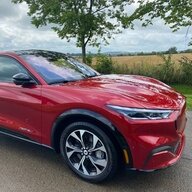
Preconditioning on the road

RMoore

Well-Known Member
First Name
Rob
Joined
Jul 25, 2021
Threads
75
Messages
1,139
Reaction score
801
Location
New Jersey
Vehicles
Audi Q5, Toyota Sienna, 2022 Mach e
Country flag
In warm weather (70-90 deg F) is there any benefit to programming in a DCFC stop in the navigation system and having it precondition the battery before charging? Does it speed up charging? How about in cold weather? I recall reading here about how the navigation system now will do this but couldn’t find the details. When should one do this?
Sponsored


 

macchiaz-o

Well-Known Member
First Name
Jonathan
Joined
Nov 25, 2019
Threads
171
Messages
8,579
Reaction score
15,987
Location
}not/A/gr8'Place.2.store-mEyePassword{
Vehicles
MY21 J1 Premium RWD SR
Country flag
The vehicle will automatically take care of the behind the scenes details as long as you tell it that you're on your way to a specific fast charge location. All you need to do is use the built in navigation for fast charger stops instead of using Android Auto or CarPlay maps.
 
OP
OP

RMoore

Well-Known Member
First Name
Rob
Joined
Jul 25, 2021
Threads
75
Messages
1,139
Reaction score
801
Location
New Jersey
Vehicles
Audi Q5, Toyota Sienna, 2022 Mach e
Country flag
The vehicle will automatically take care of the behind the scenes details as long as you tell it that you're on your way to a specific fast charge location. All you need to do is use the built in navigation for fast charger stops instead of using Android Auto or CarPlay maps.
Thanks. I realize that’s the case but what is the advantage of doing it? Does it make charging more efficient? Does that depend on the ambient temperature?
 

hybrid2bev

Well-Known Member
Joined
Dec 4, 2019
Threads
78
Messages
4,641
Reaction score
12,766
Location
USA
Vehicles
2026 Rally
Country flag
Thanks. I realize that’s the case but what is the advantage of doing it? Does it make charging more efficient? Does that depend on the ambient temperature?
Yes, external temperature plays a large role in charging speeds. In my experience on a day trip when the external temperature was <50F and plugged into a 125 kW shared ChargePoint CPE250. In ideal conditions that charger would do 75 kW max for the MME.

Before the preconditioning update I would get 40-50 kW upon plugging in. After the update I now get 70 kW immediately (slowly ramping up to 75 kW as pack temperatures and voltage rises.
 
OP
OP

RMoore

Well-Known Member
First Name
Rob
Joined
Jul 25, 2021
Threads
75
Messages
1,139
Reaction score
801
Location
New Jersey
Vehicles
Audi Q5, Toyota Sienna, 2022 Mach e
Country flag
Yes, external temperature plays a large role in charging speeds. In my experience on a day trip when the external temperature was <50F and plugged into a 125 kW shared ChargePoint CPE250. In ideal conditions that charger would do 75 kW max for the MME.

Before the preconditioning update I would get 40-50 kW upon plugging in. After the update I now get 70 kW immediately (slowly ramping up to 75 kW as pack temperatures and voltage rises.
Thanks. So is this something that makes sense to do only in colder weather?


hybrid2bev

Well-Known Member
Joined
Dec 4, 2019
Threads
78
Messages
4,641
Reaction score
12,766
Location
USA
Vehicles
2026 Rally
Country flag
Thanks. So is this something that makes sense to do only in colder weather?
Probably.

It doesn’t get hot enough here to test the preconditioning at the top end. From what I’ve heard the preconditioning is best at <60F to heat the battery. Or at >100F (or maybe it was >110F) to cool the battery.
 

macchiaz-o

Well-Known Member
First Name
Jonathan
Joined
Nov 25, 2019
Threads
171
Messages
8,579
Reaction score
15,987
Location
}not/A/gr8'Place.2.store-mEyePassword{
Vehicles
MY21 J1 Premium RWD SR
Country flag
Thanks. I realize that’s the case but what is the advantage of doing it? Does it make charging more efficient? Does that depend on the ambient temperature?
The goal is to keep the electronics and battery from getting too hot, while also ensuring the battery cells aren't too cold. I think the sweet spot for the lithium ion battery is in the 70s fahrenheit, same as for humans.

It's hard for me to grok the benefits for people in below freezing conditions since I live in Phoenix, so I'll mostly try to cover the hot climate concern. That said, I think the biggest benefits are for when the pack is way too cold. You want to spend more of your precious battery energy on heating up the pack so that you can spend a lot less time at the fast charger waiting for power from the grid to heat the pack. Until it's warm enough, the battery's chemistry is limiting charging current.

Now let's say I'm on a road trip in the southwest during summer. The car is potentially starting the trip at 120F or more (close to the pavement, and inside the greenhouse of the cabin). Immediately upon starting the vehicle, it's going to task cooling systems for the pack, vehicle electronics, and the cabin. It will be working hard to get anything close to the 70s ideal temps and working hard to keep it there, constantly battling those outdoor conditions.

Now I'm deciding to stop at a fast charger so I tell the vehicle nav. I don't know what Ford's programmed it to do for this, but my guess is that it would lower the temperature setpoint for the battery and charge management electronics, causing a reduction in driving energy efficiency (since more power is being used per mile driven) and possible further reduce cabin cooling priority.

The overall benefit is to the driver and passengers, since a little bit less time will be spent at the fast charger because the car is able to accept a higher rate of charging current thanks to its bigger margin before reaching its temperature based limits.

In our current reality though, it's not such a big benefit because the charge station itself also has to worry about overheating. Very few Electrify America stations here have any sort of shade structures and they end up throttling charge throughput to protect their own hardware, or because of demand based energy supply cost spikes that occur in the hottest part of the day around here.

That's why I mostly think of this feature as a benefit for people in cold climates... The battery has a lot more internal resistance when it's below freezing and it takes a lot of time to thaw out such a huge mass. While it's too cold, the charge rate it can accept is reduced (due to the cold-induced resistance). So you may as well get the car working its battery heater on overtime instead of delaying it until after you've plugged in to charge.
 

Mach-Lee

Well-Known Member
First Name
Lee
Joined
Jul 16, 2021
Threads
262
Messages
11,345
Reaction score
24,967
Location
Wisconsin
Vehicles
2022 Mach-E Premium AWD
Occupation
Sci/Eng
Country flag
In warm weather (70-90 deg F) is there any benefit to programming in a DCFC stop in the navigation system and having it precondition the battery before charging? Does it speed up charging? How about in cold weather? I recall reading here about how the navigation system now will do this but couldn’t find the details. When should one do this?
70-90 is the ideal temp for the battery, so it probably won't actually do anything in that situation since the battery is already in a nominal temp range.

The only situation it might help is if the battery is still cold (<70ÂşF) from being parked outside overnight. Or if you are in the desert with 95+ÂşF temps.

Doesn't hurt to enter the charger in the nav either way. It will decide if it needs to do anything.
 
  • Like
Reactions: TTF
OP
OP

RMoore

Well-Known Member
First Name
Rob
Joined
Jul 25, 2021
Threads
75
Messages
1,139
Reaction score
801
Location
New Jersey
Vehicles
Audi Q5, Toyota Sienna, 2022 Mach e
Country flag
Thanks to all for the helpful responses!
Sponsored


Top