So who has done the math?

epmd

Well-Known Member
First Name
Ed
Joined
Jul 5, 2021
Threads
11
Messages
151
Reaction score
72
Location
NV
Vehicles
Premium AWD Ex
Country flag
I typically use my ICE car for road trips and in the year that I have had my Mach-E (2021 Premium AWD ER) I have only driven once on a trip that required me to charge away from home. It was a short trip from Las Vegas to Southern California.

Anyway, I also make frequent trips to Utah to the Park City area as well. One of the concerns I have is about the decrease in efficiency from highway speeds. A large part of the trip between Vegas and Salt Lake City is 80 mph speed limit.

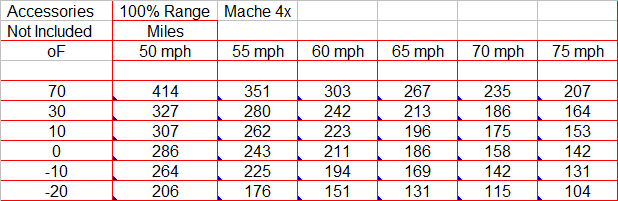
With all of that being said, has anyone done the math on range changes due to speed as well as the trade off for time saved going faster vs time lost for additional charging? For instance--If you drive 85 vs 75 over a 6 hour trip how much range do you lose vs saving close to an hour in travel time. How much of the time saved is lost to additional charging? Is it a wash? Is there a distance above or below where the time saved is worth the charge time? Just curious.

This of course does not account in anyway for the frequency of chargers over that stretch of I-15 either, but I am only just thinking ahead for summer plans.
Sponsored

 

DustyShades

Well-Known Member
Joined
Oct 11, 2022
Threads
0
Messages
201
Reaction score
400
Location
Seattle
Vehicles
2021 Premium AWD Ex Infinite Blue
Country flag
Download a better route planner and change your speed in the settings. You’ll see that it’s always worth it to go as fast as possible.

The only time it will be worth it to go slower to increase your range is if it will make the difference between you running out of juice and getting stranded vs. crawling a few more miles to the next charge station. Because obviously that’s better than waiting forever for a tow
 
OP
OP

epmd

Well-Known Member
First Name
Ed
Joined
Jul 5, 2021
Threads
11
Messages
151
Reaction score
72
Location
NV
Vehicles
Premium AWD Ex
Country flag
Download a better route planner and change your speed in the settings. You’ll see that it’s always worth it to go as fast as possible.

The only time it will be worth it to go slower to increase your range is if it will make the difference between you running out of juice and getting stranded vs. crawling a few more miles to the next charge station. Because obviously that’s better than waiting forever for a tow
That was my assumption, but I appreciate the confirmation. Of course the only bummer about going over 80 is no blue cruise.
 

sparkout

Well-Known Member
First Name
Cliff
Joined
Nov 22, 2022
Threads
11
Messages
172
Reaction score
72
Location
48307
Vehicles
2021 Mach E 4X Premium
Occupation
retired
Country flag
I typically use my ICE car for road trips and in the year that I have had my Mach-E (2021 Premium AWD ER) I have only driven once on a trip that required me to charge away from home. It was a short trip from Las Vegas to Southern California.

Anyway, I also make frequent trips to Utah to the Park City area as well. One of the concerns I have is about the decrease in efficiency from highway speeds. A large part of the trip between Vegas and Salt Lake City is 80 mph speed limit.

With all of that being said, has anyone done the math on range changes due to speed as well as the trade off for time saved going faster vs time lost for additional charging? For instance--If you drive 85 vs 75 over a 6 hour trip how much range do you lose vs saving close to an hour in travel time. How much of the time saved is lost to additional charging? Is it a wash? Is there a distance above or below where the time saved is worth the charge time? Just curious.

This of course does not account in anyway for the frequency of chargers over that stretch of I-15 either, but I am only just thinking ahead for summer plans.
One way to check to see which way is more efficient is to take the total miles listed right after a 95% charge, usually 260 miles for ex. then when you reach the 1/2 way point of the 260 that is 130 miles look at the dash and read the percentage remaining, in my case it says 55% so that means your current trip was 55% efficent. That's a fast way to figure efficiency.


SpaceEVDriver

Well-Known Member
Joined
Aug 26, 2021
Threads
71
Messages
2,651
Reaction score
4,774
Location
Arizona
Vehicles
2022 CA Route 1 AWD, ER; 2023 Lightning Lariat ER
Occupation
Planetary Science
Country flag
I typically use my ICE car for road trips and in the year that I have had my Mach-E (2021 Premium AWD ER) I have only driven once on a trip that required me to charge away from home. It was a short trip from Las Vegas to Southern California.

Anyway, I also make frequent trips to Utah to the Park City area as well. One of the concerns I have is about the decrease in efficiency from highway speeds. A large part of the trip between Vegas and Salt Lake City is 80 mph speed limit.

With all of that being said, has anyone done the math on range changes due to speed as well as the trade off for time saved going faster vs time lost for additional charging? For instance--If you drive 85 vs 75 over a 6 hour trip how much range do you lose vs saving close to an hour in travel time. How much of the time saved is lost to additional charging?
Assume you drive 300 miles without stopping. That's 4 hours at 75 mph, 3.75 hours at 80 mph, and 3.53 hours at 85 mph. So during your drive, you save 0.47 hours (28 minutes) by going 85 mph instead of 75 mph.

On a recent road trip, I got about 3.3 miles/kWh while driving 75 mph (91 kWh used). I get about 2.5 miles/kWh while driving 80 mph (120 kWh used). And 2.0 while driving 85 mph (150 kWh used).

I would need one charge stop while driving 75 mph, two stops at 80, and two or three at 85 mph. (I might take more stops while driving 75 mph, but that's not a requirement...)

Each stop requires a minimum of 5 minutes to get off the freeway, get to the charger, plug in, unplug, and get back on the freeway, but my experience is that this is closer to ten minutes of overhead.

For just the overhead of exiting and returning to the freeway: At 75 mph, I spend 10 minutes just getting to and from the charger. At 80, that's 20 minutes, 85 might require 30 minutes. The time saving from going faster has already evaporated before I've started charging.

I get an average of 80 kW charge speed, but I don't replace all of my used charge at a stop while road tripping.

Assume my driving is equally distributed around the stops. At 75 mph, that means I would use 45.5 kWh before my one stop (bringing me down to about 46.2 kWh) and I would only add about 27 kWh to bring me back to 80% SOC (72.8 kWh). Adding 27 kWh requires about 20 minutes. Total time spent leaving the freeway, charging, and getting back to the freeway is about 30 minutes.

Let's say the 85 mph driving would have me stop three times, or 50 kWh spent to go between stops. The first stop would have me arrive with 41 kWh (45% SOC). I would add 35 % (32 kWh), which would take about 25 minutes. The next stop would bring me down from 72 kWh to 22 kWh (24% SOC). Bringing the vehicle back up to 80% (72 kWh) would require another 50 kWh and 38 minutes. The third stop would require another 38 minutes. That's a total of 38+38+25+30 = 131 minutes.

So the time cost for driving 85 mph instead of 75 mph is about 73 minutes.

Even if you charge to a minimum required to arrive at your final stop, you've already spent significantly more time recovering from 85 mph than you would if you drive at 75 mph.

Even if your efficiency is not as good as mine, your time costs (as well as your dollar costs) are going to be quite a bit higher if you drive at 85 mph.

[I actually was getting close to 3.7 miles/kWh at 73 mph over 1200 miles road trip, but I cut it down for this example.]
 

jeffMachE

Well-Known Member
First Name
Jeff
Joined
Oct 27, 2020
Threads
16
Messages
361
Reaction score
440
Location
Colorado
Vehicles
F-350, '21 Prem 4EX, '24 Lyriq
Country flag
Even if your efficiency is not as good as mine, your time costs (as well as your dollar costs) are going to be quite a bit higher if you drive at 85 mph.
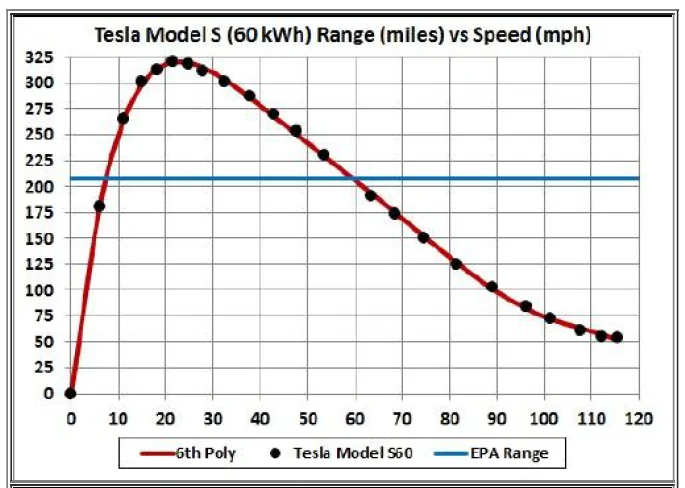
This ^^^ If you don't ever stop to charge, then yes, going faster always get you there faster. But if you have 2-4 stops for charging during your trip (2 if going at a slower speed, 3 or 4 if going at a very high speed), the extra time spent exiting, getting to charger, charging, and getting back on freeway is higher than the time saved by "driving as fast as possible". I remember reading (though I don't have the reference) that somewhere in the 68-70 mph range is the best speed for minimizing total time spent on a trip (assuming you have to stop at least a couple of times to charge).
 

mkhuffman

Well-Known Member
First Name
Mike
Joined
Nov 19, 2020
Threads
29
Messages
6,878
Reaction score
9,512
Location
Virginia
Vehicles
2025 Rivian R1T Tri-Max, Jeep GC-L, VW Jetta
Country flag
One way to check to see which way is more efficient is to take the total miles listed right after a 95% charge, usually 260 miles for ex. then when you reach the 1/2 way point of the 260 that is 130 miles look at the dash and read the percentage remaining, in my case it says 55% so that means your current trip was 55% efficent. That's a fast way to figure efficiency.
I don't think that means what you think it means.
 

RickMachE

Well-Known Member
Joined
Jul 1, 2021
Threads
267
Messages
17,933
Reaction score
27,936
Location
SE MI
Vehicles
2022 Mach-E Premium 4X, 2022 Lightning Lariat ER
Country flag
This ^^^ If you don't ever stop to charge, then yes, going faster always get you there faster. But if you have 2-4 stops for charging during your trip (2 if going at a slower speed, 3 or 4 if going at a very high speed), the extra time spent exiting, getting to charger, charging, and getting back on freeway is higher than the time saved by "driving as fast as possible". I remember reading (though I don't have the reference) that somewhere in the 68-70 mph range is the best speed for minimizing total time spent on a trip (assuming you have to stop at least a couple of times to charge).
This ^^^

People say "it only took 25 minutes to charge". I have DC fast charged for 2 years now. Just finished a trip.

Examples:

53 minutes of charge, but stop was 59 minutes NOT including getting on and off highway.
34 minutes of charge, but stop was 43 minutes NOT including getting on and off highway.

It's not a pitstop in NASCAR. You get off the highway, wait at a traffic light. Drive 50 feet, wait at another light. Drive, another light. Get in left hand lane, wait to turn. Drive in lot, look for chargers. Pick the one you want, turn car off. Me - write down trip 1, 2, this trip, % of charge, range, temp. Then, plug in and wait for it to activate. Then, try again when it fails, or when it shows 50kW instead of 140kW. Move to another charger.

On the way down, we drove over two days for 17 hours. We spent 4.5 additional hours charging and on charging stops, but only 2.5 of that was actual minutes at a charger. That's 2 hours of wasted time (some waiting for an open charger, some switching chargers, ...)

On the way home, we drove 18.75 hours. We spent an additional 5.3 hours on charging and charging stops, but only 4 hours of that was actual charging, so we wasted 1.3 hours. Less wasting, longer trip, more charging.

I rarely exceed 75, because you gulp down range. Sure, I stomp on it to pass, but the loss at sustained high speeds is not worth the stopping.
 

TD1273

Well-Known Member
First Name
Mel
Joined
Feb 9, 2022
Threads
1
Messages
152
Reaction score
68
Location
Spokane Wa
Vehicles
2017 Ford F-350
Occupation
Retired
Country flag
I typically use my ICE car for road trips and in the year that I have had my Mach-E (2021 Premium AWD ER) I have only driven once on a trip that required me to charge away from home. It was a short trip from Las Vegas to Southern California.

Anyway, I also make frequent trips to Utah to the Park City area as well. One of the concerns I have is about the decrease in efficiency from highway speeds. A large part of the trip between Vegas and Salt Lake City is 80 mph speed limit.

With all of that being said, has anyone done the math on range changes due to speed as well as the trade off for time saved going faster vs time lost for additional charging? For instance--If you drive 85 vs 75 over a 6 hour trip how much range do you lose vs saving close to an hour in travel time. How much of the time saved is lost to additional charging? Is it a wash? Is there a distance above or below where the time saved is worth the charge time? Just curious.

This of course does not account in anyway for the frequency of chargers over that stretch of I-15 either, but I am only just thinking ahead for summer plans.
Speed brings down the mileage regardless if it’s EV or ICE besides those signs are posted maximum speed limit that doesn’t mean you have do 80
 

21st Century Pony

Well-Known Member
First Name
Martin
Joined
May 21, 2022
Threads
36
Messages
1,976
Reaction score
2,243
Location
Arlington, Virginia
Vehicles
formerly Ford Mustang Mach E 2022 Premium AWD ER, now a li'l bit of Lightning ER
Country flag
Assume you drive 300 miles without stopping. That's 4 hours at 75 mph, 3.75 hours at 80 mph, and 3.53 hours at 85 mph. So during your drive, you save 0.47 hours (28 minutes) by going 85 mph instead of 75 mph.

On a recent road trip, I got about 3.3 miles/kWh while driving 75 mph (91 kWh used). I get about 2.5 miles/kWh while driving 80 mph (120 kWh used). And 2.0 while driving 85 mph (150 kWh used).

I would need one charge stop while driving 75 mph, two stops at 80, and two or three at 85 mph. (I might take more stops while driving 75 mph, but that's not a requirement...)

Each stop requires a minimum of 5 minutes to get off the freeway, get to the charger, plug in, unplug, and get back on the freeway, but my experience is that this is closer to ten minutes of overhead.

For just the overhead of exiting and returning to the freeway: At 75 mph, I spend 10 minutes just getting to and from the charger. At 80, that's 20 minutes, 85 might require 30 minutes. The time saving from going faster has already evaporated before I've started charging.

I get an average of 80 kW charge speed, but I don't replace all of my used charge at a stop while road tripping.

Assume my driving is equally distributed around the stops. At 75 mph, that means I would use 45.5 kWh before my one stop (bringing me down to about 46.2 kWh) and I would only add about 27 kWh to bring me back to 80% SOC (72.8 kWh). Adding 27 kWh requires about 20 minutes. Total time spent leaving the freeway, charging, and getting back to the freeway is about 30 minutes.

Let's say the 85 mph driving would have me stop three times, or 50 kWh spent to go between stops. The first stop would have me arrive with 41 kWh (45% SOC). I would add 35 % (32 kWh), which would take about 25 minutes. The next stop would bring me down from 72 kWh to 22 kWh (24% SOC). Bringing the vehicle back up to 80% (72 kWh) would require another 50 kWh and 38 minutes. The third stop would require another 38 minutes. That's a total of 38+38+25+30 = 131 minutes.

So the time cost for driving 85 mph instead of 75 mph is about 73 minutes.

Even if you charge to a minimum required to arrive at your final stop, you've already spent significantly more time recovering from 85 mph than you would if you drive at 75 mph.

Even if your efficiency is not as good as mine, your time costs (as well as your dollar costs) are going to be quite a bit higher if you drive at 85 mph.

[I actually was getting close to 3.7 miles/kWh at 73 mph over 1200 miles road trip, but I cut it down for this example.]
This about reflects my results on my 13k+ miles of multi-state trips in the past 9 months. Of course, really cold weather and elevation climbs at high speed will add additional energy-eating factors.
 

mkhuffman

Well-Known Member
First Name
Mike
Joined
Nov 19, 2020
Threads
29
Messages
6,878
Reaction score
9,512
Location
Virginia
Vehicles
2025 Rivian R1T Tri-Max, Jeep GC-L, VW Jetta
Country flag
posted maximum speed limit that doesn’t mean you have do 80
Correct. It means you have to drive faster.
Sponsored


Top