Supercharger Update

dpnelson

Well-Known Member
Joined
Dec 4, 2023
Threads
2
Messages
45
Reaction score
65
Location
Virginia
Vehicles
Ford Fusion, Mach E soon?
Country flag
It would be easy to blame rideshare drivers for "clogging" up DCFCs, but DCFC were built for the sole purpose to charge one's EV as fast as possible agnostic of the occupation/purpose of the EV utilizing the infrastructure. What their occupation is has nothing to do with whether they deserve to use that "limited" infrastructure or not.

Kind of like, don't hate the player hate the game, cliche. It's the lack of infrastructure for the most part (and partial blame to the manufacturers for not implementing faster charging hardware...IMO anything under 150 peak charge rate should be criminal at this point). Outside of Tesla, for the most part, the DCFC is currently not up to par to support the current demand in many geographic areas in the US, and the rate of deployment is not keeping pace. That's the problem, IMO, not rideshare users or Bolt/Leaf users.

The only time I feel as if it is appropriate to get annoyed in terms of charging is if they are their beyond 100% and are idling. It would be like waiting in line at a gas station and being annoyed that the car at the pump didn't stop at 80% full. Granted it isn't an apples to apples example, as the fuel pump doesn't exponentially slow down pumping at 80% but they aren't breaking any rules/laws. What their reasons are for filling to 75%, 85%, or 100% aren't really my business.

If a car fills its tank and then doesn't move to allow others to use the infrastructure then yes they are technically an economic impediment ergo the business should charge them for impacting sales ala idle fees at stations.
A lot of this could be solved by using a time based or blended charging rate. Setting the minimum billing rate at 100kW (edit - I originally incorrectly mistyped kWh here, which doesn't make sense) during peak hours at urban charging stations would change behavior. Even setting it to 50kW would deter trickle-charging to 100%, which in almost all cases is not necessary in an urban environment.
Sponsored

 
Last edited:

Maquis

Well-Known Member
First Name
Dave
Joined
Dec 21, 2020
Threads
34
Messages
5,688
Reaction score
8,068
Location
Illinois
Vehicles
2021 Mach E4X, 2023 Lightning Lariat ER
Country flag
A lot of this could be solved by using a time based or blended charging rate. Setting the minimum billing rate at 100kWh during peak hours at urban charging stations would change behavior. Even setting it to 50kWh would deter trickle-charging to 100%, which in almost all cases is not necessary in an urban environment.
I read this 3 times and I don’t think I understand. Charge somebody for 100 kWh (or 50) regardless of how much they actually charge???
So if I only need 10 kWh to get me home, I’m screwed? This makes stay at the charger longer to minimize my cost per kWh.
 

dbsb3233

Well-Known Member
First Name
TimCO
Joined
Dec 30, 2019
Threads
56
Messages
10,100
Reaction score
11,965
Location
Colorado, USA
Vehicles
2021 Mustang Mach-E FE, 2025 Porche Macan Electric
Occupation
Retired
Country flag
I read this 3 times and I don’t think I understand. Charge somebody for 100 kWh (or 50) regardless of how much they actually charge???
So if I only need 10 kWh to get me home, I’m screwed? This makes stay at the charger longer to minimize my cost per kWh.
Maybe he meant kW, not kWh? To disallow slower charging at peak times to get cars through faster?

That would be a mess though, and not really workable. Especially since each car controls charging speed based on its BMS and SOC.
 

dpnelson

Well-Known Member
Joined
Dec 4, 2023
Threads
2
Messages
45
Reaction score
65
Location
Virginia
Vehicles
Ford Fusion, Mach E soon?
Country flag
Maybe he meant kW, not kWh? To disallow slower charging at peak times to get cars through faster?

That would be a mess though, and not really workable. Especially since each car controls charging speed based on its BMS and SOC.
You're correct, I've edited the original post.

It would lead to more complex billing statements. It'd probably be better to state it as a minimum hourly rate. I.E. A 350kW charger could charge the higher of 50c per kWh ($175 per hour at full rate) or $25 per hour (same as charging at 50kW) for charging at less than 50kW or being plugged in idle.
 

Mirak

Banned
Banned
Joined
Oct 8, 2020
Threads
111
Messages
3,754
Reaction score
6,166
Location
Kansas
Vehicles
"Sonic" 2021 MME Grabber Blue First Edition
Country flag
It would be easy to blame rideshare drivers for "clogging" up DCFCs, but DCFC were built for the sole purpose to charge one's EV as fast as possible agnostic of the occupation/purpose of the EV utilizing the infrastructure. What their occupation is has nothing to do with whether they deserve to use that "limited" infrastructure or not.
Gonna have to disagree with you, here. DCFC was not sized or intended for commercial or routine use. In fact, manufacturers recommend against routine DCFC to preserve battery health.

Now you can argue that DCFC stations don’t expressly prohibit commercial / routine use, and that’s true, but you and I both know that was never the intention.


dbsb3233

Well-Known Member
First Name
TimCO
Joined
Dec 30, 2019
Threads
56
Messages
10,100
Reaction score
11,965
Location
Colorado, USA
Vehicles
2021 Mustang Mach-E FE, 2025 Porche Macan Electric
Occupation
Retired
Country flag
You're correct, I've edited the original post.

It would lead to more complex billing statements. It'd probably be better to state it as a minimum hourly rate. I.E. A 350kW charger could charge the higher of 50c per kWh ($175 per hour at full rate) or $25 per hour (same as charging at 50kW) for charging at less than 50kW or being plugged in idle.
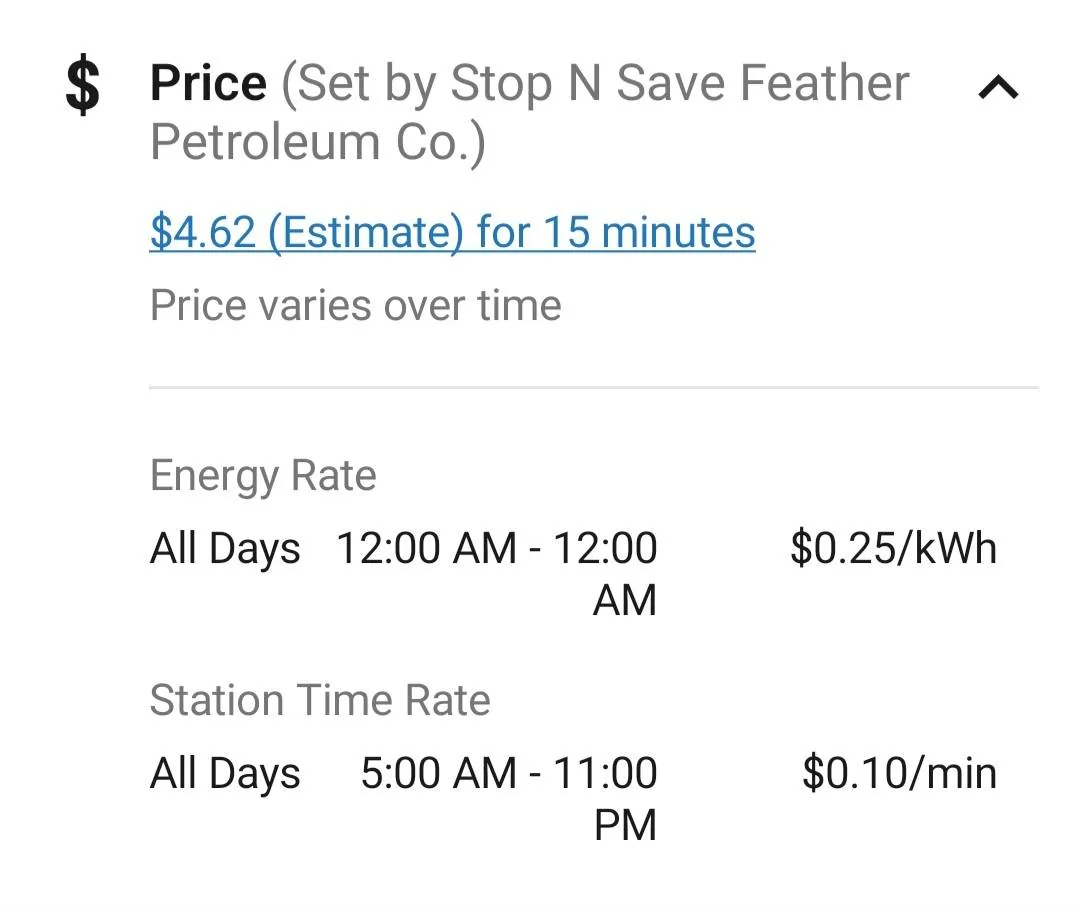
A better way to accomplish the same thing (which some already do) is to charge a dual rate for kWh + time (sometimes called a parking charge). The latter part rewards faster charging cars and penalizes slower charging ones. It also disincentivizes charging longer when the power drops late in the charge curve.

As long as the time rate isn't *too* punitive, I favor this type of rate structure. Time is a significant part of the equation, especially when we're waiting on the cars in front of us to finish up.

However there is one unfair part to it... when the charger isn't functioning fully and is the one derating the power, not the car. Then it's the charger's fault, not the car's. Not really fair to have to pay more because the charger isn't functioning fully.

Here's one ChargePoint CP250 I've used a few times.

Ford Mustang Mach-E Supercharger Update Screenshot_20240225_110018_ChargePoint
 

DCC233

Well-Known Member
First Name
David
Joined
Jul 19, 2023
Threads
2
Messages
49
Reaction score
72
Location
Ohio
Vehicles
2021 California Route 1 / 2021 Tesla MY
Country flag
Gonna have to disagree with you, here. DCFC was not sized or intended for commercial or routine use. In fact, manufacturers recommend against routine DCFC to preserve battery health.

Now you can argue that DCFC stations don’t expressly prohibit commercial / routine use, and that’s true, but you and I both know that was never the intention.
What the manufacture recommends I would argue is irrelevant to the underlying issue of demand being greater than supply. Many of us on this forum and thread wouldn't be as excited for access to the Tesla network if for instance every EA installation had at least 12 stalls, and they were all functioning at once ;), because odds are that the supply, in most parts of this country, could meet demand. You, or I, or anyone rolling up on a EA station wouldn't bat an eye at some EV driver's occupation because our needs would be met.
A EV driving rideshare driver, is just another EV driver for all intents and purposes, that is adding to the ratio in an unfavorable manner to someone else's desire to use a DCFC at any given moment. The math doesn't care what the manufacturer recommends in terms DCFC frequency, charge level, etc.

Finally, a DCFC station, in theory, exists to make money and there purposes are commercial in nature. A car idling on a charger is still making them money. A uber driver hitting up a DCFC 2 times a day is meeting their objective to make money.

  • Commercial EV drivers
  • 50Kw onboard chargers
  • People charging to 100%
  • People leaving their car idle on chargers

Nobody would care that much if that happened at a gas station because there are no shortages of alternative locations and in most cases pumps at the same location to be nothing more than a minor inconvenience. In the EV world, in particular the CCS world, that can equate to 10, 20, 30 - 90 minutes extra of waiting.........all because demand is greater than supply.
 

ChasingCoral

Well-Known Member
First Name
Mark
Joined
Feb 3, 2020
Threads
502
Messages
14,306
Reaction score
28,654
Location
Maryland
Vehicles
2021 GB E4X FE, 2022 F-150 Lightning Lariat ER
Occupation
Retired oceanographer
Country flag
Gonna have to disagree with you, here. DCFC was not sized or intended for commercial or routine use.
That's not true everywhere. As @dbsb3233 will attest, EA installed a load of DCFC stations in and around Denver to prepare for a planned use of EVs for rideshare.
 

ChasingCoral

Well-Known Member
First Name
Mark
Joined
Feb 3, 2020
Threads
502
Messages
14,306
Reaction score
28,654
Location
Maryland
Vehicles
2021 GB E4X FE, 2022 F-150 Lightning Lariat ER
Occupation
Retired oceanographer
Country flag
In fact, manufacturers recommend against routine DCFC to preserve battery health.
Sure, and I've seen lots of posts from people with leased EVs and unlimited charging plans that don't give a rat's a$$ about the health of the battery after their lease runs out.
 

dbsb3233

Well-Known Member
First Name
TimCO
Joined
Dec 30, 2019
Threads
56
Messages
10,100
Reaction score
11,965
Location
Colorado, USA
Vehicles
2021 Mustang Mach-E FE, 2025 Porche Macan Electric
Occupation
Retired
Country flag
What the manufacture recommends I would argue is irrelevant to the underlying issue of demand being greater than supply. Many of us on this forum and thread wouldn't be as excited for access to the Tesla network if for instance every EA installation had at least 12 stalls, and they were all functioning at once ;), because odds are that the supply, in most parts of this country, could meet demand. You, or I, or anyone rolling up on a EA station wouldn't bat an eye at some EV driver's occupation because our needs would be met.

A EV driving rideshare driver, is just another EV driver for all intents and purposes, that is adding to the ratio in an unfavorable manner to someone else's desire to use a DCFC at any given moment. The math doesn't care what the manufacturer recommends in terms DCFC frequency, charge level, etc.

Finally, a DCFC station, in theory, exists to make money and there purposes are commercial in nature. A car idling on a charger is still making them money. A uber driver hitting up a DCFC 2 times a day is meeting their objective to make money.

  • Commercial EV drivers
  • 50Kw onboard chargers
  • People charging to 100%
  • People leaving their car idle on chargers

Nobody would care that much if that happened at a gas station because there are no shortages of alternative locations and in most cases pumps at the same location to be nothing more than a minor inconvenience. In the EV world, in particular the CCS world, that can equate to 10, 20, 30 - 90 minutes extra of waiting.........all because demand is greater than supply.
Sure, the fact is we need more DCFC during peak times than we have. But it's so expensive to install, with such a low revenue stream, that's it's usually a big money loser (even with $billions in taxpayer money and Dieslgate fines). Thus why there's not enough of it. That's just the reality that we're stuck with.

Given that reality, it's reasonable to recommend for what helps make it all work better and recommend against what makes it worse. I'd agree that it would be wrong to deny anyone access, even heavy users like rideshare drivers and apartment residents that don't have L1/L2. But we can certainly recommend against such heavy usage patterns by a few can ruin it for everyone. That's why I always say I'd never buy an EV if I didn't have L2 where I sleep. L2 needs to be the overwhelming solution for this all to work, with DCFC being a relatively small piece where there's no other choice (like road-tripping beyond the initial L2 of the day at home or hotel).

Chasing public chargers is often a frustrating game of musical chairs. I sure wouldn't want to do it full time. It's frustrating enough part time. Hasn't been too bad yet for my travels, but I'm sure it's gonna get worse and worse as millions more EVs hit the roads without DCFC keeping pace. Most of my away-from-home charging is rural or small town though (road trips through the west), so that shouldn't be as bad. The congestion effect from rideshare and apartment dwellers w/o L2 overwhelming stations should be more of an urban problem.
 

dbsb3233

Well-Known Member
First Name
TimCO
Joined
Dec 30, 2019
Threads
56
Messages
10,100
Reaction score
11,965
Location
Colorado, USA
Vehicles
2021 Mustang Mach-E FE, 2025 Porche Macan Electric
Occupation
Retired
Country flag
That's not true everywhere. As @dbsb3233 will attest, EA installed a load of DCFC stations in and around Denver to prepare for a planned use of EVs for rideshare.
I'm still wondering how wise that was. I can't imagine it proved to be cost effective. And I wonder how many road trip route stations it displaced. I'd much rather have more stations on I-80, I-70, I-25, etc. in the region.

That decision appeared to me made 3-4 years back when EA was flush with Dieslegate cash and things looked rosy for spending it all over. Since then, the reality of their maintenance costs has hit them and their station expansions have slowed dramatically. I'm guessing they're regretting loading up so many stations here now (25 in the metro area, at last count). And we're not even one of the top-10 population metros in the country.

I'm not even sure that Lyft deal they made is in effect anymore.
 

SWO

Well-Known Member
Joined
Aug 28, 2021
Threads
21
Messages
2,222
Reaction score
2,802
Location
MD, USA
Vehicles
2022 Mach E GT, 2021 Escape PHEV, 2019 F-150
Country flag
Gonna have to disagree with you, here. DCFC was not sized or intended for commercial or routine use. In fact, manufacturers recommend against routine DCFC to preserve battery health.

Now you can argue that DCFC stations don’t expressly prohibit commercial / routine use, and that’s true, but you and I both know that was never the intention.
It would be interesting if auto manufacturers built a DCFC "counter" into their cars (in the same vein as engine hour counters) to give potential buyers an idea of how the previous owner used the car.

I think a lot leasees in particular have a "eff it, that's the next owner's problem" WRT DCFC'ing and charging to 100% that's detrimental to the EV market as a whole.
 

ChasingCoral

Well-Known Member
First Name
Mark
Joined
Feb 3, 2020
Threads
502
Messages
14,306
Reaction score
28,654
Location
Maryland
Vehicles
2021 GB E4X FE, 2022 F-150 Lightning Lariat ER
Occupation
Retired oceanographer
Country flag
It would be interesting if auto manufacturers built a DCFC "counter" into their cars (in the same vein as engine hour counters) to give potential buyers an idea of how the previous owner used the car.
More likely they would keep that information to themselves.

BTW, the Toyota BZ4X has a daily counter and only allows 2 DCFC sessions a day before it de-rates the charging sessions. Helluva road-tripper :rolleyes:
 

SWO

Well-Known Member
Joined
Aug 28, 2021
Threads
21
Messages
2,222
Reaction score
2,802
Location
MD, USA
Vehicles
2022 Mach E GT, 2021 Escape PHEV, 2019 F-150
Country flag
More likely they would keep that information to themselves.

BTW, the Toyota BZ4X has a daily counter and only allows 2 DCFC sessions a day before it de-rates the charging sessions. Helluva road-tripper :rolleyes:
I've always been curious how that works, whether it's time-based or event based. It would be awful to have charging issues and exceed 2 events before you even charge.
 

ChasingCoral

Well-Known Member
First Name
Mark
Joined
Feb 3, 2020
Threads
502
Messages
14,306
Reaction score
28,654
Location
Maryland
Vehicles
2021 GB E4X FE, 2022 F-150 Lightning Lariat ER
Occupation
Retired oceanographer
Country flag
I've always been curious how that works, whether it's time-based or event based. It would be awful to have charging issues and exceed 2 events before you even charge.
I think it would be awful to road trip one of those dogs period.
Sponsored


Top