Texas Tesla Tragedy

AllenXS

Well-Known Member
First Name
Allen
Joined
Jan 11, 2021
Threads
13
Messages
1,339
Reaction score
1,706
Location
Richmond, BC, Canada
Vehicles
Premium Blue ER AWD
Country flag
Why is it that whenever Tesla mucks up it suddenly becomes ford 's fault. Plenty of other car companies around. Why the infatuation from the fan boys? Sounds like they are questioning their cult like fanaticism.

In this case elons answer was almost comical. It appears fsd was not engaged but that answer might change later.

Sad case. Hope it's the last we see.
Sponsored


ARK

Well-Known Member
Joined
Aug 21, 2020
Threads
45
Messages
2,938
Reaction score
4,297
Location
Los Angeles
Vehicles
'21 Premium SR AWD
Country flag
You seem to be under the mistaken impression that a trained accident investigator is the one who made the determination there was no driver. That's incorrect - it was an elected official with no formal investigative training. From the sounds of it, he had minimal to no law enforcement training. That's what happens when voters elect a Sheriff or other officer as a popularity contest.

But, boy oh, boy, didn't the media run with that one regrettable statement! ;)
Thank you, that is useful to know. If accurate, I would give their findings less weight. As an aside, this does jibe with what I know about Texas - the state's judges are also all elected and don't need to be lawyers or have any legal background whatsoever to be able to stand for election.
 

buffasnow

Well-Known Member
First Name
Jeff
Joined
Oct 20, 2020
Threads
2
Messages
436
Reaction score
782
Location
Buffalo, NY
Vehicles
Grabber Blue FE, 85 Mustang GT (pasturized)
Country flag
My analysis that obviously there was a driver in the driver's seat, contrary to the elected law enforcement officer's statement that they were "100% sure" the seat was empty at the time of impact, is not based on any one piece of information. My analysis is based on the totality of publicly known information. It's clear the officer's statement was false.
Your analysis based on evidence to which only you have access? Your forensic analysis of the crash site and your extensive accident reconstruction expertise? Your interviews with the witnesses? The crop circle tree scrapings? Still waiting for you to post links to that evidence.

You can come to your final conclusion whenever you want.
Does this mean you have already reached your (expert) final conclusion?

Maybe you won't even believe the final investigation report. Elon probably paid people off, right? I already know there was a driver in the driver's seat and you will find that out in time. But it's obvious now to anyone who looks at the facts of this case in a rational manner and with a critical eye.
Obviously, I don't know how this happened, none of us here do. There are some very curious aspects to this tragic crash. I'm sure many rational people have ideas and theories, and when they critically present them here, for the most part they don't represent opinion as fact. I suspect the vast majority of us, regardless of our feelings about Musk or Tesla, feel that it's prudent to let the professionals investigate fully and issue a report.

Others are unencumbered by the fact process.
 

buffasnow

Well-Known Member
First Name
Jeff
Joined
Oct 20, 2020
Threads
2
Messages
436
Reaction score
782
Location
Buffalo, NY
Vehicles
Grabber Blue FE, 85 Mustang GT (pasturized)
Country flag
Autopilot does prevent crashes. It doesn't prevent ALL crashes, only some of them.

That's what the statistics prove and it's why the regulators are behind adoption of these technologies. Do you feel Copilot 360 is also dangerously unsafe or only Autopilot?
But those crashes autopilot doesn't prevent, ouch.

I am immeasurably relieved that Autopilot prevented ALL the crashes that I never realized did not happen, though. Thanks Uncle Elon!

I know I am setting myself up for disappointment again, but I don't suppose you'd care to share a link to those statistics? Please?


LagerHead

Banned
Banned
First Name
Marcus
Joined
Mar 17, 2021
Threads
0
Messages
438
Reaction score
228
Location
Olympic Peninsula
Vehicles
2010 Ford F-150, 2018 Tesla Model 3 & 2 Ducati M/C
Occupation
Test Dummy
Country flag
Your analysis based on evidence to which only you have access? Your forensic analysis of the crash site and your extensive accident reconstruction expertise? Your interviews with the witnesses? The crop circle tree scrapings? Still waiting for you to post links to that evidence.


Does this mean you have already reached your (expert) final conclusion?


Obviously, I don't know how this happened, none of us here do. There are some very curious aspects to this tragic crash. I'm sure many rational people have ideas and theories, and when they critically present them here, for the most part they don't represent opinion as fact. I suspect the vast majority of us, regardless of our feelings about Musk or Tesla, feel that it's prudent to let the professionals investigate fully and issue a report.

Others are unencumbered by the fact process.
I made my determination by relying on photographic evidence over witness statements and my knowledge of what happens when a car runs into a thicket of trees. We have a lot of trees here and I've personally witnessed a number of cars that have crashed into thickets and I know how strong and flexible these young trees can be this time of year. I afforded Elon Musk's statement that the preliminary examination of the logs indicated Autopilot was not engaged at the time of the accident considerable weight for two reasons:

It would be business suicide to lie about the data in the logs when he knows the investigators would subpoena them without a doubt. Over the last several years I've found him to be honest and straightforward. It would not benefit him or the company to lie about two peoples deaths when the investigators would shortly have access to them anyway. The evidence that the steering wheel was bent showed that someone was in the driver's seat.

It's also not credible that a 60 year old doctor would jury rig Autopilot to run without a driver and then climb in back. Doctors generally don't do things like that, even if they are still physically fit enough to climb over/between the front seats just for a prank. 60 year old doctors tend to not be that stupidly "playful". If the doctor was so really stupid that this was his idea of a good prank, he would have chosen a road where Autopilot works reliably, one with lane markers. And, if he did pull such a prank on such an obviously unsuitable road, the autopilot couldn't have accelerated to a high enough speed in a residential area. I'm intimately familiar with how Tesla Autopilot works and that's not how it works.

Finally, there was no evidence there was no one in the driver's seat once you remove the irresponsible statement from the elected official. Responsible investigators don't leak key details to the media before the investigation is complete. Even non-trained people know this so I suspected early on this was likely a case of anti-Tesla bias. Jumping to irrational conclusions due to personal biases. He probably fully believed what he said. But he's biased and doesn't know anything about Tesla Autopilot and it's operating parameters. Ignorance causes people to say and do stupid things.

In summary, the media story is simply not credible, the incredible leaps of faith required to believe the media version of events is simply too fantastic, on too many levels, to be true. Especially since there is a very credible alternative explanation that only requires discounting the statement made by the irresponsible elected official.

And the physical evidence that the car climbed up the tree before eventually being released by the thicket of smaller trees as the fire heated them and turned the green wood into rubber, letting the car slide to the ground gave plenty of opportunity for the driver to end up in the back seat. Either by falling via gravity as the nose of the car was up in the tree or climbing down into the backseat in an attempt to escape the burning car or a combination of gravity and climbing into the back.

Also, there was the second 911 caller that said she could see a car burning "in a tree". She didn't say "in the trees", she said "in a tree", so this indicated the car was off the ground. This will all come out in the investigation and I wouldn't convict anyone based on what I know but it's pretty much a given what the investigators will conclude.

Sure, let them do their job (I am) and let them tell us what they learned (I will) and you will see it happened exactly how I described. Watch and see. I'm willing to change my mind but I'm pretty sure that's not going to happen.
 

LagerHead

Banned
Banned
First Name
Marcus
Joined
Mar 17, 2021
Threads
0
Messages
438
Reaction score
228
Location
Olympic Peninsula
Vehicles
2010 Ford F-150, 2018 Tesla Model 3 & 2 Ducati M/C
Occupation
Test Dummy
Country flag
But those crashes autopilot doesn't prevent, ouch.

I am immeasurably relieved that Autopilot prevented ALL the crashes that I never realized did not happen, though. Thanks Uncle Elon!

I know I am setting myself up for disappointment again, but I don't suppose you'd care to share a link to those statistics? Please?
Did your Google break?
 

buffasnow

Well-Known Member
First Name
Jeff
Joined
Oct 20, 2020
Threads
2
Messages
436
Reaction score
782
Location
Buffalo, NY
Vehicles
Grabber Blue FE, 85 Mustang GT (pasturized)
Country flag
I made my determination by relying on photographic evidence over witness statements and my knowledge of what happens when a car runs into a thicket of trees. We have a lot of trees here and I've personally witnessed a number of cars that have crashed into thickets and I know how strong and flexible these young trees can be this time of year. I afforded Elon Musk's statement that the preliminary examination of the logs indicated Autopilot was not engaged at the time of the accident considerable weight for two reasons:

It would be business suicide to lie about the data in the logs when he knows the investigators would subpoena them without a doubt. Over the last several years I've found him to be honest and straightforward. It would not benefit him or the company to lie about two peoples deaths when the investigators would shortly have access to them anyway. The evidence that the steering wheel was bent showed that someone was in the driver's seat.

It's also not credible that a 60 year old doctor would jury rig Autopilot to run without a driver and then climb in back. Doctors generally don't do things like that, even if they are still physically fit enough to climb over/between the front seats just for a prank. 60 year old doctors tend to not be that stupidly "playful". If the doctor was so really stupid that this was his idea of a good prank, he would have chosen a road where Autopilot works reliably, one with lane markers. And, if he did pull such a prank on such an obviously unsuitable road, the autopilot couldn't have accelerated to a high enough speed in a residential area. I'm intimately familiar with how Tesla Autopilot works and that's not how it works.

Finally, there was no evidence there was no one in the driver's seat once you remove the irresponsible statement from the elected official. Responsible investigators don't leak key details to the media before the investigation is complete. Even non-trained people know this so I suspected early on this was likely a case of anti-Tesla bias. Jumping to irrational conclusions due to personal biases. He probably fully believed what he said. But he's biased and doesn't know anything about Tesla Autopilot and it's operating parameters. Ignorance causes people to say and do stupid things.

In summary, the media story is simply not credible, the incredible leaps of faith required to believe the media version of events is simply too fantastic, on too many levels, to be true. Especially since there is a very credible alternative explanation that only requires discounting the statement made by the irresponsible elected official.

And the physical evidence that the car climbed up the tree before eventually being released by the thicket of smaller trees as the fire heated them and turned the green wood into rubber, letting the car slide to the ground gave plenty of opportunity for the driver to end up in the back seat. Either by falling via gravity as the nose of the car was up in the tree or climbing down into the backseat in an attempt to escape the burning car or a combination of gravity and climbing into the back.

Also, there was the second 911 caller that said she could see a car burning "in a tree". She didn't say "in the trees", she said "in a tree", so this indicated the car was off the ground. This will all come out in the investigation and I wouldn't convict anyone based on what I know but it's pretty much a given what the investigators will conclude.

Sure, let them do their job (I am) and let them tell us what they learned (I will) and you will see it happened exactly how I described. Watch and see. I'm willing to change my mind but I'm pretty sure that's not going to happen.
Well you got me there. Since Teslas can climb trees, I may just sell my Mach-E. Which Tesla model does best in the canopy?

Seriously, you (again) provided zero actual evidence of your claims. Lots of conjecture, nothing much verifiable at this point.

Assuming for a moment that the 911 caller was accurate (despite common knowledge that witnesses are unreliable), your contention is the vehicle left the road, ended up atop some trees, where the car caught fire and both occupants perished? And only once the trees burned did the car come down from it's lofty perch? And the initial impact was strong enough for the 60 year old doctor bent the steering wheel but not strong enough to break those small trees?

As interesting as this sounds, I'll wait for the facts. If they line up with what you have presented here, I will donate $50 to a 501(c)(3)charity of your choice.
 

buffasnow

Well-Known Member
First Name
Jeff
Joined
Oct 20, 2020
Threads
2
Messages
436
Reaction score
782
Location
Buffalo, NY
Vehicles
Grabber Blue FE, 85 Mustang GT (pasturized)
Country flag
Did your Google break?
Nope.

Ford Mustang Mach-E Texas Tesla Tragedy 1620108888735


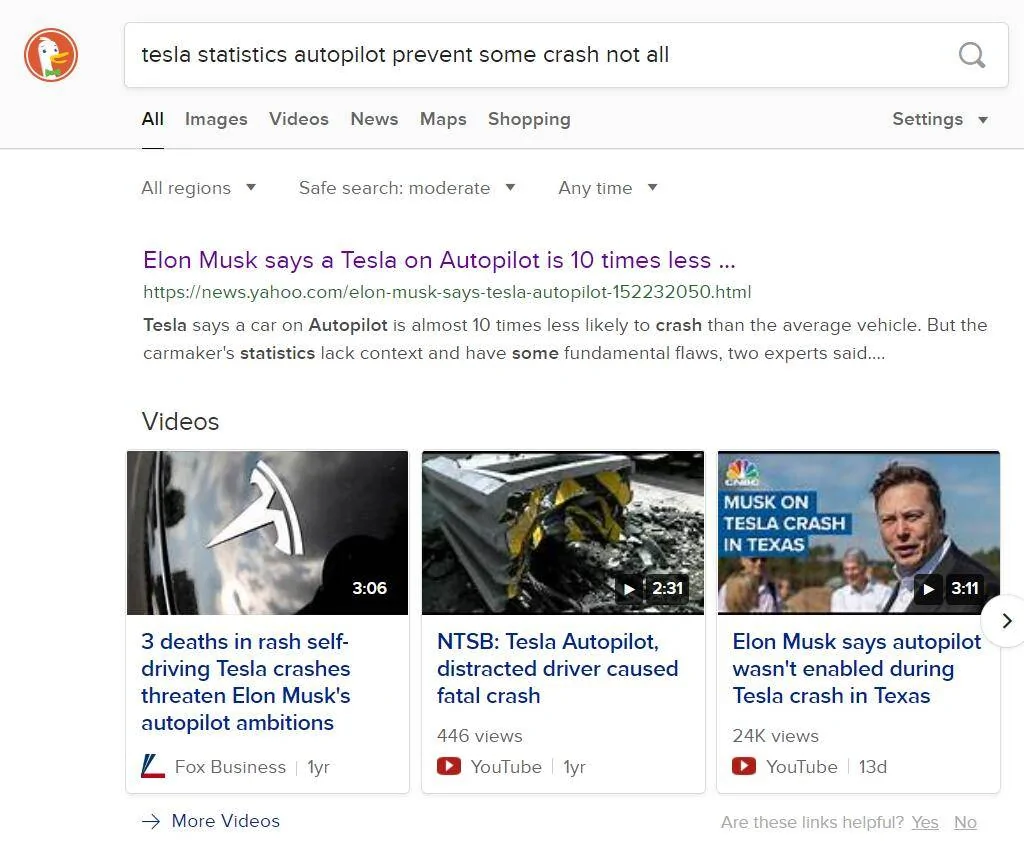
This is the first thing that came up: https://www.businessinsider.com/tes...opilot-safety-data-flaws-experts-nhtsa-2021-4

Are these the statistics of which you speak?

Elon Musk says a Tesla on Autopilot is 10 times less likely to crash than the average car, but experts say that stat is misleading

Tim Levin April 23, 2021

Tesla's safety statistics lack important context, experts say.

  • Tesla says a car on Autopilot is almost 10 times less likely to crash than the average vehicle.
  • But the carmaker's statistics lack context and have some fundamental flaws, two experts said.
  • Autopilot is mainly used on the highway and the average car in the US is 12 years old.
As Elon Musk and local authorities spar over whether Tesla's Autopilot software was to blame in a fiery Model S crash that killed two people on April 17, one thing is clear: Regardless of the technology's involvement in this particular wreck, questions remain about the safety of the system.

Musk has repeatedly touted Autopilot - which automates some driving tasks but doesn't grant cars full autonomy - as a revolutionary safety feature that can slash the likelihood of getting in a crash by a factor of 10. But the data Tesla uses to back up that claim is incomplete at best.

According to the electric-car maker's safety report from the first three months of 2021 - which Musk tweeted about hours before the crash - the company logged one crash for every 4.19 million miles driven on Autopilot. Measured against the National Highway Traffic Safety Administration's US average of an incident roughly every 484,000 miles, Tesla's self-reported figure appears mighty impressive.

But Tesla's statistics don't show the full picture, experts say.

"They can give you this little snippet of data with absolutely zero context, and it is effectively meaningless. It doesn't really tell us anything useful," Sam Abuelsamid, a principal analyst at Guidehouse Insights who specializes in electric vehicles and automated driving, told Insider.

One major flaw in Tesla's comparison is that Autopilot, which keeps a car centered in its lane and maintains a constant distance to other cars, is primarily used on the highway. Drivers can technically switch it on at any speed and on any road, but as with any cruise-control feature, it's most useful during long uninterrupted stretches of highway driving.

So comparing miles driven on Autopilot to national statistics that include a huge variety of driving environments - from packed city streets to unmarked rural roads - gives Tesla a major edge. Highways generally see fewer crashes on the whole than urban environments, and only 17% of fatal crashes occurred on interstates and freeways in 2019, according to the Insurance Institute for Highway Safety.

Tesla's data also overlooks vast differences in vehicle age, which has a major bearing on safety. The average car on the road today is 11.9 years old. One in four of those vehicles more than 16 years old, according to data from IHS Markit. The majority of Teslas were sold in the last few years, and the oldest ones equipped with the hardware to run Autopilot were built in 2014.

That makes Tesla's comparison fundamentally flawed, Abuelsamid says. Not only do older vehicles lack Autopilot-like advanced driver-assistance systems (ADAS) altogether, but they're also more likely to get in a wreck due to things like worn-out brakes, less-responsive handling, and aging tires.

"Telling me that [a Tesla] is better than a car that has no ADAS features doesn't really tell me anything useful," he said. "I would expect the same thing to be true of every modern car that has adaptive cruise control and lane-centering."

In addition to drawing some questionable comparisons, there are other ways Tesla may be skewing the data in its favor.

For instance, Tesla isn't fully transparent about cases where Autopilot disengaged before crashing, Abuelsamid says. In its methodology, the company says it counts any incidents that occurred within five seconds of Autopilot disengaging. But Abuelsamid says it's not uncommon for a driver not to notice when Autopilot shuts off, since the alert is not very intrusive.

Data that potentially misrepresents Autopilot as safer than it is could embolden customers to misuse the system or pay insufficient attention to the road when it's engaged, Abuelsamid said.

For Missy Cummings, an engineering professor at Duke University who studies autonomous vehicles, a more pressing issue is that Tesla markets Autopilot - and its more advanced, $10,000 Full Self-Driving feature - in ways that exaggerate their capabilities.

"I think we should present legitimate data in a legitimate way, so I do think there is some element of false advertising there. But what really makes people misunderstand the car's capabilities is calling it Full Self-Driving," she told Insider. "Your average person who hears statistics - it doesn't even register with them."

Neither Autopilot nor Full Self-Driving allows cars to drive themselves and both require undivided driver attention, despite their monikers. But that didn't stop Musk from taking his hands off the wheel during a now-notorious "60 Minutes" segment from 2018, Cummings notes. For years, Musk has touted that truly autonomous Teslas are just around the corner, despite the current limitations of the company's driver-assistance tech.

Moreover, Cummings says she wouldn't trust any data that hasn't been reviewed by an independent organization - whether it's from Tesla, General Motors, or any other automaker.

Musk said Monday that records reviewed by the company so far show that Autopilot wasn't engaged at the time of the Texas crash. He offered few other details. To be sure, Autopilot is considered by many to be quite safe when used in the right conditions under full supervision.

However, despite years of scrutiny surrounding Autopilot's risks - NHTSA has opened investigations into at least 28 recent Tesla wrecks - the electric-car maker hasn't provided airtight statistics about the system's safety record to assuage consumer-safety advocates.

Abuelsamid says the issues with Tesla's quarterly data all boil down to one old adage: "Tell me what side of the argument you're on, and I'll give you the statistics to prove that you're right."
 

LagerHead

Banned
Banned
First Name
Marcus
Joined
Mar 17, 2021
Threads
0
Messages
438
Reaction score
228
Location
Olympic Peninsula
Vehicles
2010 Ford F-150, 2018 Tesla Model 3 & 2 Ducati M/C
Occupation
Test Dummy
Country flag
Nope.

1620108888735.webp


This is the first thing that came up: https://www.businessinsider.com/tes...opilot-safety-data-flaws-experts-nhtsa-2021-4

Are these the statistics of which you speak?

Elon Musk says a Tesla on Autopilot is 10 times less likely to crash than the average car, but experts say that stat is misleading

Tim Levin April 23, 2021

Tesla's safety statistics lack important context, experts say.


  • Tesla says a car on Autopilot is almost 10 times less likely to crash than the average vehicle.
  • But the carmaker's statistics lack context and have some fundamental flaws, two experts said.
  • Autopilot is mainly used on the highway and the average car in the US is 12 years old.
As Elon Musk and local authorities spar over whether Tesla's Autopilot software was to blame in a fiery Model S crash that killed two people on April 17, one thing is clear: Regardless of the technology's involvement in this particular wreck, questions remain about the safety of the system.

Musk has repeatedly touted Autopilot - which automates some driving tasks but doesn't grant cars full autonomy - as a revolutionary safety feature that can slash the likelihood of getting in a crash by a factor of 10. But the data Tesla uses to back up that claim is incomplete at best.

According to the electric-car maker's safety report from the first three months of 2021 - which Musk tweeted about hours before the crash - the company logged one crash for every 4.19 million miles driven on Autopilot. Measured against the National Highway Traffic Safety Administration's US average of an incident roughly every 484,000 miles, Tesla's self-reported figure appears mighty impressive.

But Tesla's statistics don't show the full picture, experts say.

"They can give you this little snippet of data with absolutely zero context, and it is effectively meaningless. It doesn't really tell us anything useful," Sam Abuelsamid, a principal analyst at Guidehouse Insights who specializes in electric vehicles and automated driving, told Insider.

One major flaw in Tesla's comparison is that Autopilot, which keeps a car centered in its lane and maintains a constant distance to other cars, is primarily used on the highway. Drivers can technically switch it on at any speed and on any road, but as with any cruise-control feature, it's most useful during long uninterrupted stretches of highway driving.

So comparing miles driven on Autopilot to national statistics that include a huge variety of driving environments - from packed city streets to unmarked rural roads - gives Tesla a major edge. Highways generally see fewer crashes on the whole than urban environments, and only 17% of fatal crashes occurred on interstates and freeways in 2019, according to the Insurance Institute for Highway Safety.

Tesla's data also overlooks vast differences in vehicle age, which has a major bearing on safety. The average car on the road today is 11.9 years old. One in four of those vehicles more than 16 years old, according to data from IHS Markit. The majority of Teslas were sold in the last few years, and the oldest ones equipped with the hardware to run Autopilot were built in 2014.

That makes Tesla's comparison fundamentally flawed, Abuelsamid says. Not only do older vehicles lack Autopilot-like advanced driver-assistance systems (ADAS) altogether, but they're also more likely to get in a wreck due to things like worn-out brakes, less-responsive handling, and aging tires.

"Telling me that [a Tesla] is better than a car that has no ADAS features doesn't really tell me anything useful," he said. "I would expect the same thing to be true of every modern car that has adaptive cruise control and lane-centering."

In addition to drawing some questionable comparisons, there are other ways Tesla may be skewing the data in its favor.

For instance, Tesla isn't fully transparent about cases where Autopilot disengaged before crashing, Abuelsamid says. In its methodology, the company says it counts any incidents that occurred within five seconds of Autopilot disengaging. But Abuelsamid says it's not uncommon for a driver not to notice when Autopilot shuts off, since the alert is not very intrusive.

Data that potentially misrepresents Autopilot as safer than it is could embolden customers to misuse the system or pay insufficient attention to the road when it's engaged, Abuelsamid said.

For Missy Cummings, an engineering professor at Duke University who studies autonomous vehicles, a more pressing issue is that Tesla markets Autopilot - and its more advanced, $10,000 Full Self-Driving feature - in ways that exaggerate their capabilities.

"I think we should present legitimate data in a legitimate way, so I do think there is some element of false advertising there. But what really makes people misunderstand the car's capabilities is calling it Full Self-Driving," she told Insider. "Your average person who hears statistics - it doesn't even register with them."

Neither Autopilot nor Full Self-Driving allows cars to drive themselves and both require undivided driver attention, despite their monikers. But that didn't stop Musk from taking his hands off the wheel during a now-notorious "60 Minutes" segment from 2018, Cummings notes. For years, Musk has touted that truly autonomous Teslas are just around the corner, despite the current limitations of the company's driver-assistance tech.

Moreover, Cummings says she wouldn't trust any data that hasn't been reviewed by an independent organization - whether it's from Tesla, General Motors, or any other automaker.

Musk said Monday that records reviewed by the company so far show that Autopilot wasn't engaged at the time of the Texas crash. He offered few other details. To be sure, Autopilot is considered by many to be quite safe when used in the right conditions under full supervision.

However, despite years of scrutiny surrounding Autopilot's risks - NHTSA has opened investigations into at least 28 recent Tesla wrecks - the electric-car maker hasn't provided airtight statistics about the system's safety record to assuage consumer-safety advocates.

Abuelsamid says the issues with Tesla's quarterly data all boil down to one old adage: "Tell me what side of the argument you're on, and I'll give you the statistics to prove that you're right."
Haha! Business Insider.

Nice try. I fully agree it's not a full 10 times safer as the raw data might indicate to some. Because that data has to be adjusted for some of the factors mentioned. But there is no way those adjustments are going to drive the actual accident rate a full 10 times higher. And for Autopilot to be considered unsafe, it would have to drive the accident rate past the 10 times safer cited by Tesla.

The bottom line is that people claiming it's costing lives vs. if Autopilot didn't exist, are arguing a losing battle. The data is not on their side.
 
Last edited:

LagerHead

Banned
Banned
First Name
Marcus
Joined
Mar 17, 2021
Threads
0
Messages
438
Reaction score
228
Location
Olympic Peninsula
Vehicles
2010 Ford F-150, 2018 Tesla Model 3 & 2 Ducati M/C
Occupation
Test Dummy
Country flag
Well you got me there. Since Teslas can climb trees, I may just sell my Mach-E. Which Tesla model does best in the canopy?

Seriously, you (again) provided zero actual evidence of your claims. Lots of conjecture, nothing much verifiable at this point.
No, they can't "climb" trees, at least not in the monkey sense. But they do behave generally like any other passenger car of similar size and weight when run into a thicket of green saplings. Which is to say the car bends them over as it's momentum caries it forward. As they bend over they form a ramp of sorts which lifts the front of the car off the ground. Living in Western Washington I've seen this numerous times and cars end up in all sorts of crazy nose-high attitudes. Around here, Alders are best for this, not sure about Texas. In the summer or fall the car is more likely to break the trees because they are drier but in the spring, after sufficient rain, they are strong and flexible.

If the nose of the car was tilted up when it impacted the large immovable tree, the momentum of the car would tilt the car vertical. This actually happened as evidenced by the large vertical scrape extending 10 feet off the ground where the bark had been recently scraped away. It was likely held in this vertical attitude by the trees it had bent over and the doors were probably prevented from opening by saplings on either side (not to mention the weight of the doors with the car pointing upwards). Remember, these were two older gentlemen.

So, no, cars cant climb trees but they can certainly have enough energy to get hung up in them with the nose of the car pointing up. I've seen cars in the brush like this.

Assuming for a moment that the 911 caller was accurate (despite common knowledge that witnesses are unreliable), your contention is the vehicle left the road, ended up atop some trees, where the car caught fire and both occupants perished? And only once the trees burned did the car come down from it's lofty perch? And the initial impact was strong enough for the 60 year old doctor bent the steering wheel but not strong enough to break those small trees?
No, not on top of the tree, at least not the big one that stopped it. The rear of the car was likely very near the ground, within a few feet. It's impossible to say exaclty how much without inspecting the site more closely than the photos allow.

And if the green saplings were holding the car in that attitude, they didn't need to burn to release the car, they only needed to be heated. When we steam planks for a boat we heat them to 180 degrees and they turn to rubber and easily bend around surprisingly tight curves. They have no strength left. In a living tree this loss of strength and resiliency would happen at a much lower temperature. We only heat the planks to 180 degrees to give us plenty of working time once the plank is removed from the steam box. So, as the fire burned, the trees would lose their resiliency and release the car to gravity before they were even charred. In the news footage you can see a large gouge in the topsoil about 3 feet in diameter (in front of the left rear wheel) the correct distance from the large tree for the rear bumper of the car to gouge out as the car rotated down and away from the tree (right before coming to rest on it's wheels).

As interesting as this sounds, I'll wait for the facts. If they line up with what you have presented here, I will donate $50 to a 501(c)(3)charity of your choice.
Sounds good! After you have verified, you can donate the $50 to the X Prize Foundation.
 

sambastang

Well-Known Member
First Name
Bobby
Joined
Feb 24, 2021
Threads
7
Messages
145
Reaction score
290
Location
Seattle, WA
Vehicles
2013 Veloster, 2021 Mustang Mach-E FE
Occupation
IT Engineer
Country flag
I have a fence post in my back yard that is more intellectually challenging to argue with. Those of you who continue to spar with Stanley are only going to frustrate yourselves. You cannot have a reasonable discussion with this person who is quick to emote, but fast and loose with the truth.
 

theo1000

Well-Known Member
First Name
Theo
Joined
Apr 16, 2021
Threads
0
Messages
473
Reaction score
610
Location
Shawnee, KS
Vehicles
Mach-E 2021 IB, Audi Etron, Chevy Volt, BMW I3,
Country flag
Agree lets wait for the full report.

It doesn't help that the CEO of the company is not waiting for the full report but is busy casting aspersions. Shocking behavior, speaks of a careless person.
Sponsored


Top