Things to consider when DIY installing a wall charger / outlet

phidauex

Well-Known Member
First Name
Sam
Joined
Dec 8, 2020
Threads
17
Messages
967
Reaction score
1,843
Location
Colorado
Vehicles
2021 MachE 4EX, 2006 Prius, 1997 Tacoma
Occupation
Renewable Energy Engineer
Country flag
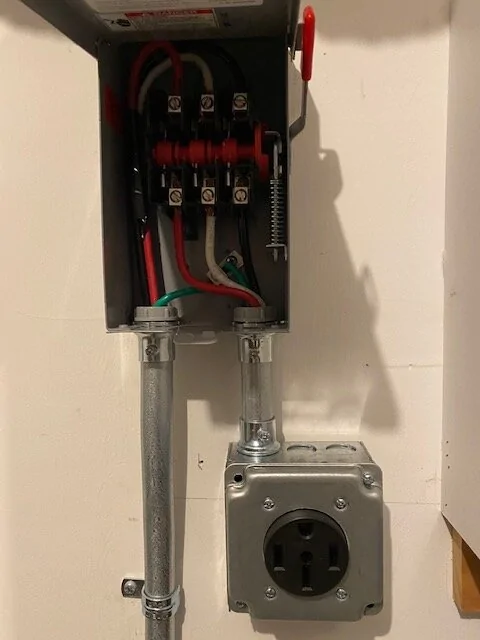
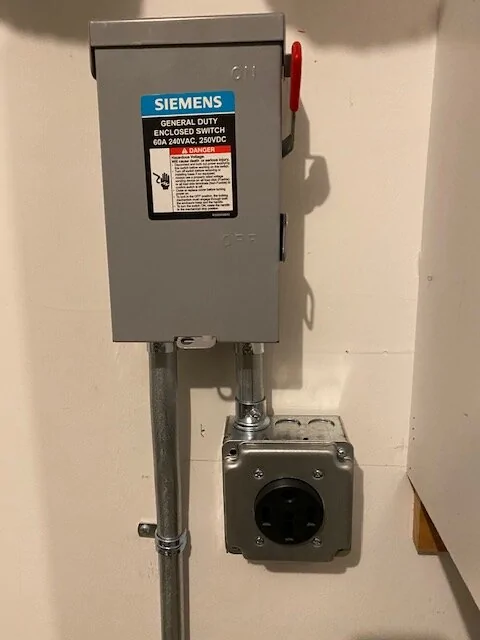
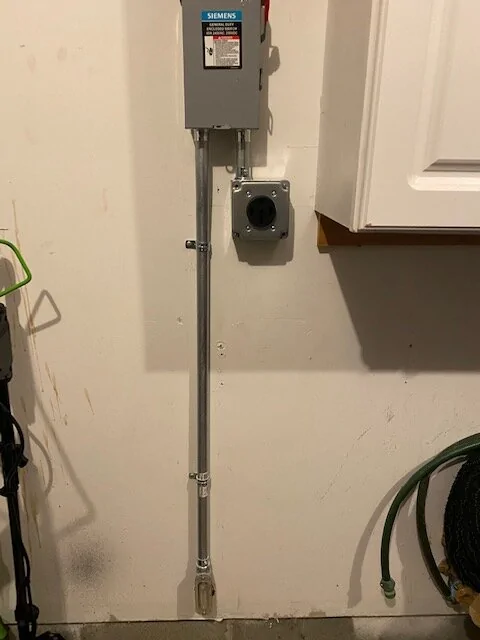
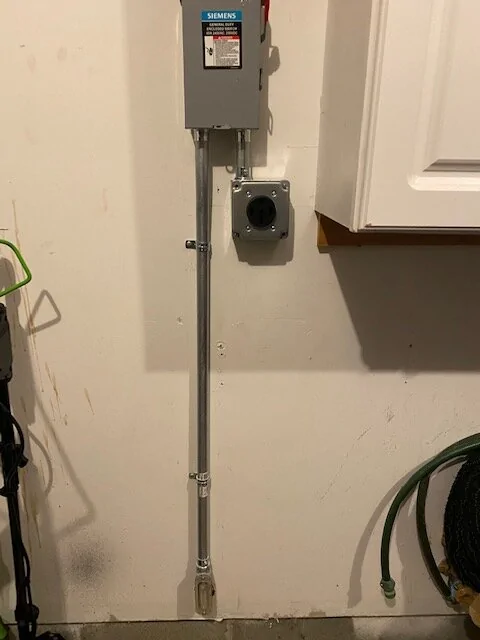
Finished today. #6 wire - 3phase disconnect - 14/50 recp - 50 amp breaker.
IMG_4791.jpg
Nice clean work! I assume you ran the #6 in order to plan ahead for a future hard-wired 60A connection to a 48A charger (with breaker upgrade to 60A)?

Also, I'm surprised you switched the neutral - that isn't typical, and isn't allowed in most cases. NEC 404.2(B) forbids switching the neutral, but it allows an exception for cases where all the phases are switched simultaneously and it isn't possible to switch the neutral before the the phase conductors. In my experience that provision isn't typically used unless there is a good reason, and you'd just use a 2-pole disconnect and pass the neutral straight through.

Was there a particular reason you switched the neutral, or is it just what you had on hand?
 

Sweetwater

Well-Known Member
Joined
Feb 5, 2020
Threads
14
Messages
500
Reaction score
347
Location
Ohio
Vehicles
Jeep
Occupation
Retired Electrician
Country flag
Nice clean work! I assume you ran the #6 in order to plan ahead for a future hard-wired 60A connection to a 48A charger (with breaker upgrade to 60A)?

Also, I'm surprised you switched the neutral - that isn't typical, and isn't allowed in most cases. NEC 404.2(B) forbids switching the neutral, but it allows an exception for cases where all the phases are switched simultaneously and it isn't possible to switch the neutral before the the phase conductors. In my experience that provision isn't typically used unless there is a good reason, and you'd just use a 2-pole disconnect and pass the neutral straight through.

Was there a particular reason you switched the neutral, or is it just what you had on hand?
You are correct in your statements. I wanted ALL conductors disconnected. It is OK
to do so in the code. I was an Electrician over 35 yr. and never did this on any job.
I guess you could say it is "Super Safe"
I must add : All gas station pumps MUST have a switch neutral breaker. I wired many of these.
 
Last edited:

phidauex

Well-Known Member
First Name
Sam
Joined
Dec 8, 2020
Threads
17
Messages
967
Reaction score
1,843
Location
Colorado
Vehicles
2021 MachE 4EX, 2006 Prius, 1997 Tacoma
Occupation
Renewable Energy Engineer
Country flag
You are correct in your statements. I wanted ALL conductors disconnected. It is OK
to do so in the code. I was an Electrician over 35 yr. and never did this on any job.
I guess you could say it is "Super Safe"
I must add : All gas station pumps MUST have a switch neutral breaker. I wired many of these.
Ah yes, I see the occupation on your profile now! I'm on the other side of the desk, power engineer, I work on industrial power systems and renewable energy plants. I didn't know about gas stations, but I do know of a few cases where grounded conductors get disconnected in circuits where you want to be able to better troubleshoot ground faults, or where the utilization device has a GFCI in it. An example is the DC circuits in large PV arrays - we disconnect positive and negative, even if the negative is grounded, because in the case of a ground fault we want to be able to isolate all the conductors for testing.

You clearly know what you are about, but for others reading, I'll just note that the method shown isn't required, and might raise some eyebrows with the inspector if they aren't used to seeing systems like this (many are just taught "never switch the neutral"). A two pole disconnect with the neutral passing through is perfectly legit.


concept machine

Active Member
First Name
Jim
Joined
Oct 21, 2021
Threads
2
Messages
40
Reaction score
26
Location
Mid West
Vehicles
GT350R, Tacoma TRD Pro, Escape, Veloster
Occupation
Business Owner
Country flag
Finished today. #6 wire - 3phase disconnect - 14/50 recp - 50 amp breaker.
?hash=41e75179f32c9d27dfc5389fb2031964.jpg
IMG_4791.jpg
IMG_4764.jpg
IMG_4766.jpg


IMG_4763.jpg
Nice and clean.
Can the Mach e charge off 3 phase power?
 

dbonsett

Well-Known Member
Joined
Oct 9, 2021
Threads
14
Messages
122
Reaction score
72
Location
Denver
Vehicles
Mustang Mach-E GT Performance
Country flag
I've installed two 240v wall mounted chargers. No, it's not difficult if you know what you're doing. IF. There are a number of code issues that need to be followed. Following code is important if you don't want to burn down your house or electrocute somebody. If you do it yourself, get a permit and get it inspected. Most jurisdictions allow you to do your own electrical work. The inspection is a cheap way of insuring you did everything right. ***IMPORTANT*** If you make an error in the installation and your house burns down, insurance WILL NOT cover your loss!!!!

Most houses these days the electrical service panel (circuit breaker panel) is in the garage. That usually makes it pretty easy to install a charger. The first thing you need to do is determine if your service can handle the extra load that your charger will require. I am not going to describe how to do this; if you're going to attempt this it's important you research this fully. Second, you need to see if your panel has room for an additional 240v breaker. (They're double wide breakers.) Even if you don't see any empty spaces, don't give up hope. Most panels allow a certain number of tandem circuit breakers. (A standard width breaker with two breakers instead of one.)

Next you have to decide if you are going to run conduit or run the wires in wall. Believe it or not, it's usually easier to cut out drywall and then use the cut piece to patch the wall after installation. Drywall work isn't really that hard. Plan your run. How many chargers? Are you sure you want just one? If might ever get a second EV, it's a lot easier doing all the wiring at once. Even if you don't want to buy a second charger, you could always just install a 240v outlet in it's place. Then down the road it would be easy to install that second charger. This will make your life a lot easier if you ever do get a second EV, and it will add value to your house.

Before you start, do your research. What are code requirements for securing the wire? How big does the conduit need to be? Will you run 2 or 3 conductor romex? What gauge will you use? how will you transition into and out of the conduit, the outlet boxes, the charger, the service panel? what are the grounding requirements for your install? These are all questions you need to not just know the answers to, you need to know why. Common sense does not cut it. Code does. For instance, my two Tesla wall chargers require a network cable run between them so they can talk to each other. No big deal right? It's a low voltage application, any comm cable will work, right? FAIL. You just burned your house down. Communications cable run in the same conduit as power cable MUST have the same insulation rating as the power cable, usually 600v. Finding 600v rated comm cable is very difficult; I could only find it in two online shops. (Amazon was not one of them.)

Long story short, every detail of your installation is covered by code. Every. Tiny. Detail. Do your research. Get a permit. Get your install inspected. Don't burn your house down or electrocute somebody.
Good info.
 

Glen

Well-Known Member
First Name
Glenn
Joined
Oct 22, 2021
Threads
10
Messages
567
Reaction score
463
Location
New Jersey
Vehicles
2022 Range Rover, 2012 Dodge, 2018 Chevy, 52 M38
Occupation
Retired, building inspector / construction super for a builder in NY.
Country flag
My way to wire it was to hire a licensed electrician I have used many times over the years. And yes I had him pull a permit to. I like the idea of the disconnect by the plug, is the necessary? I wouldnt know. Mine should get installed next week. For a car I dont get till March/April 2022. My wife thinks I am wack. Maybe I am. I like to get stuff done. ?
 

TheCats

Well-Known Member
Joined
Jan 18, 2021
Threads
0
Messages
95
Reaction score
77
Location
95033
Vehicles
Y5Z
Country flag
Nice and clean.
Can the Mach e charge off 3 phase power?
The J1772 Type 1 connector only supports single phase power. In commercial settings this is sometimes provided across two phases (208V nominal) of a three phase power supply, but it's only still single phase power.

The european standard IEC 62196-2 Type 2 connector directly supports three phase power. That's why it has seven pins instead of five -- four power contacts (N, L1, L2, L3) are in the connector instead of just two. Three phase power was intended to simplify the design of an on-board charger, but it ended up being significantly worse. The larger connector and extra wiring makes the system heavier and more expensive. The need to support various inputs makes the charger more complex and expensive.
 

concept machine

Active Member
First Name
Jim
Joined
Oct 21, 2021
Threads
2
Messages
40
Reaction score
26
Location
Mid West
Vehicles
GT350R, Tacoma TRD Pro, Escape, Veloster
Occupation
Business Owner
Country flag
The J1772 Type 1 connector only supports single phase power. In commercial settings this is sometimes provided across two phases (208V nominal) of a three phase power supply, but it's only still single phase power.

The european standard IEC 62196-2 Type 2 connector directly supports three phase power. That's why it has seven pins instead of five -- four power contacts (N, L1, L2, L3) are in the connector instead of just two. Three phase power was intended to simplify the design of an on-board charger, but it ended up being significantly worse. The larger connector and extra wiring makes the system heavier and more expensive. The need to support various inputs makes the charger more complex and expensive.
thank you, very much!
Looks like I'll just be running 1Phase then. Probably 6 gauge wire for 50 Amps
 

CHeil402

Well-Known Member
First Name
Chris
Joined
Sep 21, 2020
Threads
8
Messages
726
Reaction score
1,325
Location
King of Prussia, PA
Vehicles
2017 Audi A4, 2021 MME
Occupation
Electrical Engineer
Country flag
thank you, very much!
Looks like I'll just be running 1Phase then. Probably 6 gauge wire for 50 Amps
Do you have 3-phase at your house? One of the other reasons the US version is 1-phase is it is atypical for residences to have 3-phase.
 

concept machine

Active Member
First Name
Jim
Joined
Oct 21, 2021
Threads
2
Messages
40
Reaction score
26
Location
Mid West
Vehicles
GT350R, Tacoma TRD Pro, Escape, Veloster
Occupation
Business Owner
Country flag
Do you have 3-phase at your house? One of the other reasons the US version is 1-phase is it is atypical for residences to have 3-phase.
No, I have it at my shop, which is about 7 miles away. I have an open 60 amp breaker and will have wires ran for a charger there. I'll do a majority of charging when at work.
Home ill just have lower charge amp charger.
 

Rockcity313

Active Member
First Name
Will
Joined
Jan 25, 2021
Threads
1
Messages
40
Reaction score
25
Location
Delaware
Vehicles
Atlas
Country flag
I have two 50amp nema 14-50 outlets in my garage (each on dedicated 50amp circuits) however due to potential issues with gfci I want to have a chargepoint hard wired instead of plug in to keep it to code. Would the existing 14-50 wiring need to be altered if I remove one of the outlets and put it on a non gfci breaker? Just hoping the existing wiring is sufficient.
 

CHeil402

Well-Known Member
First Name
Chris
Joined
Sep 21, 2020
Threads
8
Messages
726
Reaction score
1,325
Location
King of Prussia, PA
Vehicles
2017 Audi A4, 2021 MME
Occupation
Electrical Engineer
Country flag
I have two 50amp nema 14-50 outlets in my garage (each on dedicated 50amp circuits) however due to potential issues with gfci I want to have a chargepoint hard wired instead of plug in to keep it to code. Would the existing 14-50 wiring need to be altered if I remove one of the outlets and put it on a non gfci breaker? Just hoping the existing wiring is sufficient.
Assuming the wiring was installed properly to handle the 50 amp load, then you can replace either end of the wiring and it will still be sufficient for 50 amps. The GFCI vs non-GFCI does not impact the wiring, it's just based on how it will trip the breaker. A traditional circuit breaker breaks when there is a current overload (meant to protect the wiring only) whereas a GFCI breaks when there is a current imbalance in the lines (meant to protect people). The only thing to check would be the current draw of the Chargepoint hardwire that you're going to add. Hardwire allows you to go above 50 amps, but you'd need to check if the wiring supports it.

Long story short, assuming the wiring was installed correctly intially, you can replace a NEMA 14-50 outlet with a hardwired charger THAT IS ALSO RATED FOR 50 AMPS MAX without issue. If you want to go over 50 A, you'll need to see if the wiring is sized for it. Hope this helps.
 

Rockcity313

Active Member
First Name
Will
Joined
Jan 25, 2021
Threads
1
Messages
40
Reaction score
25
Location
Delaware
Vehicles
Atlas
Country flag
Assuming the wiring was installed properly to handle the 50 amp load, then you can replace either end of the wiring and it will still be sufficient for 50 amps. The GFCI vs non-GFCI does not impact the wiring, it's just based on how it will trip the breaker. A traditional circuit breaker breaks when there is a current overload (meant to protect the wiring only) whereas a GFCI breaks when there is a current imbalance in the lines (meant to protect people). The only thing to check would be the current draw of the Chargepoint hardwire that you're going to add. Hardwire allows you to go above 50 amps, but you'd need to check if the wiring supports it.

Long story short, assuming the wiring was installed correctly intially, you can replace a NEMA 14-50 outlet with a hardwired charger THAT IS ALSO RATED FOR 50 AMPS MAX without issue. If you want to go over 50 A, you'll need to see if the wiring is sized for it. Hope this helps.
Thanks for the detailed response! I assume it's all done correctly as this is new construction and I had the builder put in the two dedicated 50 amp circuits and they used nema 14-50 outlets. Charge point says 50 amp circuit (charging at 40 amp draw) can be plugged in or hard wired. I just wanted to make sure that the the existing wire should work. If not, unfortunately, I'll stick with the Ford Mobile Charger at 32amp charging
Sponsored


Top