Battery Capacity and Charging

nivlem

Well-Known Member
First Name
Walter
Joined
Aug 8, 2020
Threads
17
Messages
71
Reaction score
90
Location
Tx
Vehicles
'66 Mustang;'79 Mustang;2015 Genesis;2021 Mach E
Occupation
Retired
Country flag
I am expecting my Mach E soon so I'm trying to get smart about how it works. I'm a little confused about battery capacity and charging protocols. I understand the car comes with a 98 kwh battery but only 88 kwh is available (good for 300mi range). I also understand the preferred charge/discharge band is between 10% and 80% capacity. Most charging guidance I've seen suggests regular charging up to 80% and the battery should be charged to 100% very rarely. I assume that means 80% of 88 kwh; a 100% charge would be 88 kwh.

This is what confuses me. If 70 kwh (80% of 88 kwh) is the functional battery capacity, then the true capacity is 18 kwh less than 88 kwh advertised. The result would be a 28 kwh buffer. If 62 kwh (80% - 10% capacity) is the operating range capacity, it gives a range less than 180 miles. As I see it Mach E owners have a much smaller usable battery and range based upon (80% - 10% capacity) will be very poor. Am I missing something?

If we are working with a 28 kwh buffer what could be the harm of charging to a level greater than 80% to get more usable range. If my assessment is correct what charge level would be good.
Sponsored

 

Kamuelaflyer

Well-Known Member
First Name
Bill
Joined
Feb 18, 2020
Threads
11
Messages
11,397
Reaction score
23,067
Location
Hawaii
Vehicles
2021 Premium Infinite Blue. ER AWD. 2020 Raptor, 2021 Ranger.
Country flag
You’ve asked the $64,000 question. One that has been endlessly debated here. I won’t bore you with links to old threads which discussed this topic. Someone else will at some point anyway.

The general consensus is that Ford is being conservative in their approach to battery longevity by putting in such a large buffer. It helps protect against possible warranty claims down the road and also helps delay or reduce battery degradation. There’s a group of folks who think some of the reserve will be freed up at some point as Ford gains more data from the thousands of cars that will be in consumer's hands soon. Others disagree.

Anyway, folks here will chime in soon with more detailed information. Personally, I’ll rarely charge past 80% snd probably not to that even on a regular basis. The car will most be used around town and I live in an island. Your mileage will vary. :)
 
Last edited:

Marcel

Well-Known Member
Joined
Apr 28, 2020
Threads
15
Messages
611
Reaction score
875
Location
The Netherlands
Vehicles
Mustang Mach-E
Occupation
Woodworker
I am expecting my Mach E soon so I'm trying to get smart about how it works. I'm a little confused about battery capacity and charging protocols. I understand the car comes with a 98 kwh battery but only 88 kwh is available (good for 300mi range). I also understand the preferred charge/discharge band is between 10% and 80% capacity. Most charging guidance I've seen suggests regular charging up to 80% and the battery should be charged to 100% very rarely. I assume that means 80% of 88 kwh; a 100% charge would be 88 kwh.

This is what confuses me. If 70 kwh (80% of 88 kwh) is the functional battery capacity, then the true capacity is 18 kwh less than 88 kwh advertised. The result would be a 28 kwh buffer. If 62 kwh (80% - 10% capacity) is the operating range capacity, it gives a range less than 180 miles. As I see it Mach E owners have a much smaller usable battery and range based upon (80% - 10% capacity) will be very poor. Am I missing something?

If we are working with a 28 kwh buffer what could be the harm of charging to a level greater than 80% to get more usable range. If my assessment is correct what charge level would be good.
Short answer, when NOT fast charging you can go 100%, preferrably right before departure, down below 10% is also no problem if you charge immediatly thereafter.

The programmed usable amount is because there will be folks who forget these rules and drain it fully (even on the highway) OR charge it every time to 100%. And this will significantly reduce the battery life
 

opennetus

Well-Known Member
Joined
Jun 23, 2020
Threads
1
Messages
85
Reaction score
105
Location
USA
Vehicles
Ford Fusion
Country flag
Well, the healthiest state of charge is around 50%. From there it is basically exponential curves toward the extremes (0% and 100%). So the difference between 90-100% is much greater than 80-90%, for example. Time left at a given SOC is also an important factor. That is why, if storing a lithum ion battery for several weeks or months unused, you should have it at around 50% SOC for optimal health. This is why things like phones are shipped at around 50% SOC; who knows how long they will be sitting in a warehouse after manufacture and half state of charge is gentlest on the battery.

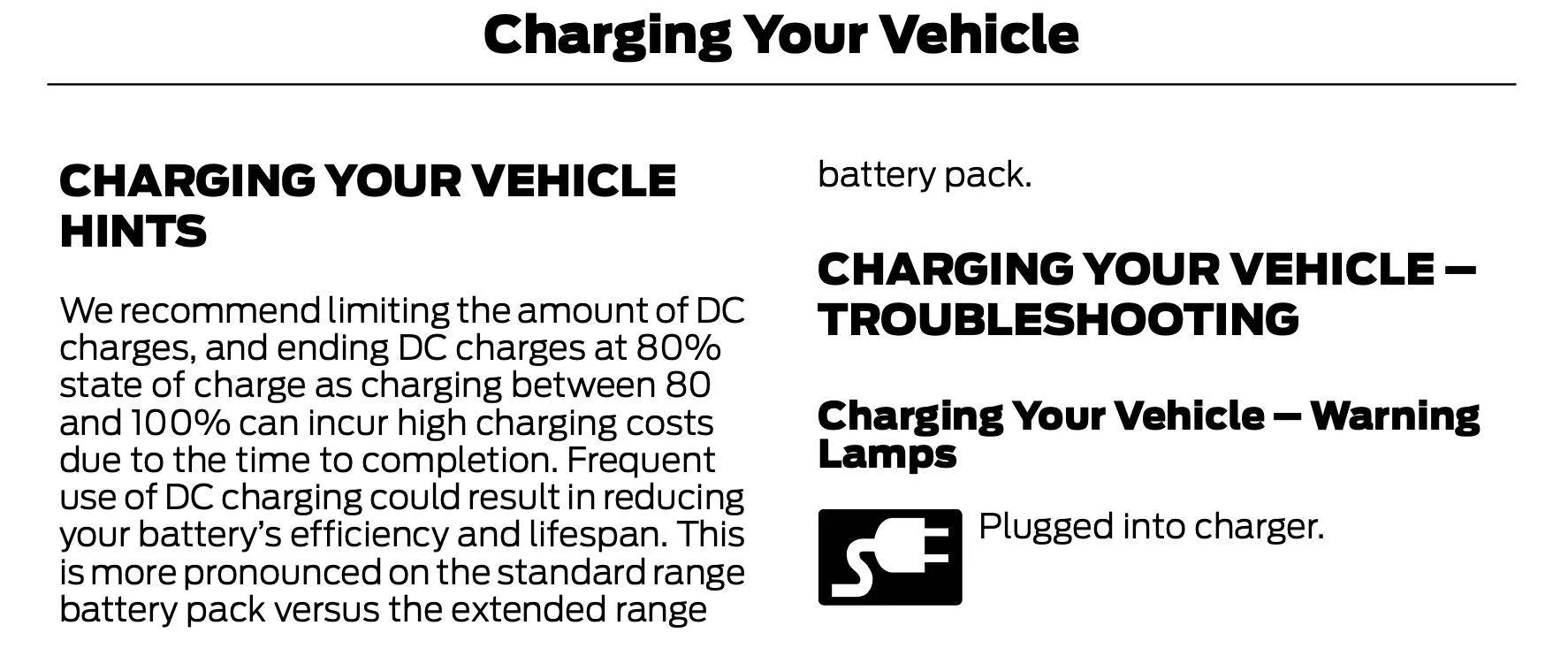
Another factor that can affect battery health is DC Fast charging. Batteries are happiest when charged slowly, particular when the battery is at a high state of charge. That is why all EVs (and other devices with batteries such as cell phones) are programmed to charge faster when near ā€œemptyā€ and slow down the charging when near full. Ford is very conservative here which is why their DC charging curve drops off dramatically after 80% SOC.

Now having said all of that; the difference between optimizing battery health and not doing so at all is quite minor in the grand scheme of things. The car protects itself very well and it is really not worth the effort to overly worry about or lose sleep over perfectly optimizing. Everything left that you the owner can control is really just playing in the margins.

If you want to optimize health, the key questions to ask is when do you need your full range? If you charge at home every night and have a typical daily commute length, you will never need your entire potential range of 300 miles on a daily basis, so there is no real reason or benefit to charging up to 100%. The only time there is a benefit is right before a long road trip, so you can wait a while longer before needing to stop to charge (and after that, for really long trips, you just want to charge high enough to get to the next charging stop since charging is faster at lower SOC making it rarely worth it to charge above 80%).

Whether you charge to 70, 80, 90, or 100% should be based on how much range you estimate needing until your next charge session and that number will be different for everyone since everyone has different commute lengths, climates, and other factors that can affect range.

Because Ford has a large battery buffer (the difference between actual capacity and usable capacity), you don’t need to be as conservative as you would with an Electric Vehicle setup with a very small battery buffer (example: Tesla’s cars). In other words, 90% SOC on a Mach-E would be similar to 80% SOC on a Tesla, as far as battery health goes. So you can regularly charge higher than 80% on a regular basis if you want/need to. Particularly if you plan to leave shortly after charging completes.

If that is all too complicated to think about, then just charge to 85-90% most days and to 100% before embarking on a long trip out of town and you will be just fine.
 
Last edited:

phidauex

Well-Known Member
First Name
Sam
Joined
Dec 8, 2020
Threads
17
Messages
969
Reaction score
1,846
Location
Colorado
Vehicles
2021 MachE 4EX, 2006 Prius, 1997 Tacoma
Occupation
Renewable Energy Engineer
Country flag
@opennetus explained things well.

The short answer is that you can use 100% to 0% as reported by the car (which in reality is probably something like 92% to 2% of the actual battery state of charge).

However, like your phone and laptop, the battery will last longer if it isn't stored at full charge for long periods of time, or run completely empty on a regular basis.

The hold-back of battery capacity may seem unfair at first, but it is a good strategy. Overbuilding the battery gives a few benefits:
  1. It gives the user a battery range that can be used without difficulty. Getting a battery to a "real" 0% or 100% is tricky and has consequences in how you use it. By restricting the range a bit you can use 99% the same way you'd use 50%.
  2. It reduces battery degradation by spreading the charge over a larger battery. Larger batteries will last longer than smaller batteries.
  3. The holdback will restrict the more damaging very high SOCs more. This is why you can use the reported 100% SOC (because it isn't really 100% in the battery).
  4. It lets the operator of the battery tune the hold back to improve performance over time. If you set the maximum range at the beginning of life, people would degrade the batteries fast by keeping them at very high states of charge like they do with their phones (whos batteries die every few years). The result would be a higher initial range number, but a rapid degradation. The more responsible move is to create a holdback to limit degradation, then gradually "open" the holdback over time. This both slows degradation, and makes the degradation less apparent, because the range can get gradually increased again. At the battery's end of life they'll probably be giving you 1% - 98% of the battery's true capacity, or something very similar.
As opennetus said, you don't have to think that hard about it if you don't want to - the short answer is that 80% is a good level to charge to for day-to-day driving, because it gives a good mix of range and low degradation. You can go to 100% whenever you need to, but it isn't recommended to do that unless you are taking a long drive that day.


OP
OP

nivlem

Well-Known Member
First Name
Walter
Joined
Aug 8, 2020
Threads
17
Messages
71
Reaction score
90
Location
Tx
Vehicles
'66 Mustang;'79 Mustang;2015 Genesis;2021 Mach E
Occupation
Retired
Country flag
Excellent info. Thanks for all of your responses and insight into Ford's battery support strategy. My anxiety relieved has been relieved!!


Billyk24

Well-Known Member
First Name
William
Joined
Nov 29, 2019
Threads
117
Messages
2,328
Reaction score
1,312
Location
PA
Vehicles
Ford C-Max Energi, Premium Mach-E ordered
Country flag
A point added: No one really knows the temperature of the battery pack is while driving and charging on L2 and DCFC. Or, if the battery pack becomes even warmer while charging during the hot summer months. Heat can be a killer of the battery pack. There is more to learn about the thermoregulation capabilities of the battery pack.
 

JoeSmoeFromIDontKnow

Well-Known Member
First Name
Joe
Joined
Jun 13, 2020
Threads
3
Messages
60
Reaction score
105
Location
Rochester, NY
Vehicles
Mach-E Premium AWD ER (canceled)
Country flag
Well, the healthiest state of charge is around 50%.
Yes, for a single cell, the healthiest SOC is 50%. But, when there are many cells involved which are arranged in arrays, it's not realistic to expect the same charge to be on every single cell equally after many cycles that hover around 50% SOC. When you drive, some cells will tend to loose more energy than others. And apparently, charging won't recover them equally if you stop charging too early. Therefore, you'll need to force a full charge (>=90%) occasionally in order to equalize all of the cells. That is why I think Ford recommends charging to 90%. It is a compromise between topping it off and keeping it under 100% to increase longevity.

There is a video from a Tesla tuber talking about this concept:


machefan

Well-Known Member
Joined
Jan 14, 2020
Threads
26
Messages
1,719
Reaction score
2,450
Location
NJ
Vehicles
RR FE 21', Leaf 18' and Bronco BadLands 2022
Occupation
IT
Country flag
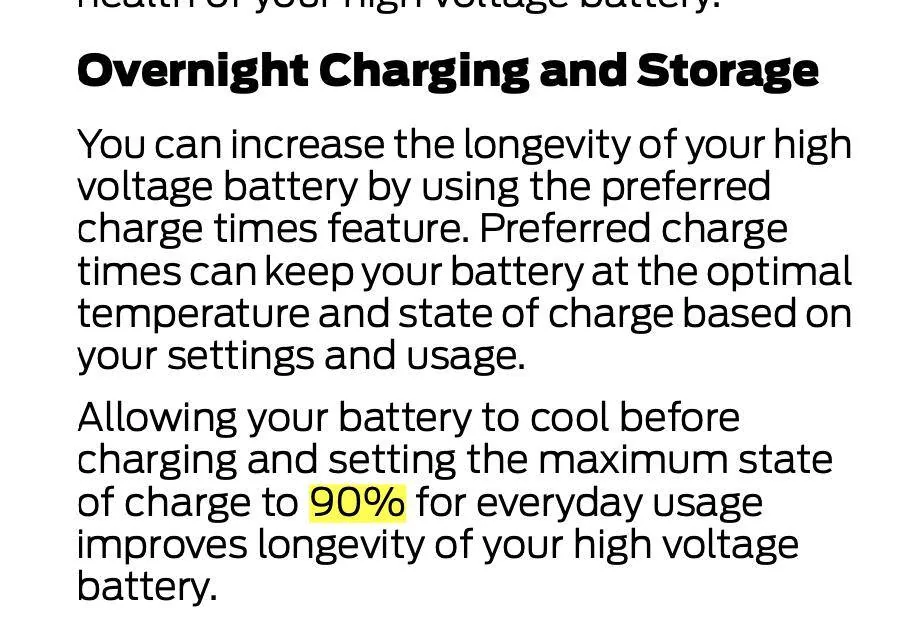
So many threads on this topic, easiest answer is follow the manual which says 90% and avoid DC fast chargers whenever possible. Meaning a daily top off at a DCFC is not a good idea.

Ford Mustang Mach-E Battery Capacity and Charging Screen Shot 2021-02-20 at 6.15.51 AM


Ford Mustang Mach-E Battery Capacity and Charging Screen Shot 2021-02-20 at 6.14.31 AM
 

machefan

Well-Known Member
Joined
Jan 14, 2020
Threads
26
Messages
1,719
Reaction score
2,450
Location
NJ
Vehicles
RR FE 21', Leaf 18' and Bronco BadLands 2022
Occupation
IT
Country flag
The MME doesnā€˜t rebalance the cells automatically when needed? My Outlander PHEV does, and it has a much simpler system.
It has a built in buffer so charing to 100% will not yield the same effect when charing to 100% as other EV's that let you use 100% of the battery. We can only charge to 90% of capacity even when it says 100% charged.

100% = 90% usage~ 90% = 80% usage~

So ford tells us 90% which is the typical 80% rule, the video is for a Tesla, so I don't suggest folks disregard the manual and charge to 100% daily, but follow what. you want your choice. I am also a Leaf owner and we have them at work as well. My team killed 3 Leafs by daily charing to 100% and DCFC on a regular basis. In three years of ownership the battery before returning the lease was at 75% capacity (SOC MAX). My 2018 leaf after two and half years is at 95% capacity, I am religious about 80%. I only charge to 100% when I am leaving shortly, I also once in a while top off with a fast charger to level off as others have stated. The MME is not going to let you do this given the buffer which is preset. DCFC to 100% with the MME is a really long process since it slows charing after 80% to preserve the battery.

For folks with the standard battery and it's your first EV, after a while you might wish you had the extended battery. This is because what's said as range is not real world due to limiting factors.

Only charge to 90% (Ford recommendation for preserving the battery)
Battery Buffer (You can use the total capacity) 99 kW is not usable, only 88 kW
Weather conditions (70 - 80 deg max range) (colder weather will lower the total miles)
DCFC slows to a crawl after 80%, if you are taking a long trip you might want to keep this in mind
After a period of time 100% state will diminish, total driving miles will be lower, how much or when is unknown.

We have to see how well Ford did with the battery design, given the buffer they could compensate for losses, but they haven't said such takes place.

Range is also subject to how you drive and how use the cabin comforts.

Sorry long post
 

JoeSmoeFromIDontKnow

Well-Known Member
First Name
Joe
Joined
Jun 13, 2020
Threads
3
Messages
60
Reaction score
105
Location
Rochester, NY
Vehicles
Mach-E Premium AWD ER (canceled)
Country flag
The MME doesnā€˜t rebalance the cells automatically when needed? My Outlander PHEV does, and it has a much simpler system.
I don't know about your outlander PHEV, but I don't think balancing occurs until at about 70-80% on the SOC curve. (and higher % if considering the Mach-E buffer) This is especially tricky with serial/parallel arrays. Some relevant links to read:
easiest answer is follow the manual which says 90%
So, yes, the Mach-E will be fine if you adhere to their 90% SOC daily recommendation. But, for those that want to extend their battery life even longer, one could do a daily SOC at say 60%, but then periodically go to >=90% SOC to perform a balance. I think once a week would be reasonable.
 

ChasingCoral

Well-Known Member
First Name
Mark
Joined
Feb 3, 2020
Threads
502
Messages
14,318
Reaction score
28,680
Location
Maryland
Vehicles
2021 GB E4X FE, 2022 F-150 Lightning Lariat ER
Occupation
Retired oceanographer
Country flag
The MME doesnā€˜t rebalance the cells automatically when needed? My Outlander PHEV does, and it has a much simpler system.
I don't think we know the answer to this question yet.
 

generaltso

Well-Known Member
Joined
Jun 24, 2020
Threads
76
Messages
15,389
Reaction score
28,696
Location
Vermont
Vehicles
2024 Kia EV9 GT-Line
Country flag
I don't think we know the answer to this question yet.
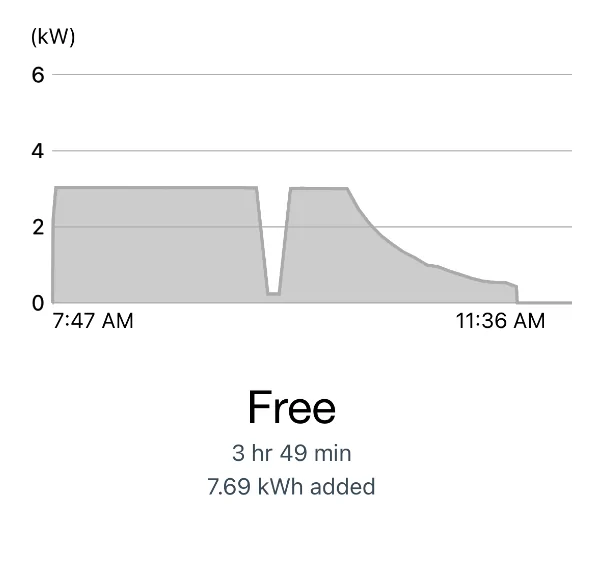
I can tell when my Outlander is rebalancing by looking at the charging graph. The charging rate drops to almost nothing for about 10 minutes while it's rebalancing, and then it goes back to normal. Has anyone observed anything like this when the MME is charging?

Ford Mustang Mach-E Battery Capacity and Charging 1613836056674
 

Billyk24

Well-Known Member
First Name
William
Joined
Nov 29, 2019
Threads
117
Messages
2,328
Reaction score
1,312
Location
PA
Vehicles
Ford C-Max Energi, Premium Mach-E ordered
Country flag
The MME doesnā€˜t rebalance the cells automatically when needed? My Outlander PHEV does, and it has a much simpler system.
My 2005 Ford Escape hybrid did "rebalance" the system around every 10,0000 miles even when driving the vehicle. I had seen it up until around 160,000 miles. I traded the vehicle in with just under 200,000 miles in October 2019 at which time the battery cells were worn/dying as they would not hold a charge overnight well. I would have single digit SOC readings if I did not drive it for three or more days. The 2016 Toyota RAV 4 that replaced it has not displayed such a rebalance. My 2017 CMax Energi (PHEV) has not displayed such a rebalance either.
Sponsored


Top