SpaceEVDriver

Well-Known Member
Joined
Aug 26, 2021
Threads
71
Messages
2,654
Reaction score
4,780
Location
Arizona
Vehicles
2022 CA Route 1 AWD, ER; 2023 Lightning Lariat ER
Occupation
Planetary Science
Country flag
Thanks! I understood about storing more when warmer. I was just wondering if the precondition process also packed in additional electrons while it warmed the batteries.
Yes. As @Mach-Lee stated, the preconditioning process keeps the battery SOC the same.

Assume a battery has a capacity of 100 kWh at the perfect temperature and a capacity of 80 kWh at a lower temperature.

At 90% SOC, the warm battery has 90 kWh.
At 90% SOC, the cold battery has 72 kWh.

The warm battery has (a lot) more "electrons packed in" at the same SOC.
Sponsored
 

AKgrampy

Well-Known Member
First Name
Mike
Joined
Jan 29, 2022
Threads
7
Messages
3,525
Reaction score
3,600
Location
Fairbanks, Alaska
Vehicles
Ford Expedition, Ford F-150, Mach E GT
Occupation
Retired
Country flag
Yes. As @Mach-Lee stated, the preconditioning process keeps the battery SOC the same.

Assume a battery has a capacity of 100 kWh at the perfect temperature and a capacity of 80 kWh at a lower temperature.

At 90% SOC, the warm battery has 90 kWh.
At 90% SOC, the cold battery has 72 kWh.

The warm battery has (a lot) more "electrons packed in" at the same SOC.
Yes, I understand that; however, it takes energy to heat the battery and energy to charge the battery. So my question was does the system charge while preconditioning? In your example, for instance, could the vehicle precondition the batteries and also add another 18kW to the battery pack? I just wanted it to be clear that charging was also taking place during the preconditioning process and not just warming the battery. The reason I asked this is my understanding was all preconditioning did was warm (or cool) the batteries.
 

MrPeanut

Well-Known Member
First Name
Bob
Joined
Dec 11, 2021
Threads
1
Messages
63
Reaction score
21
Location
Wake Forest, NC
Vehicles
2022 MME Premium ER
Occupation
Retired
Country flag
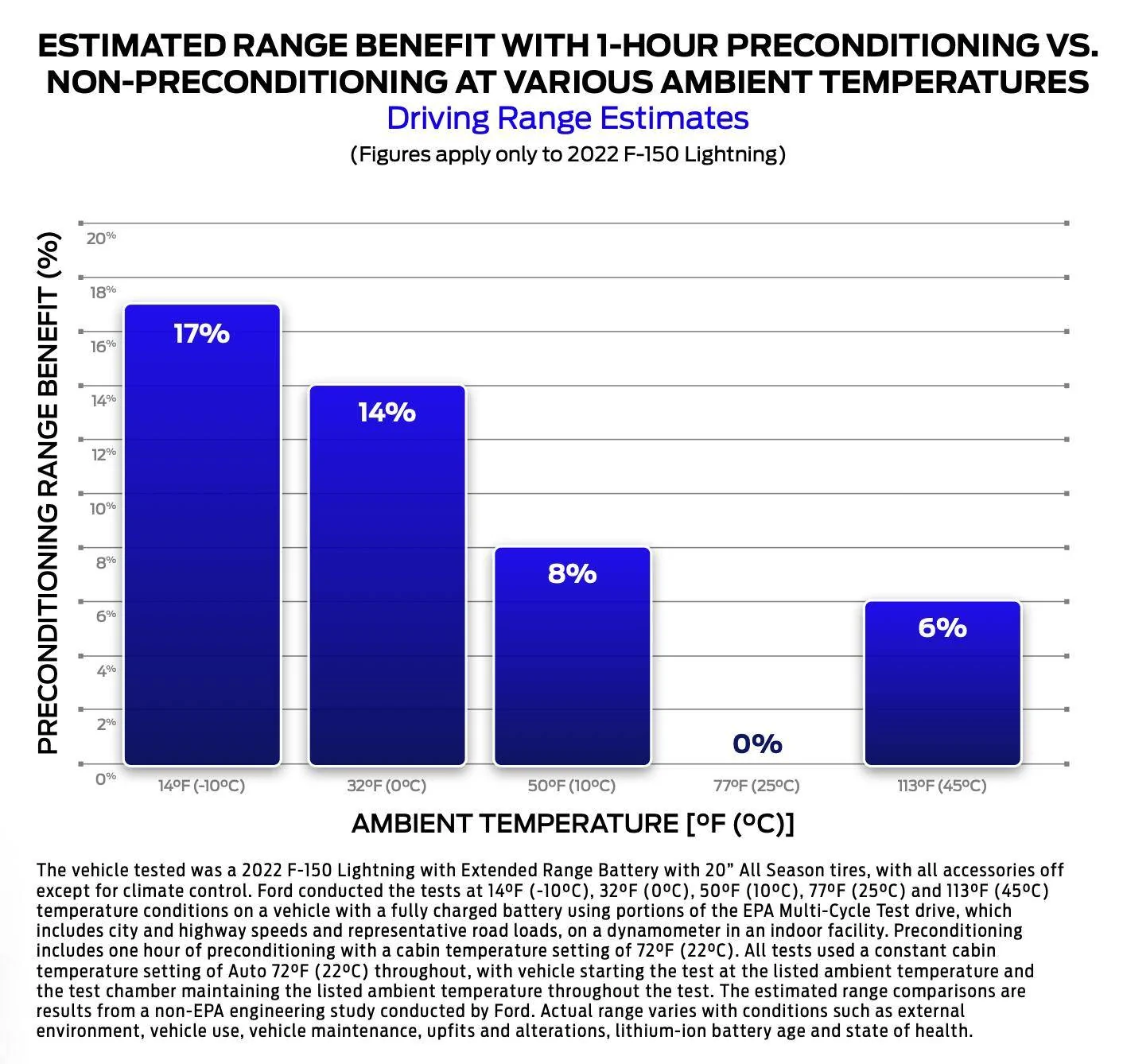
Ford just released a very informative brochure detailing things that affect range with test results. It's for the F150 Lightning, but the effects would be very similar and relevant for the Mach-E as well. If you want to jump straight to the full brochure, I've attached the PDF at the bottom. Let me discuss some of the highlights:

Effect of Preconditioning:

Preconditioning Range.png


As you can see, the colder it is outside, the larger the range improvement from preconditioning (setting a departure time). If we extrapolate with this data, the effect would be +20% improved range at -4ºF(-20ºC). Warmer batteries store more energy, so that's why heating the battery improves range. Preconditioning also has a slight improvement of range when it's very hot outside as well. For more information on how to precondition your battery when you don't have a regular schedule, see my cold weather strategy topic.

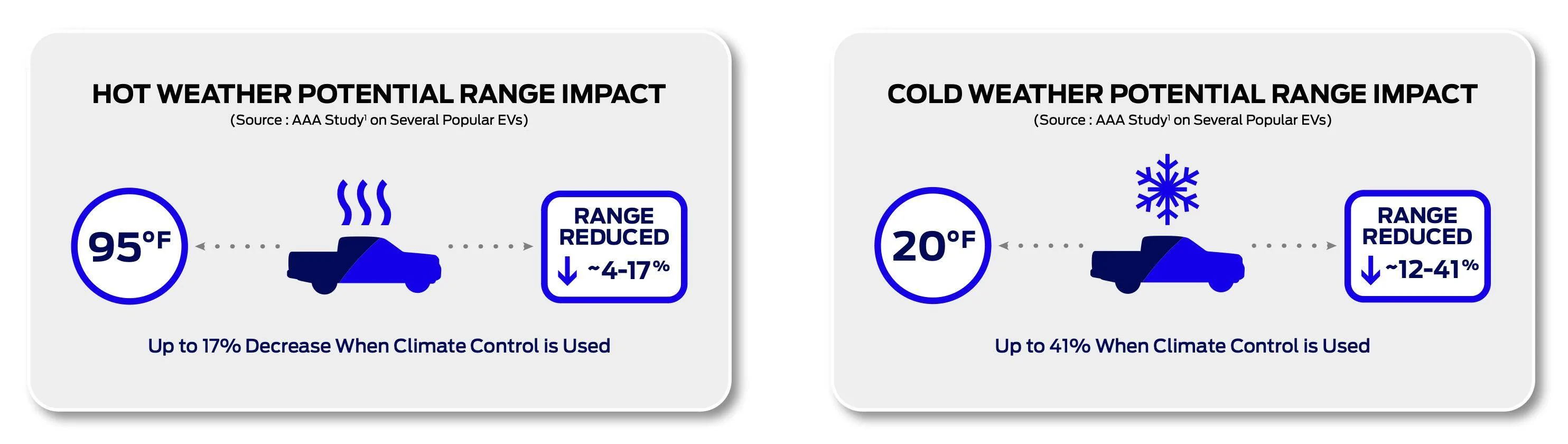
Effect of Outdoor Temperature:

Outdoor Temp.png


This one isn't specific to the F150 Lightning, but we all know range can decrease with climate use in hot or cold conditions.

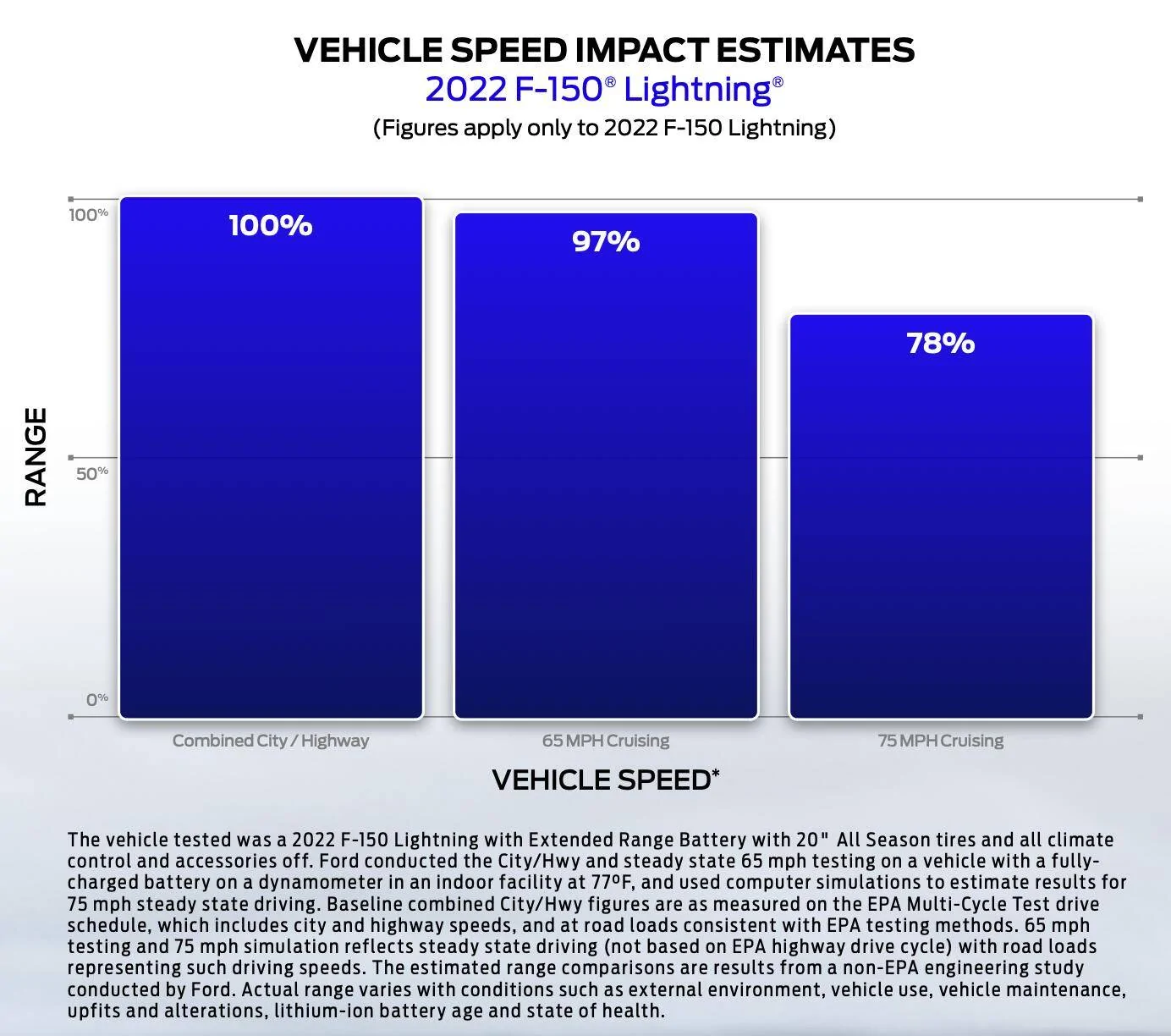
Effect of Speed:

Speed Range.png


If you want EPA range, you have to drive about 65 MPH. If you drive just 10 MPH faster (75 MPH), your range will go down about 20%. This is because drag is proportional to velocity squared (not linear)! Which means if you drive 20 MPH faster (85 MPH), your range will go down about 54%! Driving 65-75 MPH is really the sweet spot for getting decent range in an EV.

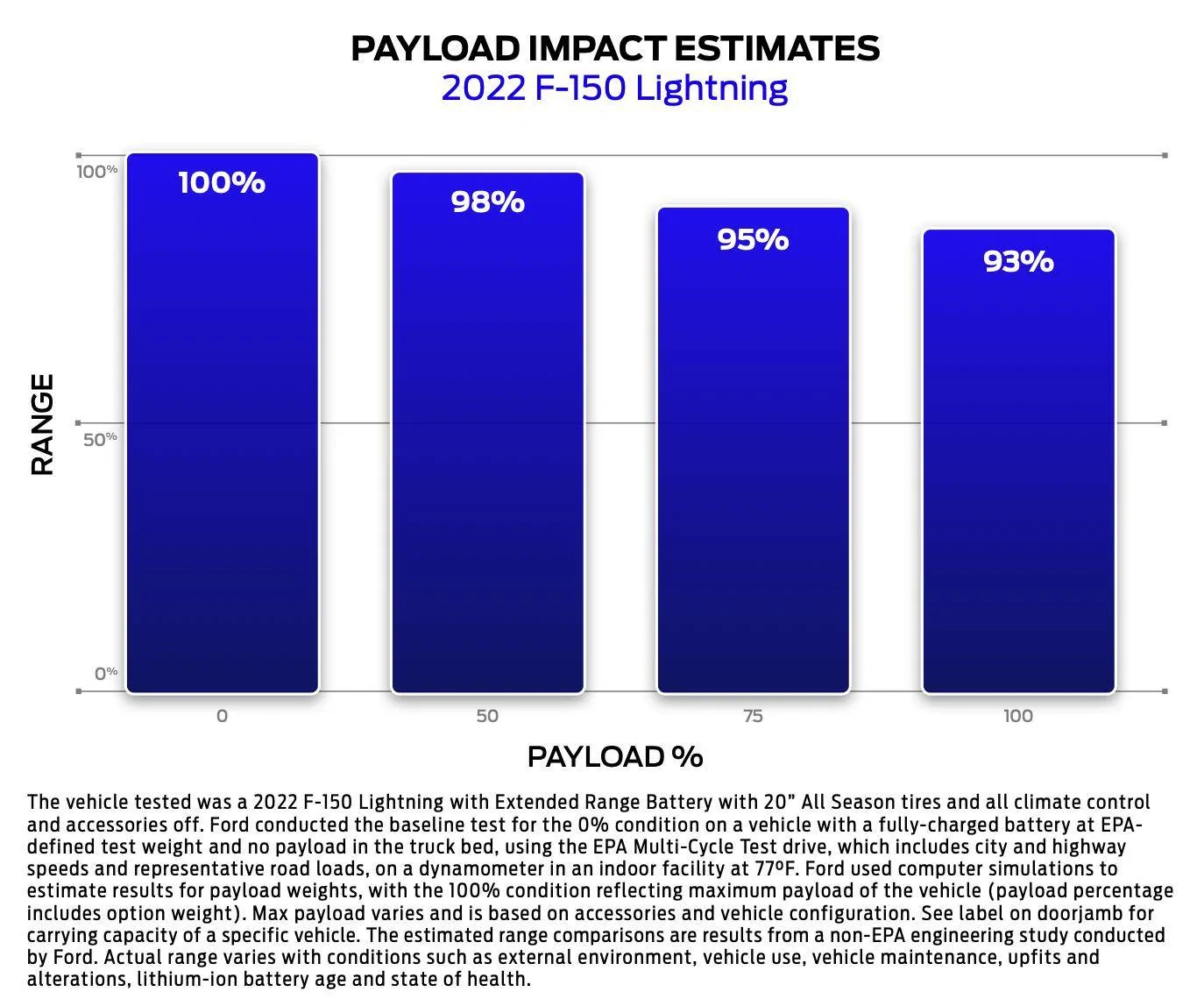
Effect of Payload:

Payload Range.png


The max payload for the Lightning varies depending on trim, but it's around 2,000 lbs here. You can see that even with an extra 2,000 lbs, there is only a 7% decrease in range. It is a common misconception that weight has a much bigger effect on range than it actually does. Speed and aero are much more important. Weight only significantly affects range if you are driving up an incline to a higher elevation. On flat land it's not a big effect. The payload of the Mach-E is roughly half that of the F150 Lightning (~1000 lbs) so a fully loaded Mach-E would only have about a 2% range penalty.

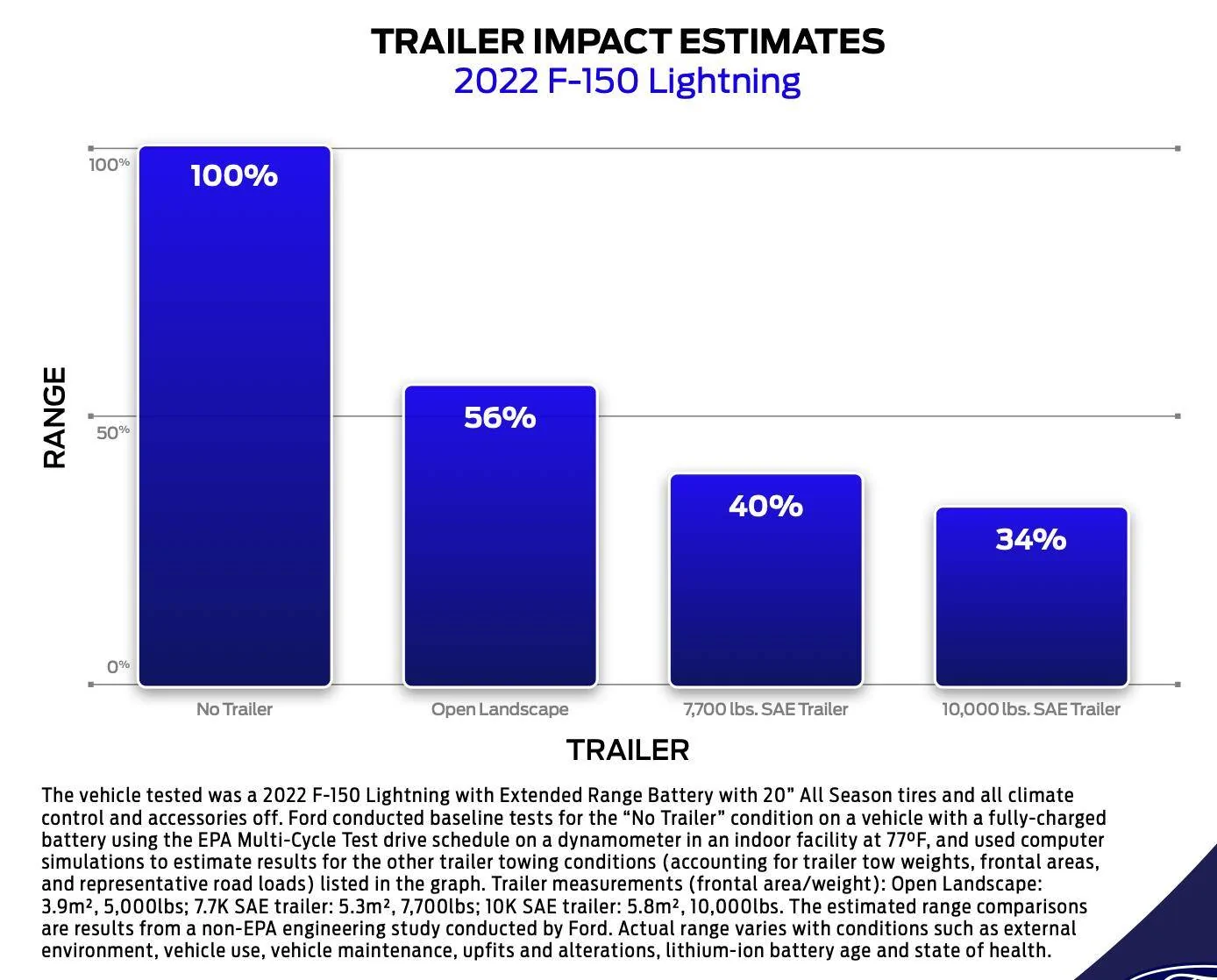
Effect of Trailer:

Trailer Range.png


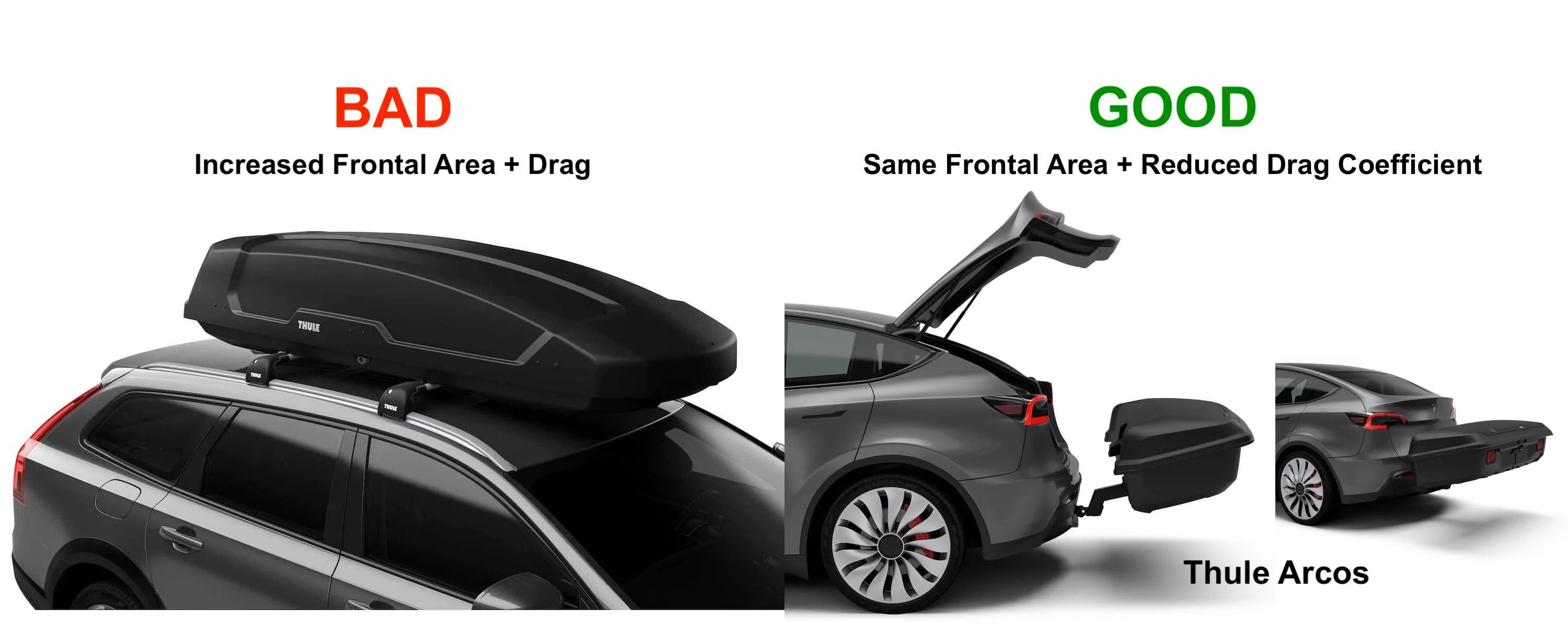
The Mach-E isn't rated to tow, but you can see pulling a trailer has a huge effect on range. I want to emphasize that it's not the weight, it's mostly the aero (frontal area) that saps the range. It takes a tremendous amount of energy to push a large flat box through the air at speed. This is why you want as short and as aerodynamic trailer as possible if towing. If you are adding a cargo box to the Mach-E, you want to put it behind the car in the wake, not on top:

Aero Box.jpg


An aerodynamic box in the back can actually INCREASE the range of an EV (compared to no box) because it makes the overall shape of the vehicle more like a teardrop and improves the drag coefficient. The box must be placed correctly in the wake behind the vehicle as shown above.

Anyway, hopefully you learned something. Read the PDF brochure below for more details:
 

MrPeanut

Well-Known Member
First Name
Bob
Joined
Dec 11, 2021
Threads
1
Messages
63
Reaction score
21
Location
Wake Forest, NC
Vehicles
2022 MME Premium ER
Occupation
Retired
Country flag
I just got 4.2.4 and the word "preconditioning" has disappeared! I had had problems trying to schedule departure times before and wanted to see what the new version offered that might solve the problem. Well, I spent the better part of 30 minutes trying to find out the process. It's not in the index to that pitiful in car manual. None of the menus on the display mention it.

I wish FOMOCO would give us an update when they change terminology from one update to another. It's always a scavenger hunt to find out how things have been changed.


ChasingCoral

Well-Known Member
First Name
Mark
Joined
Feb 3, 2020
Threads
502
Messages
14,318
Reaction score
28,680
Location
Maryland
Vehicles
2021 GB E4X FE, 2022 F-150 Lightning Lariat ER
Occupation
Retired oceanographer
Country flag
This is wild because here in the SF Bay Area where 50F/10C is a common outdoor temperature at night and morning along the coast/Bay. I’ve noticed outside temperature usage being a factor for consuming energy while driving. I don’t have a garage so preconditioning is more difficult, but this means my car should be plugged into a shared charger in my condo complex more often before departure.
At 8% I don't see much benefit to spend the money preconditioning unless you need absolutely all of your range in a trip.
 

SpaceEVDriver

Well-Known Member
Joined
Aug 26, 2021
Threads
71
Messages
2,654
Reaction score
4,780
Location
Arizona
Vehicles
2022 CA Route 1 AWD, ER; 2023 Lightning Lariat ER
Occupation
Planetary Science
Country flag
Yes, I understand that; however, it takes energy to heat the battery and energy to charge the battery. So my question was does the system charge while preconditioning? In your example, for instance, could the vehicle precondition the batteries and also add another 18kW to the battery pack? I just wanted it to be clear that charging was also taking place during the preconditioning process and not just warming the battery. The reason I asked this is my understanding was all preconditioning did was warm (or cool) the batteries.
Ah, okay, I understand your question now.
The unfortunate answer is that it will depend.

When I was testing DCFC-destination as an approach to preconditioning (thread here), I was using a low-amperage L1 EVSE. The draw on the battery was about 6.5 kW. My 1 kW L1 EVSE could not overcome that draw and I didn't track what the car was doing with requesting power from the EVSE. I have a L2 EVSE that can provide about 11 kW, which would be able to override the preconditioning draw, but it's not installed at the moment so I can't test it--I believe it will continue charging the battery but cannot say with certainty.

Here's an example: This was while plugged in to my L1 EVSE. You can see the SOC% goes down but the Energy-to-empty goes up. The battery temperature goes up, and it's drawing mostly from the battery...while increasing the total battery kWh to empty.

Ford Mustang Mach-E Preconditioning Improves Range up to 20% [Ford Brochure] Screenshot_20230430-145740
 
OP
OP
Mach-Lee

Mach-Lee

Well-Known Member
First Name
Lee
Joined
Jul 16, 2021
Threads
262
Messages
11,379
Reaction score
25,066
Location
Wisconsin
Vehicles
2022 Mach-E Premium AWD
Occupation
Sci/Eng
Country flag
I agree that it felt expensive the times I did It regularly, but it was also really cold outside so never knew exactly how much it added to my electric bill. Anyone have insight as to how much this would roughly cost us daily to precondition for departure in the winter (attached garage)?
I typically see it use 1-3 kWh each time depending on how cold it is. You’ll have to figure out your local costs from that.
 

AKgrampy

Well-Known Member
First Name
Mike
Joined
Jan 29, 2022
Threads
7
Messages
3,525
Reaction score
3,600
Location
Fairbanks, Alaska
Vehicles
Ford Expedition, Ford F-150, Mach E GT
Occupation
Retired
Country flag
Ah, okay, I understand your question now.
The unfortunate answer is that it will depend.

When I was testing DCFC-destination as an approach to preconditioning (thread here), I was using a low-amperage L1 EVSE. The draw on the battery was about 6.5 kW. My 1 kW L1 EVSE could not overcome that draw and I didn't track what the car was doing with requesting power from the EVSE. I have a L2 EVSE that can provide about 11 kW, which would be able to override the preconditioning draw, but it's not installed at the moment so I can't test it--I believe it will continue charging the battery but cannot say with certainty.

Here's an example: This was while plugged in to my L1 EVSE. You can see the SOC% goes down but the Energy-to-empty goes up. The battery temperature goes up, and it's drawing mostly from the battery...while increasing the total battery kWh to empty.

Screenshot_20230430-145740.webp
Your example is perfect for my present conundrum! First the simple part: heat up battery and the SOC drops as a warmer battery can hold more electrons and therefore more kWh. Now here is the rub and it is really obvious in your case - you can’t increase the electrons in the battery without shoving more in. In your case you are draining the battery at 6 kW for the time period so how can your battery charge increase? It should have decreased.

Another good but opposite example is I would drive 10 miles in the winter, start with SOC of 90 and end with 93. That was due to battery cooling down and computation of SOC. Back to garage later car would warm up and the SOC would change but there is no way the kW could increase unless I charged the battery.

Or maybe I have to do a bit more research on batteries!
 

SpaceEVDriver

Well-Known Member
Joined
Aug 26, 2021
Threads
71
Messages
2,654
Reaction score
4,780
Location
Arizona
Vehicles
2022 CA Route 1 AWD, ER; 2023 Lightning Lariat ER
Occupation
Planetary Science
Country flag
Your example is perfect for my present conundrum! First the simple part: heat up battery and the SOC drops as a warmer battery can hold more electrons and therefore more kWh. Now here is the rub and it is really obvious in your case - you can’t increase the electrons in the battery without shoving more in. In your case you are draining the battery at 6 kW for the time period so how can your battery charge increase? It should have decreased.
Nope.
Batteries are not volumetric containers.
They're chemical potential energy devices. When a battery warms up, the rate of chemical reactions increases. The internal chemistry increasing in activity means the battery increases its state of charge (adds electrons). Even when it uses its own energy to warm itself up!

A well-designed battery can do that, anyway. A poorly-designed battery could go too far and create a run-away reaction that causes it to burn up.
 

ArthurDOB

Well-Known Member
First Name
Arthur
Joined
Dec 16, 2022
Threads
24
Messages
1,303
Reaction score
1,359
Location
Twin Cities West Metro, Minnesota
Vehicles
Mach-e Premium AWD STD Range (Delivered 5/22/23)
Occupation
High School Teacher
Country flag
@Mach-Lee
A very interesting thread. Thanks for posting. My MME is about 3 weeks away and threads like this one is why I joined this forum. I am learning so much, thanks to people like you. ?
 

ArthurDOB

Well-Known Member
First Name
Arthur
Joined
Dec 16, 2022
Threads
24
Messages
1,303
Reaction score
1,359
Location
Twin Cities West Metro, Minnesota
Vehicles
Mach-e Premium AWD STD Range (Delivered 5/22/23)
Occupation
High School Teacher
Country flag
The range testing was done
Real-world would cut these improvements down significantly, no? Sounds like this was a car sitting still (relative to air) in a cold box. Actually driving through below-freezing air at 50mph (or whatever) would sap the heat out of the battery (and cabin) pretty quick, I'd think
True, but only to the ambient temperature at the time you were driving. If the wind chill caused by driving feels like ‐20F on a 5F degree day and you stick your hand out the window, both your hand and you car will chill to 5F, only faster than if you sat in your parked car under the same conditions, doing the same thing (don't try this at home ?). While wind chill speeds heat loss, it does not decrease ambient temperature. It will not chill to -20 F under either condition.

Perhaps you realize this, but many others do not. I had a guy tell me on a sub-freezing, windy Minnesota day, not to park my car facing the wind because "It'll freeze your block to 40 below!" When I didn't move my car, he said "You'll be sorry!"

I wasn't sorry.

Physics.
 

Sam2084

Well-Known Member
First Name
Sam
Joined
May 3, 2021
Threads
2
Messages
266
Reaction score
367
Location
Madison, WI
Vehicles
2007 CR-V, E4X Ordered
Occupation
Engineering
Country flag
I agree that it felt expensive the times I did It regularly, but it was also really cold outside so never knew exactly how much it added to my electric bill. Anyone have insight as to how much this would roughly cost us daily to precondition for departure in the winter (attached garage)?
Mine would cost between $1.5-.25 a day.
 

Jimbo

Well-Known Member
First Name
Jimbo
Joined
Dec 16, 2021
Threads
0
Messages
212
Reaction score
226
Location
US
Vehicles
Premium 4X
Country flag
True, but only to the ambient temperature at the time you were driving. If the wind chill caused by driving feels like ‐20F on a 5F degree day and you stick your hand out the window, both your hand and you car will chill to 5F, only faster than if you sat in your parked car under the same conditions, doing the same thing (don't try this at home ?). While wind chill speeds heat loss, it does not decrease ambient temperature. It will not chill to -20 F under either condition.

Perhaps you realize this, but many others do not. I had a guy tell me on a sub-freezing, windy Minnesota day, not to park my car facing the wind because "It'll freeze your block to 40 below!" When I didn't move my car, he said "You'll be sorry!"

I wasn't sorry.

Physics.
Yup, I realize this*. But when we're talking about -10c, "only to ambient" is no joke.

*Which is technically wrong: evaporative cooling is a thing, and can take you down below ambient to the wet bulb temp (although generally your car is dry, plus at subzero temps, the effect is much smaller).
 

buzzz

Member
Joined
Jan 22, 2022
Threads
2
Messages
17
Reaction score
16
Location
Mountain West
Vehicles
21 Prem AWD ER, Jeep 4xe (Rubi and GC)
Country flag
So with the new update, how does one precondition? Asking for a friend
Sponsored


Top