

- Joined
- Oct 8, 2020
- Threads
- 111
- Messages
- 3,754
- Reaction score
- 6,166
- Location
- Kansas
- Vehicles
- "Sonic" 2021 MME Grabber Blue First Edition

- Thread starter
- Banned
- #1
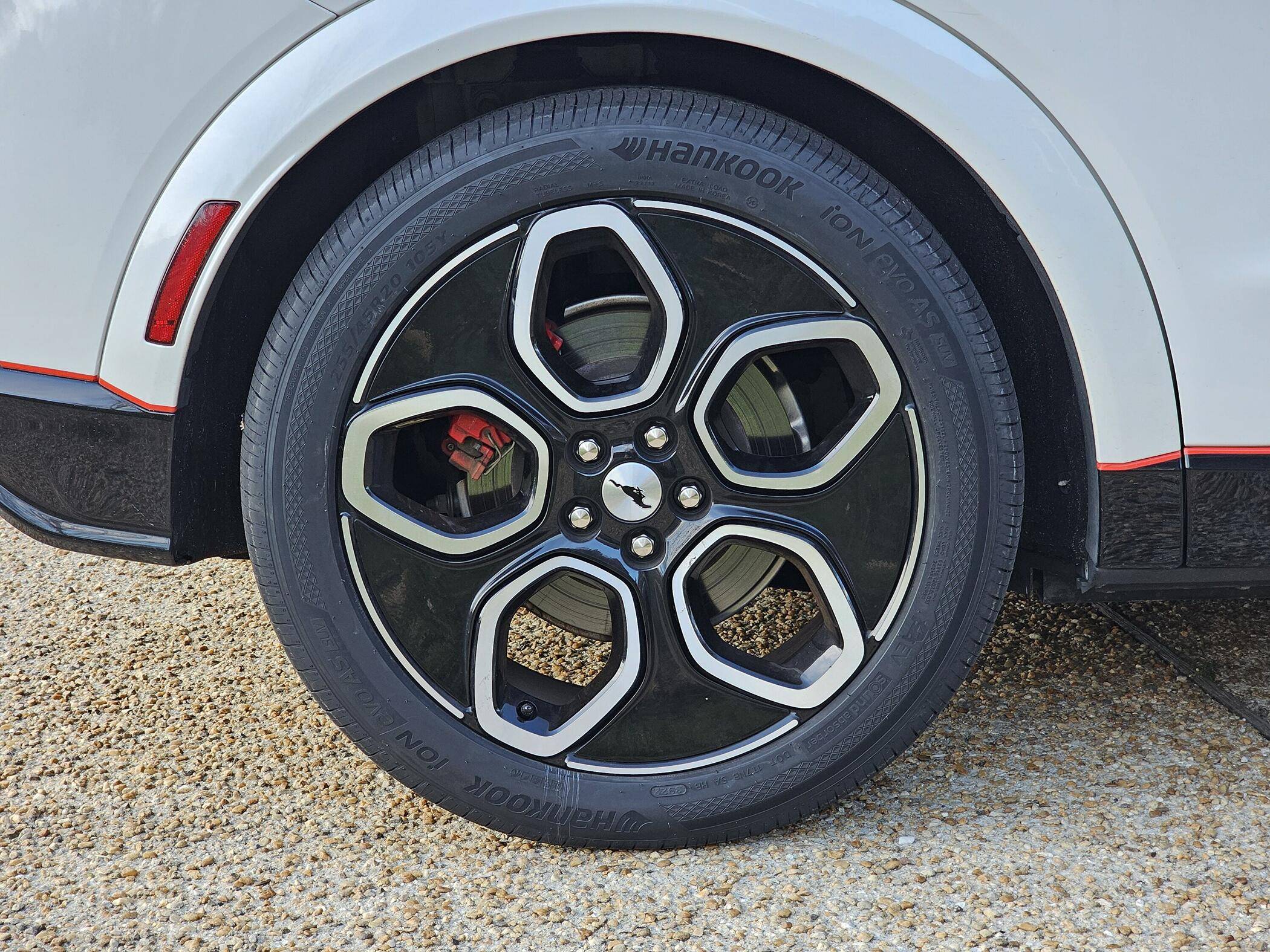
At 38 months and 49,000 miles, the tread was getting quite low on my OEM Michelin Primacy A/S tires. I was persuaded by the marketing hype to try Hankook's relatively new EV-specific low rolling resistance "iOn evo" tires. But before I did so, I recorded a little data to do a before and after comparison.
First, this is not a scientific review. I did not test traction, which is obviously pretty important. I am going to assume that the new tires provide significantly better traction than the old and balding ones. I also didn't compare to any other brands. This was only to see how the Hankooks stack up as a replacement for the OEMs. And I am impressed!
I looked at efficiency, noise, and comfort. These are all areas where the well-worn Michelins should have outperformed the new set of tires. Like comparing a worn and soft set of moccasins to a new pair of sneakers with better grip. My hope was that the Hankooks wouldn't be too much of a step back in any of these categories. So I was surprised to see no real change at all.
Before testing, I made sure my old tires were properly aired up, and I checked to make sure the new tires were, also.
Re efficiency, I measured the mi/kWh over 200 miles before, and 200 miles after, the swap. This was about 5 days-worth of driving before, and another 5 days after. My driving follows a very typical pattern, I kept the AC off, the temps remained pretty constant throughout (pleasant springtime highs in the 60s and 70s), and all dry conditions, so this was about as close to apples-to-apples comparison as you can get outside a lab. Because I live near the confluence of two major highways, about 75% of my daily driving are highway miles at speeds of 65-75mph (depending on the speed limit).
Efficiency for the worn Michelin's was 3.7mi/kWh. Efficiency for the new Hankooks was 3.6mi/kWh. That is a 2.7% range reduction switching from worn tires to brand new tires, practically a rounding error. That is a WIN in my book.
Re noise, I used a decibel meter on my phone to average three readings over three days for each set, on the same stretch of highway at the same speed. All dry conditions. I placed the phone on the floor to try to focus more on road noise and less on wind noise (and hopefully the averaging helped compensate for some variability in wind). The average reading for the Michelins: 82.1dB. The average reading for the Hankooks: 82.2dB. Again, a rounding error, and another WIN in my book for switching to new tires.
Re comfort, this is more subjective, but I don't feel any difference at all between the worn Michelins and the new Hankooks. That's got to be another win for the new tires.
Price was also great. About $250 per tire, plus install ($18/tire at Walmart), minus a $120 rebate. The complete model name is Hankook iON evo AS SUV IH01A 225/55R19 103V XL.
Verdict: RECOMMEND
First, this is not a scientific review. I did not test traction, which is obviously pretty important. I am going to assume that the new tires provide significantly better traction than the old and balding ones. I also didn't compare to any other brands. This was only to see how the Hankooks stack up as a replacement for the OEMs. And I am impressed!
I looked at efficiency, noise, and comfort. These are all areas where the well-worn Michelins should have outperformed the new set of tires. Like comparing a worn and soft set of moccasins to a new pair of sneakers with better grip. My hope was that the Hankooks wouldn't be too much of a step back in any of these categories. So I was surprised to see no real change at all.
Before testing, I made sure my old tires were properly aired up, and I checked to make sure the new tires were, also.
Re efficiency, I measured the mi/kWh over 200 miles before, and 200 miles after, the swap. This was about 5 days-worth of driving before, and another 5 days after. My driving follows a very typical pattern, I kept the AC off, the temps remained pretty constant throughout (pleasant springtime highs in the 60s and 70s), and all dry conditions, so this was about as close to apples-to-apples comparison as you can get outside a lab. Because I live near the confluence of two major highways, about 75% of my daily driving are highway miles at speeds of 65-75mph (depending on the speed limit).
Efficiency for the worn Michelin's was 3.7mi/kWh. Efficiency for the new Hankooks was 3.6mi/kWh. That is a 2.7% range reduction switching from worn tires to brand new tires, practically a rounding error. That is a WIN in my book.
Re noise, I used a decibel meter on my phone to average three readings over three days for each set, on the same stretch of highway at the same speed. All dry conditions. I placed the phone on the floor to try to focus more on road noise and less on wind noise (and hopefully the averaging helped compensate for some variability in wind). The average reading for the Michelins: 82.1dB. The average reading for the Hankooks: 82.2dB. Again, a rounding error, and another WIN in my book for switching to new tires.
Re comfort, this is more subjective, but I don't feel any difference at all between the worn Michelins and the new Hankooks. That's got to be another win for the new tires.
Price was also great. About $250 per tire, plus install ($18/tire at Walmart), minus a $120 rebate. The complete model name is Hankook iON evo AS SUV IH01A 225/55R19 103V XL.
Verdict: RECOMMEND
Sponsored




 ). I agree with your conclusions and findings
 ?
?
 Be all that as it may, this is one of the reasons there are different tires. Choice is good.


