Zardoz
Well-Known Member

I knew that at one point.you can just click the link to see the graphs anyway. i paste them there just for ease / super lazy people
Sponsored
I knew that at one point.you can just click the link to see the graphs anyway. i paste them there just for ease / super lazy people

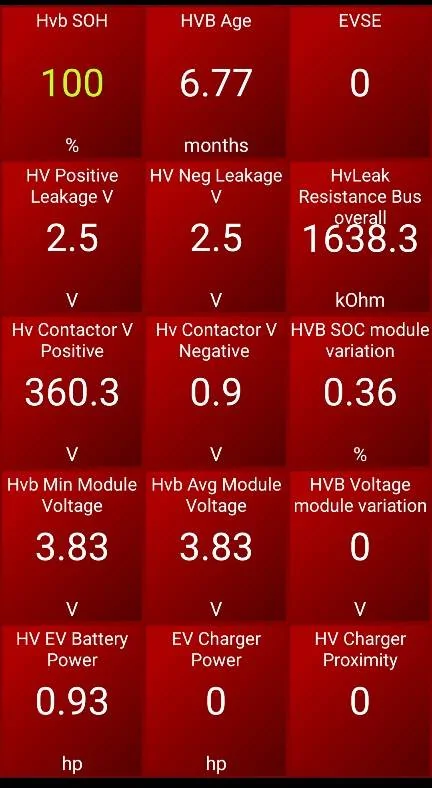
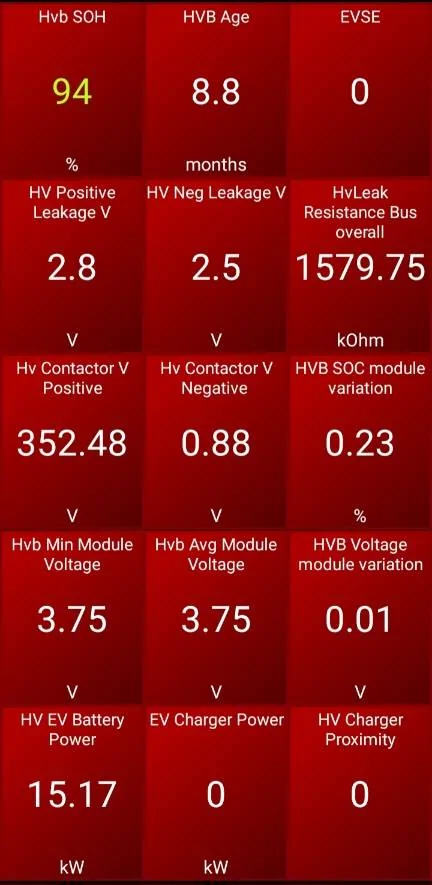
This is super interesting. But when it was at 94% the variation was within .01v right? What was the variation at 92%? I'm just trying to understand if you're able to observe the improvement in variation, and if it's as subtle as going from .01 to .00? Also, what actually is the L2 balancing procedure? How low do you let the battery go, and how long do you leave it on the charger after it reaches 100%? Is there a recommended charging amperage for this? Thanks!The day I purchased the car, it was 100%

I'm sure that was bogus and the algorithm just hadn't had time to populate the equation.
I didn't really look at it again for a few weeks and it had dropped to 94%

A couple of months later it hit 92% and I decided to follow Mach-Lee's suggestion of using L2 charging and giving the BMS an opportunity to "balance" the pack.
Sure enough I gained a couple of % the first time.
I waited about a month and did the procedure again. Gained another %.
The third attempt gained yet another % and that's the screenshot of 96%.
Honestly, I still don't care as much about the SOH PID value as I do about how well balanced the battery pack is as it gets to the lower half of the SOC. To me that's far more indicative of how "healthy" a battery is since THAT is what determines the real range that the battery can provide to the vehicle.
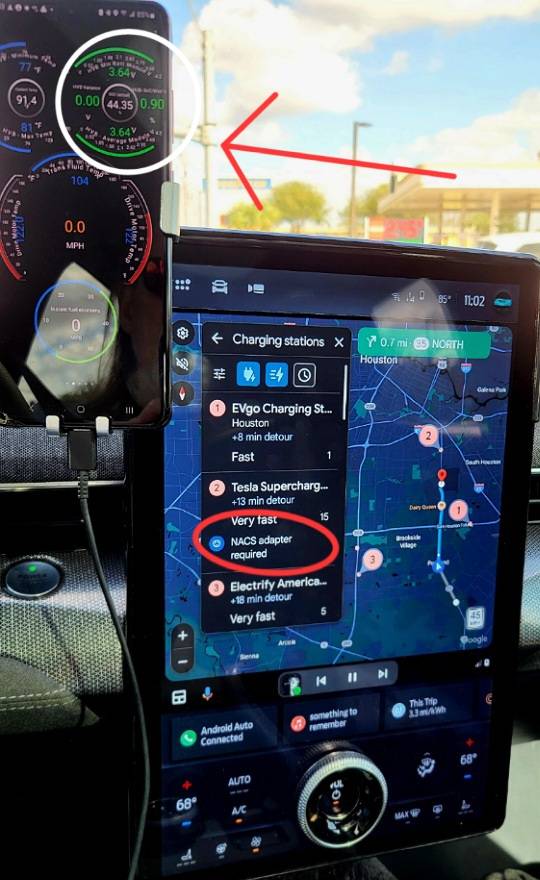
I built a PID gauge that summarizes the balance of the battery pack at a glance. It has been interesting to watch the 100% L2 charging procedure narrow the variation of SOC between cells to basically NO variation, and watch the SOH value climb simultaneously.
It's the cluster of green pids/gauges below. (red arrow)
4Pids =
HVB minimum module voltage
HVB average module voltage
HVB variation SOC between modules
HVB variation voltage <> Batt modules

Thanks.The app Snakebitten mentioned and an OBD2 reader like the one below. There are cheaper options, bu this one is known good for forscan.
https://www.amazon.com/dp/B07JFRFJG6
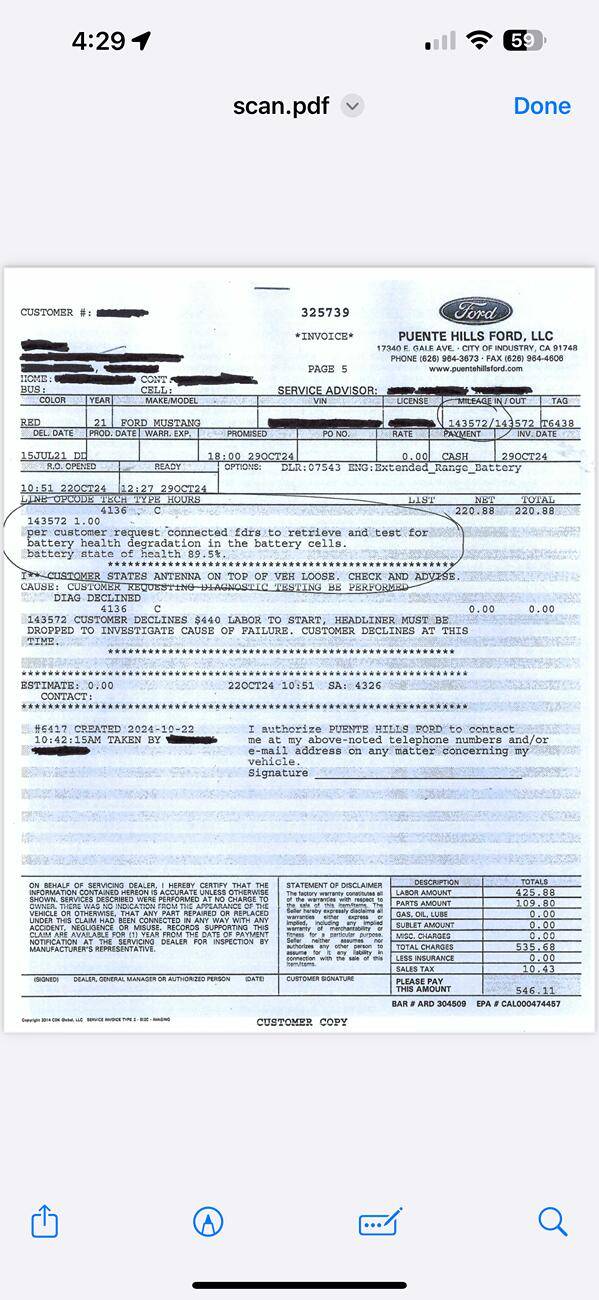
Excellent. That is some very useful info for those who wonder what happens after the warranty on the battery expires. Confidence is high.Took my E-Pony into dealer for recall issues. I asked dealer to test for battery degradation. It is at 89.5%.
My 2021 Pony has 143,000 miles. That battery degradation is much better than I expected. For most people, that mileage is 10 years of driving.
I charged the car nightly up to 90%. Since new, I have used fast charging less than 20 times.
So I guess the car will last to 1.4 millions miles before battery degrades to 0%. Haa haaaa.

I have the Carscanner app and setup. I need to look into that same page myself and look at that.App called Carscanner
The Ford Battery Control Module doesn't do balancing till you charge it up to 90% or greater. (almost all BCMs work this way, the balancing is right at the top of the pack). Soooo.... charge it to 90% or greater a few times and give it a chance to balance the pack. Balancing takes some time so leave it at 90 for a few hours as opposed to driving it right away.I’ve tried that in the past but will give it another try. I did dial down my L2 charger from 50 to 30 amps since then and will try again. I usually run it down to around 20-30% and then back up to 80. I’m retired so have shorter daily drives and charge about every 5 days. In the past I have seemed to loose the most on long trips between Michigan and Florida. Perhaps that unbalances the cells? Will try what you suggest.
I was not aware of Mach-Lee's method to balance the battery pack but I stumbled up a SOH change that was interesting to me. The battery on our FE (46,000 miles) was in the 91.5% to 93% range when I submitted my SOH to the thread tracking it. At the time I submitted my SOH we were at 92%...The day I purchased the car, it was 100%
I'm sure that was bogus and the algorithm just hadn't had time to populate the equation.
I didn't really look at it again for a few weeks and it had dropped to 94%
A couple of months later it hit 92% and I decided to follow Mach-Lee's suggestion of using L2 charging and giving the BMS an opportunity to "balance" the pack.
Sure enough I gained a couple of % the first time.
I waited about a month and did the procedure again. Gained another %.
The third attempt gained yet another % and that's the screenshot of 96%.
Honestly, I still don't care as much about the SOH PID value as I do about how well balanced the battery pack is as it gets to the lower half of the SOC. To me that's far more indicative of how "healthy" a battery is since THAT is what determines the real range that the battery can provide to the vehicle.
I built a PID gauge that summarizes the balance of the battery pack at a glance. It has been interesting to watch the 100% L2 charging procedure narrow the variation of SOC between cells to basically NO variation, and watch the SOH value climb simultaneously.
It's the cluster of green pids/gauges below. (red arrow)
4Pids =
HVB minimum module voltage
HVB average module voltage
HVB variation SOC between modules
HVB variation voltage <> Batt modules

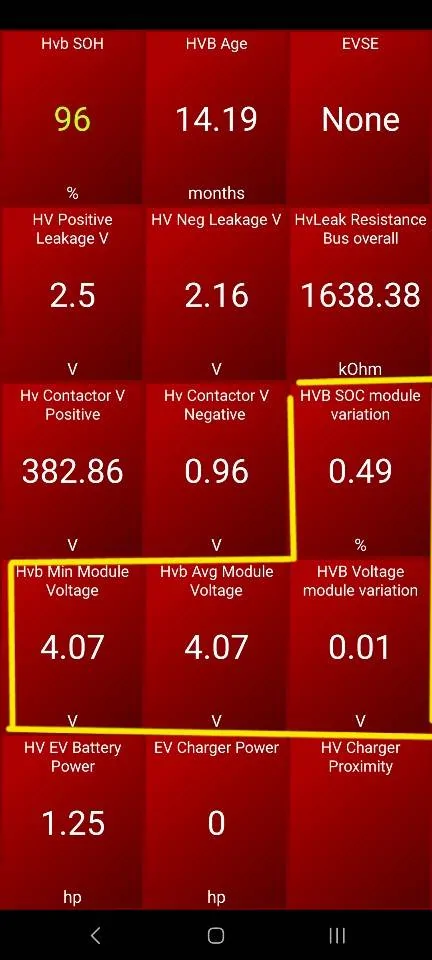
That variation of .01V was momentary. The screenshot is static, of course. Sometimes the variation is 0V. But it can fluctuate as you are driving, especially as the SOC gets low(er).This is super interesting. But when it was at 94% the variation was within .01v right? What was the variation at 92%? I'm just trying to understand if you're able to observe the improvement in variation, and if it's as subtle as going from .01 to .00? Also, what actually is the L2 balancing procedure? How low do you let the battery go, and how long do you leave it on the charger after it reaches 100%? Is there a recommended charging amperage for this? Thanks!
Great information. Thank you! I have an electric skateboard and I'm loosely familiar with battery balancing and BMS protections, so this does make a lot of sense.That variation of .01V was momentary. The screenshot is static, of course. Sometimes the variation is 0V. But it can fluctuate as you are driving, especially as the SOC gets low(er).
On a Nissan Leaf, notorious for not having any kind of active thermal management (designed 14 years ago. Pre-Tesla even), you would want the variation to be less than 400milivolts ? as you got into the lower range of SOC. Say below 30%
The variation on a good Leaf battery pack might be 6-7 millivolts at 90% SOC. And then increase to 20-30mv at 30% SOC.
As the battery packs degraded, the variation could get in the 100's of mv. You'd be driving along at 28% SOC and if you hit an incline or punched it, your SOC could drop by 10% in the blink of an eye as the BMS intervened to protect the cell or cells that weren't stable at the lower voltage range.
For those folks on the road heading to a destination that needed the whole 30% SOC? Talk about range anxiety losing 20 miles in 1 second. ??
We are spoiled with the excellent BMS and balanced battery packs in these much more advanced EV's than yesterdecade.
Hey there now!Great information. Thank you! I have an electric skateboard and I'm loosely familiar with battery balancing and BMS protections, so this does make a lot of sense.

Well, as someone who's recovering from a separated shoulder on the thing, I would recommend AGAINST buying a OneWheel, which is a special sort of self-balancing skateboard that will throw you onto the ground under a number of conditions (pushing it too hard, failed electronics, overcharge, and of course a battery problem like imbalance combined with too low SOC).Hey there now!
I recently broke my femur, resulting in an artificial hip, when I naively laced up some roller skates to skate with my best friend. (6 year old granddaughter)
I've recovered pretty much, but I now know I'm too old to fall down. Which I was completely unaware of 3 months ago. ?
So.........I have been considering...... You guessed it. ?
What’s the sweet spot? Just before you start getting a reduced return on the additional co$t of purchase?
Just a nice smooth 30 minutes of actual ride time between charges, with an emphasis on old geezer stability.