20-30 years for EV transition?

Larry Paul

Well-Known Member
First Name
Larry
Joined
Aug 27, 2021
Threads
24
Messages
929
Reaction score
1,051
Location
Southern California
Vehicles
MME-GTPE, Sunbeam Tiger w1970 Boss302, 2002Rav4EV
Country flag
War is always ultimately about habitable land and potable water (and the governance of those who live on it and use it). Whether cars are powered by electricity or carbon liquid fuels is immaterial to that situation.
Respectfully, I disagree. Oil has been central to many wars in the last 70 years if not before, not every war, but most.
Sponsored


Hammered

Banned
Banned
Joined
Oct 4, 2022
Threads
26
Messages
1,303
Reaction score
1,175
Location
SE US
Vehicles
2022 PB F150, MME GTPE
Country flag
Respectfully, I disagree. Oil has been central to many wars in the last 70 years if not before, not every war, but most.
I remember 2, decadal long conflicts in the immediate past which wasn't over resources at all. though it did cost several trillion $$. There's another one involving 3rd parties also getting 100s of billions funneled through it. Nam didn't have oil, nor did Bosnia. Any reason is a valid excuse to such people.
 

Gloff

Well-Known Member
First Name
Sean
Joined
Mar 26, 2021
Threads
6
Messages
340
Reaction score
581
Location
San Francisco
Website
www.serramonteford.com
Vehicles
2024 F150 Lightning, 2023 Mach E Extended Range, 2007 Mini Cooper Cab,
Occupation
Sales Manager
Country flag
I guess I’m in the minority here, but I just don’t have a love affair with batteries as a technology. I really hope we come up with something better.

For now, they’re a niche use case and you have to be willing to live with the downsides.

I love my car, but only drive in town and have another gas car. Works great for us.

Kinda like how we have an electric weedeater and blower but a gas lawnmower.
Yeah, we all want better. Suppose a battery came out tomorrow with a 3000 charge cycle life, charge time of 5 minutes, and a capacity of 300kWh in the size of a shoebox. That would solve your battery problem, would it not? It's not batteries you're opposed to, its the capacity and recharge time, is it not? We won't get there without R&D though. Gas engines are 40% thermally efficient at best in automobile applications, and that's with 100 years of R&D.

That's where you and I disagree. I think the niche case is those that wouldn't benefit from EVs. I think that most US consumers would have their needs met by an EV with a 250 mile range. I know personally, if it's over 300 miles, I'm flying, not driving. Inside that radius there's enough DC charging for me to make any trip I want to take. I recognize this is not the case for all of America, hence my infrastructure argument.

US consumers also don't like things rammed down their throat. I can pitch the benefits all day long, but if they think they're not being given a choice, human nature is to resist. You and I will probably agree on that.
 

devmach-e

Well-Known Member
First Name
David
Joined
Sep 8, 2021
Threads
1
Messages
2,028
Reaction score
2,480
Location
SF Bay Area
Vehicles
2022 Premium RWD ER, 2016 Toyota Highlander Hybrid
Occupation
Unix Sysadmin
Country flag
No, not really.
BMW i3 with the small gas engine was basically a serial hybrid where the gas engine just drove an generator which powered the car and recharged the battery. No connection to the wheels.
 

devmach-e

Well-Known Member
First Name
David
Joined
Sep 8, 2021
Threads
1
Messages
2,028
Reaction score
2,480
Location
SF Bay Area
Vehicles
2022 Premium RWD ER, 2016 Toyota Highlander Hybrid
Occupation
Unix Sysadmin
Country flag
The increase in RAV4 Primes is pathetic. I would have got one at the end of 2018 when I got mine, and it was backordered. They should be making 100s of thousands now - and they would sell. Toyota really is not much committed to hybrid models other the Prius and I think the Crown. I suspect the RAV4 Prime could come modestly close to matching Tesla Ys in number.
The RAV4 Prime wasn't announced until late 2019, and didn't officially become available until late 2020, so I'm not sure how in 2018 you would've been able to order one.

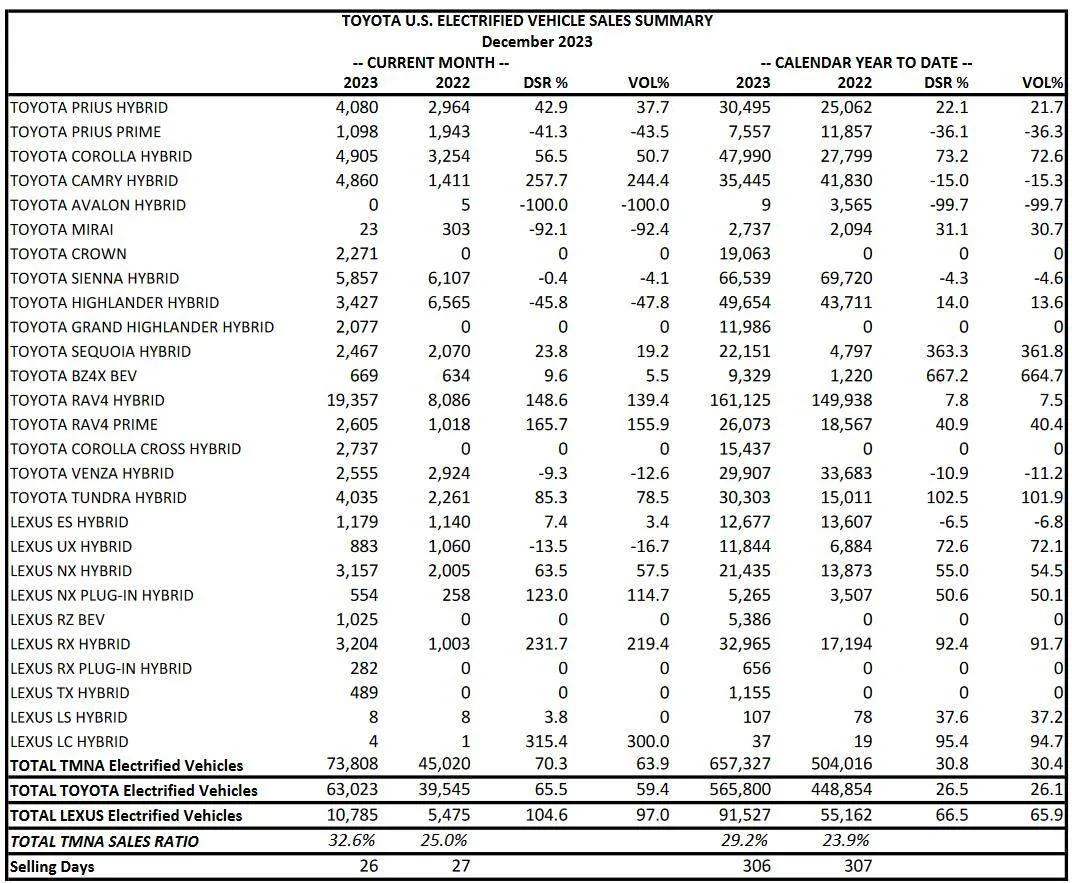
Nearly a third of Toyota's sales in the US are hybrids. That's over 650K vehicles between the Lexus and Toyota divisions. The biggest selling hybrid? It isn't the Prius. That's not even 4th or 5th. Top selling hybrid for them was the RAV4 hybrid at over 161K. Followed by the Sienna at 66K. Highlander Hybrid comes in at 49K. Even the lowly Corolla hybrid out sold the Prius with just under 48K. The Prius? 31K for the regular Prius, and 7K for the Prime. The RAV4 Prime? 26K.

The Prius is less than 10% of the hybrids that Toyota sells in the US. Really more like less than 6%.

Sales figures are here:
Ford Mustang Mach-E 20-30 years for EV transition? ta-and-lexus-plug-in-car-sales-in-the-us-q4-2023-d

Which came from https://insideevs.com/news/703436/toyota-us-electric-car-sales-2023q4/


devmach-e

Well-Known Member
First Name
David
Joined
Sep 8, 2021
Threads
1
Messages
2,028
Reaction score
2,480
Location
SF Bay Area
Vehicles
2022 Premium RWD ER, 2016 Toyota Highlander Hybrid
Occupation
Unix Sysadmin
Country flag
So I was there in person and listened attentively to his remarks. That’s not what he means by 20-30 years. He and all other industry execs only consider new car sales. He said that by 2030, 50% of car sales in the US will be electrified (EVs and hybrids). And the full transition takes 20-30 years (again, for all new car sales to be EV.

We will have some form of gas cars that are roadworthy for the next 50+ years.
I was more pointing out that people who are expecting the transition to happen in the next 10 years are ignoring certain economic and manufacturing realities. I don't think California's mandate of 2035 is realistic for 100% ZEV. Probably gets pushed to 2040 around 2028-2029. I don't see us giving up our Highlander Hybrid anytime soon, too.
 
OP
OP
Mach1E

Mach1E

Well-Known Member
Joined
Sep 5, 2021
Threads
93
Messages
10,509
Reaction score
13,295
Location
Florida
Vehicles
69 Mach 1, 11 GT, 21 GTPE- sold, 24 Taycan 4S, 20 F type R
Country flag
Yeah, we all want better. Suppose a battery came out tomorrow with a 3000 charge cycle life, charge time of 5 minutes, and a capacity of 300kWh in the size of a shoebox. That would solve your battery problem, would it not? It's not batteries you're opposed to, its the capacity and recharge time, is it not? We won't get there without R&D though. Gas engines are 40% thermally efficient at best in automobile applications, and that's with 100 years of R&D.

That's where you and I disagree. I think the niche case is those that wouldn't benefit from EVs. I think that most US consumers would have their needs met by an EV with a 250 mile range. I know personally, if it's over 300 miles, I'm flying, not driving. Inside that radius there's enough DC charging for me to make any trip I want to take. I recognize this is not the case for all of America, hence my infrastructure argument.

US consumers also don't like things rammed down their throat. I can pitch the benefits all day long, but if they think they're not being given a choice, human nature is to resist. You and I will probably agree on that.
For sure that battery would fix the problem.

I just think it’s a fairy tale.

Just like gas engines, batteries have been developing for 100+ years.

I bet the likelihood of a battery/electric motor combo that weighs, charges and costs less than a gas engine and tank is as likely as a gas engine that’s 90% efficient.

It’s just not likely. Thats why I hope we continue to look for and develop other fuel sources.

Definitely agree on the last a paragraph.
 

ctenidae

Well-Known Member
First Name
Alex
Joined
Jan 19, 2022
Threads
37
Messages
1,403
Reaction score
1,852
Location
Stamford, CT
Vehicles
DMG GT; Taycan, Q7, Sienna Hybrid
Occupation
Solver of problems
Country flag
War is always ultimately about habitable land and potable water - resources- (and the governance of those who live on it and use it). Whether cars are powered by electricity or carbon liquid fuels is immaterial to that situation.
It's immaterial now, but the compromises live on.

Fortunately with EVs we can (or will, likely in step with adoption) also produce pretty much all the lithium the US needs inside the US. At least we can skip the "wars in other places" step this time.
 

Gloff

Well-Known Member
First Name
Sean
Joined
Mar 26, 2021
Threads
6
Messages
340
Reaction score
581
Location
San Francisco
Website
www.serramonteford.com
Vehicles
2024 F150 Lightning, 2023 Mach E Extended Range, 2007 Mini Cooper Cab,
Occupation
Sales Manager
Country flag
This is a thorough response, and I appreciate that.

Considering my experience with ICE is stopping for 10 minutes to go 600 miles, yes, that is very unreasonable. It's over an additional 100 minutes of stopping to go 600 miles. Your 75 mile example does seem extremely low. And that's only if I'm also driving slower to get better range in the BEV. I pack a cooler and snacks. I don't stop for food. I stop for fuel and that's it. My thought for long road trips is that the quicker I get there, the less fatigued I am and the safer I am. Unless I take a nap at a fuel stop, stretching my legs for 30 minutes does not refresh me.
How often are you making these trips? This is certainly a fringe case, how many people in the US are actually regularly taking 600 mile trips? Most people are flying that.

What bugs me is when people project their own habits and lifestyle and can't understand that not everyone is just like them. Or that not everyone should just adapt and be just like them. All of us have different ways of doing things. We have different requirements.
No doubt, my argument is that your above argument is a unique lifestyle, most people would fly that distance.

300 mile range was my minimum requirement. I've road tripped in both my MME and my wife's MY. It greatly impacts how we travel. I took one trip in the MME that used to take me under 10 hours. It took nearly 14. That is not a tired argument about a lifestyle change. That's a 40% increase in travel time. Part of that was the need to take a less direct route due to charging infrastructure. Another part was needing to slow down to reduce stops (and in some cases, just to make it between chargers). But a very big part was more stops and longer stops. Traveling in the MY isn't as bad as the MME. It seems to do better mileage at highway speeds and charging tends to be faster.
If the infrastructure was better, would that not make the Mach E as enjoyable as the MY?

People should not need to know any of this. It needs to be, stop, plugin, then leave when it's time (the car navigation telling you when to leave is a big help in this regard). But the 80% rule is also not hard and true depending on where the next charger is. If your destination is before the next charger (or just not in the direction of one) and you need to get back to this same charger again on your return trip, etc, you very well might need to go well past 80% and hit the dreaded slow part of the curve.
Why not, it's an operational characteristic of the vehicle, and not that complicated. Someone has to show you how to put gas in the car the first time, then it's pretty easy from there. My point is that the charging hardware is not uniform, that's a teething issue that could be resolved with some regulation.

EA is not overly interested because there's no money in fast charging. With the current volume, there's no money to be made (if a single 350kw charger is in use 24x7x365 it would take about 100 days just to pay for the cost of that charger without considering overhead like electricity, maintenance, land cost, etc and no chargers are in use anywhere near that). That's why the rates to charge are so high compared to electric rates. To even try to break even, they have to jack up the margin. So long as the average charge is 15-25 minutes, volume per charger will never be sufficient for profit. Gas stations barely make money on gas and they have vastly higher volume. They depend on convenience store revenue. But that's also a fast turn/high volume business as well (just with way better margins). People spend no more than 5 minutes inside so you need quick turn over of customers at the pump/charger to bring more customers in to the store.

Adding additional government regulation will just make things worse. It always makes doing business more expensive. In a business that is struggling to find a profitable business model, that will just deter investment.
EA isn't interested because they were forced to do it. There is money in fast charging, it's just not mature yet. Technology will have to improve, energy generation will have to be cleaner and more efficient. These things are not overnight changes, I understand that.

I want to make clear, I'm not talking about regulation of pricing/cost. I'm talking regulation of components. Gas stations sell the same grade of fuel that must meet certain regulations and that fuel must be dispensed using regulated equipment.

That being said, most infrastructure doesn't make money directly. It's social and societal profit. The interstate system makes $0 (not withstanding some toll sections), but its a benefit to the entire country. People are up in arms about taxes/government paying for EV infrastructure because of the political tilt, not because it could be a benefit or determent to the public at large. EV's have become a political hot button issue linked to climate change, both sides of the aisle are guilty here.

Tesla has a unique interest in charging - it's been a necessity to sell cars. And Musk also has an honest goal of making all cars on the road BEVs. That's their mission and charging is required for that. They don't need it to be profitable. They make money from selling cars. They spend money on charging infrastructure rather than advertising as other automakers do. But they were also motivated to make charging deployments cost efficient. They also designed their chargers to be simple and reliable. And here comes government regulations...they're going to be required to add complexity with payment terminals and other addons that they had removed to both decrease cost and increase reliability. Getting other automakers in the SuperCharger network is more about the electrification goal, not profit. Although the higher volume should help keep the SuperCharger network from being a loss on the balance sheet.
Tesla doesn't make money selling cars, they make money from regulatory credits. I agree their charging infrastructure is just plain better. I'm saying that any regulation could use the SC network as a basis for it's requirements. Standardization would go a long way to expanding the network and streamlining costs.

Energy density needs to vastly increase and fueling time needs to decrease. There will be limits to fueling time for electric. The charging cable can only get so big and be cooled so much. The distribution of power to charging stations can only be so much and if 30 cars need to charge, it has to be split between them. Solid state will only do so much to help
100% agree. Density, Charge times, AND infrastructure need to be improved. Solid state may help with density and charge time, but infrastructure is a massive part of this.

People that can charge at home and have typical daily commutes are good candidates for BEVs. But people also buy cars to meet all their needs. If they take several road trips a year, they need a car that can do that. If they're outdoors people and take frequent day trips out to the wilderness every weekend, they need a car that can do that. Commuting/errands is only one part of people's needs. Telling people to rent a different car for their other use cases is not a valid retort. Telling people to just change their lifestyle is bs. Telling people that no one needs something that does something you don't personally have a need for is just typical being stuck in your own echo chamber.
I agree with you, I'm just making the argument that the daily commute individuals are the majority, and the massive road trippers and outdoors people are the outliers. I'm a sales person by nature, so objections trigger my brain to overcome them. It's ok that people don't want them, but for those of us that do, and want to see more adoption, we know what's needed:

Energy density needs to vastly increase and fueling time needs to decrease.
 

Gloff

Well-Known Member
First Name
Sean
Joined
Mar 26, 2021
Threads
6
Messages
340
Reaction score
581
Location
San Francisco
Website
www.serramonteford.com
Vehicles
2024 F150 Lightning, 2023 Mach E Extended Range, 2007 Mini Cooper Cab,
Occupation
Sales Manager
Country flag
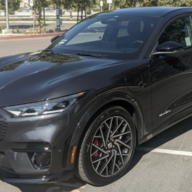
By all means, screen shot your trips 1&2, and lifetime. Quite curious to see a MME get a 3m/kWh lifetime. Mine is sitting at 2.2 with 20k miles on it.
I expect warmer temps will bring this up, admittedly, this is a small sample size, but also my wife is 85% of this and she drives it like it's not an EV.

Ford Mustang Mach-E 20-30 years for EV transition? PXL_20240215_005120564
 

ctenidae

Well-Known Member
First Name
Alex
Joined
Jan 19, 2022
Threads
37
Messages
1,403
Reaction score
1,852
Location
Stamford, CT
Vehicles
DMG GT; Taycan, Q7, Sienna Hybrid
Occupation
Solver of problems
Country flag
When someone who is an advocate of others (climate) needs actually lives (i.e. sacrifices) like they propose others do, then I may start paying attention. I've yet to come across such a person. Ed Bagley comes close, though.
Respectfully, I don't think anyone who puts "climate" in the plus column when considering getting an EV cares whether you pay attention or not. A significant portion of the population isn't absolutist and believes that every little bit counts.

A lot of people who consider driving an EV to be good for climate related reasons have driven EV adoption, most often by just buying a car and paying for charging. Much more visible are greenwashers, of course, and they draw the most ire, it seems.

In any case, choosing a car is a matter of balancing a variety of compromises, as are so many other choices in life.
 

Gloff

Well-Known Member
First Name
Sean
Joined
Mar 26, 2021
Threads
6
Messages
340
Reaction score
581
Location
San Francisco
Website
www.serramonteford.com
Vehicles
2024 F150 Lightning, 2023 Mach E Extended Range, 2007 Mini Cooper Cab,
Occupation
Sales Manager
Country flag
For sure that battery would fix the problem.

I just think it’s a fairy tale.

Just like gas engines, batteries have been developing for 100+ years.

I bet the likelihood of a battery/electric motor combo that weighs, charges and costs less than a gas engine and tank is as likely as a gas engine that’s 90% efficient.

It’s just not likely. That's why I hope we continue to look for and develop other fuel sources.

Definitely agree on the last a paragraph.
If you told the average American in 1994 that only thirty years later a watch would out have 100x the computing power of a home computer, they'd tell you you're crazy.

Electric motors are incredibly reliable and efficient, which is why so much stock is being put into energy storage to power those devices. I agree we should develop multiple fuel sources, but they have to be clean and ideally renewable.
 

corradoborg

Well-Known Member
First Name
Mike
Joined
Jun 9, 2023
Threads
1
Messages
317
Reaction score
559
Location
Aptos, CA
Vehicles
2025 Mach-E GT
Country flag
I was more pointing out that people who are expecting the transition to happen in the next 10 years are ignoring certain economic and manufacturing realities. I don't think California's mandate of 2035 is realistic for 100% ZEV. Probably gets pushed to 2040 around 2028-2029. I don't see us giving up our Highlander Hybrid anytime soon, too.
Nothing in California's 2035 law would require you to give up the Highlander anyway. Only new vehicles sold would be required to be ZEV. It allows a natural phase-out of remaining non-ZEV cars as they are wrecked, stop working, or are retired at their owners' choice.

You're probably right that 2035 is an unrealistic cutoff and will have to be pushed out. But it was still smart to choose 2035 as the initial cutoff. It will encourage innovation while companies try to meet that deadline. A later date would allow for complacency. When they inevitably have to push it out, we'll still be technologically ahead of where we would be if the initial law said 2040 from the get go.
 

devmach-e

Well-Known Member
First Name
David
Joined
Sep 8, 2021
Threads
1
Messages
2,028
Reaction score
2,480
Location
SF Bay Area
Vehicles
2022 Premium RWD ER, 2016 Toyota Highlander Hybrid
Occupation
Unix Sysadmin
Country flag
Nothing in California's 2035 law would require you to give up the Highlander anyway. Only new vehicles sold would be required to be ZEV. It allows a natural phase-out of remaining non-ZEV cars as they are wrecked, stop working, or are retired at their owners' choice.

You're probably right that 2035 is an unrealistic cutoff and will have to be pushed out. But it was still smart to choose 2035 as the initial cutoff. It will encourage innovation while companies try to meet that deadline. A later date would allow for complacency. When they inevitably have to push it out, we'll still be technologically ahead of where we would be if the initial law said 2040 from the get go.
I didn't mean to imply that I had to give up my Highlander in 2035. I'm merely pointing out that a pure ZEV future for us personally right now is not a viable path.

I'm fully aware of what the "law" requires. And I say "law" because California hasn't actually passed a new law banning new ICE-powered vehicles. All they've done is approve new emissions regulations. New regulations that were prompted by the current governor stating a lofty goal that he wants to see be accomplished long after he is out of office. The "law" that lets them do it has been around for over half a century.

CARB could take a look at the state of the market in 2030 and realize that we're a ways away from hitting the goal and push it to 2040. Or a future more conservative administration may decide that the whole idea is unachievable and abandon it. I do agree that drawing a line in the sand (2035) is a good way to light a fire under manufacturer's butts to get them to start actually working towards a ZEV future, rather than have an open-ended requirement.
Sponsored


Top