Comparing DCFC costs to gas prices

AKgrampy

Well-Known Member
First Name
Mike
Joined
Jan 29, 2022
Threads
7
Messages
3,525
Reaction score
3,600
Location
Fairbanks, Alaska
Vehicles
Ford Expedition, Ford F-150, Mach E GT
Occupation
Retired
Country flag
Utilities are notorious for cramming bills. There's a solid 4 nonsense fees on mine so they can claim their rates are lower than they actually are. The nonsense fees increase actual cost ~25%
I have no idea what fees you are referring to so I can not argue. I can say utilities are regulated so they can’t just charge whatever they please and they do have to justify their rates.
Sponsored


Teslaeata

Well-Known Member
First Name
Mark
Joined
Sep 28, 2022
Threads
9
Messages
3,470
Reaction score
4,210
Location
Nottingham, England, UK
Vehicles
Red June ā€˜21 RWD ER Premium MME
Occupation
Forensic vehicle examiner, motor insurance assessor, expert witness
Country flag
I’ve been wondering just how much we save on energy costs when DC Fast Charging. It can cost up to 3x as much per kWh. I decided to compare to how much I’d spend on gas in an ICE equivalent.

For the ICE benchmark, I used the Ford Edge with an MPG of 25 combined.

I had driven 141 miles since my last charge, which consumed 42 kWh at the charger. The same distance at 25mpg would consume 5.64 gallons of gasoline.

I divided the cost of charging at various networks near me by the number of gallons to get a Cost per Gallon equivalent.

Here is what I found:
42 kWh at home (0.18/kWh) = $7.52
42 kWh public DCFC:
FPL (0.30/kWh): $12.60
ChargeUp (0.35/kWh+0.55+5%): $16.01
EA (0.48/kwh): $20.16
EVGo (0.57/kWh+$1): $24.95

Price per gallon (equivalent):
Home: $1.33/gal
FPL: $2.23/gal
ChargeUp: $2.83/gal
EA: $3.58/gal
EVGo: $4.42/gal

Assuming Tesla charging will cost the same as Magic Dock stations, those seem to be priced similar to EA.

I realize you can save 20% or more if you buy a membership, but for us who rarely charge away from home it seems quite pricy.
141 miles is too narrow a sample of data.

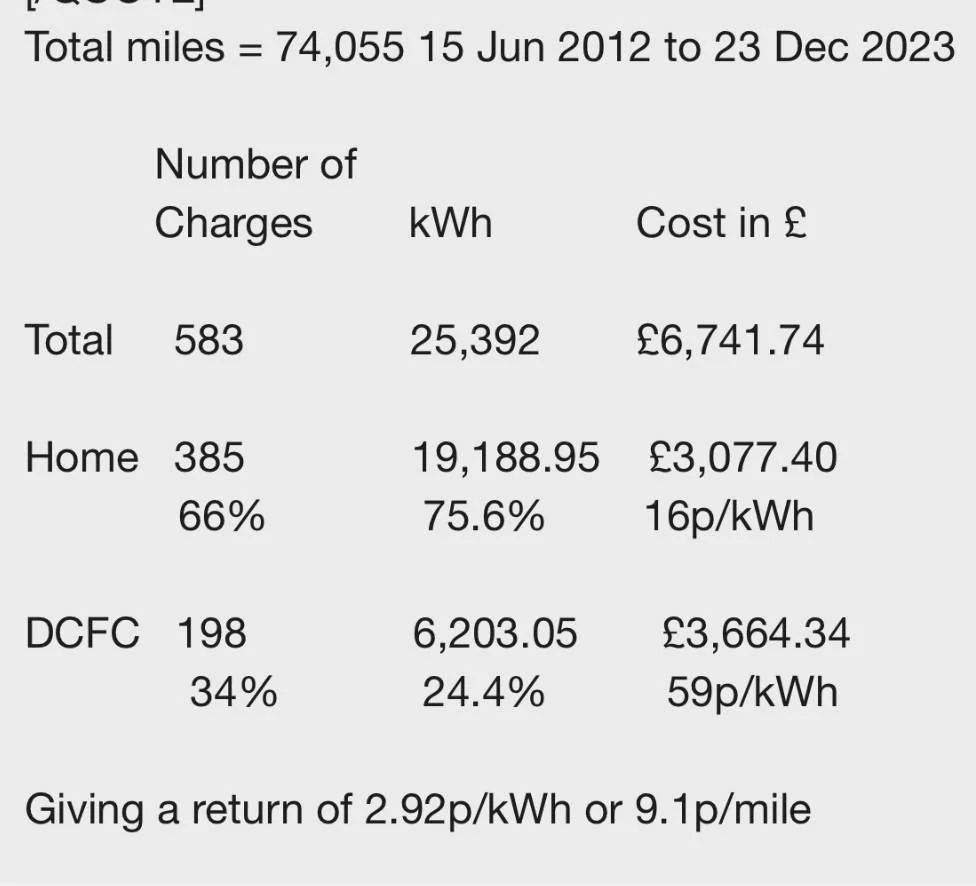
Try the attached; it’s based on UK rates but you can re-calculate entering in your own energy rates and work out an ICE mpg rate and US cost of petrol (your ā€œgasā€), or diesel which should provide a more accurate result.

Ford Mustang Mach-E Comparing DCFC costs to gas prices IMG_3592
 

kennethjk

Well-Known Member
First Name
Ken
Joined
Sep 3, 2021
Threads
30
Messages
3,331
Reaction score
2,124
Location
NY
Vehicles
MME Prem. EB 4WD, X3, IX50
Occupation
Retired
Country flag
Utilities are notorious for cramming bills. There's a solid 4 nonsense fees on mine so they can claim their rates are lower than they actually are. The nonsense fees increase actual cost ~25%
Everybody does this nowadays to show how cheap their fares are, such as airlines, hotels etc
 

GlennMacC

Member
First Name
Glenn
Joined
Oct 7, 2021
Threads
1
Messages
22
Reaction score
49
Location
Virginia
Vehicles
2025 Mustang Mach-E AWD ER
Occupation
Architect
Country flag
I’ve been wondering just how much we save on energy costs when DC Fast Charging. It can cost up to 3x as much per kWh. I decided to compare to how much I’d spend on gas in an ICE equivalent.

For the ICE benchmark, I used the Ford Edge with an MPG of 25 combined.

I had driven 141 miles since my last charge, which consumed 42 kWh at the charger. The same distance at 25mpg would consume 5.64 gallons of gasoline.

I divided the cost of charging at various networks near me by the number of gallons to get a Cost per Gallon equivalent.

Here is what I found:
42 kWh at home (0.18/kWh) = $7.52
42 kWh public DCFC:
FPL (0.30/kWh): $12.60
ChargeUp (0.35/kWh+0.55+5%): $16.01
EA (0.48/kwh): $20.16
EVGo (0.57/kWh+$1): $24.95

Price per gallon (equivalent):
Home: $1.33/gal
FPL: $2.23/gal
ChargeUp: $2.83/gal
EA: $3.58/gal
EVGo: $4.42/gal

Assuming Tesla charging will cost the same as Magic Dock stations, those seem to be priced similar to EA.

I realize you can save 20% or more if you buy a membership, but for us who rarely charge away from home it seems quite pricy.

I have tracked my mileage similarly. I use the miles/kwh from the car each month (trip 1 which I reset every month - it changes drastically depending on the season, etc.). There are various ways to make the comparison, cost per mile or equivalent miles per gallon (This is what I use, as it helps others compare apples and apples). I almost always charge my car at home and our electric rate is $.14/kwh (all in including taxes, etc.). I compare my mileage to premium gas (93 octane) as it is what I've always used in our ICE cars.

When I make that comparison, my mileage equivalent is about 120 miles to the gallon, assuming $4.00/gallon gas cost. YMMV. Of course, the math is easy if you use EA or similar at say $.42/kwh. Then the miles per gallon equivalent is 1/3 or about 40 mpg. Translated to equivalent $/gallon, I get about $1.00/gallon, assuming mileage of the ICE car at 30 mpg. Using regular gas or fewer mpg changes the math of course, but still for me, it is a large savings.

Glenn

PS BTW, I use an charging electricity efficiency factor of .8 in these calculations. I am seeing much lower efficiency in the recent cold weather, but that is the number I use.
 
Last edited:

RickMachE

Well-Known Member
Joined
Jul 1, 2021
Threads
267
Messages
17,957
Reaction score
27,991
Location
SE MI
Vehicles
2022 Mach-E Premium 4X, 2022 Lightning Lariat ER
Country flag
Many people miss the loss part. They look at what the vehicle says, i.e. 3 miles per kilowatt hour, and don't realize that when they charge at home and other chargers, they lose from the wall to the vehicle, yet pay for it. When they charge with DC fast charging they pay for the net, so apples and oranges.


dbsb3233

Well-Known Member
First Name
TimCO
Joined
Dec 30, 2019
Threads
56
Messages
10,100
Reaction score
11,965
Location
Colorado, USA
Vehicles
2021 Mustang Mach-E FE, 2025 Porche Macan Electric
Occupation
Retired
Country flag
It still seems to me that DCFC providers are overcharging.
Most are actually undercharging. Sometimes dramatically. And lose a ton of money (some of which is recovered by taxpayer subsidy, but that's just shifting losses to taxpayers).

For many of these stations to break even, they'd need to be charging well over $1/kWh.

Most of the cost is in the equipment and installation. Sometimes as much as a $200k+ per charger.

That's all on top of the ongoing costs like maintenance, land rental, administration, networking costs, etc. And of course the electricity cost, which is also high because 300kw, 500kw, even 1000kw like a 4-charger EA station requires a huge cost commitment to meet such a potential surge in demand all at once.
 

Mach1E

Well-Known Member
Joined
Sep 5, 2021
Threads
93
Messages
10,509
Reaction score
13,296
Location
Florida
Vehicles
69 Mach 1, 11 GT, 21 GTPE- sold, 24 Taycan 4S, 20 F type R
Country flag
The issue is it depends what is your price of gas, price of DCFC, and mpg of the car you drive. The comparison is going to vary from vehicle to vehicle and place to place but my sense hs always been DCFC is the same or more expensive than gas in most cases. Especially now that it appears that DCFC is going to real time pricing.
Which is why I don’t understand how people think that expanding the DCFC network is somehow the solution to getting everyone to drive an EV.

DCFC is expensive and inconvenient.

In an ideal world, you only lvl 3 charge if you don’t have another choice.

Charge at home, work and destinations are the cheap and convenient solutions.
 

4sallypat

Well-Known Member
First Name
Pat
Joined
Mar 30, 2022
Threads
103
Messages
2,806
Reaction score
2,463
Location
Southern California
Website
www.kudo-ume-farms.com
Vehicles
'23 MME delivered May '23 + '22 Lightning July '22
Occupation
Network Tech
Country flag
Must be nice paying such low gas prices and electricity rates.

Southern California is still over $5/gallon and $0.23 / kWh.

With those rates, its still cheaper to use EV than gasoline.

Just wait till the middle east crisis starts to impact oil import prices....
 

dbsb3233

Well-Known Member
First Name
TimCO
Joined
Dec 30, 2019
Threads
56
Messages
10,100
Reaction score
11,965
Location
Colorado, USA
Vehicles
2021 Mustang Mach-E FE, 2025 Porche Macan Electric
Occupation
Retired
Country flag
There's a reason we still see new 50kW DCFC being installed even today: cost. EV drivers complain that's too slow, but the costs skyrocket as you go higher.

It's also why I roll my eyes at stories that tout new EV battery packs that can "fully charge in 10 minutes"! Yeah, good like finding 1000kw chargers across the country that will do that.
 

Mach1E

Well-Known Member
Joined
Sep 5, 2021
Threads
93
Messages
10,509
Reaction score
13,296
Location
Florida
Vehicles
69 Mach 1, 11 GT, 21 GTPE- sold, 24 Taycan 4S, 20 F type R
Country flag
I have tracked my mileage similarly. I use the miles/kwh from the car each month (trip 1 which I reset every month - it changes drastically depending on the season, etc.). There are various ways to make the comparison, cost per mile or equivalent miles per gallon (This is what I use, as it helps others compare apples and apples). I almost always charge my car at home and our electric rate is $.14/kwh (all in including taxes, etc.). I compare my mileage to premium gas (93 octane) as it is what I've always used in our ICE cars.

When I make that comparison, my mileage equivalent is about 120 miles to the gallon, assuming $4.00/gallon gas cost. YMMV. Of course, the math is easy if you use EA or similar at say $.42/kwh. Then the miles per gallon equivalent is 1/3 or about 40 mpg. Translated to equivalent $/gallon, I get about $1.00/gallon, assuming mileage of the ICE car at 30 mpg. Using regular gas or fewer mpg changes the math of course, but still for me, it is a large savings.

Glenn

PS BTW, I use an charging electricity efficiency factor of .8 in these calculations. I am seeing much lower efficiency in the recent cold weather, but that is the number I use.
Could you show your work on how you equate the DC charging to $1.00/gallon?

Using $.42/kwh and 30 miles per gallon, I’ll compare the cost to travel 30 miles….

If it’s 3 miles per kwh efficiency- then it would take 10 kwh to go 30 miles. 10 times $.42 is $4.20.

So it’s $4.20/gallon equivalent. Your at home math is the same (multiply by 10 = $1.40/gallon).

Again, that’s using your numbers. Let me know how you got a significantly different result.
 

thekat03

Well-Known Member
First Name
Kat
Joined
May 2, 2023
Threads
5
Messages
808
Reaction score
1,508
Location
China, Maine
Vehicles
2023 Mustang Mach-E CR-1, 2022 Volvo C40
Occupation
Physician
Country flag
Which is why I don’t understand how people think that expanding the DCFC network is somehow the solution to getting everyone to drive an EV.

DCFC is expensive and inconvenient.

In an ideal world, you only lvl 3 charge if you don’t have another choice.

Charge at home, work and destinations are the cheap and convenient solutions.
We also need more level 1 and 2 chargers in residential areas where people aren't able to have home charging (i.e. apartments). And rideshare and car rental places need to build out their own charging infrastructure to support their cars and drivers.
 

Mach1E

Well-Known Member
Joined
Sep 5, 2021
Threads
93
Messages
10,509
Reaction score
13,296
Location
Florida
Vehicles
69 Mach 1, 11 GT, 21 GTPE- sold, 24 Taycan 4S, 20 F type R
Country flag
We also need more level 1 and 2 chargers in residential areas where people aren't able to have home charging (i.e. apartments). And rideshare and car rental places need to build out their own charging infrastructure to support their cars and drivers.
If those chargers are run by a 3rd party, they aren’t the solution either- too expensive.

Apartments and condos need access to charge ā€œat homeā€ at regular electric rates.

We don’t need chargers, we just need electrical outlets. Solution- assigned parking spots with outlets in a lock box. Electricity attached to your own meter or just included with rent.
 

dbsb3233

Well-Known Member
First Name
TimCO
Joined
Dec 30, 2019
Threads
56
Messages
10,100
Reaction score
11,965
Location
Colorado, USA
Vehicles
2021 Mustang Mach-E FE, 2025 Porche Macan Electric
Occupation
Retired
Country flag
If those chargers are run by a 3rd party, they aren’t the solution either- too expensive.

Apartments and condos need access to charge ā€œat homeā€ at regular electric rates.

We don’t need chargers, we just need electrical outlets. Solution- assigned parking spots with outlets in a lock box. Electricity attached to your own meter or just included with rent.
Agree with the first 2 paragraphs, but not sure about the 3rd. People having to carry their own mobile EVSEs introduces new problems. And separate meters for each outlet adds cost. Also, it makes them each a dedicated circuit that doesn't take advantage of load-sharing to reduce costs.

I think I would simply use physical security for the parking area (which often already exists) to limit it to residents only. Then just install a bunch of cheap (relatively) home EVSEs, like Grizzl-E Duos that can split power. Most people don't really need 6 kW all night anyway. 3 kW is usually plenty. That's ~100 miles in most EVs. Then just charge your renters $30/mo or something for access to them, rather than adding the expense of individual metering.

In places where individual EVSEs and metering really are necessary, the UK example is a good one... the EVSE is installed at the parking space, but you bring your own cord.
 
Last edited:

Jimmyd

Well-Known Member
First Name
Jim
Joined
Oct 19, 2023
Threads
2
Messages
54
Reaction score
33
Location
Babcock Ranch Florida
Vehicles
Mustang Mach E
Occupation
Retired
Country flag
Utilities are notorious for cramming bills. There's a solid 4 nonsense fees on mine so they can claim their rates are lower than they actually are. The nonsense fees increase actual cost ~25%
You guys are missing the point. It’s not what you pay for the energy, you are saving the world.?
 

david_quick

Well-Known Member
First Name
David
Joined
Sep 10, 2023
Threads
54
Messages
643
Reaction score
487
Location
Bremerton WA
Vehicles
2023 Mach E GT
Occupation
Retired
Country flag
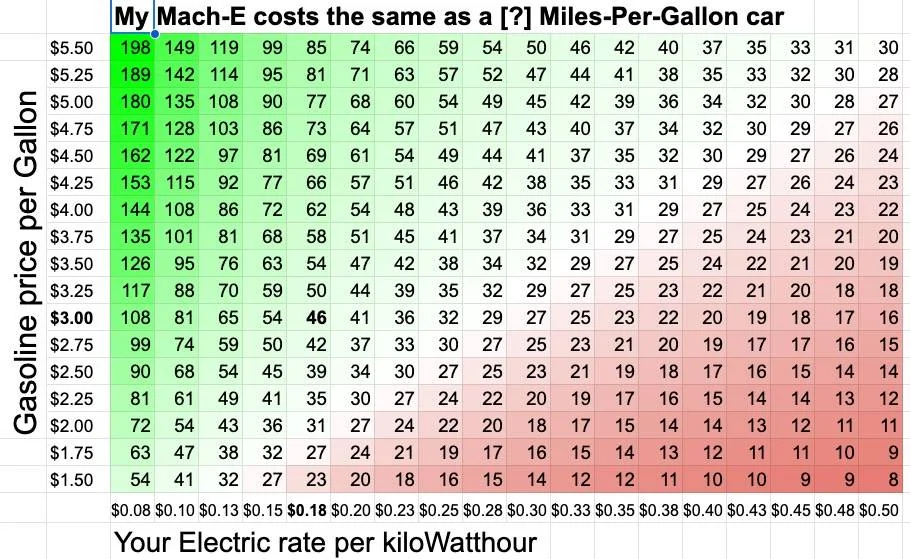
The current low gas prices and high DCFC rates could make operating MME as expensive as a gas guzzler. This table helps to quickly determine the 'penalty' for charging DCFC. It shows how equivalent MPG depends on the price of gasoline and your electric rate. At the current US national averages of $3/gallon and $0.18/kWh, the Mach-e is equivalent to a 46MPG car (similar to a Carmy Hybrid). If you live in Texas ($2.7/gallon) and charge at a public DCFC charger for $0.5/kWh the equivalent is a dismal 15 MPG. If you are in Washington state ($4/gallon, $0.13/kWh) the MME drives as cheap as an 86 MPG car. The values are for the AWD extended range MME. The RWD is slightly better, while the GT and in winter will see worse numbers.

Screenshot 2024-01-19 at 14.51.09.jpg
That chart needs to go down to $.04. That is the lowest I have seen.
Sponsored


Top