Could a software update enable faster DCFC charging?

billy_at

Well-Known Member
First Name
Bill
Joined
Jul 15, 2021
Threads
65
Messages
342
Reaction score
466
Location
New Jersey
Vehicles
Mach-E California Route 1
Country flag
Currently my 2021 MME has a theoretical max charge rate of 150 KW. In practice, it doesn’t usually get higher than about 110 KW at a DCFC station.

But the newest EA chargers now have max rates of 350 KW, and you can guess that future EVs will be able to use all of that.

Is it possible that a future software update would ever allow higher charging rates higher than the current 150KW limit in the MME without needing to have new hardware (ie buy a new car)? I’m not sure what the limiting factor is in determining max charge rate.
Sponsored
 

HuntingPudel

Well-Known Member
First Name
Steve
Joined
Mar 23, 2021
Threads
88
Messages
12,940
Reaction score
17,386
Location
Bay Area, CA
Vehicles
2024 MME GT with Performance Upgrade, 1979 Fire-Am, 1972 K/5 Blazer
Occupation
Engineering
Country flag
I have seen momentary charge rate as high as 164 KW on a 350KW charger. The car will dip pretty quickly below 140KW, following its charge curve. The car will charge slightly faster on a 350 charger than a 150 charger, but you will likely anger someone with an 800v car. ?‍♂?
 

hybrid2bev

Well-Known Member
Joined
Dec 4, 2019
Threads
78
Messages
4,642
Reaction score
12,770
Location
USA
Vehicles
2026 Rally
Country flag
Is it possible that a future software update would ever allow higher charging rates higher than the current 150KW limit in the MME without needing to have new hardware (ie buy a new car)? I’m not sure what the limiting factor is in determining max charge rate.
Based on prior conversations on here. The car is hardware limited. You're not going to see a meaningful increase in the peak charging rate. 160ish is possible under ideal conditions, but you're never going to see 180-200+ kW peak charging with the current hardware.

An OTA could feasibly adjust the curve to maintain a higher rate for longer. But that's about the best we could hope for.
 

LM_COGT

Active Member
First Name
Brandon
Joined
Feb 3, 2023
Threads
0
Messages
31
Reaction score
75
Location
Colorado USA
Vehicles
2023 Vapor Blue Mach-E GT, 2019 CX-5, 2018 Leaf S
Occupation
EE
Country flag
Yes and no.

First the no - the peak charging rate is determined by charging voltage and maximum current, the voltage is set by the battery and power system design and the Mach-E maxes just above 400V. The current limit is set based on multiple things, but between charger cable thickness, and Mach-E cable sizing and battery thermal control this maxes out ~400A - so somewhere around 160KW is the peak. The vehicles hitting 300+KW rates are doing so with higher voltage, 800-920V at the same 400A.

Now the yes - peak rate is not the whole story, and in many ways misses the bulk of the story. Peak rates are only possible with the battery at lower capacity and can generally not be sustained for long without too much risk of damaging the battery. But how much of the peak rate can be sustained during the charge cycle (charging curve) is much more flexible, and Ford has already made SW updates that improve that, most recently raising the maximum charge speed after the 80% SOC mark significantly. Future charging curve improvements could be made as Ford optimizes thermal management during charging, and gets enough data on battery degradation rates to be more confident of longevity with higher charge rates.


Mirak

Banned
Banned
Joined
Oct 8, 2020
Threads
111
Messages
3,754
Reaction score
6,166
Location
Kansas
Vehicles
"Sonic" 2021 MME Grabber Blue First Edition
Country flag
Like others said, can't do much about the peak charging rate, but a software update could significantly expand the charging curve, which would significantly increase overall charging speed. But it could also impair battery life, particularly for frequent DCFC users, so Ford probably won't alter the charging curve much.

Better, smarter battery preconditioning would also help during cold weather. This is realistically the best we can probably hope for.
 

Deleted member 16048

Guest
I'm hopeful they will improve the charging curve. I think they are being careful though and not as aggressive as Tesla is on their curves. As they earn confidence in allowing higher rates for longer, we will see an improvement. Honestly holding the 140-150 for a bit deeper into the pack would be great to see. They fall off pretty quickly after 10% is reached.
 

azerik

Well-Known Member
First Name
Erik
Joined
Jan 8, 2023
Threads
79
Messages
4,545
Reaction score
4,557
Location
Chandler/Flagstaff, AZ
Vehicles
'21 Spacey Prem4x, '21 RX450H, 13 Focus EV
Occupation
DevSecNetOps, General PITA
Country flag
That’d still be 98 kW for an ER car. Better than what I see most of the time.
Too many factors to try to guess why your charge rate is low but the handful of times I DCFC'd I was 91~100kw until 80% every time. Unless I used a messed up EA charger. There is 1 specific charger that every time I plugged into (interestingly this charger was also the ONLY charger to work with P&C) the max I saw was 61kw on 4 different attempts on 4 different weeks. The 3 next to it 90+ every time.
 

Rory

Well-Known Member
First Name
Rory
Joined
Dec 7, 2022
Threads
13
Messages
245
Reaction score
413
Location
Davis, California
Vehicles
Mustang Mach-E 2022 Premium ER AWD
Country flag
Like others said, can't do much about the peak charging rate, but a software update could significantly expand the charging curve, which would significantly increase overall charging speed. But it could also impair battery life, particularly for frequent DCFC users, so Ford probably won't alter the charging curve much.

Better, smarter battery preconditioning would also help during cold weather. This is realistically the best we can probably hope for.
Well, Ford could put in smarter charging management, and only derate DCFC charging if it’s used frequently, to protect the batteries from excessive high-speed DCFC use, and allow those using DCFC only on long trips to get a faster charge.
 
  • Like
Reactions: ATL

tuminatr

Well-Known Member
First Name
Brian
Joined
Apr 22, 2020
Threads
51
Messages
2,185
Reaction score
2,221
Location
Saint Paul,MN
Vehicles
2021 MME GTPE
Occupation
sales
Country flag
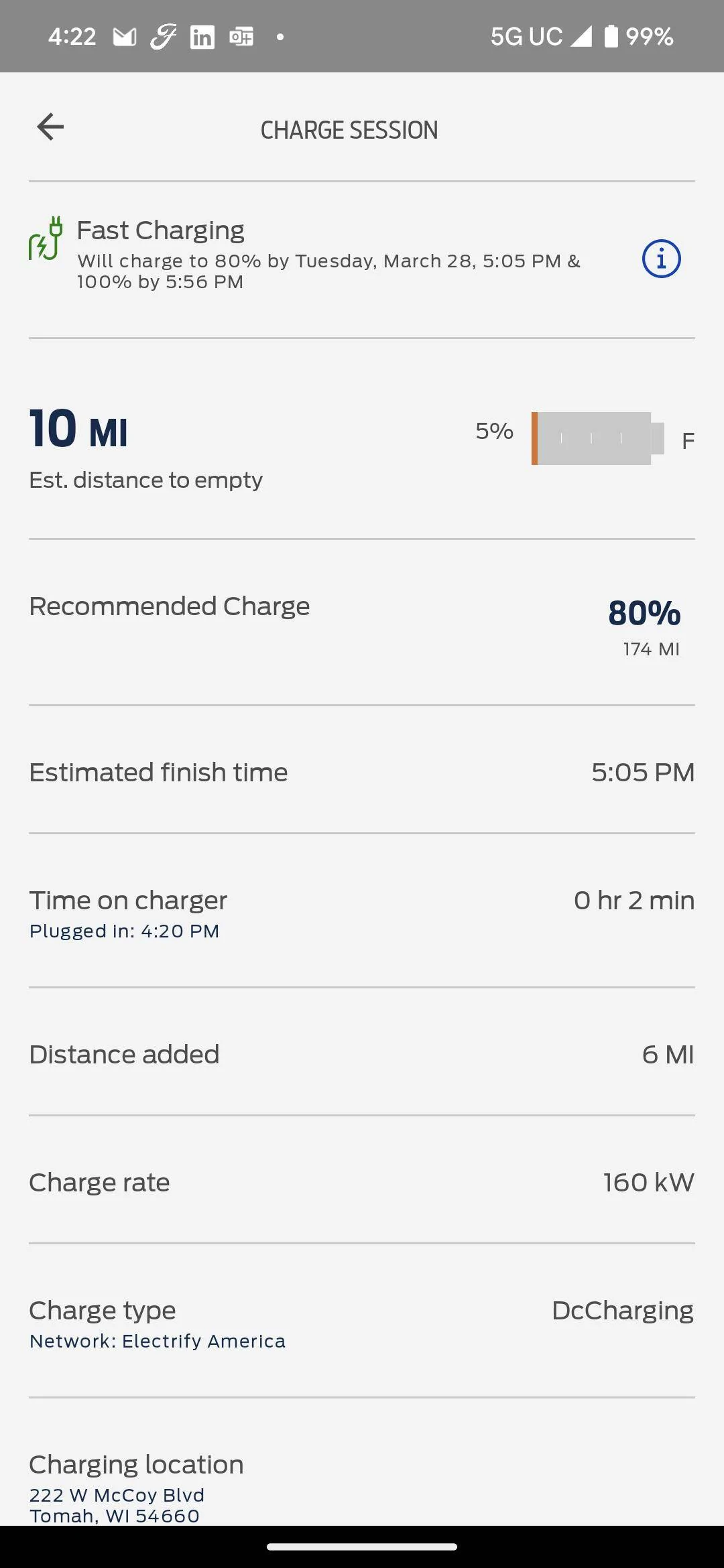
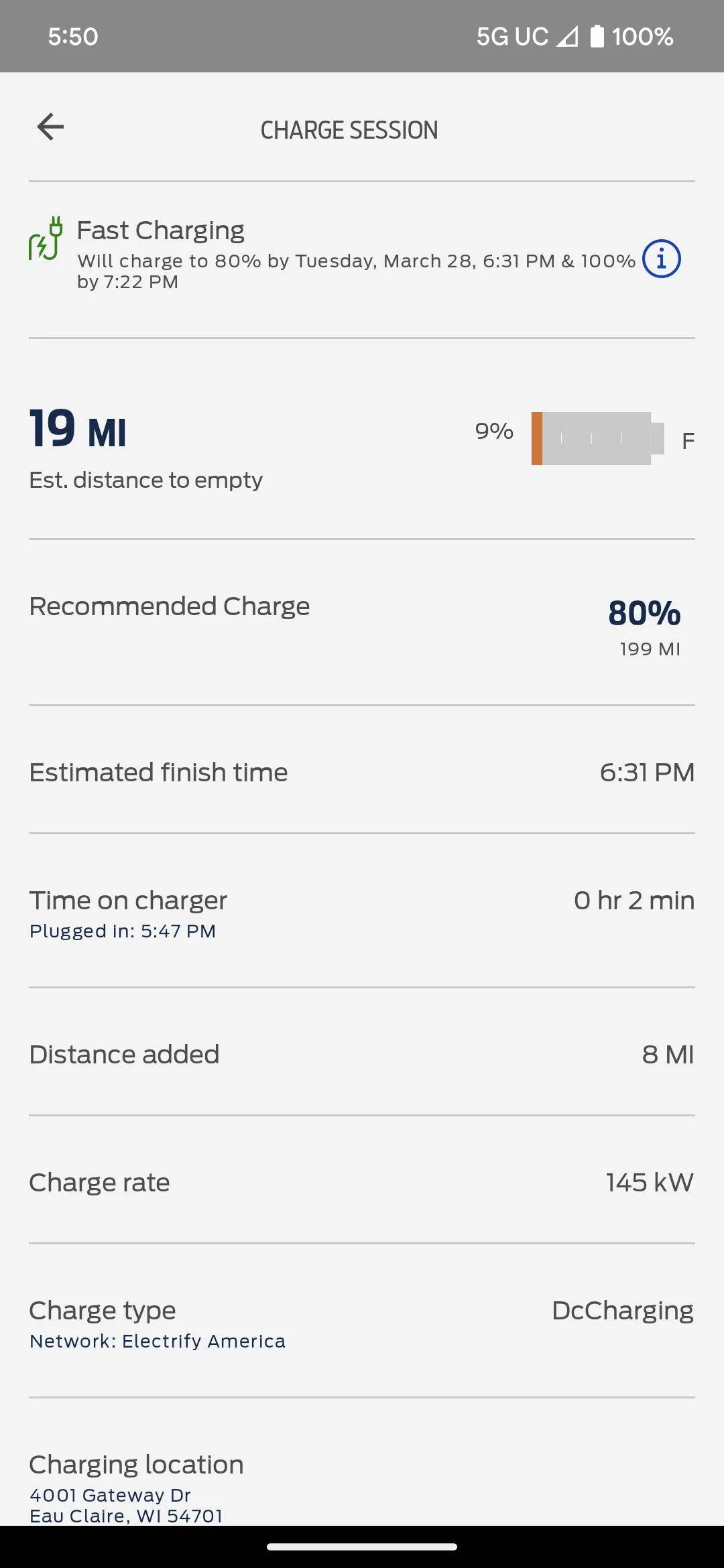
I will back up what has been explained if my car is really low say under 10% I have seen rates as high as 160kw. It typically takes around between 140-110kw up to about 35% and then slows down to 70-80kw up to 80% then sharply down to 40-45kw

Here are a few app screenshots. I don't like to let the battery get less than 20% but traveling in under 40° Fahrenheit takes a lot of power.

Ford Mustang Mach-E Could a software update enable faster DCFC charging? Screenshot_20230328-162242


Ford Mustang Mach-E Could a software update enable faster DCFC charging? Screenshot_20230328-175043
 

Deleted member 16048

Guest
I will back up what has been explained if my car is really low say under 10% I have seen rates as high as 160kw. It typically takes around between 140-110kw up to about 35% and then slows down to 70-80kw up to 80% then sharply down to 40-45kw

Here are a few app screenshots. I don't like to let the battery get less than 20% but traveling in under 40° Fahrenheit takes a lot of power.

Screenshot_20230328-162242.png


Screenshot_20230328-175043.png
Yep that's exactly the same as I have seen. Though like you, I don't usually let it fall below 20 int he cold like this. The curve they have seems very sharp and staggered. I feel as if they can smooth it out a bit which would increase the rate in some areas that they can probably get away with. I know thermals is an issue, but it seems like other manufactures are finding they can get away with a lot more than Ford thinks they can.
 

Mach-Lee

Well-Known Member
First Name
Lee
Joined
Jul 16, 2021
Threads
262
Messages
11,356
Reaction score
24,987
Location
Wisconsin
Vehicles
2022 Mach-E Premium AWD
Occupation
Sci/Eng
Country flag
…but it seems like other manufactures are finding they can get away with a lot more than Ford thinks they can.
Bingo. Ford is too conservative. 10% to 80% takes 45 minutes on a good day. I feel like they could get that down to 38 minutes with some optimization.

The biggest limitation are the DC cables from the charge port to the battery only support about 90-100 kW continuous.
 

Deleted member 16048

Guest
Bingo. Ford is too conservative. 10% to 80% takes 45 minutes on a good day. I feel like they could get that down to 38 minutes with some optimization.

The biggest limitation are the DC cables from the charge port to the battery only support about 90-100 kW continuous.
Yeah, they could get away with more for short periods of time after they let it settle down. Almost like throttling it up and down. it seems they want to be very careful though.

Only time will tell if they earn some more confidence in their own engineering and push things to what they “can” do vs what it was “designed” to do.
 

ATL

Well-Known Member
Joined
Aug 27, 2022
Threads
1
Messages
212
Reaction score
197
Location
Canada
Vehicles
1979 Trans Am, 2016 Mustang GT
Occupation
Electrical Engineer
Country flag
Well, Ford could put in smarter charging management, and only derate DCFC charging if it’s used frequently, to protect the batteries from excessive high-speed DCFC use, and allow those using DCFC only on long trips to get a faster charge.
Yes, there are a few strategies that would seem to be possible, given the plethora of sensors in the vehicle, or that could be added in future years. Eg: if the power delivery ratings for components are based on temperature, as with typical engineering standards, it is likely that longer charging at higher rates could be tolerated in cooler ambient conditions. Bring a little AI to the table for improved charging without battery impacts, perhaps? If they do this already it would be useful to publish the algorithm for the techies that harp on such things?.
Sponsored


Top