Did you know Neutral (N) does this?

OP
OP
mkhuffman

mkhuffman

Well-Known Member
First Name
Mike
Joined
Nov 19, 2020
Threads
29
Messages
6,875
Reaction score
9,507
Location
Virginia
Vehicles
2025 Rivian R1T Tri-Max, Jeep GC-L, VW Jetta
Country flag
No need to debate. It’s been tested with our cars.

Whisper- coasting
Any other mode- regen

They consume the same energy over the same distance.
There is a big "if" in there.

If you drive the same way: same speed, same acceleration, same deceleration, same stops, same everything. My point is simply that it is easier in some modes to drive gently. I can drive very gently in 1PD Unbridled, but it is easier in Whisper. And coasting is an easy way to minimize energy use while moving.

I agree you can do the same thing in other modes if you carefully manage the speed, maybe even do better. So we agree, mostly.
Sponsored
 
OP
OP
mkhuffman

mkhuffman

Well-Known Member
First Name
Mike
Joined
Nov 19, 2020
Threads
29
Messages
6,875
Reaction score
9,507
Location
Virginia
Vehicles
2025 Rivian R1T Tri-Max, Jeep GC-L, VW Jetta
Country flag
That’s not correct.

The energy lost in getting to speed is drag. Coasting or regenning, that energy is gone for good. Coasting doesn’t get it back.
Coasting doesn't do any regen. The car just moves along, with the same battery drain you get when you are sitting still at a stoplight.

Of course there is energy lost due to drag, friction, air resistance, etc. That is another reason why regen cannot offset the energy used to get the car up to a specific speed. I agree with you.


Now the fact that EVs regen does remove the need for holding a steady speed. Cruise control does not make EVs more efficient the way it does in ICE vehicles as a result.
I don't agree with this. All cruise control does is maintain a steady speed. Regen is not as efficient as maintaining a steady speed. Speeding up to 80 then regen braking to 70 is not as efficient as driving a steady 75 mph due to physics. Physics applies to ICE and BEV equally.

All regen does is allow you to recapture SOME of the energy needed to get you up to 80 mph. Or put another way, instead of transferring the energy needed to slow a moving object into brake pads, some of the energy is transferred into the battery. Some, not all. Some is lost in heat via internal electrical resistance, and system inefficiencies.
 
OP
OP
mkhuffman

mkhuffman

Well-Known Member
First Name
Mike
Joined
Nov 19, 2020
Threads
29
Messages
6,875
Reaction score
9,507
Location
Virginia
Vehicles
2025 Rivian R1T Tri-Max, Jeep GC-L, VW Jetta
Country flag
On a side note, I read an article once (in Road and Track or another car magazine) that said it is more efficient to accelerate quickly to the desired speed in a ICE vehicle because it more efficiently burns the fuel when the throttle is fully open. I understood the logic and science behind it, but it still didn't seem to be consistent with my own personal experience. Maybe because when you floor it, you tend to get the car going faster than you would if you don't, so you waste energy going faster than you would if you accelerated slowly.

I wonder if there is something similar happening in BEVs. Could it be hitting the go-pedal hard is as efficient or more efficient than accelerating slowly? It does not seem to be true, but I wonder...

Spinning the tires on the road is definitely not as efficient as keeping them firmly planted, so of course hitting the pedal hard enough to spin the tires is not as efficient. But otherwise?
 

Mach1E

Well-Known Member
Joined
Sep 5, 2021
Threads
93
Messages
10,509
Reaction score
13,294
Location
Florida
Vehicles
69 Mach 1, 11 GT, 21 GTPE- sold, 24 Taycan 4S, 20 F type R
Country flag
On a side note, I read an article once (in Road and Track or another car magazine) that said it is more efficient to accelerate quickly to the desired speed in a ICE vehicle because it more efficiently burns the fuel when the throttle is fully open. I understood the logic and science behind it, but it still didn't seem to be consistent with my own personal experience. Maybe because when you floor it, you tend to get the car going faster than you would if you don't, so you waste energy going faster than you would if you accelerated slowly.

I wonder if there is something similar happening in BEVs. Could it be hitting the go-pedal hard is as efficient or more efficient than accelerating slowly? It does not seem to be true, but I wonder...

Spinning the tires on the road is definitely not as efficient as keeping them firmly planted, so of course hitting the pedal hard enough to spin the tires is not as efficient. But otherwise?
I remember reading that article too.

And it seemed more theoretical than how things actually work.

For example, in PE mode at full throttle, my ICE had a air/fuel ratio around 12.5:1 but at part throttle it’s 14.7:1.

For BEVs, everything seems to say to accelerate slowly for more efficiency. I’m not sure on the why, but they just all consistently say that. Possibly energy lost to heat.

BEVs are much more efficient in putting power to the ground. It just takes a specific amount of energy to maintain a specific speed. It’s why there are only very minimal gains (5%) with a transmission.
 

Chuck

Well-Known Member
First Name
Chuck
Joined
May 13, 2021
Threads
96
Messages
1,258
Reaction score
1,775
Location
SoCal
Vehicles
Mustang Mach E 2021
Country flag
I am a regular on the forum, but it is possible I missed someone else posting about this. Link to it if you must!

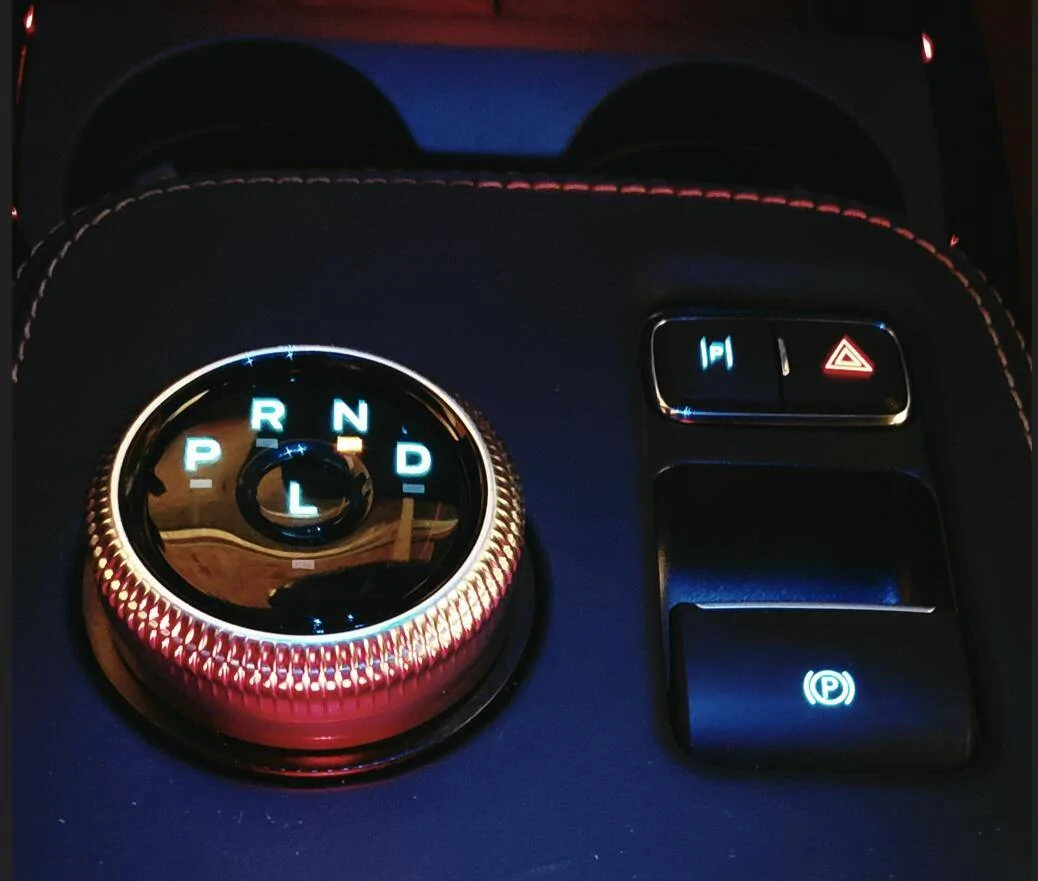
So the other day, I was driving around town and decided to play around with the drive selector. What would happen if I spun it all the way into Reverse or Park? Actually, nothing really happens except for a warning from the car that it won't engage until you are going slower. But Neutral was a revelation.

1645404684957.png


If you like to hyper-mile, or get the best range possible, coasting is key. It is possible to approximate coasting using the go-pedal and careful modulation, but really you are just playing around the edges. You are either pressing the pedal too hard or too soft, and the car is not really coasting.

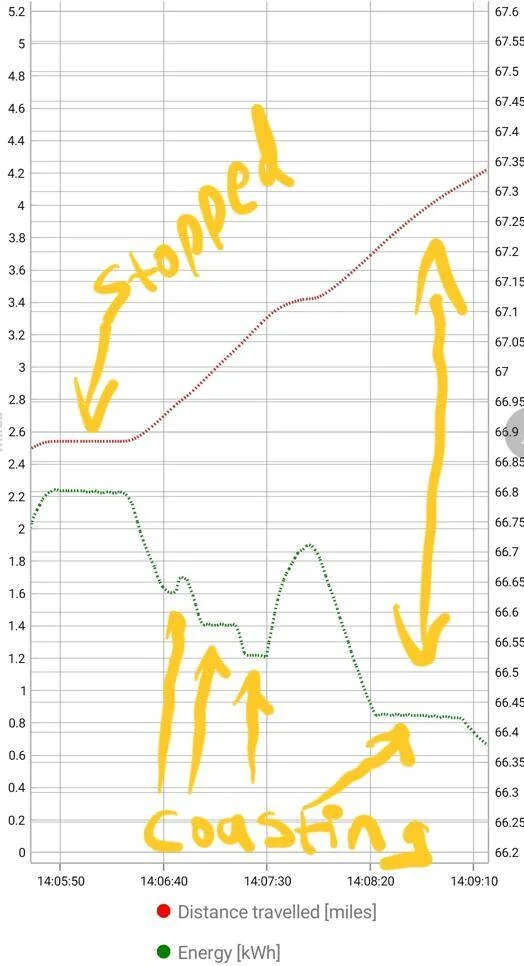
But if you put the car in Neutral, it coasts. The car uses zero energy while in Neutral, just like if you are sitting still. If you time things right, you pop it into Neutral and coast up to the stoplight. Of course it won't slow you down, so you either need to press the brake pedal or flip it into Drive to slow the car (using 1PD). I do the latter because I know 1PD is using the motor not the brakes, so I get the best regen possible.

Here is a graph that shows how coasting compares to sitting still. It is exactly the same. So the more time you spend coasting, the less energy you use.
1645404878213.png


Does it actually improve your efficiency to coast? I think it absolutely does. The challenge is knowing when to coast. Since it uses no energy to coast, if you are going up a hill, you will slow down pretty quickly. If you are in a flat area, you will slow down but not as quickly. Of course you may pick up speed when going down a hill. It takes practice and timing to really get it right.

One thing is for sure at least for me: you don't want to do this with passengers in the car. It is almost impossible to make all the transitions from coasting to Drive smoothly. Some are great and you can't even feel it. Others are rough. I suppose with a lot of practice you can get the transitions to be mostly smooth. It is much easier to drive smoothly by just keeping it in Drive.

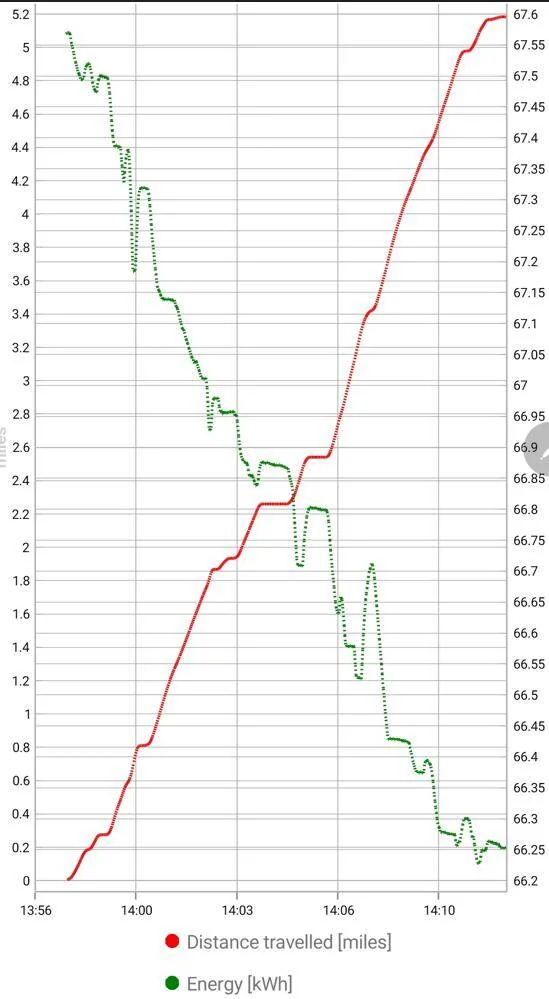
Here is a 5.2 mile trip in 50 F weather (not cold) with no heat being used. At that temperature, I often turn off the climate because the car is sufficiently warm inside, especially because I start my drive in the warmer than outside garage.
1645405333191.png


Starting battery = 67.57 kWh
Ending battery = 66.25
Total battery used = 1.32 kWh
Distance traveled = 5.2 miles
Efficiency = 5.2 / 1.32 = 3.9 mi/kWh

Pretty excellent. Of course there are many variables, and I didn't repeat the trip without using Neutral coasting. I think though, that for a GT, it is about as good as it gets.

The trip was in town, multiple stop lights, and max speed around 45 mph during a one mile stretch. It is definitely a highly efficient route which I would have done well without coasting, but still. I think the coasting helped.
Coasting in neutral is illegal in my state (California) and probably in most states.


Neil4Real

Well-Known Member
Joined
Jul 8, 2021
Threads
17
Messages
3,385
Reaction score
3,073
Location
Southern California
Vehicles
Mach-E GT Performance Edition - Shadow Black
Country flag
No need to debate. It’s been tested with our cars.

Whisper- coasting
Any other mode- regen

They consume the same energy over the same distance.
Is this with 1PD off that you coast? So whisper you coast, engage and unbridled it acts like an ICE and just does small amounts of power with foot off the pedal to keep you from coming to a complete stop?

And with 1PD on, all 3 modes are the same just more aggressive regen going from whisper > engage > unbridled?
 

dml105

Well-Known Member
Joined
Jul 26, 2020
Threads
27
Messages
949
Reaction score
1,421
Location
Arlington, VA
Vehicles
Shadowfax, the Star White Tricoated Metallic Pony
Country flag
Coasting doesn't do any regen. The car just moves along, with the same battery drain you get when you are sitting still at a stoplight.

Of course there is energy lost due to drag, friction, air resistance, etc. That is another reason why regen cannot offset the energy used to get the car up to a specific speed. I agree with you.
i'm not sure you do. When you are sitting still, you are not losing kinetic energy because there is no drag. When you are coasting, you are losing energy to drag. So, saying coasting is just like the power output when you are standing still is ignoring that drag. You are not getting something for nothing. The reason why coasting gets you increased efficiency in an ICE vehicle is because the idle waste. Idle waste in an EV is negligible (things like HVAC and running the computer).

Think of it this way: getting your 2000kh Mach-e to highway speed (100km/hr) will cost you about 1543 kJ of energy from your battery. Since we like to speak in terms of kWh, 1543 kJ = about .42 kWh. That energy is not gone: it has moved from battery to kinetic energy. You can get up to 70% of that back by regenning down to zero.

Coasting, which you have defined as not adding any more power input, does not mean you maintain 100km/hr. It means you slowly roll to a stop. Forget about regen for a sec: we can't continue if you don't agree that coasting = slowly rolling to a stop, because without power, the drag forces will eventually win. The only way to not roll to a stop is to keep adding power to overcome the drag. Well, if you're adding power, you're ALSO not regenning! So, what is the point of comparing coasting to regenning? When you are cruising along, there is no point for comparison.


I don't agree with this. All cruise control does is maintain a steady speed. Regen is not as efficient as maintaining a steady speed.
Regen is not used to maintain a steady speed. Power is.

The point above was that in an ICE vehicle, power used to get to speed is LOST FOREVER, so efforts to keep the speed where it is causes an efficiency gain. In hybrids and EVs, that energy is not lost forever, so the efficiency gain of a constant cruising speed is minimal.
 
Last edited:

Mach1E

Well-Known Member
Joined
Sep 5, 2021
Threads
93
Messages
10,509
Reaction score
13,294
Location
Florida
Vehicles
69 Mach 1, 11 GT, 21 GTPE- sold, 24 Taycan 4S, 20 F type R
Country flag
Is this with 1PD off that you coast? So whisper you coast, engage and unbridled it acts like an ICE and just does small amounts of power with foot off the pedal to keep you from coming to a complete stop?

And with 1PD on, all 3 modes are the same just more aggressive regen going from whisper > engage > unbridled?
Kinda. But the modes also change throttle input, steering stiffness, and suspension settings (if GTPE).

Then there’s also L setting and 1PD you can add to any mode.

I made a video to show the differences:

watch the power meter on the bottom left. Blue is power, green regen:
 

Neil4Real

Well-Known Member
Joined
Jul 8, 2021
Threads
17
Messages
3,385
Reaction score
3,073
Location
Southern California
Vehicles
Mach-E GT Performance Edition - Shadow Black
Country flag
Kinda. But the modes also change throttle input, steering stiffness, and suspension settings (if GTPE).

Then there’s also L setting and 1PD you can add to any mode.

I made a video to show the differences:

watch the power meter on the bottom left. Blue is power, green regen:
Oh, yes, I’m aware of the other things it changes. I just wanted to clarify what people mean when they say coasting in whisper mode, etc.
 

Neil4Real

Well-Known Member
Joined
Jul 8, 2021
Threads
17
Messages
3,385
Reaction score
3,073
Location
Southern California
Vehicles
Mach-E GT Performance Edition - Shadow Black
Country flag
Oh, yes, I’m aware of the other things it changes. I just wanted to clarify what people mean when they say coasting in whisper mode, etc.
Thanks for the video. That’s explains everything. I have only driven with 1PD so didn’t know the other modes actually have slight regen with it off.

Question - with 1PD on and then using L, the regen looked the same to me. I thought even ford said that turning L on when you have 1PD active does absolutely nothing?
 

SnBGC

Well-Known Member
First Name
Greg
Joined
Apr 20, 2020
Threads
46
Messages
5,962
Reaction score
9,778
Location
Phoenix
Vehicles
2021 Mach-E FE, 2021 Wrangler 4xe High Altitude
Occupation
Manager
Country flag
Thanks for the video. That’s explains everything. I have only driven with 1PD so didn’t know the other modes actually have slight regen with it off.

Question - with 1PD on and then using L, the regen looked the same to me. I thought even ford said that turning L on when you have 1PD active does absolutely nothing?
Correct. "L" has no effect while 1PD is enabled.
"L" only matters if 1PD is OFF. I don't use 1PD so "L" is something that I use on a regular basis. I like how it's a simple easy toggle on/off without the need to take my eyes off the road. I can find that button and activate or deactivate without looking. I think that is a very clever idea on Ford's part. I don't really like the rotary gear selector but the L in the center is a very good idea and I have forgiven Ford for taking my gear shift lever away. :)
 

Mach1E

Well-Known Member
Joined
Sep 5, 2021
Threads
93
Messages
10,509
Reaction score
13,294
Location
Florida
Vehicles
69 Mach 1, 11 GT, 21 GTPE- sold, 24 Taycan 4S, 20 F type R
Country flag
Correct. "L" has no effect while 1PD is enabled.
"L" only matters if 1PD is OFF. I don't use 1PD so "L" is something that I use on a regular basis. I like how it's a simple easy toggle on/off without the need to take my eyes off the road. I can find that button and activate or deactivate without looking. I think that is a very clever idea on Ford's part. I don't really like the rotary gear selector but the L in the center is a very good idea and I have forgiven Ford for taking my gear shift lever away. :)
Yup and just to clarify- L is not the same as 1PD.

1PD will take your car to a complete stop. L does similar regen, but you have to hit the brake pedal to completely stop. L will creep from a stop, 1 PD will not.
 

Motomax

Well-Known Member
First Name
Max
Joined
Jul 19, 2021
Threads
5
Messages
1,019
Reaction score
1,027
Location
California
Vehicles
VW GLI, 4Runner
Country flag
On a side note, I read an article once (in Road and Track or another car magazine) that said it is more efficient to accelerate quickly to the desired speed in a ICE vehicle because it more efficiently burns the fuel when the throttle is fully open. I understood the logic and science behind it, but it still didn't seem to be consistent with my own personal experience. Maybe because when you floor it, you tend to get the car going faster than you would if you don't, so you waste energy going faster than you would if you accelerated slowly.

I wonder if there is something similar happening in BEVs. Could it be hitting the go-pedal hard is as efficient or more efficient than accelerating slowly? It does not seem to be true, but I wonder...

Spinning the tires on the road is definitely not as efficient as keeping them firmly planted, so of course hitting the pedal hard enough to spin the tires is not as efficient. But otherwise?
Higher load means better efficiency but that doesn’t mean higher rpm. More throttle will result in better efficiency until a certain point, then it goes back down.
Electric motors work the same way. They all have a peak efficiency at a certain load.

The issue with real world application is keeping your average speed the same. If your heavy on the throttle with a higher average speed, you won’t be more efficient.

atleast that’s how in interpret it.
 

JSeis

Well-Known Member
Joined
Jul 23, 2021
Threads
33
Messages
410
Reaction score
537
Location
98577
Vehicles
AWD Select
Country flag
Given that HVAC is the biggest BEV energy suck, this discussion is basically moot. I can prove a point in winter (averaging say 3.7 Mi/KWh) while ridin’ chill. Or 3.9 in the summer rollin’ hot with a tailwind. But at 118 MPGe average commuting, just driving the MME makes my EcoBoost Flex look every part 1/6th efficient. All my hyper-mile skill just gets tossed. Of course I could just drive slower to prove I can get 4.1 or whatever. While I do miss the challenging old days of supertuning my Type 2 flat four (40 hp pushing a brick) to get 28 mpg on a good day of maybe averaging 45 mph. That thought leaves my brain the minute I get wiggy with the MME go-pedal.
Sponsored


Top