
measuring real efficiency

RedStallion

Banned
Banned
Joined
Mar 9, 2021
Threads
50
Messages
1,393
Reaction score
1,770
Location
People's Republic of California
Vehicles
Mach-E, et al
Country flag
  • Thread starter
  • Banned
  • #1
So I decided to make a 39.3 mile trip (60% city, 40% freeway) and calculate the efficiency numbers and compare it with what the car reported. The car was charged to 80% before and after the trip.

The meter reported 17.188 kWh.
FordPass reported 14.28 kWh (which means 20.4% was wasted)
GOM reported efficiency: 3.1 mi/kWh
Actual efficiency based on consumed power: 2.286 mi/kWh (which is 35.6% less)

Translating this into prices @ 43c/kWh
Real cost per mile: $.188
The last gas price I've seen was $6.49/gal, the equivalent gas efficiency is 34.6 mi/gal
Sponsored
 

Blue highway

Well-Known Member
First Name
Steve
Joined
Oct 15, 2021
Threads
5
Messages
2,694
Reaction score
4,238
Location
Oregon
Vehicles
Mach E Premium SR RWD
Country flag
So I decided to make a 39.3 mile trip (60% city, 40% freeway) and calculate the efficiency numbers and compare it with what the car reported. The car was charged to 80% before and after the trip.

The meter reported 17.188 kWh.
FordPass reported 14.28 kWh (which means 20.4% was wasted)
GOM reported efficiency: 3.1 mi/kWh
Actual efficiency based on consumed power: 2.286 mi/kWh (which is 35.6% less)

Translating this into prices @ 43c/kWh
Real cost per mile: $.188
The last gas price I've seen was $6.49/gal, the equivalent gas efficiency is 34.6 mi/gal
43c/kWh? the national average is around 15c. In Oregon, with all the junk fees included, my all in cost is 13.5c
 

Scooby24

Well-Known Member
First Name
Greg
Joined
Jul 2, 2021
Threads
29
Messages
2,123
Reaction score
3,296
Location
Olathe, KS
Vehicles
'25 BMW i4 M50; '25 MME GT
Occupation
Healthcare IT
Country flag
Meanwhile, for the rest of us that pay a reasonable rate for electricity...
 

voxel

Well-Known Member
First Name
Nelson
Joined
Sep 6, 2021
Threads
27
Messages
2,032
Reaction score
1,858
Location
Altamonte Springs, FL
Vehicles
22 Mach-E 4X, 23 GC Limited
Occupation
Software Engineer
Country flag
So I decided to make a 39.3 mile trip (60% city, 40% freeway) and calculate the efficiency numbers and compare it with what the car reported. The car was charged to 80% before and after the trip.

The meter reported 17.188 kWh.
FordPass reported 14.28 kWh (which means 20.4% was wasted)
GOM reported efficiency: 3.1 mi/kWh
Actual efficiency based on consumed power: 2.286 mi/kWh (which is 35.6% less)

Translating this into prices @ 43c/kWh
Real cost per mile: $.188
The last gas price I've seen was $6.49/gal, the equivalent gas efficiency is 34.6 mi/gal
20.4% loss is high.

Generally EV charger to car losses is about 7-12% so that's about 4 cents per kWh (using your 43c/kWh number) wasted due to transmission/heat/etc.
 
Last edited:

Nklem

Well-Known Member
First Name
Norm
Joined
May 20, 2021
Threads
105
Messages
1,318
Reaction score
1,699
Location
Coast of Maine
Vehicles
Subaru Solterra
Occupation
Mechanical Engineer
Country flag
A few misses. You cannot rely on battery percentage from the dash for anything calculation based. It is a "calculated" number based on many factors. 100% is not 100% and 80% is not 80%. You need to read the OBD data and get the actual battery "state of charge".

I tried this same type of test and nothing worked out (Everything was off by 8-12%), when I got the OBD data and correlated to "real" battery KWH from the BMS, and "real" energy charged, everything made sense, the Mi/kWh from the car was reported perfectly and the charging loss for level 2 was perfect at just about 10%.

So I have proved the Mach E trip Mi/kWh is spot on, but you need to add 10% for charger losses when using your charger input on level 2.

Also, NEVER rely on FordPass. That is totally inaccurate and can only be used for amusement.

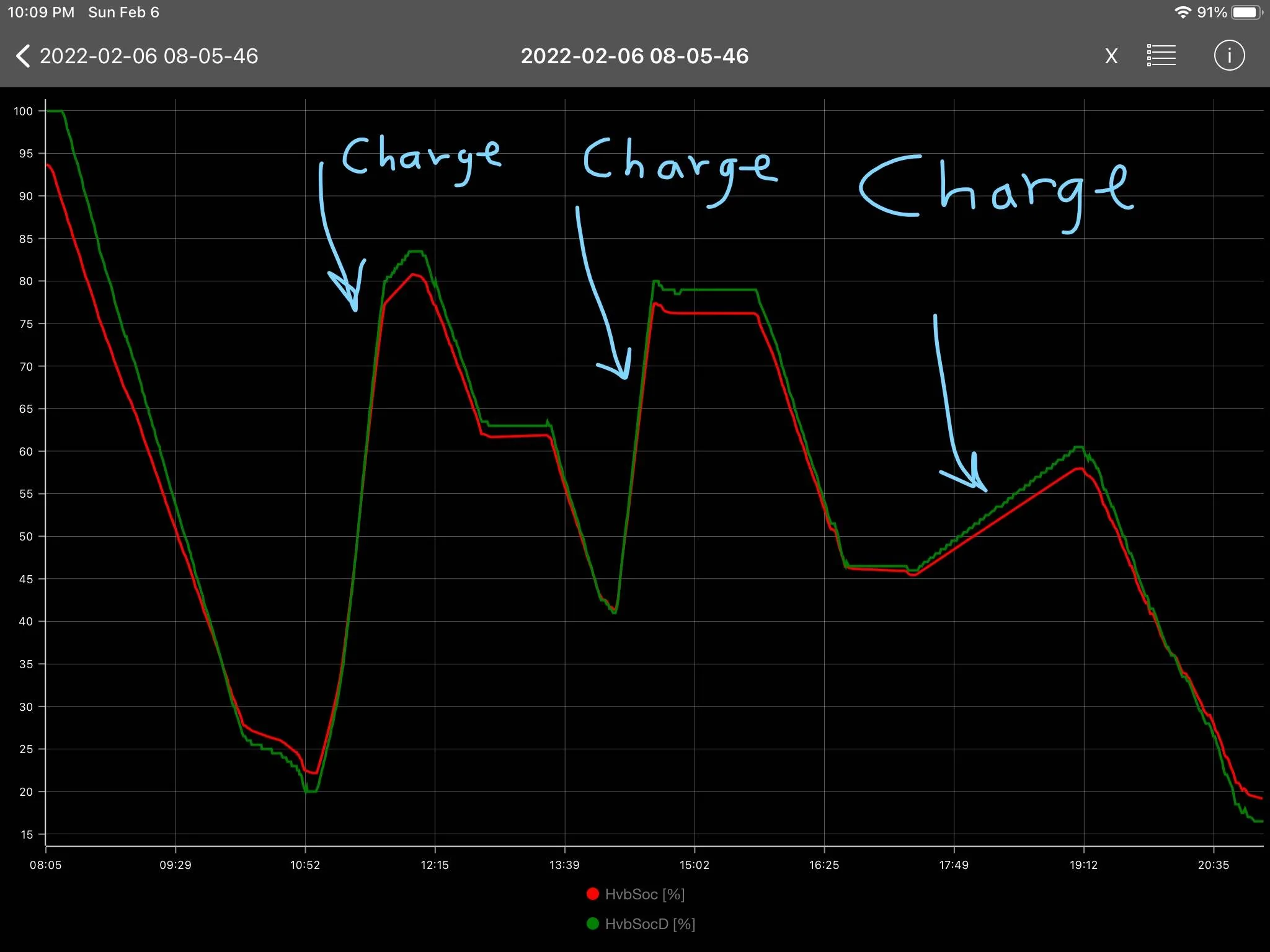
Attached is an older graph showing displayed battery percentage "D" vs actual "state of Charge" "SOC" for a 300+ mile road trip. Look how it changes as you drive. The SOC is absolute. The Display is completely variable. If you see, the cross each other at around 37%. Also note charged information, sometimes you get more than reported. BTW you can get this data logged to your phone for less than $30 out of pocket.

I spent many hours trying to use the display and this BMS data saved my sanity.


...Norm

Ford Mustang Mach-E measuring real efficiency battery displayed vs real_LI


OP
OP
RedStallion

RedStallion

Banned
Banned
Joined
Mar 9, 2021
Threads
50
Messages
1,393
Reaction score
1,770
Location
People's Republic of California
Vehicles
Mach-E, et al
Country flag
  • Thread starter
  • Banned
  • #6
A few misses. You cannot rely on battery percentage from the dash for anything calculation based. It is a "calculated" number based on many factors. 100% is not 100% and 80% is not 80%. You need to read the OBD data and get the actual battery "state of charge".

I tried this same type of test and nothing worked out (Everything was off by 8-12%), when I got the OBD data and correlated to "real" battery KWH from the BMS, and "real" energy charged, everything made sense, the Mi/kWh from the car was reported perfectly and the charging loss for level 2 was perfect at just about 10%.

So I have proved the Mach E trip Mi/kWh is spot on, but you need to add 10% for charger losses when using your charger input on level 2.

Also, NEVER rely on FordPass. That is totally inaccurate and can only be used for amusement.

Attached is an older graph showing displayed battery percentage "D" vs actual "state of Charge" "SOC" for a 300+ mile road trip. Look how it changes as you drive. The SOC is absolute. The Display is completely variable. If you see, the cross each other at around 37%. Also note charged information, sometimes you get more than reported. BTW you can get this data logged to your phone for less than $30 out of pocket.

I spent many hours trying to use the display and this BMS data saved my sanity.


...Norm

battery displayed vs real_LI.webp
I used numbers reported by the car and FordPass only for comparison. I wouldn't rely on OBD as it has all the same problems as the numbers reported by car in any other ways. I assume the total mileage is reported correctly as there is a legal requirement for that, which gives the error margin less than 2.5% for this trip. I also assume that the car stops charging at the same level even if it's not precisely 80%, even allowing for 1.25% error wouldn't change the final results. The power consumption is measured by the electric meter, not the car and its precision is within 1Wh, so the error margin here is 0.006%. The actual waveform makes no difference.
What these measurements show that the car reported efficiency numbers are way too optimistic: 35.6% if you consider grid-to-wheels and 13.5% if you consider battery-to-wheels. Those are considerably bigger numbers than about 2.75% error margin of the experiment.
 

Nklem

Well-Known Member
First Name
Norm
Joined
May 20, 2021
Threads
105
Messages
1,318
Reaction score
1,699
Location
Coast of Maine
Vehicles
Subaru Solterra
Occupation
Mechanical Engineer
Country flag
I used numbers reported by the car and FordPass only for comparison. I wouldn't rely on OBD as it has all the same problems as the numbers reported by car in any other ways. I assume the total mileage is reported correctly as there is a legal requirement for that, which gives the error margin less than 2.5% for this trip. I also assume that the car stops charging at the same level even if it's not precisely 80%, even allowing for 1.25% error wouldn't change the final results. The power consumption is measured by the electric meter, not the car and its precision is within 1Wh, so the error margin here is 0.006%. The actual waveform makes no difference.
What these measurements show that the car reported efficiency numbers are way too optimistic: 35.6% if you consider grid-to-wheels and 13.5% if you consider battery-to-wheels. Those are considerably bigger numbers than about 2.75% error margin of the experiment.
We will just have to disagree and I understand the point of your post was equivalent MPG. From the BMS data that I attached. At 8:45 AM the display was 80% and the real state of charge was 72%. At 12:15, 80% was actually 77%. So the charger may truly have not stopped at the same SOC since it is triggered off from the Displayed value.

80% displayed in my two cases had a difference of 5% or 4.4 KWh. You can actually get the true KWh remaining from the pack from the BMS as well which mirrors the SOC.

Just for my curiosity, were you charging at Level 1 or level 2? Ford included charger or ChargePoint or other? Home electric meter, charger meter, kill-a-watt or other?

I’m not disagreeing with the numbers you got, from your data.

When I do the comparisons with the BMS Data and the real SOC or KWh as well as the BMS kWh charged remaining or KW charged from the BMS, I tend to get pretty much exactly the trips Mi/kWh or slightly better and when I bring in my ChargePoint meeting data, I routinely end up with just 10% more as “in car“ charge losses.

I do not trust the data from the “Ford connected charger” either. I have one of those too and that reporting is absolutely not accurate And cannot be trusted For the power charged to the car. I had one charge session where it said I got 15 kWh in 1 hour when I am on a 24 amp setting and can get no more than 5.7 kWh.

Before, when I did exactly what you were doing, I got dismal results, similar to yours that I could not understand why Ford would report efficiency In the car so far off. And I actually contemplated contacting Ford about why they misled people, as I felt that was dishonest. I had pretty much proved the 10% charger losses and an additional 8-12% discrepancy all the time, being overall 18-22% off from the displayed efficiency when reviewing charged values. Another member had the same issue.

We actually proved the BMS was pretty much right on during a winter range test with 2 Mach E’s, ID4 and Ioniq 5 over 200 miles . And several DCFC charges with the Correlating BMS data

Anyway enjoy! This stuff is so fun….
 

gpgrim

Well-Known Member
First Name
Gary
Joined
May 17, 2021
Threads
11
Messages
233
Reaction score
213
Location
Danville, CA
Vehicles
RR 4XP, MB E-350, Exp. EB, Subaru XTrek
Occupation
Physicist
Country flag
So I decided to make a 39.3 mile trip (60% city, 40% freeway) and calculate the efficiency numbers and compare it with what the car reported. The car was charged to 80% before and after the trip.

The meter reported 17.188 kWh.
FordPass reported 14.28 kWh (which means 20.4% was wasted)
GOM reported efficiency: 3.1 mi/kWh
Actual efficiency based on consumed power: 2.286 mi/kWh (which is 35.6% less)

Translating this into prices @ 43c/kWh
Real cost per mile: $.188
The last gas price I've seen was $6.49/gal, the equivalent gas efficiency is 34.6 mi/gal

My PG&E EV-A TOU plan charges $0.24 / kWh today, and it was less in the winter.

I've logged 7400 miles at 2.8 mi/kWh.

My Chargepoint EVSE & PGE bill have shown the delivery losses to be 10%,

Using these numbers gives apparent true operating cost rate of $0.094 per mile.

This is actually higher than I've paid due to the free kWh Ford provided.

Now since my solar system went live a couple of weeks ago, this operating cost just spiked by a factor a few thousand, but hey only 7 more years to go until it's free! ?‍♂
 

moparguy

Well-Known Member
Joined
Dec 30, 2021
Threads
12
Messages
523
Reaction score
442
Location
San Diego
Vehicles
Mach E GT, Miata, Mach E Select, Fusion
Country flag
43c/kWh? the national average is around 15c. In Oregon, with all the junk fees included, my all in cost is 13.5c
He's in the people's republic of California, my on-peak price is $0.63 .
 

Nklem

Well-Known Member
First Name
Norm
Joined
May 20, 2021
Threads
105
Messages
1,318
Reaction score
1,699
Location
Coast of Maine
Vehicles
Subaru Solterra
Occupation
Mechanical Engineer
Country flag
He's in the people's republic of California, my on-peak price is $0.63 .
That’s your peak, but what is the blended average?

I pay a flat .234/kWh in Maine. I get a discount for Community Solar so that drops it to .199/kWh and contemplating a TOU switch which should take me down to .18/kWh or so. I need to make sure the wife can live within the TOU boundary As peak is $0.25.

So my Mach E has averaged 2.7 mi/kWh over it’s life 12500 miles, and deduct 10% for charge losses, it’s equivalent to 52 MPG for me with gas at $5.00. But since things have warmed, I am averaging 3.9 over the last 650 miles, it now 76 MPG at my retail power rate of $0.234. No complaints from me.

At the $0.43 EA rate, that’s 41 mpg although DCFC losses are less and it should be 5-8% better, 45 MPG equivalent.
 
Last edited:

gpgrim

Well-Known Member
First Name
Gary
Joined
May 17, 2021
Threads
11
Messages
233
Reaction score
213
Location
Danville, CA
Vehicles
RR 4XP, MB E-350, Exp. EB, Subaru XTrek
Occupation
Physicist
Country flag
That’s your peak, but what is the blended average?

I pay a flat .234/kWh in Maine. I get a discount for Community Solar so that drops it to .199/kWh and contemplating a TOU switch which should take me down to .18/kWh or so. I need to make sure the wife can live within the TOU boundary As peak is $0.25.

So my Mach E has averaged 2.7 mi/kWh over it’s life 12500 miles, and deduct 10% for charge losses, it’s equivalent to 52 MPG for me with gas at $5.00. But since things have warmed, I am averaging 3.9 over the last 650 miles, it now 76 MPG at my retail power rate of $0.234. No complaints from me.

At the $0.43 EA rate, that’s 41 mpg although DCFC losses are less and it should be 5-8% better, 45 MPG equivalent.
I get there are times when you have to pay more, i.e. when 240V services is not an option, but for the vast majority of us, the off peak cost, as opposed to the blended cost, is the true cost.
 

moparguy

Well-Known Member
Joined
Dec 30, 2021
Threads
12
Messages
523
Reaction score
442
Location
San Diego
Vehicles
Mach E GT, Miata, Mach E Select, Fusion
Country flag

mkhuffman

Well-Known Member
First Name
Mike
Joined
Nov 19, 2020
Threads
29
Messages
6,875
Reaction score
9,507
Location
Virginia
Vehicles
2025 Rivian R1T Tri-Max, Jeep GC-L, VW Jetta
Country flag
We will just have to disagree and I understand the point of your post was equivalent MPG. From the BMS data that I attached. At 8:45 AM the display was 80% and the real state of charge was 72%. At 12:15, 80% was actually 77%. So the charger may truly have not stopped at the same SOC since it is triggered off from the Displayed value.

80% displayed in my two cases had a difference of 5% or 4.4 KWh. You can actually get the true KWh remaining from the pack from the BMS as well which mirrors the SOC.

Just for my curiosity, were you charging at Level 1 or level 2? Ford included charger or ChargePoint or other? Home electric meter, charger meter, kill-a-watt or other?

I’m not disagreeing with the numbers you got, from your data.

When I do the comparisons with the BMS Data and the real SOC or KWh as well as the BMS kWh charged remaining or KW charged from the BMS, I tend to get pretty much exactly the trips Mi/kWh or slightly better and when I bring in my ChargePoint meeting data, I routinely end up with just 10% more as “in car“ charge losses.

I do not trust the data from the “Ford connected charger” either. I have one of those too and that reporting is absolutely not accurate And cannot be trusted For the power charged to the car. I had one charge session where it said I got 15 kWh in 1 hour when I am on a 24 amp setting and can get no more than 5.7 kWh.

Before, when I did exactly what you were doing, I got dismal results, similar to yours that I could not understand why Ford would report efficiency In the car so far off. And I actually contemplated contacting Ford about why they misled people, as I felt that was dishonest. I had pretty much proved the 10% charger losses and an additional 8-12% discrepancy all the time, being overall 18-22% off from the displayed efficiency when reviewing charged values. Another member had the same issue.

We actually proved the BMS was pretty much right on during a winter range test with 2 Mach E’s, ID4 and Ioniq 5 over 200 miles . And several DCFC charges with the Correlating BMS data

Anyway enjoy! This stuff is so fun….
I agree with you. I have done similar testing using the OBDII scanner and found 7-10% charger losses, and the FP reported kWh used mapped very closely to that reported by the scanner, while the efficiency did not.

But usually when the efficiency is off it is because the distance traveled in FP was combining multiple drives. The trip fails to reset distance 30% or more of the time I start the car. It is very annoying.
 

Nklem

Well-Known Member
First Name
Norm
Joined
May 20, 2021
Threads
105
Messages
1,318
Reaction score
1,699
Location
Coast of Maine
Vehicles
Subaru Solterra
Occupation
Mechanical Engineer
Country flag
I agree with you. I have done similar testing using the OBDII scanner and found 7-10% charger losses, and the FP reported kWh used mapped very closely to that reported by the scanner, while the efficiency did not.

But usually when the efficiency is off it is because the distance traveled in FP was combining multiple drives. The trip fails to reset distance 30% or more of the time I start the car. It is very annoying.
Yes that has happened many times. I wish they would fix it.
Sponsored


Top