
Most Efficient EVSE

OWG

Well-Known Member
Joined
Oct 24, 2021
Threads
8
Messages
329
Reaction score
318
Location
MA
Vehicles
2021 MME Premium Extended Range AWD
Country flag
What EVSE has the least loss?

This topic was inconclusively addressed in this thread: Charger efficiency question | MachEforum - Ford Mustang Mach-E Forum, News, Owners, Discussions

Measuring at the circuit panel I am seeing a 16-17% loss using the supplied Ford Mobile Charger (L2). I have seen discussions where 10% to 15% loss due to heat and inverter inefficiencies was discussed as "normal".

The Energy Star data is of very little help, it is too incomplete. In fact, the very value "Full Current Operation Mode Test: Calculated Efficiency" is uniformly blank for L2 chargers. My efforts to calculate efficiency from the reported data (Full Current Operation Mode Test: Total Loss (W)/Calculated wattage) produces a uncrediblely small value (between .04% and 6.17% depending on the charger). It is more than possible that I am overlooking a math error, I don't think so.

Which leads me back to the question: What EVSE has the least loss?
Sponsored

 

JamieGeek

Well-Known Member
Joined
Dec 29, 2019
Threads
82
Messages
3,589
Reaction score
6,823
Location
Southeastern Michigan
Website
spareelectrons.wordpress.com
Vehicles
Escape PHEV, old: Mach-E, Bolt, C-Max Energi, Focus Electric
Country flag
Just pointing out the fact that the "inverter" is, in fact, inside the car. I would bet that most of the % loss is from the circuitry in the car. (Not really an "inverter" because an inverter makes AC from DC. The charger is in the car which is were most of the loss happens. The car does have an inverter but it is used while driving to power the motor(s).)

All the EVSE provides is a ground fault circuit and a disconnect (relay, contactors or solid state). Thus there is very likely not much loss from the EVSE itself. (Further I bet most of its loss comes from the long cable between the EVSE and the car.) There is a small circuit in the EVSE to provide a square wave to the car indicating how much current it can provide but this circuit likely consumes very little current.

Thus if the greater part of the loss is in the car then it really doesn't matter which EVSE you purchase (sure you can try to minimze that 1% or so coming from the EVSE).
 
Last edited:

Maquis

Well-Known Member
First Name
Dave
Joined
Dec 21, 2020
Threads
34
Messages
5,688
Reaction score
8,068
Location
Illinois
Vehicles
2021 Mach E4X, 2023 Lightning Lariat ER
Country flag
Just pointing out the fact that the "inverter" is, in fact, inside the car. I would bet that most of the % loss is from the circuitry in the car. (Not really an "inverter" because an inverter makes AC from DC. The charger is in the car which is were most of the loss happens. The car does have an inverter but it is used while driving to power the motor(s).)

All the EVSE provides is a ground fault circuit and a disconnect (relay, contactors or solid state). Thus there is very likely not much loss from the EVSE itself. (Further I bet most of its loss comes from the long cable between the EVSE and the car.) There is a small circuit in the EVSE to provide a square wave to the car indicating how much current it can provide but this circuit likely consumes very little current.

Thus if the greater part of the loss is in the car then it really doesn't matter which EVSE you purchase (sure you can try to minimze that 1% or so coming from the EVSE).
?? What he said!
 

RobbertPatrison

Well-Known Member
Joined
Mar 24, 2022
Threads
13
Messages
187
Reaction score
492
Location
Silicon Valley, California
Vehicles
Ice White Mustang Mach-E
Country flag
With Car Scanner I measure a ~11% loss between the AC power at the plug and the DC charging power going into the battery. Most of that loss is in the charging electronics that rectifies AC into DC and upconverts it to the ~380V battery voltage.

On other words: the 11% charger loss costs me $108 per year with my current electric rates an 12K miles.

An EVSE is just a glorified cable. The Ford EVSE cable seems to be 12 AWG which is a little thin. The resistance of 12feet of 12awg wire is 0.018 ohm, and at 32 amps that means a loss of 0.6V. That is 0.25% of the loss: the other 10.75% is in the charger.

So the EVSE cable costs me about $2.50 per year. With a 10AWG charge cable the loss would be ~0.16%: too small to bother.

Note that DCFC chargers also have a similar conversion loss. You can hear the fans working hard to get rid of the heat.
 
Last edited:

RobbertPatrison

Well-Known Member
Joined
Mar 24, 2022
Threads
13
Messages
187
Reaction score
492
Location
Silicon Valley, California
Vehicles
Ice White Mustang Mach-E
Country flag
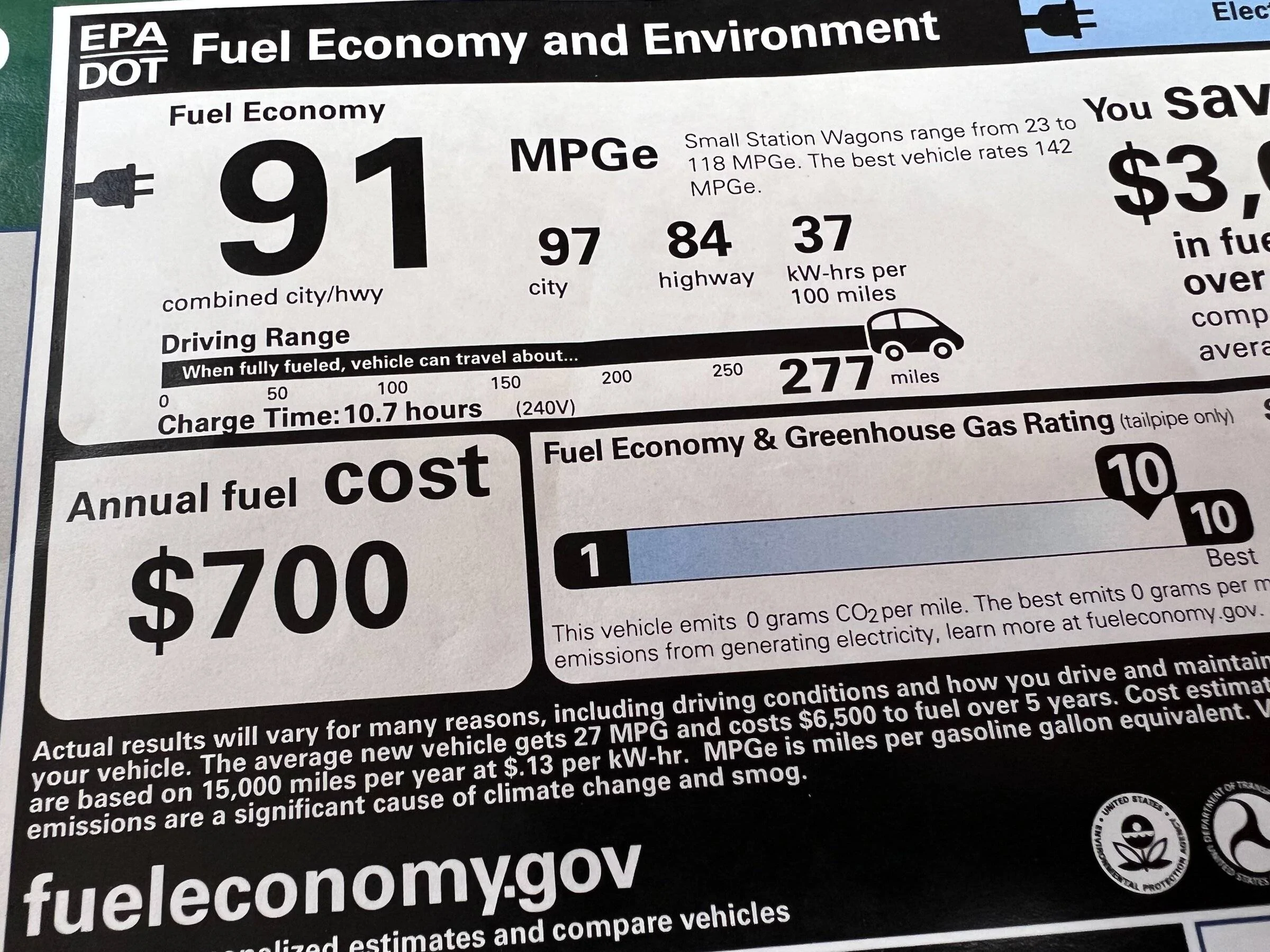
The charger loss is also in the EPA window sticker:
Ford Mustang Mach-E Most Efficient EVSE A881D9C1-9311-4D3E-AECB-DB7514E4DD6A

37 kWh/100 miles means 2.7miles per kWh plug-to-wheel.
277 miles range with 91 kWh usable energy in the battery means 3.0 kWh per mile battery-to-wheel.

The difference between 2.7 plug-to-wheel and 3.0 battery-to-wheel is the charger loss. That is 11.1% loss in the on-board charger according to Ford. It seems to be consistent with what I measure using CarScanner.

11.1% of 7.6kW means that the charger heats up with about 0.8kW. It needs to be liquid cooled so that the heat can be dissipated in the radiator. I wonder whether this heat is also used to warm up the battery when it is cold.
 
Last edited:


RickMachE

Well-Known Member
Joined
Jul 1, 2021
Threads
267
Messages
17,898
Reaction score
27,850
Location
SE MI
Vehicles
2022 Mach-E Premium 4X, 2022 Lightning Lariat ER
Country flag
I believe my loss is around 8%.
 

Mach-Lee

Well-Known Member
First Name
Lee
Joined
Jul 16, 2021
Threads
262
Messages
11,344
Reaction score
24,963
Location
Wisconsin
Vehicles
2022 Mach-E Premium AWD
Occupation
Sci/Eng
Country flag
Asking which EVSE is the most efficient is like asking which night light is the most efficient. Compared to the usage of the car and voltage conversion losses, you’re talking about pennies per year. Buy an energy star rated EVSE and that’s about as much as you need to concern yourself with efficiency wise.

BTW charging with 120V is less efficient than 240V by around 5%.


Top