Turtle Mode (Cold Weather Warning)

GarageWarrior2023

Well-Known Member
Joined
Aug 18, 2023
Threads
13
Messages
238
Reaction score
179
Location
Manitoba, Canada
Vehicles
2023 Mustang Mach-E Premium x2
Country flag

GarageWarrior2023

Well-Known Member
Joined
Aug 18, 2023
Threads
13
Messages
238
Reaction score
179
Location
Manitoba, Canada
Vehicles
2023 Mustang Mach-E Premium x2
Country flag
Wondering if anyone can confirm that they have taken their Mach-e down to really low percentages in warmer weather recently?

I know this is supposed to only be an issue in colder weather for now, but was hoping to have actual confirmation from someone that its working well down to low percentages in warm weather still before I put myself in a position where I may need to use below 30% this summer.
 

ArthurDOB

Well-Known Member
First Name
Arthur
Joined
Dec 16, 2022
Threads
24
Messages
1,303
Reaction score
1,359
Location
Twin Cities West Metro, Minnesota
Vehicles
Mach-e Premium AWD STD Range (Delivered 5/22/23)
Occupation
High School Teacher
Country flag
Wondering if anyone can confirm that they have taken their Mach-e down to really low percentages in warmer weather recently?

I know this is supposed to only be an issue in colder weather for now, but was hoping to have actual confirmation from someone that its working well down to low percentages in warm weather still before I put myself in a position where I may need to use below 30% this summer.
I'm below 10% right now. The temperature here (Twin Cities Metro, MN) is 46F as I write this, and will top out at 60F today. No turtles to be seen! The increase in range with warming temperatures has been very noticeable. Range-wise, it's performing as it did last Summer and Autumn before the temperatures started to drop.

The only reason I'm so low is that I haven't had a chance to charge it overnight the last few days (I'm a cheapskate! :LOL:) and knew I wasn't going to be doing much driving during that time. Definitely plugging in tonight!
 

GarageWarrior2023

Well-Known Member
Joined
Aug 18, 2023
Threads
13
Messages
238
Reaction score
179
Location
Manitoba, Canada
Vehicles
2023 Mustang Mach-E Premium x2
Country flag
I'm below 10% right now. The temperature here (Twin Cities Metro, MN) is 46F as I write this, and will top out at 60F today. No turtles to be seen! The increase in range with warming temperatures has been very noticeable. Range-wise, it's performing as it did last Summer and Autumn before the temperatures started to drop.

The only reason I'm so low is that I haven't had a chance to charge it overnight the last few days (I'm a cheapskate! :LOL:) and knew I wasn't going to be doing much driving during that time. Definitely plugging in tonight!
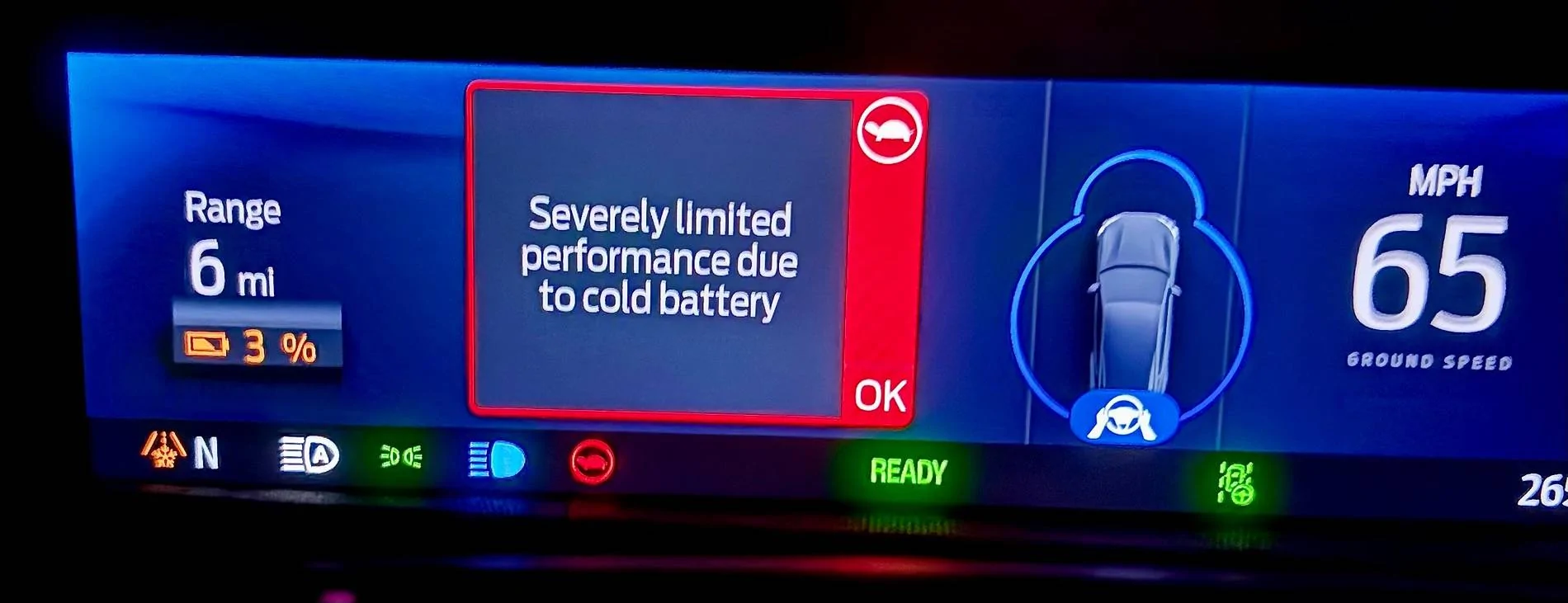
Awesome! thank you! That puts my mind at ease for summer. Time to put some miles on!
 

ArthurDOB

Well-Known Member
First Name
Arthur
Joined
Dec 16, 2022
Threads
24
Messages
1,303
Reaction score
1,359
Location
Twin Cities West Metro, Minnesota
Vehicles
Mach-e Premium AWD STD Range (Delivered 5/22/23)
Occupation
High School Teacher
Country flag
Awesome! thank you! That puts my mind at ease for summer. Time to put some miles on!
You're welcome.

Jets fan? They're my second choice if my Kings don't make it to the Final!


GarageWarrior2023

Well-Known Member
Joined
Aug 18, 2023
Threads
13
Messages
238
Reaction score
179
Location
Manitoba, Canada
Vehicles
2023 Mustang Mach-E Premium x2
Country flag
Has anyone heard any news from Ford about the turtle mode at 30%soc in cold weather issue? Any rumblings that they will be releasing an OTA to reverse/adjust the changes that were previously made so that we can have that 30% of our battery back for use in winter again?
 
OP
OP
Mach-Lee

Mach-Lee

Well-Known Member
First Name
Lee
Joined
Jul 16, 2021
Threads
262
Messages
11,345
Reaction score
24,967
Location
Wisconsin
Vehicles
2022 Mach-E Premium AWD
Occupation
Sci/Eng
Country flag
November 2024 Update - Turtle mode still exists in the software at low states of charge and low battery temps. Don't plan on going below 10% this winter. I had it pop up last night during testing:

Ford Mustang Mach-E Turtle Mode (Cold Weather Warning) IMG_0314


Outdoor temp 15ÂşF/-9ÂşC. Battery temp was 39ÂşF/+4ÂşC. The first yellow turtle showed up with 7% battery left. A couple miles later the red turtle shows up with about 5% left. After a while, red turtle switched back to yellow turtle. The algorithm must be dynamic based on voltage sag and recovery, you will probably notice red shortly after an acceleration, and regen might bring back yellow status.

I went home very shortly after the red turtle popped up (2% arrival), and the worst power limit I saw was about 55 kW or about 75 HP. You will have difficulty accelerating and maintaining speed up hills with red turtle mode active. The windows will also fog up soon after as the heat is cut off.

From my perspective, the cold temperatures I encountered were relatively minor, so I'm still surprised the power limit strategy remains very aggressive. The battery was relatively warm at +4ÂşC, so I don't think I should be seeing cold battery warnings. The car was heating the battery for most of the drive, it actually increased temperature from -1ÂşC to 4ÂşC and was using full heater power until about 3% left. The strategy seems to not want to let the battery voltage sag below 310V, which is about 3.3V per cell. This is a pretty conservative cutoff point for lithium battery discharge, it could be lower.

And I've said this before, but I don't believe the user should be subjected to red turtle mode before 0% state of charge has been reached. The bottom buffer should be dynamically adjusted so that doesn't happen.

Keep in mind the colder the battery temp, the sooner turtle mode will start. Which is why it's very important to try to warm up the battery before leaving on a trip where you may end below 30% SoC. I don't advise trying to go below 10%. And my advice from the first post remains, if you encounter yellow turtle slow down, get off the freeway, and find the nearest Level 2/3 charger ASAP.
 
Last edited:

GarageWarrior2023

Well-Known Member
Joined
Aug 18, 2023
Threads
13
Messages
238
Reaction score
179
Location
Manitoba, Canada
Vehicles
2023 Mustang Mach-E Premium x2
Country flag
Outdoor temp 15ÂşF/-9ÂşC. Battery temp was 39ÂşF/+4ÂşC. The first yellow turtle showed up with 7% battery left. A couple miles later the red turtle shows up with about 5% left. After a while, red turtle switched back to yellow turtle. The algorithm must be dynamic based on voltage sag and recovery, you will probably notice red shortly after an acceleration, and regen might bring back yellow status.
Thanks for the update @Mach-Lee

I agree, 4C is warm. I've seen my battery at -13c and operating with no warnings at higher SOC (40%-80%). usually in the winter the system seems to try to get the battery to just above 0c somewhere while driving, so it's usually sitting at 5c at best by the end of a drive unless preconditioned first. I've been clipped for power and speed (amber warning) at 28%SOC with the battery at 5C, which is silly......that's a warm enough battery......

Ford needs to revert this programming so that our vehicles have access to the full battery in cold weather again. Honestly that's when we need it the most....
 
OP
OP
Mach-Lee

Mach-Lee

Well-Known Member
First Name
Lee
Joined
Jul 16, 2021
Threads
262
Messages
11,345
Reaction score
24,967
Location
Wisconsin
Vehicles
2022 Mach-E Premium AWD
Occupation
Sci/Eng
Country flag
ChatGPT Prompt: Is a 3.3V/cell cutoff appropriate for an EV in cold weather?


A 3.3V/cell cutoff for an electric vehicle (EV) operating in cold weather is generally too conservative for most practical scenarios. While it provides significant protection for the battery, it excessively limits usable capacity, which is especially undesirable in an EV where maximizing range is a priority. Instead, a slightly lower cutoff (e.g., 2.9–3.1V) is usually more appropriate.

Why 3.3V is Too Conservative:

1. Significant Loss of Usable Capacity:
- Lithium NCM batteries typically store most of their usable energy between 4.2V (fully charged) and 3.0V (nominal lower limit). Cutting off at 3.3V leaves 15–25% of the available energy unused, which translates to a significant reduction in range—something critical for EVs, especially in cold weather when range is already reduced due to increased energy consumption for heating and reduced battery performance.

2. Cold Weather and Voltage Sag:
- At low temperatures, internal resistance increases, leading to greater voltage sag under load. A 3.3V cutoff under load could prematurely trigger a low-voltage disconnect or power limit even when substantial capacity remains. This would result in reduced range and inefficiencies.

3. Temperature-Compensated Design:
- Modern EVs typically employ a Battery Management System (BMS) capable of temperature compensation. The BMS adjusts parameters like cutoff voltage dynamically to account for cold-weather effects, ensuring both safety and efficient capacity usage. A static 3.3V cutoff does not leverage these capabilities effectively.

Practical Alternatives:

1. Dynamic Cutoff Voltage:
- A temperature-compensated cutoff (e.g., 2.9–3.1V at 0°C) is better suited for EVs. This ensures the battery is protected from over-discharge without sacrificing unnecessary capacity.

2. Battery Heating Systems:
- Many EVs include battery pre-heating systems that raise the temperature of the pack before operation. This improves performance and reduces the impact of voltage sag, enabling lower cutoffs to be used safely, even in cold conditions.

3. Manufacturer Guidance:
- Always follow the manufacturer's recommended settings, as these are optimized for the specific battery chemistry and design. For example, Tesla and other manufacturers dynamically adjust cutoffs based on pack conditions to strike a balance between performance and longevity.

EV-Specific Considerations:

- Longevity vs. Range: While 3.3V protects the battery, it may overly prioritize longevity at the cost of range, which is undesirable for drivers in cold climates where range anxiety is already heightened.
- Degradation Risks: A slightly lower cutoff (e.g., 3.0V) does not significantly increase degradation risk if the battery is not regularly discharged to this limit, especially when used with thermal management and controlled charging.

Conclusion:

For an EV in cold weather, a 3.3V cutoff is too conservative. A cutoff in the range of 2.9–3.1V, managed by a temperature-aware BMS, is more appropriate. This allows for better range utilization while still protecting the battery from the adverse effects of cold weather discharge.

------------------

Researching the voltage cutoff more, I'm not finding a whole lot of work that supports limiting the discharge to only 3.3V in cold conditions. Found a few cycle studies that went all the way down to 2.7V below 0ÂşC which resulted in severe capacity loss, but 3.3V is quite a bit higher than that. As you can see, AI agrees with my assessment that the current 3.3V voltage cutoff (which results in turtle mode) is too conservative for an EV battery. In my opinion, it should be lowered to 3.0-3.2V/cell to allow more of the battery to be utilized before turtle mode kicks in, which won't cause additional harm to the cells. This feels like an inexperienced engineer setting arbitrary voltage limits without the testing to back up the impact on usability.
 
Last edited:

GarageWarrior2023

Well-Known Member
Joined
Aug 18, 2023
Threads
13
Messages
238
Reaction score
179
Location
Manitoba, Canada
Vehicles
2023 Mustang Mach-E Premium x2
Country flag
ChatGPT Prompt: Is a 3.3V/cell cutoff appropriate for an EV in cold weather?


A 3.3V/cell cutoff for an electric vehicle (EV) operating in cold weather is generally too conservative for most practical scenarios. While it provides significant protection for the battery, it excessively limits usable capacity, which is especially undesirable in an EV where maximizing range is a priority. Instead, a slightly lower cutoff (e.g., 2.9–3.1V) is usually more appropriate.

Why 3.3V is Too Conservative:

1. Significant Loss of Usable Capacity:
- Lithium NCM batteries typically store most of their usable energy between 4.2V (fully charged) and 3.0V (nominal lower limit). Cutting off at 3.3V leaves 15–25% of the available energy unused, which translates to a significant reduction in range—something critical for EVs, especially in cold weather when range is already reduced due to increased energy consumption for heating and reduced battery performance.
.........
I second this!! @Mach-Lee nailing it with the most information rich and helpful posts you can find on the mach-e

@Ford Motor Company @Ford of Canada when will you release an update to correct this overly conservative change that was made to the mach-e so that we can start to use the full battery capacity of our mach-e's in cold weather again!?
 
OP
OP
Mach-Lee

Mach-Lee

Well-Known Member
First Name
Lee
Joined
Jul 16, 2021
Threads
262
Messages
11,345
Reaction score
24,967
Location
Wisconsin
Vehicles
2022 Mach-E Premium AWD
Occupation
Sci/Eng
Country flag
I second this!! @Mach-Lee nailing it with the most information rich and helpful posts you can find on the mach-e

@Ford Motor Company @Ford of Canada when will you release an update to correct this overly conservative change that was made to the mach-e so that we can start to use the full battery capacity of our mach-e's in cold weather again!?
Agree, I think a change needs to be made ASAP for winter, especially relevant in Canada.

The other elephant in the room here is why excessive amounts of regen (~70 kW) are allowed when the battery is below 0ÂşC. The large amount of regen allowed with cold cells does far more damage to battery capacity than discharge below 310V. I would like to see them limit regen more in cold temps and also allow more discharge to occur. On the one hand they are doing something excessively conservative, and on the other hand they are doing something the complete opposite that can harm the cells.
 

GarageWarrior2023

Well-Known Member
Joined
Aug 18, 2023
Threads
13
Messages
238
Reaction score
179
Location
Manitoba, Canada
Vehicles
2023 Mustang Mach-E Premium x2
Country flag
Agree, I think a change needs to be made ASAP for winter, especially relevant in Canada.

The other elephant in the room here is why excessive amounts of regen (~70 kW) are allowed when the battery is below 0ÂşC. The large amount of regen allowed with cold cells does far more damage to battery capacity than discharge below 310V. I would like to see them limit regen more in cold temps and also allow more discharge to occur. On the one hand they are doing something excessively conservative, and on the other hand they are doing something the complete opposite that can harm the cells.
Couldn't agree more!
 

luckie

Well-Known Member
First Name
Doug
Joined
Apr 6, 2022
Threads
18
Messages
421
Reaction score
456
Location
Michigan, USA
Vehicles
2021 Mach-E Silver AWD Select SR, traded for, 2025 Mach-E Green AWD Premium ER
Occupation
Professor
Country flag
Curious about cold testing of LFP battery versus NCM.
 

Billyk24

Well-Known Member
First Name
William
Joined
Nov 29, 2019
Threads
116
Messages
2,307
Reaction score
1,295
Location
PA
Vehicles
Ford C-Max Energi, Premium Mach-E ordered
Country flag
ChatGPT Prompt: Is a 3.3V/cell cutoff appropriate for an EV in cold weather?


A 3.3V/cell cutoff for an electric vehicle (EV) operating in cold weather is generally too conservative for most practical scenarios. While it provides significant protection for the battery, it excessively limits usable capacity, which is especially undesirable in an EV where maximizing range is a priority. Instead, a slightly lower cutoff (e.g., 2.9–3.1V) is usually more appropriate.

Why 3.3V is Too Conservative:

1. Significant Loss of Usable Capacity:
- Lithium NCM batteries typically store most of their usable energy between 4.2V (fully charged) and 3.0V (nominal lower limit). Cutting off at 3.3V leaves 15–25% of the available energy unused, which translates to a significant reduction in range—something critical for EVs, especially in cold weather when range is already reduced due to increased energy consumption for heating and reduced battery performance.

2. Cold Weather and Voltage Sag:
- At low temperatures, internal resistance increases, leading to greater voltage sag under load. A 3.3V cutoff under load could prematurely trigger a low-voltage disconnect or power limit even when substantial capacity remains. This would result in reduced range and inefficiencies.

3. Temperature-Compensated Design:
- Modern EVs typically employ a Battery Management System (BMS) capable of temperature compensation. The BMS adjusts parameters like cutoff voltage dynamically to account for cold-weather effects, ensuring both safety and efficient capacity usage. A static 3.3V cutoff does not leverage these capabilities effectively.

Practical Alternatives:

1. Dynamic Cutoff Voltage:
- A temperature-compensated cutoff (e.g., 2.9–3.1V at 0°C) is better suited for EVs. This ensures the battery is protected from over-discharge without sacrificing unnecessary capacity.

2. Battery Heating Systems:
- Many EVs include battery pre-heating systems that raise the temperature of the pack before operation. This improves performance and reduces the impact of voltage sag, enabling lower cutoffs to be used safely, even in cold conditions.

3. Manufacturer Guidance:
- Always follow the manufacturer's recommended settings, as these are optimized for the specific battery chemistry and design. For example, Tesla and other manufacturers dynamically adjust cutoffs based on pack conditions to strike a balance between performance and longevity.

EV-Specific Considerations:

- Longevity vs. Range: While 3.3V protects the battery, it may overly prioritize longevity at the cost of range, which is undesirable for drivers in cold climates where range anxiety is already heightened.
- Degradation Risks: A slightly lower cutoff (e.g., 3.0V) does not significantly increase degradation risk if the battery is not regularly discharged to this limit, especially when used with thermal management and controlled charging.

Conclusion:

For an EV in cold weather, a 3.3V cutoff is too conservative. A cutoff in the range of 2.9–3.1V, managed by a temperature-aware BMS, is more appropriate. This allows for better range utilization while still protecting the battery from the adverse effects of cold weather discharge.

------------------

Researching the voltage cutoff more, I'm not finding a whole lot of work that supports limiting the discharge to only 3.3V in cold conditions. Found a few cycle studies that went all the way down to 2.7V below 0ÂşC which resulted in severe capacity loss, but 3.3V is quite a bit higher than that. As you can see, AI agrees with my assessment that the current 3.3V voltage cutoff (which results in turtle mode) is too conservative for an EV battery. In my opinion, it should be lowered to 3.0-3.2V/cell to allow more of the battery to be utilized before turtle mode kicks in, which won't cause additional harm to the cells. This feels like an inexperienced engineer setting arbitrary voltage limits without the testing to back up the impact on usability.
What is the limit for Tesla vehicles?
Sponsored


Top