
Why do we have a 12V battery?

E90alex

Well-Known Member
Joined
Feb 17, 2025
Threads
3
Messages
1,000
Reaction score
1,811
Location
Seattle, WA
Vehicles
‘25 MME GT
All it needs to do is close the contacts and its job could be over. That fires up the power supply that takes over. You do not need a 12V lead acid rechargeable with CCA's to close the contacts. With some 12V lasting only 3 years it indicates that the 12V has a much higher workload than putting 12V across contacts.
Exactly. It’s needed to close the contacts.

The question wasn’t about how big the 12V needs to be. Just that all EVs still need some type of LVB matter what.

The 12V dying prematurely is a combination of it being lead acid, being super tiny so it gets cycled more, and poor charging/management strategies by Ford (especially in the beginning).

Tesla for example uses a Lithium LVB now which helps mitigate premature failures. Teslas are also programmed to close the HVB contactors for every little thing so the LVB is not used for much other than for standby and flipping the HVB contactors. Ford relies on the LVB for everything until the ignition is turned on (or using remote climate or when actively charging).
Sponsored

 

astrorob

Well-Known Member
First Name
rob
Joined
Aug 26, 2022
Threads
22
Messages
873
Reaction score
388
Location
bay area
Vehicles
24GT, plug-in prius, 99 MBZ C43
Country flag
i'm actually a little surprised by the move to 48VDC in newer EV platforms. 48VDC is considered somewhat dangerous - i remember when we were building our first datacenter routers and converted to a 48V backplane, there were a whole host of new compliance stuff we had to do, including stenciling 'shock hazard' graphics onto the backplanes.

i wonder if this means that the LVB systems in newer EV's are going to be considered "no user serviceable parts inside" territory.
 

Shayne

Well-Known Member
Joined
Aug 9, 2020
Threads
18
Messages
3,824
Reaction score
2,738
Location
Northern Ontario Canada
Vehicles
2021 MME4x Prem
Occupation
Retired
Country flag
Exactly. It’s needed to close the contacts.

The question wasn’t about how big the 12V needs to be. Just that all EVs still need some type of LVB matter what.

The 12V dying prematurely is a combination of it being lead acid, being super tiny so it gets cycled more, and poor charging/management strategies by Ford (especially in the beginning).

Tesla for example uses a Lithium LVB now which helps mitigate premature failures. Teslas are also programmed to close the HVB contactors for every little thing so the LVB is not used for much other than for standby and flipping the HVB contactors. Ford relies on the LVB for everything until the ignition is turned on (or using remote climate or when actively charging).
Take all workload off the 12V and use the big pack seems pretty obvious glad tesla is getting around to that after all this time. Have no idea why tesla would model after an ice to begin with. Ford I understand. Can't be scared the contacts will melt if you start opening and closing them more often.

A capacitor could close the contacts as well as open a door ;) If batteries some day become better and not the fire hazard due to the electrolyte in them today there maybe no need for contacts in the future? Simpler and no more melting contacts.



All have the developed designs of a desktop computers logic and components to model after so really it does not appear to be rocket science after that. A power supply can condition current better for electronics than a 12V acid battery anyway. Just need to stop thinking you need to crank an engine to generate the juice and all 12V electronics must run off/thru a 12V battery.
 
Last edited:

Mach1E

Well-Known Member
Joined
Sep 5, 2021
Threads
93
Messages
10,508
Reaction score
13,293
Location
Florida
Vehicles
69 Mach 1, 11 GT, 21 GTPE- sold, 24 Taycan 4S, 20 F type R
Country flag
Take all workload off the 12V and use the big pack seems pretty obvious glad tesla is getting around to that after all this time. Have no idea why tesla would model after an ice to begin with. Ford I understand. Can't be scared the contacts will melt if you start opening and closing them more often.

A capacitor could close the contacts as well as open a door ;) If batteries some day become better and not the fire hazard due to the electrolyte in them today there maybe no need for contacts in the future? Simpler and no more melting contacts.

All have the developed designs of a desktop computers logic and components to model after so really it does not appear to be rocket science after that. A power supply can condition current better for electronics than a 12V acid battery anyway. Just need to stop thinking you need to crank an engine to generate the juice and all 12V electronics must run off/thru a 12V battery.
In theory they could eliminate the 12v battery, but why?

What do you gain?

The 12v is a simple and cheap solution.
 

phidauex

Well-Known Member
First Name
Sam
Joined
Dec 8, 2020
Threads
17
Messages
966
Reaction score
1,843
Location
Colorado
Vehicles
2021 MachE 4EX, 2006 Prius, 1997 Tacoma
Occupation
Renewable Energy Engineer
Country flag
For what its worth, battery chemistry isn't relevant here - the battery is a massive energy storage device and it would be able to release a huge amount of fault current regardless of how the battery is designed. There will always need to be a low voltage system to start up the high voltage system, though it is certainly possible to make improvements on that low voltage system.


Blue highway

Well-Known Member
First Name
Steve
Joined
Oct 15, 2021
Threads
5
Messages
2,693
Reaction score
4,237
Location
Oregon
Vehicles
Mach E Premium SR RWD
Country flag
So, I will make a prediction. With 10 years, many EVs will not have a low voltage battery. If I had to guess, I would guess that the Chinese will figure out a good way to do this and the American manufacturers will play catch up. Watch this space!!
I'll make a prediction... 20 years from now all EVs will still have a low voltage battery... because of the most damaging thing known to mankind... Lawyers. :crazy:
 

Mach-Lee

Well-Known Member
First Name
Lee
Joined
Jul 16, 2021
Threads
262
Messages
11,344
Reaction score
24,963
Location
Wisconsin
Vehicles
2022 Mach-E Premium AWD
Occupation
Sci/Eng
Country flag
i'm actually a little surprised by the move to 48VDC in newer EV platforms. 48VDC is considered somewhat dangerous - i remember when we were building our first datacenter routers and converted to a 48V backplane, there were a whole host of new compliance stuff we had to do, including stenciling 'shock hazard' graphics onto the backplanes.

i wonder if this means that the LVB systems in newer EV's are going to be considered "no user serviceable parts inside" territory.
Depends what standards you're following, usually 50-60V is considered the "warning" threshold so 48VDC is chosen because it's just under that.
 

Graction

Well-Known Member
First Name
Gil
Joined
Oct 28, 2021
Threads
7
Messages
202
Reaction score
151
Location
Northern NJ
Vehicles
Rapid Red Mach-e GT
Country flag
Better question is why did Ford make it so hard to access the battery? I fail to see any reason for this design choice. Why not a simple tool-less opening access door.
 

Shayne

Well-Known Member
Joined
Aug 9, 2020
Threads
18
Messages
3,824
Reaction score
2,738
Location
Northern Ontario Canada
Vehicles
2021 MME4x Prem
Occupation
Retired
Country flag
In theory they could eliminate the 12v battery, but why?

What do you gain?

The 12v is a simple and cheap solution.
Taking a cart and horse into town was also cheap. Not everyone wants cheap. Sodium will be cheaper than solid state.

I would have no problems seeing the lead acid disappear. A change for something that is more dependable with greater longevity, has less of a environmental impact and is cheaper in the long run. We will again see who the new innovators are. It has been going at a good pace in the last few years. May not be those that put annual profit first but I look forward to watching?

Same longevity of the low voltage system as the high voltage is possible. No 3 year plan just because maybe required.

Depends what standards you're following, usually 50-60V is considered the "warning" threshold so 48VDC is chosen because it's just under that.
Do you know the logic for stepping it up? 12V appears to still be the electronic/computer standard for many other things.

Better question is why did Ford make it so hard to access the battery? I fail to see any reason for this design choice. Why not a simple tool-less opening access door.
Hole drill and drill two ports at the terminal allows you to hook up a charger and takes pretty much all that away; at least until you have to change it. Still like the frunk here.

There is a whole DIY thread on how to do it on this forum.
 

HuntingPudel

Well-Known Member
First Name
Steve
Joined
Mar 23, 2021
Threads
88
Messages
12,927
Reaction score
17,370
Location
Bay Area, CA
Vehicles
2024 MME GT with Performance Upgrade, 1979 Fire-Am, 1972 K/5 Blazer
Occupation
Engineering
Country flag
<SNIP>
Do you know the logic for stepping it up? 12V appears to still be the electronic/computer standard for many other things.
<SNIP>
Higher voltage allows the same number of watts to travel along a smaller diameter wire due to less amperage needed. This is a weight and cost savings change that will be happening over time. đŸ€”đŸ©

It is a common misconception that electronics operate on 12V. Most modern computer components operate at 5V, 3.3V, or less. Data signals are measured at the sub-1 volt level. đŸ˜đŸ©

So in order to step up the voltage to supply these subassemblies with power, the subassemblies need to have their input power handling changed to step down from 48V rather than 12V to the individual component operating voltages.đŸ‘đŸ©
 

mkhuffman

Well-Known Member
First Name
Mike
Joined
Nov 19, 2020
Threads
29
Messages
6,875
Reaction score
9,507
Location
Virginia
Vehicles
2025 Rivian R1T Tri-Max, Jeep GC-L, VW Jetta
Country flag
Rivian has a patent application to remove the 12V battery. Based on the description, it sounds more expensive than a simple 12V AGM or lithium battery. That's probably why it has not actually been done yet.

Key Details from the Patent (US20250296474A1)

Title: Low Voltage Battery-Less Architecture for Electric Vehicles.

Assignee: Rivian IP Holdings LLC.

Inventors: Kyle Lobo, Sanjeewa Keven Sugatapala, Muhammad Mobeen Mahmood, Joseph Daniel Himmelheber, Baojin Wang, Brandon Louis Fennema, and Todd Adams Putnam.

Filing Date: June 2, 2025 (this is a continuation application with priority claiming earlier filings back to at least February 21, 2024).

Publication Date: September 25, 2025.

Abstract Summary: The architecture supplies both high voltage (hundreds of volts for propulsion) and low voltage (e.g., 12-15V or 40-60V for auxiliary systems) from a shared high-voltage energy volume, without any separate low-voltage battery. It uses modular, serviceable enclosures that can attach to various battery pack frames, incorporating power electronics for conversion and distribution.

How It Works

The system taps into the high-voltage battery pack (which consists of multiple battery modules or subassemblies) to generate low-voltage power. Here's a breakdown:

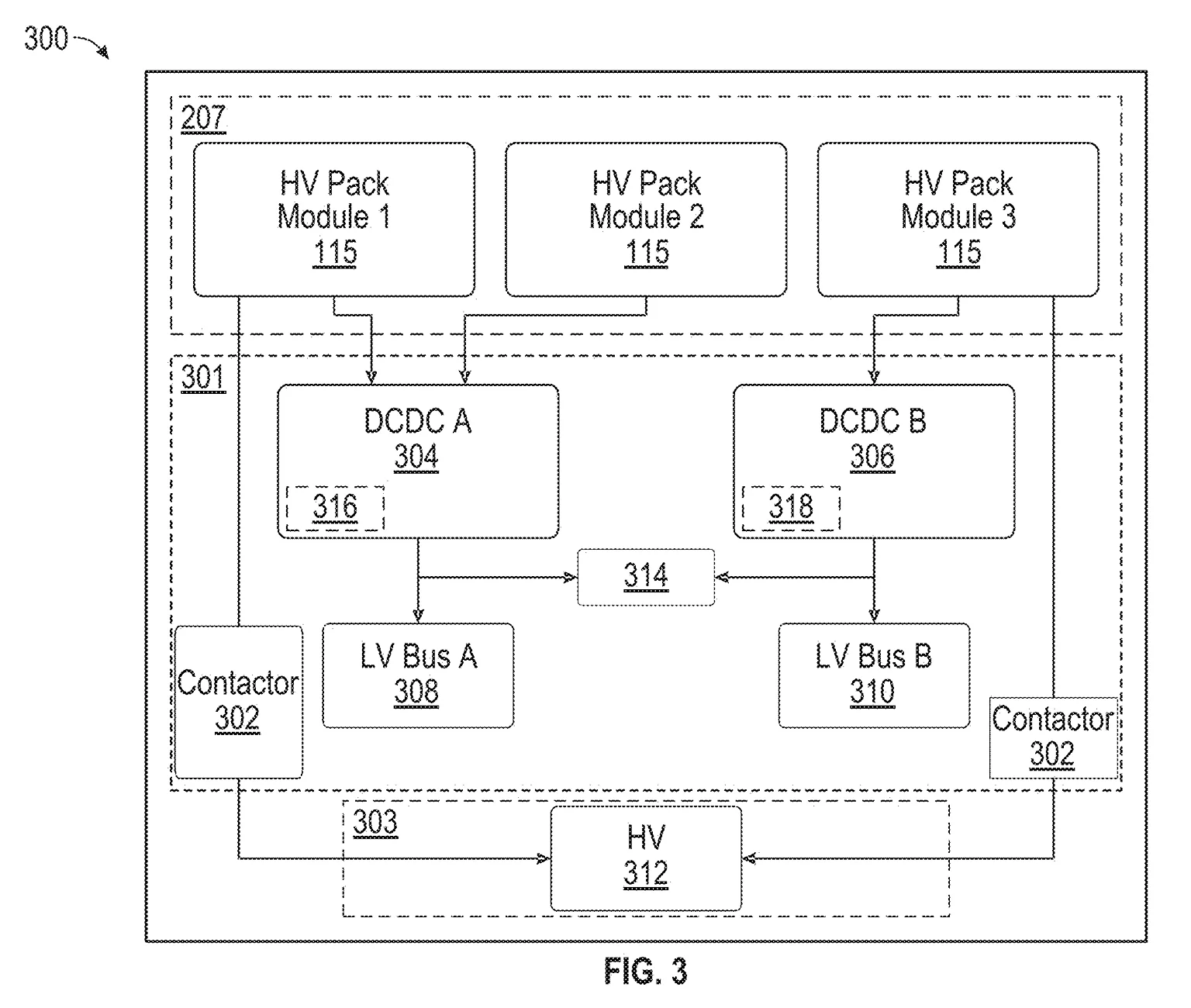
Core Mechanism: Direct-current-to-direct-current (DC-DC) converters are connected "pre-contactor" (before the main high-voltage switches) to specific subsets of battery cells or modules within the high-voltage pack. These converters step down the high voltage to low voltage without needing a dedicated 12V battery. For example:
One DC-DC converter might draw from one group of battery modules, while another draws from a different group, ensuring electrical isolation between them.
This setup allows the low-voltage system to remain powered even if the high-voltage contactors open (e.g., for safety reasons), as the converters pull unswitched power directly from the battery cells.

Redundancy and Load Balancing: Multiple DC-DC converters (at least two) provide redundant low-voltage buses. A switching mechanism can connect these buses across converters to balance loads between battery subassemblies, preventing uneven drain. Pyrofuses (pyrotechnic disconnects) allow selective isolation of faulty sections without cutting off all low-voltage power.

Modular Design: The power electronics are housed in a separate, attachable enclosure made from insulating materials with conductive layers for EMI/EMC protection. This module connects to the battery pack frame (e.g., under a rear seat) and provides accessible ports for high-voltage (to drive units) and low-voltage (to vehicle harnesses) outputs. It's compatible with different battery sizes and chemistries.

Low-Voltage Applications: The derived 12V (or similar) powers non-propulsion components like lights (headlamps, turn indicators, brake lamps), actuators (doors, windows, seats, mirrors), sensors, HVAC, audio systems, wipers, defrosters, radar, charging ports, and more. It also supports zone controllers for different vehicle areas (e.g., rear zone).

Benefits and Operation: In normal use, high voltage powers the motors while low voltage runs auxiliaries simultaneously from the same battery source. If high voltage is disconnected (e.g., via contactors), low voltage continues uninterrupted. The vehicle operates entirely without a standalone low-voltage battery, reducing complexity and potential failure points.
 

Mach-Lee

Well-Known Member
First Name
Lee
Joined
Jul 16, 2021
Threads
262
Messages
11,344
Reaction score
24,963
Location
Wisconsin
Vehicles
2022 Mach-E Premium AWD
Occupation
Sci/Eng
Country flag
Rivian has a patent application to remove the 12V battery. Based on the description, it sounds more expensive than a simple 12V AGM or lithium battery. That's probably why it has not actually been done yet.

Key Details from the Patent (US20250296474A1)

Title: Low Voltage Battery-Less Architecture for Electric Vehicles.

Assignee: Rivian IP Holdings LLC.

Inventors: Kyle Lobo, Sanjeewa Keven Sugatapala, Muhammad Mobeen Mahmood, Joseph Daniel Himmelheber, Baojin Wang, Brandon Louis Fennema, and Todd Adams Putnam.

Filing Date: June 2, 2025 (this is a continuation application with priority claiming earlier filings back to at least February 21, 2024).

Publication Date: September 25, 2025.

Abstract Summary: The architecture supplies both high voltage (hundreds of volts for propulsion) and low voltage (e.g., 12-15V or 40-60V for auxiliary systems) from a shared high-voltage energy volume, without any separate low-voltage battery. It uses modular, serviceable enclosures that can attach to various battery pack frames, incorporating power electronics for conversion and distribution.

How It Works

The system taps into the high-voltage battery pack (which consists of multiple battery modules or subassemblies) to generate low-voltage power. Here's a breakdown:

Core Mechanism: Direct-current-to-direct-current (DC-DC) converters are connected "pre-contactor" (before the main high-voltage switches) to specific subsets of battery cells or modules within the high-voltage pack. These converters step down the high voltage to low voltage without needing a dedicated 12V battery. For example:
One DC-DC converter might draw from one group of battery modules, while another draws from a different group, ensuring electrical isolation between them.
This setup allows the low-voltage system to remain powered even if the high-voltage contactors open (e.g., for safety reasons), as the converters pull unswitched power directly from the battery cells.

Redundancy and Load Balancing: Multiple DC-DC converters (at least two) provide redundant low-voltage buses. A switching mechanism can connect these buses across converters to balance loads between battery subassemblies, preventing uneven drain. Pyrofuses (pyrotechnic disconnects) allow selective isolation of faulty sections without cutting off all low-voltage power.

Modular Design: The power electronics are housed in a separate, attachable enclosure made from insulating materials with conductive layers for EMI/EMC protection. This module connects to the battery pack frame (e.g., under a rear seat) and provides accessible ports for high-voltage (to drive units) and low-voltage (to vehicle harnesses) outputs. It's compatible with different battery sizes and chemistries.

Low-Voltage Applications: The derived 12V (or similar) powers non-propulsion components like lights (headlamps, turn indicators, brake lamps), actuators (doors, windows, seats, mirrors), sensors, HVAC, audio systems, wipers, defrosters, radar, charging ports, and more. It also supports zone controllers for different vehicle areas (e.g., rear zone).

Benefits and Operation: In normal use, high voltage powers the motors while low voltage runs auxiliaries simultaneously from the same battery source. If high voltage is disconnected (e.g., via contactors), low voltage continues uninterrupted. The vehicle operates entirely without a standalone low-voltage battery, reducing complexity and potential failure points.
That’s interesting, but I don’t know how you’d prevent uneven discharge of the cells in the battery pack unless there are perhaps two DC/DC converters connected to half of the battery each, and they periodically alternate back and forth like wing fuel tanks on an airplane to balance discharge. If one failed this would create a bad situation where only half the cells in the pack are drained, unless you have a switching matrix to change sides of the pack. That would be difficult or impossible to do without a 12V interruption. If one DC/DC suddenly failed I think that would still create a stop safely now situation.

It’s an interesting idea if you absolutely have to eliminate a 12 battery, but it is definitely more complex and more expensive than having one. Once you start getting into the possible failure, modes, I think you’d really need to have at least 3x DC/DC converters to make it safe.

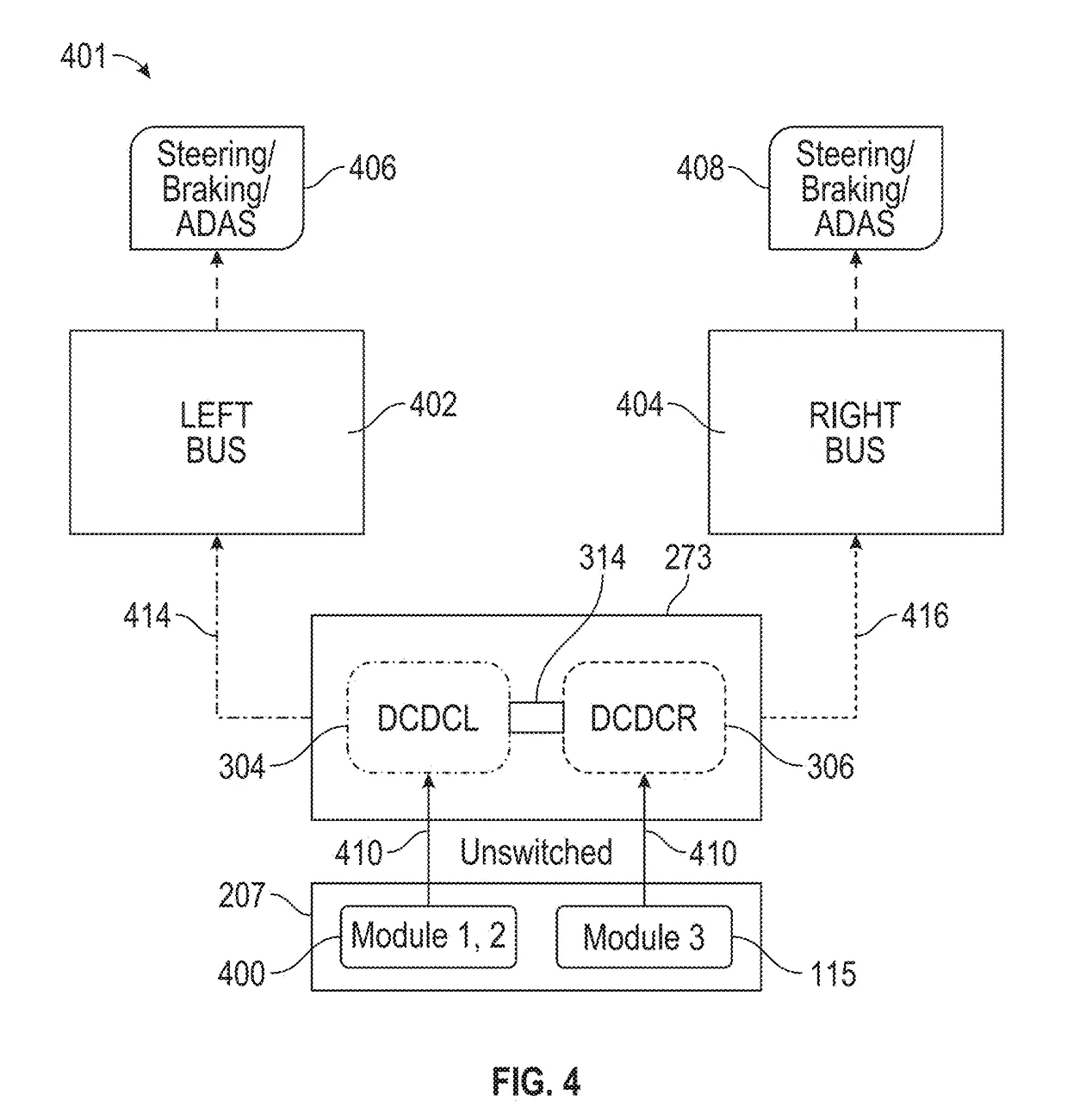
EDIT: I found the figures. In the patent two DCDC (A and B) are fed from three separate cell modules, and 314 is a bus cross tie that allows DCDC A to power LV bus B and vice versa as needed to balance discharge on the HV pack modules with unequal LV bus loads. The bus cross tie would have to periodically swap the LV busses back and forth to ensure the cells all stay within 5% SoC of each other.

If a DCDC failed, you would have a limited amount of time to drive the car until the cells got too far out of balance, basically this would force a service visit to replace the failed DCDC.

The key thing that also makes this work is a zonal LV architecture, basically two separate body control modules that can power separate areas of the car or provide redundancies (such as steering/braking/ADAS as illustrated).

Ford Mustang Mach-E Why do we have a 12V battery? US_2025296474_A1_Fig3

Ford Mustang Mach-E Why do we have a 12V battery? US_2025296474_A1_Fig4
 
Last edited:

Shayne

Well-Known Member
Joined
Aug 9, 2020
Threads
18
Messages
3,824
Reaction score
2,738
Location
Northern Ontario Canada
Vehicles
2021 MME4x Prem
Occupation
Retired
Country flag
This setup allows the low-voltage system to remain powered even if the high-voltage contactors open (e.g., for safety reasons), as the converters pull unswitched power directly from the battery cells.
That should make for a more responsive EV. One idea and they may keep coming.

You would thinking if the batteries themselves become nonflammable that design regulation will adapt and may help also. It is the electrolyte burning that makes all those spectacular videos. Smoldering wires not so much and there is no gas tank. Why not take low voltage off the pack at that point.
Sponsored


Top